
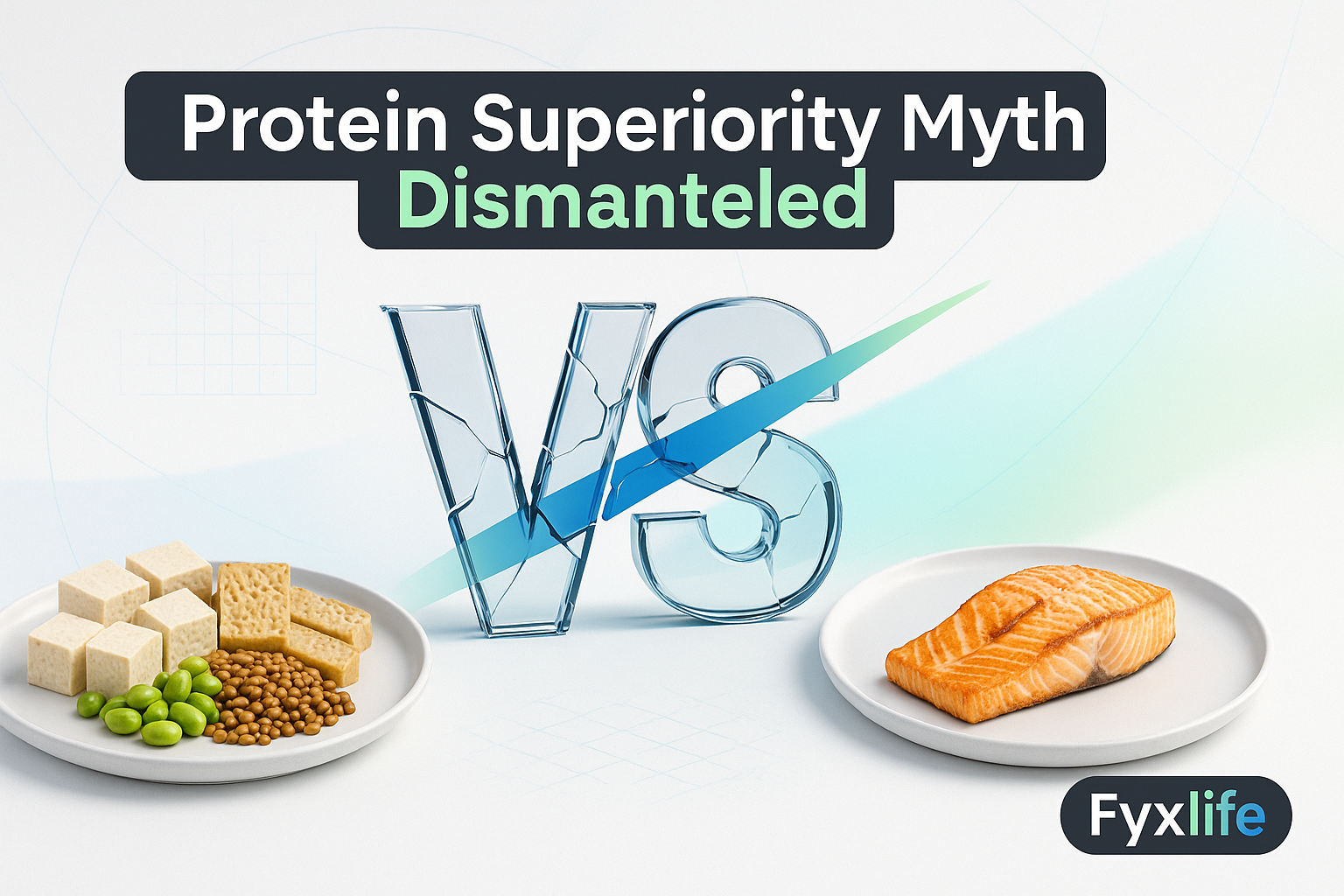
The Myth Being Crushed: ‘One Type of Protein Is Categorically Better’
You have been told to pick a side — go plant-based for longevity, or go animal-based for muscle. Both camps sound convincing. Both are selling you a false binary. The real answer is more precise, more actionable, and more inconvenient for anyone trying to sell you a single solution.
If you have ever stood in the supermarket genuinely unsure whether to reach for the Greek yoghurt or the edamame, or felt quietly confused watching a carnivore advocate and a vegan dietitian cite opposing studies with equal confidence, you are not confused because you are not paying attention. You are confused because the public conversation on protein has been flattened into a tribal debate that the actual evidence does not support.
Where this belief comes from — and why both sides keep reinforcing it
The animal protein camp points to something real: animal proteins are nutritionally complete proteins — meaning they contain all nine amino acids your body cannot manufacture on its own, which researchers call essential amino acids (EAAs). Most individual plant proteins do not. That fact is accurate. The leap from “animal protein is complete” to “animal protein is categorically superior” is where the logic breaks.
The plant protein camp responds by pointing to longevity data, environmental impact, and associations between red meat consumption and metabolic disease. Those points also contain real signal. But signal is not the same as settled science, and neither side has much incentive to say “it depends.” Nuance does not sell supplements, cookbooks, or documentaries.
What both camps are doing is taking a genuinely complex, context-dependent question and resolving it into a bumper sticker. The people paying the price for that simplification are you — trying to make actual decisions about what to eat.
What the Evidence Actually Shows
The real difference — amino acid profile and bioavailability, not a moral hierarchy
Think of amino acids as a set of 20 Lego bricks your body uses to build muscle, hormones, and repair tissue. Animal proteins come with all 20 bricks in one bag. Most plant proteins come with 15 or 16 bricks — missing a few. But if you buy two or three different plant protein bags throughout the day, you end up with all 20. The myth is that you need the complete bag in every meal. The truth is your body keeps inventory across the whole day — not meal by meal.
One of the core differences between plant and animal proteins is their amino acid content — animal proteins are generally complete, while most individual plant proteins are not. But dietary patterns are not single foods. A day that includes lentils, tofu, rice, and nuts assembles the full set of essential amino acids without a gram of meat in sight. The “completeness” argument only holds if you are evaluating individual foods in isolation, which is not how anyone actually eats.
The second real difference is bioavailability — how much of the protein you consume your body can actually absorb and use. Animal proteins generally score higher here. Both plant and animal sources can be effective for muscle growth and weight management, but they differ meaningfully in amino acid profile and bioavailability — and those differences have real-world consequences depending on your circumstances.
Why animal protein has an edge for muscle signalling — and when that edge actually matters
The muscle-building signal your body responds to is not total protein grams. It is specifically driven by essential amino acids — and most critically by leucine, the amino acid that acts as the trigger for a process called muscle protein synthesis (the cellular mechanism by which your body actually builds new muscle tissue). Animal proteins tend to be denser in leucine and other EAAs per gram.
EAAs are a key lever for metabolic and muscle support, particularly for people eating in a caloric deficit and for older adults — which means EAA quality matters more than simply hitting a daily protein gram target. If you are over 50, eating less to lose weight, or both, the source quality of your protein becomes genuinely more important. Not because animal protein is morally superior, but because the anabolic signal per gram is higher, and your body’s ability to respond to that signal starts declining with age.
That said, new research indicates that plant-based protein can be just as effective as animal protein for building muscle, provided total intake and amino acid adequacy are met. The gym-floor assumption that you must eat meat to build muscle does not survive scrutiny when the actual variables — EAA completeness, leucine threshold, total daily intake — are properly controlled.
Why plant protein has an edge for longevity markers — and when that matters more
The longevity data for plant protein is harder to dismiss than the animal protein camp tends to acknowledge. Eating more plant protein has been associated with healthier ageing in women, including lower risk of conditions such as cancer and diabetes — suggesting that plant protein carries benefits beyond muscle maintenance that are relevant across decades, not just training cycles.
This does not prove that plant protein is superior. It suggests that the package plant protein arrives in — fibre, phytonutrients, lower saturated fat load — carries its own signal, one that matters more the longer your time horizon. A 58-year-old managing blood glucose, family history of cardiovascular disease, and a moderate activity level is asking a fundamentally different question than a 38-year-old in a caloric deficit trying to preserve lean mass. The evidence answers both — differently.
The Variable Nobody Talks About: Age Changes the Equation
What optimal protein balance looks like at 35 vs 55
Here is the variable that almost all popular protein content ignores: the right answer is not fixed across your adult life. The optimal balance of plant versus animal protein varies with age, suggesting that no single ratio is universally ideal across all life stages. A 35-year-old with good insulin sensitivity, stable lean mass, and no metabolic flags can get excellent outcomes from a predominantly plant-based diet if the EAA profile is covered. A 55-year-old experiencing the muscle loss that comes with ageing — a process called sarcopenia — faces a different physiological reality, one where the anabolic efficiency of protein sources starts to matter more.
The challenge is that this is exactly the kind of question a routine annual check-up was not designed to answer — not because doctors do not care, but because population-level dietary guidelines were never built to account for your specific combination of age, body composition, activity level, and metabolic markers. Knowing whether you are at the point where protein source quality is clinically relevant to you requires more than a general recommendation.
The essential amino acid shortcut — how to get the signal without the debate
The practical resolution to the plant-versus-animal debate is not choosing a team. It is shifting your evaluative lens from protein category to EAA completeness. Protein timing and its muscle-building potential are influenced by protein source, amino acid composition, and meal distribution — not simply animal versus plant origin. Whether your protein comes from eggs, salmon, lentils, or tempeh matters less than whether it delivers the full EAA set across your day and hits the leucine threshold at key meals — particularly your first substantial meal and the one around any resistance training you do.
There is also a clinical context worth naming plainly. For those managing chronic kidney disease (CKD) — a condition where the kidneys lose their ability to filter waste efficiently — the protein source question carries real stakes. But even here the science is not clean. In the context of chronic kidney disease, the effects of plant versus animal protein on outcomes like blood pressure control remain to be established. If you have a kidney-related diagnosis, this debate is not resolved for you by popular nutrition content. It requires clinical management of your specific markers.
The Verdict
What you should actually believe after reading the evidence
Animal protein has a genuine edge in bioavailability and anabolic signalling per gram. That edge is most relevant for older adults, people in caloric deficit, and anyone where muscle preservation is a clinical priority. It does not make animal protein categorically superior for all people in all contexts.
Plant protein carries a different kind of advantage — one associated with longevity markers, reduced disease risk over time, and a favourable nutritional package beyond the protein itself. That advantage grows more meaningful the longer your time horizon and the more your health concerns shade toward metabolic disease rather than acute muscle-building.
The research supports a pragmatic conclusion: varied plant proteins across a day can cover all essential amino acids effectively. Animal proteins deliver those amino acids more efficiently per gram. Both statements are simultaneously true. Neither one cancels the other out.
The one thing to stop doing based on this research
Stop evaluating protein sources by whether they are plant or animal. That is a category label, not a nutritional assessment. The question the evidence actually asks is whether your protein sources — taken together across the day — are delivering the full set of essential amino acids in sufficient quantity, with enough leucine at key meals to trigger muscle protein synthesis. A chicken breast and a poorly assembled grain bowl can both fail that test. A well-constructed plant-based day and a moderate animal protein intake can both pass it. The category is not the variable. The EAA profile is.
Your Single Next Step
This week, stop evaluating your protein sources by category — plant or animal — and start evaluating them by one metric instead: are you hitting your essential amino acid needs across the full day? If you are already tracking food, look at your leucine intake specifically — the key trigger for muscle protein synthesis (the process by which your body builds and repairs muscle tissue). If you are not tracking, pick one meal today and ask: does this protein source — plant or animal — contain all essential amino acids, or do I need to pair it with something else? That one mental shift replaces the false binary with a question the evidence actually supports.