What Is Vitamin D — And What It Actually Does In Your Body
You have been taking vitamin D for years — your blood levels look fine on paper, and yet something still feels off. What most people taking vitamin D alone do not realise is that without K2, the calcium that vitamin D moves into your bloodstream has no reliable instruction on where to go next. That missing co-pilot could be quietly sending calcium to the wrong places in your body.
Vitamin D has been one of the most talked-about supplements of the last decade, and for good reason. But the public conversation has collapsed a complex molecule into a simple story: take vitamin D, get healthier. The reality is more interesting — and more actionable — than that.
More Than Bone Health: Vitamin D As A Hormone-Like Signal
Vitamin D is not really a vitamin in the traditional sense. It behaves more like a steroid hormone — a molecule that travels through your bloodstream, enters cell nuclei, and directly influences how your genes express themselves. The technical description is that it is a secosteroid hormone, and once you understand that, the breadth of its effects on immune function, mood, and metabolic health stops being surprising.
Its most studied job is calcium absorption. When vitamin D levels are sufficient, your gut absorbs calcium from food efficiently. When they are not, absorption drops significantly — and your body compensates by pulling calcium from your bones instead. That is why deficiency affects not just bone density but also immune signalling, mood regulation, and multiple metabolic pathways. This is not a single-purpose molecule doing one job quietly in the background. It is a system regulator.
The problem arises when you supplement with vitamin D — particularly at higher doses — without accounting for where all that newly absorbed calcium actually goes.
Why Deficiency Is So Common (And Why Singapore Makes It Worse, Not Better)
Here is the counterintuitive part: you can live near the equator, spend time outdoors, and still be vitamin D deficient. In Singapore and across Southeast Asia, the combination of high UV index and high UV avoidance creates a paradox. People use sunscreen, stay indoors during peak hours, and work in air-conditioned offices — all sensible behaviours that happen to block the skin synthesis that would otherwise keep vitamin D levels healthy.
The result is that deficiency is widespread in a region where the sun never disappears. Supplementation is often genuinely warranted. But supplementing without understanding the downstream effects of raising circulating calcium is where the story gets more complicated.
What Is Vitamin K2 — And Why It Is Not The Same As Vitamin K1
Most people who know anything about vitamin K think of it in terms of blood clotting. That is vitamin K1 — found in leafy greens, and the version your body uses to produce clotting factors. Vitamin K2 is a different compound with a different job, found in a completely different set of foods, and almost entirely absent from the modern diet unless you are eating fermented foods like natto, aged hard cheeses, or organ meats with some regularity. For most people in Singapore eating a contemporary diet, K2 intake is low.
Both vitamin D and K2 are fat-soluble, involved in bone metabolism, and frequently deficient together — a pairing that turns out to be far more than coincidence.
The Two Proteins K2 Activates: Osteocalcin and MGP
K2’s mechanism centres on activating two critical proteins through a process called carboxylation — essentially, switching the proteins on so they can do their job. The first is osteocalcin, a protein produced by bone-building cells (osteoblasts) that, once activated by K2, binds to calcium and incorporates it into bone matrix. Without K2, osteocalcin sits in your bloodstream in an inactive, undercarboxylated state — present but functionally useless.
The second is Matrix Gla Protein (MGP), the most potent known inhibitor of soft tissue and arterial calcification — the hardening of vessel walls driven by calcium deposits. MGP needs K2 to activate. Without it, the protein cannot do its job of keeping calcium out of places it should not be.
K2’s Role As The ‘Guardian Of The Vessels’
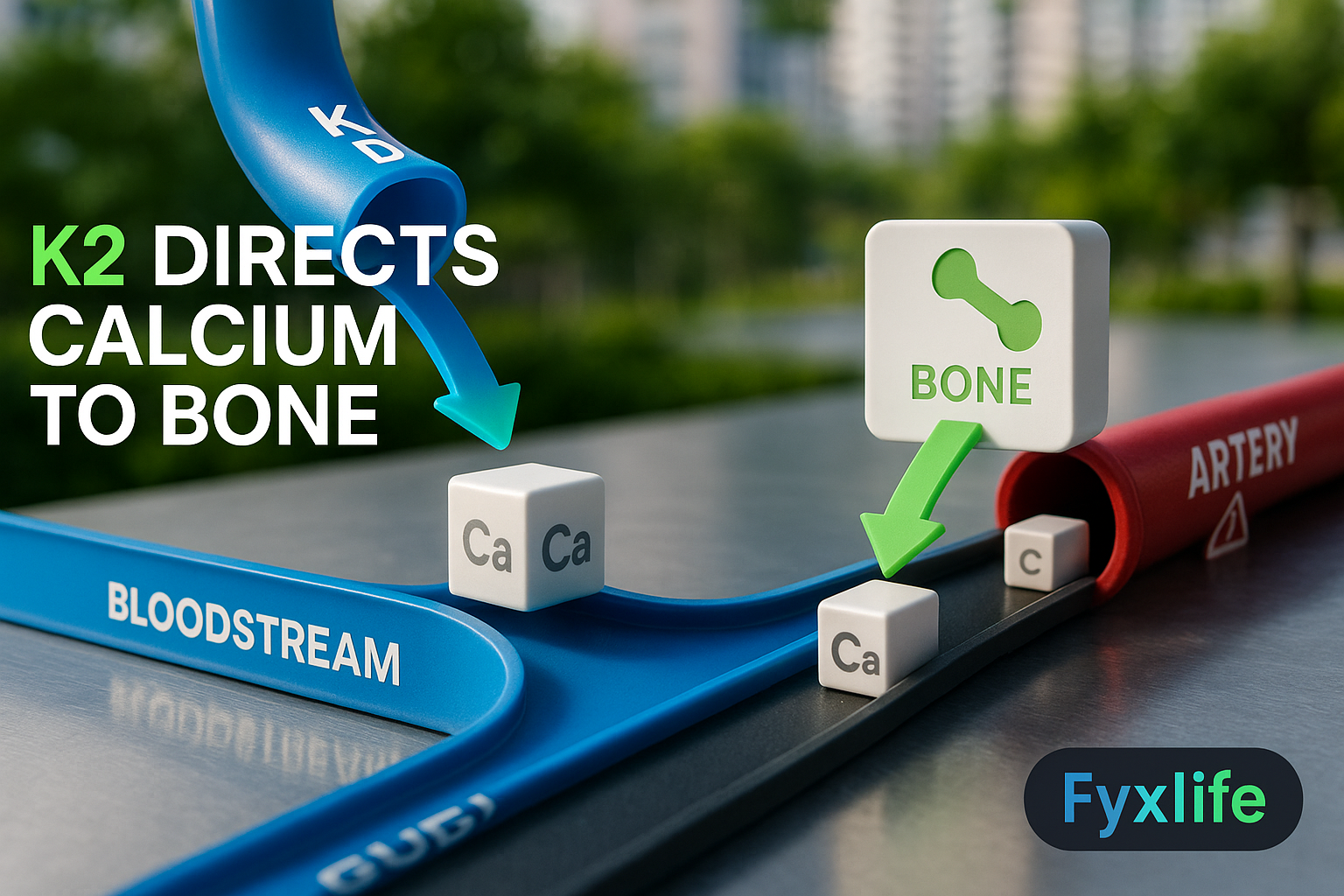
This is where the mechanism becomes clinically relevant. Vitamin K2 acts as a guardian of the vessels by activating MGP, which prevents unwanted calcium buildup in arteries and soft tissue. Think of vitamin D as the delivery driver that picks up calcium from your gut and drops it into your bloodstream. K2 is the logistics manager who reads the address label and makes sure that calcium gets delivered to your bones — not dumped into your arteries. Without the logistics manager, the driver just leaves packages on the nearest doorstep, and sometimes that doorstep is the inside of your blood vessel walls.
Why Vitamin D Without K2 May Create A Problem It Cannot Solve
Calcium In Transit: Where Does It Actually Go?
When you take vitamin D and your gut absorbs more calcium, that calcium enters circulation. Your body then needs to route it somewhere. With adequate K2, the routing system works: osteocalcin pulls calcium into bone, and MGP keeps it out of arteries. With insufficient K2, neither protein is fully activated, and the calcium circulates without clear direction.
This is not hypothetical. Real-world reports of people supplementing with high-dose D3 for years without K2 and developing elevated serum calcium — a condition called hypercalcaemia — reflect exactly this mechanism. Calcium was being absorbed efficiently. It just had nowhere safe to go.
The Vascular Calcification Concern — What The Evidence Actually Says
The concern about vascular calcification is worth taking seriously without catastrophising it. Observational studies indicate that K2 reduces the risk of vascular calcification, and taking vitamin D and K2 together appears to enhance bone mineralisation while reducing this vascular risk — which is why researchers are now framing this combination as relevant to cardiometabolic health, not just bone density. Arterial calcification is a significant independent predictor of cardiovascular events. The possibility that routine vitamin D supplementation without K2 contributes to it, even modestly, is a legitimate question the evidence has not yet fully closed.
The challenge is that this is exactly the kind of question a routine annual check-up was not designed to answer — not because doctors do not care, but because population-level reference ranges were never built to account for how an individual’s specific supplement protocol interacts with their calcium metabolism and arterial health over years.
How D And K2 Work Together — The Mechanism Explained Simply
Bone Mineralisation: D Brings The Calcium, K2 Tells It Where To Sit
For bone quality specifically, the two vitamins play roles that are genuinely distinct and non-overlapping. Vitamin D ensures calcium is available in circulation. K2 ensures that the proteins responsible for incorporating calcium into bone matrix are switched on. Research on human 3D bone models demonstrated that K2 modulates the effects that vitamin D alone induces on bone mechanical properties — meaning the two vitamins are doing different things to the same tissue, and removing either one changes the outcome. This is not a story about one vitamin helping the other work a bit better. It is a story about two separate mechanisms that both need to be active for the endpoint — strong, well-mineralised bone — to be achieved.
What Research On Combined Supplementation Has Found
Research confirms that vitamin D and K2 have a synergistic effect, with dual supplementation providing an added benefit compared to either vitamin taken alone across multiple metabolic outcomes. The word synergistic is often used loosely in nutrition writing; here it has a specific mechanistic basis. D raises the calcium available for deposition. K2 activates the proteins that determine where it deposits. Each one creates the conditions for the other to be effective.
Combined supplementation is also an area of ongoing research in the context of osteosarcopenia — the simultaneous loss of bone density and muscle mass seen in people with metabolic dysfunction — suggesting this combination has clinical relevance that extends well beyond straightforward calcium management.
Do You Need Both? How To Think About This Before Spending Money
Who Is Most Likely To Benefit From The Combination
If you are already supplementing with vitamin D at doses above 1,000 IU daily, the case for adding K2 is strongest. The higher the D dose, the more calcium you are mobilising — and the more dependent you become on K2’s routing function to manage it safely. If you eat natto regularly, consume significant amounts of aged hard cheese, or have a diet genuinely rich in K2 food sources, your dietary intake may partially compensate. Most people in Singapore do not. If you are postmenopausal, have a family history of cardiovascular disease, or have any existing concern about arterial health, the argument for the combination becomes more compelling still.
Forms, Doses, and What To Take With Fat
For K2, the form matters. MK-7 (menaquinone-7) is the long-chain form with a significantly longer half-life in the body than MK-4, meaning a single daily dose maintains active levels more consistently. Typical supplemental doses of MK-7 range from 90 to 200 micrograms daily. For vitamin D3, standard supplemental doses for adults in deficiency-prone regions typically range from 1,000 to 4,000 IU, though the right dose for your specific situation depends on your baseline blood level.
Critically: both vitamins are fat-soluble, meaning they require dietary fat for absorption — and timing supplementation with a fat-containing meal is not optional but directly affects how much your body can actually use. Taking either with a black coffee in the morning is a reliable way to waste most of what you paid for.
What This Supplement Pair Cannot Do
Knowing what a supplement pair does not do is as important as knowing what it does. Vitamin D and K2 will not reverse existing arterial calcification. They will not compensate for a diet consistently high in processed foods, low in protein, or chronically low in other micronutrients. They will not replace weight-bearing exercise as a stimulus for bone formation — osteocalcin responds to mechanical load as well as nutritional signalling. And they are not a substitute for monitoring: if you are supplementing with D at meaningful doses, checking your serum 25(OH)D and serum calcium periodically is basic responsible practice, not overcaution.
Research examining the effects of long-term anticoagulant use — which depletes vitamin K — has highlighted the interdependence of these two vitamins, and if you are on anticoagulant medication, K2 supplementation requires a conversation with your prescribing doctor before you start, given K2’s relationship with the clotting pathway.
The One Thing To Do This Week
Check the label of your current vitamin D supplement this week. If K2 is not listed as an ingredient — specifically as MK-7 (menaquinone-7) — and you are taking more than 1,000 IU of D3 daily, bring this to your next doctor visit and ask whether your serum calcium and vitamin D levels warrant adding K2 to your protocol.