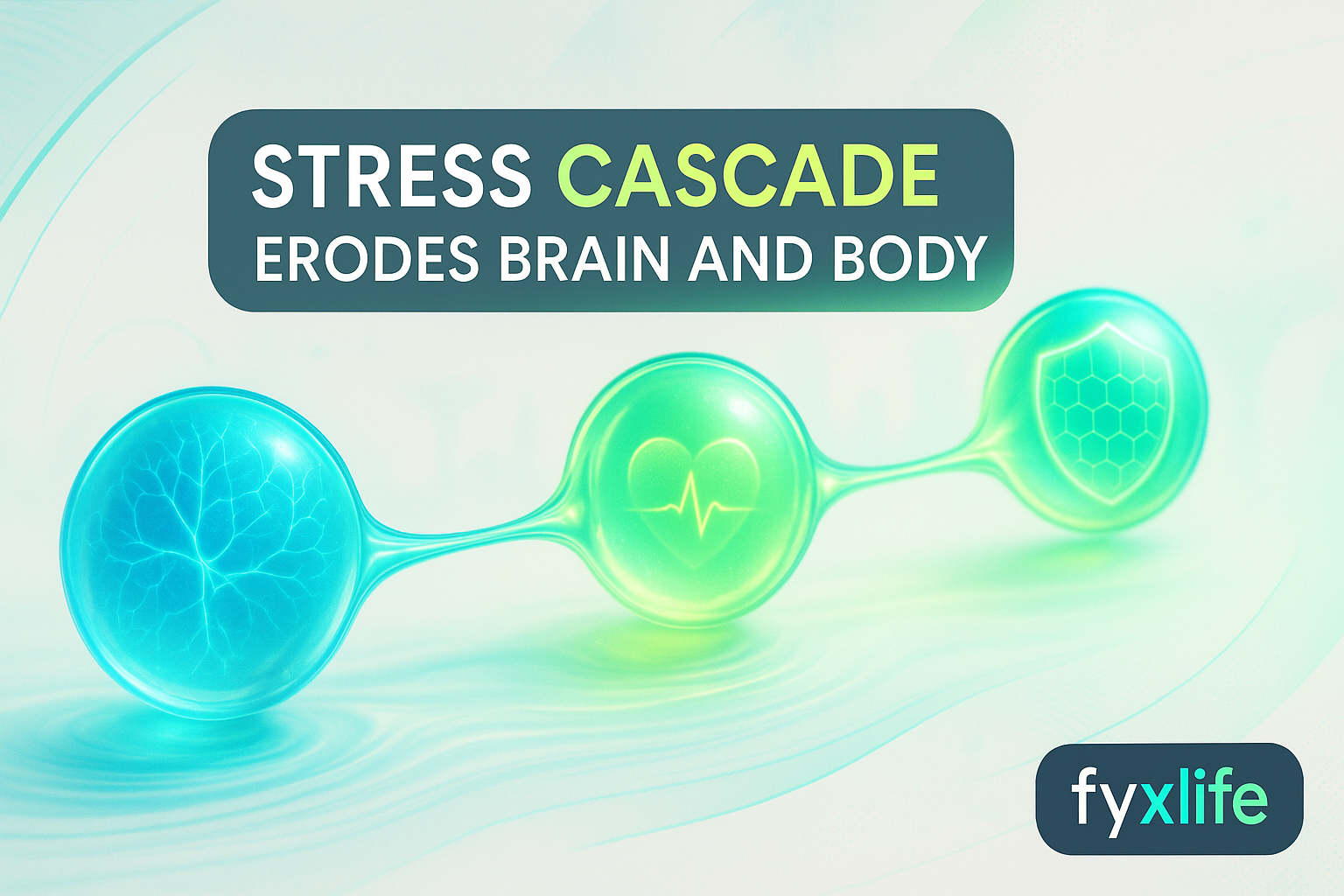
You optimise your sleep, track your steps, and eat well — but there is one variable most high performers ignore until it is too late: the slow, compounding damage of unresolved emotional stress. Chronic emotional strain does not stay in your head. It flows downstream, triggering a chain reaction of damage that touches your brain, your cardiovascular system, and your immune defences — often without a single obvious symptom until the damage is done.
If you have ever pushed through a sustained period of pressure — a difficult quarter at work, a family crisis, months of isolation — and noticed that you felt inexplicably fatigued, mentally foggy, or physically worn down in ways that sleep alone could not fix, you have already experienced the early edges of this cascade. Most people only recognise it in retrospect. The research suggests you should be paying attention now.
The Root Cause — Why Emotional Stress Is a Biological Event, Not Just a Mental One
What chronic emotional strain actually does inside the body
Think of your emotional state as the thermostat for your entire body. When chronic stress keeps that thermostat stuck on high, every organ system in the building — brain, heart, immune — runs hot and wears out faster. The cascade is not a metaphor. It is a sequence of biological events, each one making the next more likely. Fix the thermostat, and you change the environment for every system downstream.
This is the critical reframe: emotional health is not a soft metric. It is a hard biological input with measurable downstream effects on both how long you live and how well you live while you are doing it. Strong stress reduction and a positive mindset rank among the evidence-based habits that directly support longer life expectancy — placed in the same category as exercise and diet, not as a lifestyle add-on.
The chemical alarm signals that never switch off
When you experience a threat — real or perceived — your body releases stress hormones, primarily cortisol and adrenaline, as part of the coordinated survival response your nervous system triggers (what researchers call the hypothalamic-pituitary-adrenal axis, or HPA axis). In the short term, this is adaptive. Your heart rate rises, your attention sharpens, your immune system primes itself. The problem begins when the threat never fully resolves.
Chronic emotional strain — the kind that accumulates from sustained work pressure, unresolved relationship conflict, financial anxiety, or prolonged grief — keeps the HPA axis partially activated. The result is persistently elevated chemical alarm signals circulating in your blood (what researchers call pro-inflammatory cytokines, the molecular messengers that signal tissue damage and threat). This sustained low-grade whole-body inflammation is the shared mechanism linking poor emotional regulation to accelerated damage across multiple organ systems. The thermostat is stuck. And every system downstream is paying for it.
The Cascade Begins — Stage 1: Your Brain Takes the First Hit
How sustained stress impairs memory, focus, and cognitive processing
The brain is the first organ where you are likely to notice the damage — and the place where most professionals dismiss the earliest warning signs as normal. Brain fog is not a personality trait. Forgetting words mid-sentence, losing your thread in a meeting, finding that your attention fractures more easily than it did five years ago — these are not signs of ageing or overwork alone. They are, in part, the neurological signature of an overactivated stress response.
Cortisol, in sustained excess, damages the part of the brain most responsible for forming and retrieving memories (the hippocampus). It also disrupts the chemical signalling between brain cells (synaptic plasticity) that underlies sharp thinking and fast processing. The thermostat running hot does not just tire you out. It physically remodels your brain architecture over time.
The link between emotional dysregulation and accelerated cognitive decline
Research consistently links chronic emotional stress with accelerated cognitive decline — impairing not just day-to-day focus, but the trajectory of brain ageing over years and decades. The same inflammatory signals that keep your immune system on high alert also cross into the brain, contributing to the kind of low-grade neural inflammation now understood to be an early feature of neurodegenerative conditions, including the processes that eventually manifest as dementia.
This is not a distant risk. The biological changes that set the trajectory for cognitive decline in your sixties and seventies are being shaped right now, in your forties and fifties, by exactly the stress load you are currently carrying.
Why professionals with family history of dementia should treat emotional health as a clinical priority
If you have a parent or sibling who developed dementia, you already know the weight of that family history. What the research now makes clear is that your emotional health — specifically your chronic stress burden and your capacity to regulate it — is among the modifiable factors that can meaningfully shift your risk trajectory. Genetics loads the gun. The inflammatory environment created by unresolved emotional stress, sustained over decades, helps pull the trigger. Treating emotional health as a clinical priority is not an act of self-indulgence. For anyone with a family history of cognitive decline, it is arguably the most underused intervention available.
Stage 2: The Heart Pays the Price
From emotional distress to plaque building in arteries — the biological chain
The cardiovascular system is the second major casualty. Chronic emotional distress raises blood pressure, increases the tendency of blood to clot inappropriately, and — through sustained inflammation — accelerates the process of fatty deposits quietly building inside artery walls (what cardiologists call atherosclerosis). This is a process that begins decades before symptoms appear and does not announce itself with pain or warning. Unresolved emotional distress is a recognised contributor to cardiovascular disease risk, operating through the same inflammatory cascade that begins upstream in your emotional state.
The thermostat analogy holds precisely here. When cortisol and inflammatory signals are chronically elevated, the inner lining of your blood vessels (the endothelium) becomes more permeable and more prone to the early-stage arterial damage that is the foundation of heart disease. Emotional stress does not bypass cardiovascular biology. It drives it.
Why high-performing professionals are especially vulnerable
There is a particular irony for high performers. The same driven orientation that fuels professional success — the ability to push through discomfort, suppress emotional signals in service of output, treat stress as a performance input rather than a cost — is precisely the pattern that keeps the thermostat stuck. You are not feeling the stress acutely because you have become good at managing the surface experience. The biology underneath is less impressed by your coping strategies.
Stage 3: Your Immune System Ages Faster
Chronic emotional strain and the biological clock ticking faster
The third system downstream is your immune function — and the damage here operates at the most fundamental level of biological ageing. Chronic emotional strain disrupts the normal regulation of immune cells, pushing the immune system into a state of persistent low-level activation. Over time, this contributes to a process called inflammaging — the gradual, inflammation-driven acceleration of biological ageing that is now understood to underlie many age-related diseases simultaneously.
At the cellular level, chronic stress shortens the protective caps on the ends of chromosomes (telomeres), which are one of the most reliable markers of biological age versus chronological age. Emotional strain disrupts immune regulation in ways that make your biological clock tick faster than your birth certificate would suggest. You can be 45 in years and significantly older in cellular terms, and chronic emotional stress is one of the inputs that drives that gap.
How immune dysregulation compounds brain and heart risk
This is where the cascade becomes self-reinforcing. The immune dysfunction driven by chronic stress feeds additional inflammation back into the brain and cardiovascular system — amplifying the damage in Stage 1 and Stage 2. Each stage does not simply add to the previous one. It multiplies it. The longer the thermostat stays stuck on high, the harder each downstream system works, and the more wear accumulates across all three simultaneously. Avoiding risky behaviours and cultivating stress reduction operate on the same biological axis — which means addressing emotional health is not a separate intervention. It is a systemic one.
The Circuit Breakers — What Actually Interrupts the Cascade
Social connection as a measurable biological buffer
The most consistently replicated circuit breaker in the research is not a supplement, a biohack, or a protocol. It is other people. Strong relationships and social ties are direct contributors to longevity outcomes — not merely to quality of life. The mechanism is measurable: social connection actively downregulates the HPA axis, reduces circulating inflammatory markers, and buffers the cortisol response to acute stress. Your nervous system is genuinely calmer in the presence of people you trust.
Blue Zone research — the systematic study of the world’s longest-lived populations — identifies maintaining close family relationships and community ties as one of the nine core lessons for living longer. These populations invest deliberately in quality time with family and relationships as a longevity practice — not as a preference, but as a biological input they treat with the same seriousness as food and movement.
Stress reduction practices with evidence behind them
The practices with the strongest evidence for interrupting the cortisol cascade are also the least glamorous: regular physical movement, consistent sleep, and deliberate downregulation practices such as slow diaphragmatic breathing and mindfulness-based techniques. Sleep is a particularly powerful lever — it simultaneously restores physical, mental, and emotional regulation, and disruption in one dimension reliably degrades the others. If your sleep is compromised by stress, you are not recovering from the day’s cortisol load overnight — you are compounding it.
Why mindset and positive emotional states are not optional extras
Research links mindset directly to measurable health outcomes, suggesting that emotional orientation is a biological variable, not merely a subjective state. A positive emotional baseline — what psychologists call positive affect — actively reduces inflammatory marker levels, supports immune regulation, and predicts cardiovascular resilience. This is not positive thinking as a philosophy. It is positive emotional states as a physiological input, one that can be cultivated deliberately, not simply felt spontaneously.
The challenge is that this is exactly the kind of insight a routine annual check-up was not designed to translate into action for you — not because your doctor does not understand it, but because a 15-minute appointment built around reference ranges was never designed to assess your chronic stress burden, map it against your biomarkers, and help you identify which stage of this cascade is already active in your body. That gap is real, and it matters.
The Upstream Variable to Track This Week
One measurable input that predicts downstream damage before symptoms appear
Before you can address the cascade, you need to see it operating in your own data. Most people carry a vague sense that stress affects them physically. What they lack is personal evidence — the kind that makes the connection concrete and actionable rather than theoretical.
This week, track one upstream variable: at the end of each day, note your subjective stress level on a 1–10 scale alongside one physical marker you already monitor — sleep quality score, resting heart rate, or HRV if you have a wearable. Do this for seven days. If you see a consistent correlation between high stress days and degraded physical markers, you have personal evidence that your emotional thermostat is already affecting downstream systems — and a concrete data point to bring to your next health conversation.