You’ve seen CoQ10 on the shelf, probably dismissed it as another wellness fad, and moved on. But if you’re over 35 and your energy has quietly declined, the mechanism behind this molecule is worth understanding — because it sits at the exact junction where your cells either make energy efficiently or don’t. This isn’t about hype. It’s about cell biology you can actually act on.
The frustration with supplements like CoQ10 is a familiar one. You try something for six weeks, feel nothing definitive, and conclude it was money wasted. But that experience often says less about the molecule and more about whether you understood what it does, whether you took the right form, and whether your expectations were calibrated to what the evidence actually supports. That’s what this article is for.
First, Understand Where Your Energy Actually Comes From
Your mitochondria are the energy factories — here’s the one-minute version
Inside almost every cell in your body sit structures called mitochondria — the organelles responsible for converting the food you eat into usable energy. You have trillions of them. In high-demand tissues like the heart, brain, and muscles, mitochondria can make up nearly 40 percent of the cell’s volume. They are not passive storage units. They are active, oxygen-consuming, chemically complex machines running continuously from the moment you wake up to the moment your last cell divides.
Mitochondria work through a sequence of chemical reactions known as the electron transport chain — a series of protein complexes embedded in the inner mitochondrial membrane that strip electrons from food-derived molecules and use the resulting energy to drive a molecular turbine. What comes out the other end is the molecule your body runs on.
ATP: the currency your cells spend on everything
Adenosine triphosphate, or ATP, is that molecule. Every muscle contraction, every nerve signal, every cellular repair process, every heartbeat — all of it is purchased with ATP. You produce and consume your own body weight in ATP every single day. It is not stored in meaningful quantities. It must be made continuously, on demand, from the food you eat and the oxygen you breathe. When that production falters — even slightly — you feel it. Not always as a dramatic crash, but as the quiet, creeping sense that you’re running at 80 percent.
What CoQ10 Is and Why It Has Two Names
Ubiquinone vs ubiquinol — the same molecule in two states
CoQ10, also known by its chemical name ubiquinone, is a fat-soluble compound your body produces naturally and that exists in virtually every cell. It is classified as a potential treatment under investigation and is recognised as an important antioxidant with a direct role in mitochondrial function. The two names you’ll see on supplement labels — ubiquinone and ubiquinol — refer to the same molecule in two different states. Ubiquinone is the oxidised form. Ubiquinol is the reduced, active form that your body actually uses. To work, ubiquinone must be converted to ubiquinol inside the body. That conversion is efficient when you’re young. After 40, it becomes increasingly unreliable — a distinction most supplement labels are not designed to help you understand.
Why it’s called ‘ubiquitous’ and where your body makes it
The name ubiquinone comes from the Latin ubique, meaning everywhere. It earned that name because it appears in every tissue of every organism that uses oxygen to produce energy. Your body synthesises it through a complex pathway involving the amino acid tyrosine and several B vitamins. The highest concentrations sit in the organs with the greatest energy demands: the heart, liver, and kidneys. It is also found in small amounts in food — organ meats, sardines, beef, and some nuts — but dietary intake alone is never sufficient to meaningfully raise tissue levels. Supplementation is where the practical question begins.
The Electron Shuttle: CoQ10’s Exact Job Inside Your Mitochondria
How CoQ10 moves electrons through the energy production chain
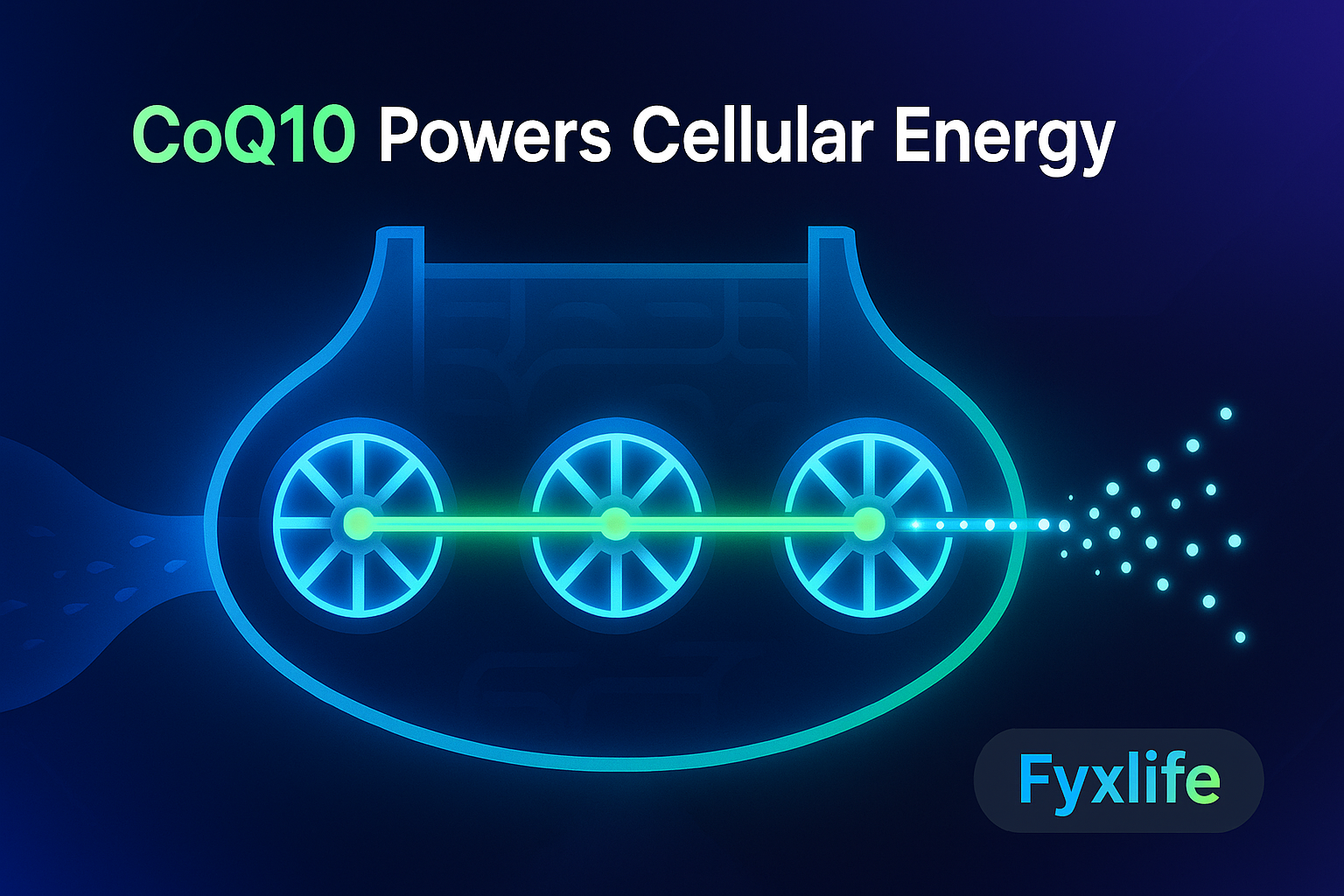
Your body uses both NAD+ and CoQ10 to produce ATP — these two molecules operate interdependently in the mitochondrial energy production process. CoQ10’s specific role within that process is as a mobile electron carrier. It accepts electrons from the first two complexes of the electron transport chain (Complexes I and II) and ferries them to Complex III. Without that shuttle, the chain stalls. Electrons cannot proceed. The turbine stops. ATP production collapses.
The plain English version — the analogy that makes this click
Think of your mitochondria as a hydroelectric dam. Water — representing the energy from food — flows through turbines, which are the enzyme complexes, to generate electricity in the form of ATP. CoQ10 is the pipe connecting the turbines. Without it, the water has nowhere to flow, the turbines stall, and the lights in your cells start to dim. CoQ10 doesn’t generate the power itself, but nothing generates power without it. That is a precise description of its biochemical role, not a marketing metaphor.
The Second Job: Neutralising Cellular Damage Before It Spreads
What oxidative stress actually means for your cells
Energy production is not a clean process. As electrons move through the transport chain, some escape and react with oxygen to form unstable molecules called free radicals. When free radicals outnumber your body’s capacity to neutralise them, you get oxidative stress — a state of molecular imbalance where reactive molecules attack proteins, fats, and DNA. Over time, this contributes to the cellular deterioration we broadly call ageing. It is also implicated in cardiovascular disease, neurodegeneration, and declining metabolic function.
Why CoQ10 sits in the right place to intercept that damage
CoQ10’s dual role spans energy production and antioxidant protection — and the reason it can do both is geography. Because CoQ10 lives inside the mitochondrial membrane, precisely where free radicals are generated, it is uniquely positioned to intercept them before they spread. Most dietary antioxidants work at a distance. CoQ10 works at the source. It is well-recognised for its ability to protect cells from damage, with documented effects particularly relevant to heart health. That combination — energy support and on-site antioxidant activity — is what makes it biologically interesting and what separates it, mechanistically, from most of the supplement aisle.
Why CoQ10 Levels Drop As You Age — And What Happens Next
The age-related decline curve
Your body’s CoQ10 production peaks in your twenties and begins a measurable decline from your thirties onward. By your fifties, tissue levels can be substantially lower than they were at peak. This decline is compounded by statins — one of the most widely prescribed drug classes globally — which block the same biochemical pathway used to produce CoQ10. If you are on a statin, your CoQ10 depletion may be more pronounced than age alone would predict. That is not a fringe claim. It is the reason many cardiologists recommend CoQ10 supplementation alongside statin therapy, even when they rarely discuss it proactively in a standard appointment.
The heart connection: why cardiac muscle is especially dependent on CoQ10
Declining CoQ10 levels with age are associated with mitochondrial dysfunction that contributes to heart-related issues as we get older. The heart never rests. It beats approximately 100,000 times a day, every day, for your entire life — and it does so using almost exclusively mitochondrial ATP. No organ in the body is more dependent on efficient mitochondrial function, which means no organ is more sensitive to the slow erosion of CoQ10 levels. CoQ10 deficiency has also been identified as a measurable marker in certain mitochondrial disorders, suggesting its clinical significance extends well beyond the supplement context.
CoQ10 and NAD+: The Partnership Most Supplement Labels Ignore
How the two molecules interact in the energy production process
NAD+ (nicotinamide adenine dinucleotide) is the other major electron carrier in the mitochondrial energy chain. Where CoQ10 shuttles electrons between Complexes I and III, NAD+ collects electrons earlier in the process and delivers them to Complex I. They are not interchangeable. They are sequential. Both NAD+ and CoQ10 are required to produce ATP, and they operate interdependently. If NAD+ is the feeder road and CoQ10 is the highway, then a blockage in either one creates a bottleneck in the same destination. CoQ10 is grouped alongside NAD+ precursors, omega-3s, and resveratrol as part of a recognised category of supplements studied for cellular longevity and inflammation management.
Why taking one without understanding the other may leave results on the table
This is where the supplement industry consistently fails the informed consumer. Products are marketed in isolation. You see a CoQ10 bottle and a separate NMN or NR bottle, each promising energy support, with no explanation of how they relate. The honest answer is that both pathways converge on the same mitochondrial output. Optimising one while neglecting the other is like upgrading half a pipeline. PQQ (pyrroloquinoline quinone) is also being explored alongside CoQ10 as a complementary compound in the context of mitochondrial health, suggesting that researchers are increasingly looking at multi-pathway approaches rather than single-molecule solutions. None of this means you need to take everything at once. It means understanding the system matters before choosing what to put in it.
What the Evidence Actually Says CoQ10 Can (and Cannot) Do
Supported by research: where CoQ10 shows real signal
The strongest evidence for CoQ10 sits in cardiovascular health, particularly in people with heart failure and in statin users experiencing muscle pain (the technical term for this is statin-induced myopathy). There is also credible evidence supporting its role in reducing oxidative stress markers in metabolic disease, and in supporting mitochondrial function in people with confirmed CoQ10 deficiency. These are not trivial findings. They point to a molecule doing a real job in a real biological context.
Where the evidence is thin or preliminary — be honest here
Outside those contexts, the evidence thins considerably. Claims that CoQ10 will meaningfully improve energy in a healthy, non-deficient person are not well supported by controlled trials. The anecdotal record is enormous — and genuinely inconsistent. Some people report clear subjective improvement. Many report nothing. This mirrors precisely what you hear from people who have tried it seriously: strong theoretical basis, uneven personal results. The mechanism is sound. The translation to felt experience in already-healthy individuals is not guaranteed, and the research does not currently tell us why some people respond and others don’t.
Small adjunct for VO2 max: what ‘small improvement’ actually means in practice
VO2 max — your body’s maximum capacity to consume and use oxygen during exercise — is one of the strongest predictors of long-term health and longevity we have. It declines with age. CoQ10 is listed among lower-impact adjunct supplements — alongside creatine, epicatechin, and citrulline — that provide small improvements in maintaining VO2 max as we age. Small is the operative word. CoQ10 will not transform your aerobic capacity. But for someone already doing the right training, managing sleep, and eating well, small adjunct gains at the margins of a critical biomarker are genuinely worth something. Context matters. CoQ10 is not a substitute for exercise. It may be a modest complement to it.
The Sceptic’s Summary: Is CoQ10 Worth Your Money?
If you are on a statin, the answer is almost certainly yes — the depletion mechanism is established and the risk of not supplementing is real. If you have documented heart failure or a mitochondrial disorder, the evidence is meaningful. If you are a healthy person over 40 looking to support mitochondrial function as part of a broader longevity strategy, the biological rationale is sound even where the trial evidence for subjective energy improvements is inconsistent. If you are under 35, healthy, and not on any medication that depletes CoQ10, the case is weaker.
What the evidence does not support is buying the cheapest ubiquinone capsule off the shelf and expecting to feel transformed. The form matters. The dose matters. The context of what else you are — or aren’t — doing for your mitochondria matters. CoQ10 is not magic. It is a molecule with a specific job in a specific place, and when the conditions are right, it does that job well.
The challenge with translating any of this to personal application is that it genuinely requires knowing your baseline — whether you’re deficient, whether you’re on medications that affect CoQ10 synthesis, what your cardiovascular risk profile looks like. These are questions that don’t get answered in a standard annual check-up, not because your doctor doesn’t care, but because routine appointments were designed around population-level thresholds, not the kind of individual metabolic picture this question actually demands.
Apply this mechanism insight to one decision you’re already making this week: if you’re currently taking or considering CoQ10, check whether you’re taking the ubiquinol form — the active, reduced state — rather than standard ubiquinone. Particularly if you’re over 40, when the body’s ability to convert ubiquinone into usable ubiquinol declines. This single specification change is where most buyers leave efficacy on the table, and it costs nothing to verify on the label you already own.