You sleep eight hours and wake up exhausted. You eat clean, train hard, and still can’t shift the belly fat or silence the mental noise. If that sounds familiar, chronic stress hormones — not willpower — may be the problem. The question is: do any of the products claiming to fix your cortisol actually do anything?
The cortisol supplement market has exploded in the last three years. Walk into any pharmacy or scroll through any wellness feed and you will find adrenal support blends, cortisol cocktails, and stress-relief stacks promising to fix what your lifestyle apparently cannot. Some of these products have real science behind them. Most do not. And the gap between the marketing and the mechanism is wide enough to cost you both money and time you do not have.
This article cuts through it systematically — what the evidence actually supports, what it doesn’t, and what you should be measuring before you spend a dollar on any of it.
The Verdict First — Here Is What the Evidence Actually Supports
What earns a pass, what earns a fail, and what needs more data
Pass: Ashwagandha has published clinical evidence behind it and deserves to be taken seriously at the right dose. Magnesium glycinate has a plausible mechanism and a reasonable safety profile. Breathwork, structured sleep, and appropriately dosed exercise are the most consistently evidenced cortisol regulators available to you — full stop.
Fail: Cortisol cocktails and adrenal support blends — usually a mix of vitamin C, salt, and cream of tartar — have no credible clinical evidence for cortisol reduction. Neither do most branded “stress support” stacks. They are not dangerous. They are just expensive and largely irrelevant to the biology they claim to address.
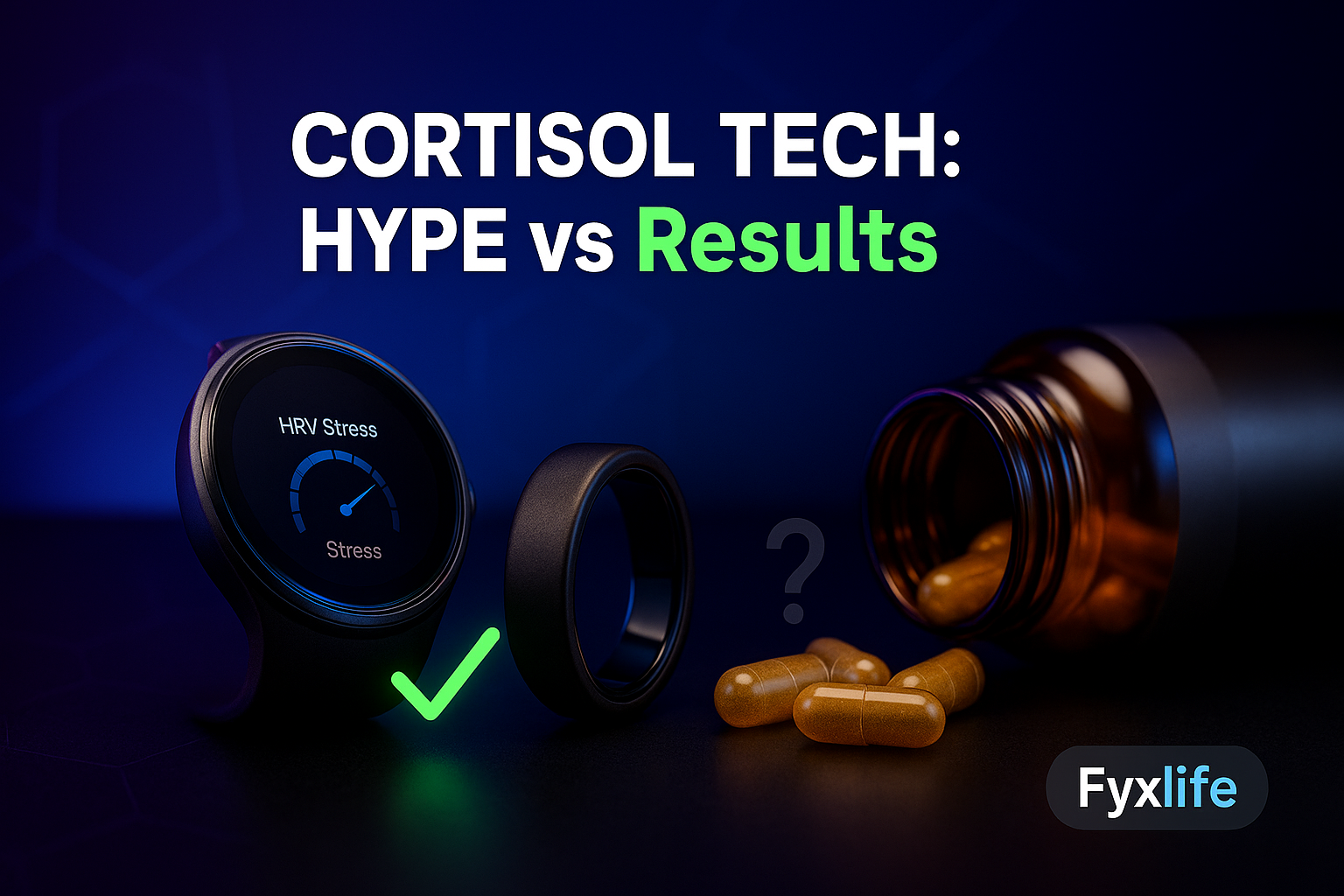
Needs more data: Phosphatidylserine shows a signal worth watching. Wearables that track something called heart rate variability — the variation in time between your heartbeats, which reflects how your nervous system is recovering — offer a useful proxy signal, but are not measuring cortisol directly and can mislead you in both directions.
What Chronic Stress Actually Does to Your Biology
The alarm system that never turns off
Think of your stress response system like a smoke alarm hardwired to release adrenaline and cortisol the moment it detects danger. In true emergencies, this is life-saving. But chronic stress is like having a faulty alarm that goes off every hour — even when there is no smoke. Over time, the constant siren does not protect you; it wears out the building. Your immune system, metabolism, sleep architecture, and hormonal balance all take damage from the noise — and no supplement can permanently silence a faulty alarm without fixing the wiring.
The alarm system in question is called the hypothalamic-pituitary-adrenal axis — the HPA axis for short. It is a signalling chain that runs from the brain to the adrenal glands sitting above your kidneys. When the brain perceives threat — whether that is a predator, a difficult conversation, or an overflowing inbox — it triggers a cascade that ends with cortisol being released into the bloodstream. Cortisol then raises blood sugar, suppresses digestion, sharpens alertness, and shifts blood flow to the muscles. All of this is exactly what you want in a genuine emergency. None of it is what you want happening every afternoon for five years.
Why elevated cortisol is a disease precursor, not just a bad mood
This is not a soft claim about feeling stressed. Chronic stress is a documented biological precursor to multiple disease states — not merely a psychological inconvenience but a measurable driver of poor health outcomes. The mechanism is not mysterious. Persistently high cortisol degrades insulin sensitivity, suppresses immune function, accelerates cellular ageing processes, and promotes something called neuroinflammation — a low-grade, chronic activation of the brain’s immune cells that has been linked to depression, cognitive decline, and metabolic disease.
Cortisol also does not operate in a silo. High cortisol combined with low progesterone and fluctuating estrogen creates a compounding hormonal disruption — chronic stress destabilises the wider hormonal ecosystem, not just cortisol in isolation. For women in perimenopause, this is particularly relevant. The conversation about stress and hormones rarely connects these dots clearly enough.
The compounding disaster — cortisol plus poor sleep plus metabolic dysfunction
The reason so many people feel stuck — doing most things right and still not recovering — is that these variables compound. Combining elevated cortisol with sleep apnea, poor diet, and excessive alcohol creates a cascading metabolic disaster that no single intervention addresses. Each factor worsens the others. Poor sleep raises cortisol. Elevated cortisol impairs sleep architecture. Chronically elevated cortisol is a direct contributor to fat stored around the organs — visceral fat accumulation is a hormone equation, not only a calorie equation. And dieting and intermittent fasting are themselves physiological stressors that can compound this hormonal load rather than resolve it.
If you are restricting calories hard while under chronic stress and sleeping poorly, you may be running three stressors simultaneously while expecting one of them to provide relief.
The Measurement Problem — You Cannot Trust How You Feel
Why self-reported stress diverges from measurable cortisol
Here is a finding that should change how you think about this entire category. Self-reported stress over the previous 30 days does not reliably reflect chronic stress as measured by cortisol in hair or nails — subjective experience is a poor biomarker for actual hormonal stress load. This matters enormously. You might feel relatively calm and still be running chronically elevated cortisol. Equally, you might feel frantic and have cortisol within a functional range. Feeling stressed is not a diagnosis. Not feeling stressed is not clearance.
This is the central measurement problem. Most people buying cortisol supplements are doing so based entirely on subjective experience. Most stress tracking apps rely on self-report. Without an objective marker, you cannot know whether a supplement is doing anything — or whether you even need it.
What hair, nail, and salivary cortisol testing actually tells you
Salivary cortisol testing — taken at multiple points across a single day — gives you a cortisol curve, showing whether your cortisol is spiking and falling appropriately or staying flat and elevated throughout the day. Hair and nail cortisol testing measures average cortisol exposure over weeks to months — effectively a long-run hormonal average rather than a snapshot. None of these tests are routine in a standard annual check-up, and none of them are what your GP’s fasting blood panel is measuring. Fasting blood cortisol gives you a single morning number, which has limited interpretive value on its own.
The challenge is that the nuanced interpretation of these markers — what is optimal for your age, sex, and risk profile, rather than what falls within the broad population reference range — is exactly the kind of question a ten-minute appointment was not designed to answer. Not because doctors don’t care, but because population-level reference ranges were never built to account for your specific constellation of risk factors.
Supplements Under the Microscope
Ashwagandha — the most evidenced option and what the evidence actually shows
Ashwagandha — the root extract of Withania somnifera, classified as an adaptogen (a compound that helps the body modulate its stress response) — is the most discussed cortisol supplement online, and for once, the discussion is partially warranted. Published clinical research — including a trial by Chandrasekhar, Kapoor, and Anishetty — has demonstrated reductions in salivary cortisol and perceived stress with standardised ashwagandha extract. The operative phrase is standardised extract. A product standardised to 5% withanolides — the active compounds responsible for the effect — is not the same as a generic ashwagandha powder at an uncertain dose.
The typical effective dose in trials runs between 300mg and 600mg daily of a standardised extract, taken consistently over 8 to 12 weeks. This is not a supplement you take when you feel stressed. It is one you take as a sustained intervention with measurable entry and exit markers. Even within this framework, the effect size is meaningful but not dramatic — and it does nothing to address the structural stressors that are triggering the alarm in the first place.
Cortisol cocktails and adrenal blends — marketing versus mechanism
The so-called cortisol cocktail — typically a combination of vitamin C, sodium, and potassium — is framed as a way to support the adrenal glands and lower cortisol. The logic is superficially appealing: the adrenal glands do use vitamin C, and sodium and potassium are electrolytes involved in adrenal function. But trending cortisol products framed as quick fixes for a complex endocrine problem deserve direct scrutiny — because the jump from “this nutrient supports adrenal function” to “this drink lowers your cortisol” is not supported by clinical evidence. You are not vitamin C deficient. Your adrenal glands are not failing because you are not drinking cream of tartar.
Adrenal support blends — typically a proprietary mix of B vitamins, adaptogens, and herbal extracts at sub-therapeutic doses — follow the same pattern. Each ingredient might have a plausible mechanism at the right dose. Combined at undisclosed quantities in a blend, the evidence base effectively disappears.
Magnesium, phosphatidylserine, and other candidates — where do they stand
Magnesium — specifically magnesium glycinate or magnesium threonate, not magnesium oxide — has a reasonable case. Magnesium is a cofactor in over 300 enzymatic reactions, plays a role in regulating the HPA axis activity, and is commonly depleted by chronic stress itself. The evidence for direct cortisol reduction is modest, but the safety profile is good and the downstream benefits for sleep quality are well-supported. This one earns a cautious pass.
Phosphatidylserine — a fatty compound naturally found in high concentrations in brain cell membranes — has shown some signal in blunting the cortisol response to acute exercise stress in small trials. The effect appears most meaningful in the context of overtraining rather than generalised stress. Promising, but not yet strong enough to recommend broadly.
Wearables and Stress Tracking Devices — Do They Measure the Right Thing
HRV as a cortisol proxy — useful signal or misleading shortcut
Heart rate variability — the beat-to-beat variation in your heart rhythm, which reflects the balance between your sympathetic (fight-or-flight) and parasympathetic (rest-and-recover) nervous systems — is the metric most wearables use as a proxy for stress and recovery. It is a legitimate physiological signal. When HRV is consistently low, your autonomic nervous system is under load. When HRV is trending upward over weeks, recovery is improving.
But HRV is not cortisol. It is an indirect downstream signal of nervous system state — useful, but several steps removed from your actual hormonal profile. A night of alcohol can tank your HRV while your cortisol curve looks unremarkable. Conversely, a high-HRV reading does not tell you that your 3am cortisol spike — the kind associated with non-restorative sleep — is or isn’t happening.
What wearables can and cannot tell you about your stress hormones
Wearables are best understood as trend tools, not diagnostic instruments. A week-long decline in your HRV baseline following a period of intense work or travel is meaningful data — it tells you that your nervous system recovery is under strain and that adding training load would be counterproductive. Used this way, they change behaviour in useful directions. The problem arises when people use a single night’s HRV score to make supplement decisions or to reassure themselves that they are recovering — when what they are actually seeing is normal biological variation.
No consumer wearable currently on the market measures cortisol directly. Continuous cortisol monitoring through sweat or interstitial fluid is an active research area, but nothing commercially available is accurate enough to make clinical decisions from yet.
What Actually Works — Interventions With Legitimate Evidence
Breathwork, sleep, and exercise as cortisol regulators
The interventions with the strongest evidence base for cortisol regulation are not supplements. They are breathwork — specifically slow, extended exhalation breathing patterns that directly activate the parasympathetic nervous system (your body’s rest-and-recovery state); structured sleep with consistent timing, which aligns your cortisol rhythm to its natural morning peak and evening decline; and exercise at appropriate intensity, which acutely raises cortisol but, over time, improves HPA axis regulation and reduces baseline stress reactivity.
Five minutes of slow breathing — targeting a roughly 4-second inhale and 6-second exhale — has measurable effects on what researchers call vagal tone (the activity of the vagus nerve, the main pathway of your parasympathetic nervous system). This is not a relaxation gimmick. It is a direct input into the same nervous system circuit that regulates your cortisol response.
Why lifestyle levers outperform supplements for most people
Going back to the smoke alarm analogy: supplements can muffle the sound slightly, but they do not fix the faulty wiring. The wiring — your HPA axis regulation, your sleep architecture, your nervous system baseline — responds to inputs that are consistent, physiological, and structural. An ashwagandha capsule cannot undo the effect of chronic sleep restriction, unresolved psychological stress, or a training programme that outpaces your recovery capacity. Lifestyle interventions are not the consolation prize for people who cannot afford supplements. They are the primary mechanism, and everything else is adjunctive.
The SuperDoc Verdict — Spend Here, Skip There, Investigate This
One decision to make based on where you sit right now
Spend here: A standardised ashwagandha extract (look for KSM-66 or Sensoril on the label — both are well-characterised, standardised forms) at 300–600mg daily if you are experiencing sustained, measurable stress load over weeks or months. Magnesium glycinate at 200–400mg in the evening if your sleep is disrupted or your diet is not rich in magnesium-dense foods like leafy greens, seeds, and dark chocolate. A quality wearable for HRV trend tracking — used as a behavioural feedback tool, not a diagnostic device.
Skip: Cortisol cocktails. Adrenal support blends. Any product calling itself a “cortisol blocker.” These are marketing constructs, not mechanisms. The money is better spent on the interventions above.
Investigate this: Your actual cortisol curve and your metabolic markers — not because a supplement decision depends on them, but because the most important question is whether your stress biology is already affecting downstream systems. If your fasting insulin is creeping up, your body composition is shifting despite reasonable effort, or your sleep is consistently non-restorative, these are signs that the alarm has been ringing long enough to affect the building.
Before spending on any cortisol supplement or stress wearable, check your most recent bloodwork for fasting cortisol, fasting insulin, and HbA1c. If any are elevated or trending in the wrong direction, that is your signal that lifestyle-level interventions — not a supplement — should be your first move. Bring those three numbers to your next doctor visit and ask specifically: “Do my cortisol and metabolic markers suggest chronic stress is affecting my biology, and what is the highest-leverage intervention for my profile?”