
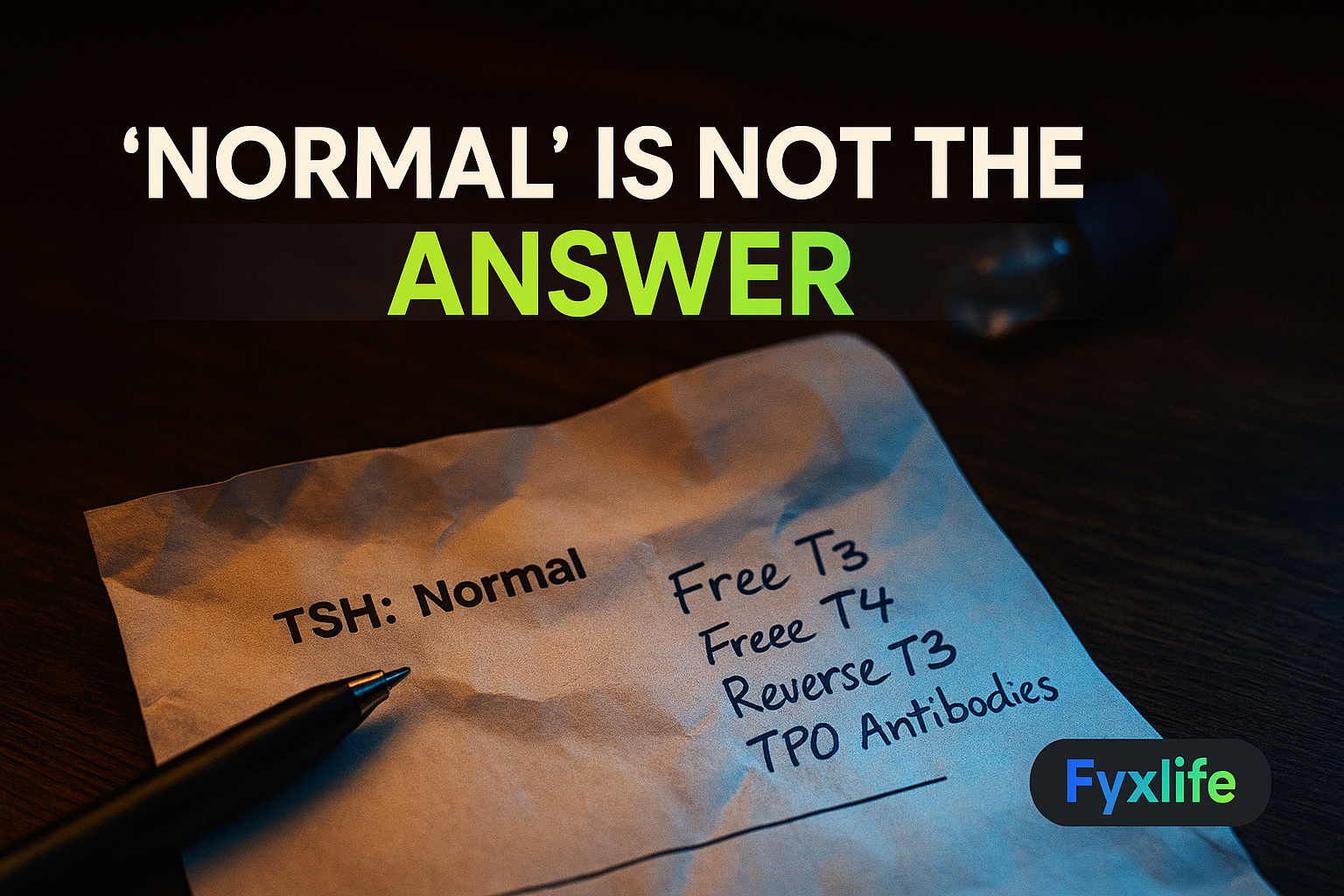
You’ve been told your thyroid is fine. The fatigue, the weight that won’t shift, the brain fog that arrives by 3pm — all unexplained. The problem isn’t your thyroid. It’s that your doctor only ran one number when the real story requires five.
This is one of the most common frustrations among health-conscious adults who are already doing the right things — sleeping enough, eating well, exercising consistently — and still feel like they’re running on half power. The thyroid is a small gland at the base of your neck, but it acts as the metabolic control centre for nearly every cell in your body. When it’s not working properly, everything feels harder. And when your test comes back “normal,” the temptation is to accept that answer and keep looking elsewhere. Often, you shouldn’t.
Why ‘Normal’ TSH Can Still Mean Something Is Wrong
What TSH actually measures (and what it misses)
Think of your thyroid system like a factory supply chain. TSH — thyroid-stimulating hormone — is the purchase order from head office. It’s a signal sent by your pituitary gland telling the thyroid to produce. But TSH doesn’t measure what the thyroid is actually making, and it certainly doesn’t measure what your cells are receiving. It only tells you that the order was sent. Whether the finished product is being manufactured, shipped, and used is an entirely separate question — one that a TSH-only test cannot answer.
A standard TSH test can return false-normal results, making antibody testing or a full thyroid panel necessary to reveal dysfunction that TSH alone does not detect. Your TSH could sit comfortably inside the reference range while your cells are quietly starved of the active hormone they need.
The conversion problem: T4 is inactive until your body converts it to T3
Here’s where the supply chain breaks down in ways TSH cannot see. T4 (thyroxine) is the raw material shipped out from the thyroid — but it’s largely inert. Your body has to convert it into T3 (triiodothyronine), the finished product that your cells actually run on. This conversion happens primarily in the liver, gut, and peripheral tissues. If that conversion process is impaired — due to chronic stress, nutritional deficiencies, gut dysfunction, or inflammation — your T4 levels can look perfectly normal while your cells are functionally hypothyroid.
What makes this particularly frustrating is that this entire conversion step is invisible on a standard panel. You can have adequate T4 production and TSH well within range, and still have the symptoms of an underactive thyroid, because the bottleneck isn’t at the factory gate — it’s on the production floor.
Why autoimmune thyroid disease can be invisible on a standard panel
The third blind spot is perhaps the most consequential. Hashimoto’s thyroiditis — the autoimmune condition in which your immune system gradually attacks your own thyroid tissue — can be actively progressing for years before TSH shifts enough to trigger a flag. Postpartum thyroiditis cases were missed in clinical research because diagnosis relied on TSH shifting out of range alone, without a full thyroid panel and formal clinical assessment — illustrating precisely how TSH-only testing creates diagnostic blind spots in real patients with real symptoms.
The Full Thyroid Panel — Every Marker Explained
A full thyroid panel should include TSH, Free T4, Free T3, Reverse T3, and thyroid antibodies (TPO) to provide a complete picture of thyroid hormone production, conversion, and immune status. Each marker illuminates a different stage of the supply chain. Together, they tell a story no single number can.
TSH — the pituitary signal, not the thyroid output
TSH remains useful — it’s the starting point, not the endpoint. When TSH is significantly elevated, your pituitary is working overtime to compensate for a sluggish thyroid. When it’s suppressed, the signal suggests overproduction or, in some cases, pituitary dysfunction. But because it’s a feedback signal rather than a direct measure of thyroid function, it responds slowly to changes and can sit within range long after the underlying system has started to falter.
Free T4 — what your thyroid is producing
Free T4 measures the biologically available (unbound) form of thyroxine circulating in your blood — the raw material the thyroid is actively releasing. Low Free T4 with elevated TSH is a textbook sign of primary hypothyroidism. But normal Free T4 with persistent symptoms is the scenario that sends people in circles — because the bottleneck is further downstream.
Free T3 — what your cells are actually using
Free T3 is the finished product. It’s the active form of thyroid hormone that binds to receptors inside your cells and drives metabolism, energy production, temperature regulation, and cognitive function. A functional medicine approach extends beyond TSH to a full thyroid panel in order to identify root causes of thyroid symptoms, rather than treating the TSH number in isolation — and Free T3 is often the number that finally explains why someone with “normal” TSH still feels terrible.
Reverse T3 — the blocker that looks like the real thing
Reverse T3 is the faulty product that jams the assembly line. It’s a structurally similar molecule to Free T3, but it’s biologically inactive. Under conditions of chronic stress, severe illness, prolonged calorie restriction, or high inflammation, your body preferentially converts T4 into Reverse T3 rather than Free T3 — essentially filling the receptor locks with the wrong key. A comprehensive baseline assessment for patients with systemic inflammation must include full thyroid panel evaluation as part of endocrine function testing — TSH alone is insufficient as a pre-treatment screen. An elevated Reverse T3 relative to Free T3 can explain why someone under sustained stress develops classic hypothyroid symptoms despite normal conventional results.
TPO Antibodies — the autoimmune early warning system
TPO antibodies (anti-thyroid peroxidase antibodies) are the immune system’s fingerprints at the crime scene. Thyroid peroxidase is an enzyme essential to thyroid hormone production. When your immune system begins attacking it, TPO antibody levels rise — often years before TSH or Free T4 move. Hashimoto’s thyroiditis is diagnosed via a full thyroid panel including elevated TSH, low Free T4, and positive anti-TPO antibodies — antibody testing is essential to distinguish autoimmune from non-autoimmune thyroid dysfunction. Knowing whether your thyroid dysfunction is autoimmune in origin changes everything about how it should be managed.
The Protocol: How to Get This Done Step by Step
Step 1 — Write down your symptoms before any appointment
Before you walk into any appointment, document your symptoms with specificity and duration. Not “I’m tired” — but “persistent fatigue that is worse in the afternoon, present for eight months, not improved by sleep.” Include any hair thinning, unexplained weight changes, cold intolerance, constipation, low mood, brain fog, or changes in heart rate. Symptoms are clinical data. They belong in your file, and they carry weight when you’re asking for tests that fall outside a standard panel.
Step 2 — The exact words to use when requesting a full panel from your doctor
Be direct and specific. Say: “I’d like to test my full thyroid panel — TSH, Free T3, Free T4, Reverse T3, and TPO antibodies.” The word “free” matters. Total T3 and Total T4 measure both bound and unbound hormone, which is less useful because bound hormone isn’t biologically active. Free fractions are what count. Write it down on paper and hand it over. A written request signals you’ve done your research and takes the conversation out of the improvised zone.
Step 3 — Timing your test correctly (morning, fasted, consistent across retests)
TSH follows a circadian rhythm — it’s highest in the early morning and drops through the day. To get consistent, comparable results across retests, always test in the morning, ideally before 9am, while fasted. If you’re already on thyroid medication, take it after the blood draw, not before. Consistency in timing is not a minor detail. A TSH drawn at 8am and one drawn at 2pm can differ enough to shift your result across a clinical threshold.
Step 4 — What to do if your doctor refuses to order the full panel
Ask, calmly, why each marker is not indicated for your symptoms. This is a reasonable clinical question, not a confrontation. If the answer is cost or local clinical guidelines, you have options. Private laboratories across Singapore and Southeast Asia offer direct-to-consumer thyroid panels without a referral, at a cost that is typically modest relative to the value of the information. Experts recommend that a full thyroid panel — including Free T3, Free T4, and TPO antibodies — should be part of any serious health optimisation protocol, particularly for women over 40. You are entitled to pursue that without waiting for permission.
Step 5 — How to read your results alongside your symptoms, not instead of them
This is where the protocol becomes nuanced. Lab reference ranges are population averages — they were built to identify the extremes of a bell curve, not to define optimal function for an individual who feels unwell. A Free T3 at the bottom quartile of the reference range is technically “normal.” Whether it’s normal for you, given your symptoms and history, is a different question. Understanding that lab normal ranges are population averages, not optimal ranges, and weighing symptoms alongside numbers, is a functional medicine principle supported by integrative thyroid specialists. Numbers and symptoms together form the picture. Neither alone is enough.
The challenge is that this is exactly the kind of question a routine annual check-up was not designed to answer — not because doctors don’t care, but because population-level reference ranges were never built to account for your specific symptom profile, stress load, or inflammatory status. A 10-minute appointment reviewing a single TSH result cannot do what this protocol is asking you to think about.
What NOT to Do (Equally Important)
Don’t self-diagnose from online reference ranges
The internet is full of forums where people compare TSH numbers and declare themselves hypothyroid. This is dangerous in both directions. A Free T3 that looks low relative to a functional medicine “optimal” range doesn’t automatically mean you need treatment — it means you need clinical context. Symptoms, history, the full five-marker picture, and an informed clinician all belong in that conversation before any conclusion is drawn.
Don’t skip the antibody test to save money — it changes the entire picture
If you’re going to cut anything from the panel to reduce cost, do not let it be the TPO antibodies. This is the marker that tells you whether your immune system is involved — and that answer determines whether you’re managing a conversion problem, a production problem, or an autoimmune condition. Each has different implications. Thyroid optimisation specialists recommend monitoring with a full panel — not TSH alone — and considering combination T4 and T3 therapy where Free T3 remains suboptimal despite normal TSH. Without antibody data, that decision cannot be made intelligently.
Don’t request treatment based on a single abnormal number without a full baseline
One low Free T3 result does not warrant starting thyroid medication. One elevated TPO reading without symptoms or additional markers does not either. The protocol works in both directions — it protects you from underdiagnosis, but also from premature intervention. A full baseline, tested at the right time, fasted, and reviewed alongside your symptom history, is what gives any clinician a real foundation to work from.
How Often to Test and What Triggers a Retest
Baseline testing for adults 35+ with unexplained symptoms
If you’re over 35 and have persistent unexplained symptoms — fatigue, weight resistance, mood changes, hair loss, cold intolerance, cognitive slowing — a full thyroid panel is a reasonable first-line investigation. Environmental toxin exposure has been associated with greater TSH concentrations in studies that measured a full thyroid panel as a key biomarker set, illustrating that thyroid disruption has multiple upstream causes that standard screening won’t catch. Get the full baseline done once, correctly, so you have a genuine reference point.
Retest intervals once a pattern is established
For most adults without a confirmed thyroid condition, an annual full panel is sufficient once a baseline has been established. If you’ve had elevated TPO antibodies with normal TSH — a pre-Hashimoto’s pattern — retesting every six months makes sense to track progression. If you’re on thyroid medication, your clinician will guide timing, but the same principle applies: retest the full panel, not just TSH.
Red flag results that require urgent follow-up
Some results shouldn’t wait. A TSH above 10 mIU/L, a TSH below 0.1 mIU/L, very low Free T4, or significantly elevated TPO antibodies paired with new or worsening symptoms all warrant prompt clinical review — not a wait-and-see approach. These are scenarios where a functional medicine read on reference ranges takes a back seat to conventional medical assessment. Know the difference.
What to Tell Your Doctor at Your Next Appointment
You don’t need to walk in armed with a printout of research papers. You need three things: your symptom list written down with duration and specificity, the exact names of the markers you want tested, and the willingness to ask one follow-up question if you’re told it isn’t necessary. The follow-up question is simply: “Why is this marker not indicated for my symptoms?” That question shifts the conversation from dismissal to clinical reasoning — and sometimes, that shift alone produces the result you need.
Before your next GP or health screening appointment, write down your three most persistent unexplained symptoms and bring this specific request: “I’d like to add Free T3, Free T4, Reverse T3, and TPO antibodies to my thyroid panel alongside TSH.” Hand it to your doctor in writing. If they decline, ask why each marker is not indicated for your symptoms — the conversation itself is diagnostic.