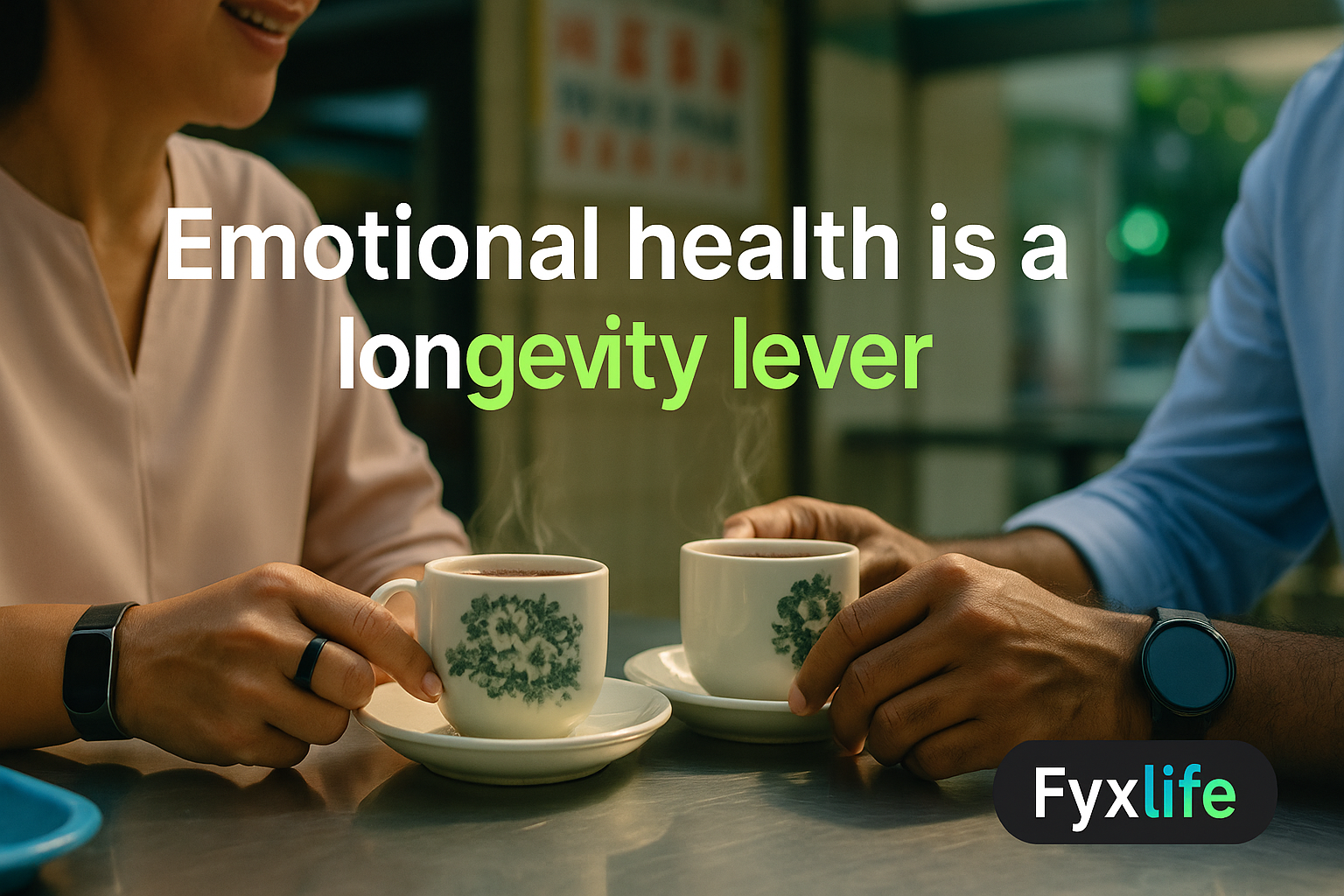

You track your sleep, monitor your HRV, and optimise your nutrition — but when did you last audit the quality of your relationships? A growing body of large-scale research, including a major UK Biobank prospective cohort study, now positions social connection not as a lifestyle nice-to-have, but as a measurable predictor of how long you live.
Most people who read this will not recognise themselves as lonely. They are busy. They are employed. They have a partner, maybe children, a full calendar. And yet something about the research landing in recent years has started to feel uncomfortably personal — because the risk it describes doesn’t require isolation in any dramatic sense. It accumulates quietly, behind a perfectly functional-looking life.
What the Study Actually Measured — and Why It Matters More Than Previous Research
The UK Biobank Dataset: Scale, Methodology, and Why It Carries Weight
A single study rarely changes how we should think about health. What changes minds is replication at scale, across different populations, using rigorous methodology. The UK Biobank prospective cohort analysis is among the most rigorous large-scale studies to examine the relationship between specific dimensions of social connection and all-cause mortality. The UK Biobank recruited hundreds of thousands of middle-aged adults across the United Kingdom, collected detailed health, lifestyle, and biological data at baseline, and then followed participants forward in time — tracking who died, when, and from what. Prospective design matters here because it reduces the reverse-causality problem that plagues cross-sectional snapshots: the dataset captures people before illness, not after.
This is not a survey about how happy people felt. It is a population-scale, longitudinal record of social behaviour and death outcomes.
Three Variables Researchers Tracked — Social Isolation, Loneliness, and Living Alone
One of the things that gives this research its precision is the decision to break social connection into distinct components rather than treating it as a single undifferentiated concept. Loneliness and social isolation are conceptually and empirically distinct: loneliness is the subjective feeling of inadequate connection — the sense that your relationships are thinner than you need them to be — while social isolation is the objective reality of having few social contacts, regardless of how you feel about it. Living alone is a third variable that partially overlaps with both but is not equivalent to either. Disentangling these three allows researchers to ask a more precise question: which of these actually predicts mortality, and by how much?
What the Research Found
The Mortality Signal — How Strong Is It?
The signal is not subtle. Systematic research linking social connection to mortality risk dates back to one of the first large-scale longitudinal epidemiological studies conducted in 1979, making this one of the most replicated associations in public health — a finding that has now survived more than four decades of scrutiny across different countries, age groups, and measurement approaches. People who experienced social isolation showed a meaningfully higher risk of dying early from any cause compared with those who were not isolated — a figure that resonates precisely because it operates silently, in people who often appear socially normal from the outside.
Multiple meta-analyses have documented a prospective association between measures of social connection and mortality, though researchers have also been honest about inconsistencies in how connection is defined across studies. The directional finding, however, is strikingly consistent: more connection, lower risk. Less connection, higher risk. The strength of that association is comparable to well-established risk factors that we already take seriously.
Isolation vs. Loneliness: Two Different Problems, Two Different Risks
Here is where the research becomes particularly relevant for the high-functioning professional. Social isolation and loneliness do not always travel together — and their health consequences are not identical. You can be objectively connected, surrounded by colleagues and family, and still experience the subjective depletion that comes from relationships that never go deep enough. Conversely, some people live with minimal social contact and report feeling genuinely content. The biology appears to track both signals, but through different pathways.
What makes this especially significant is the finding on combined exposure: social isolation and loneliness together show synergistic effects on all-cause mortality — when both are present simultaneously, the combined risk exceeds the sum of each factor measured independently. This is not simply additive. The two conditions amplify each other.
The Biological Mechanism — How Weak Social Connection Gets Under Your Skin
Think of your social connections like your cardiovascular fitness — you can feel fine day-to-day with a low VO2 max, but the risk is silently accumulating in the background. Just as poor cardiorespiratory fitness doesn’t announce itself until a crisis, chronic social disconnection works the same way: invisible in the short term, measurable in the data, and compounding over years into an outcome you can’t reverse quickly.
The biological pathways are increasingly well-characterised. Social isolation is associated with accelerating biological ageing — the progressive shortening of protective chromosome caps (what researchers call telomere attrition) — and all-cause mortality independently of conventional cardiovascular risk factors, meaning it functions as a standalone health risk variable, not merely a proxy for already being unwell. Social connection has been identified as a critical factor for both mental and physical health, with evidence supporting its role across multiple physiological systems — including the body’s chronic low-grade alarm response (what researchers call the neuroendocrine stress axis), immune regulation, and inflammatory signalling. Persistent disconnection appears to keep these systems in a low-level threat state that, over years, wears on the tissues that matter most.
What This Research Cannot Prove
Causality vs. Correlation — The Confounders That Remain
Good research is honest about what it cannot establish. Even the best prospective cohort studies carry residual confounding — people who are already sick may withdraw from social contact before they are formally diagnosed, making it look as though isolation preceded illness when the causal arrow runs partly in the opposite direction. Researchers attempt to adjust for baseline health status, but they cannot fully eliminate this possibility. What the data establishes firmly is a robust prospective association. Whether improving your social connection will directly extend your life — in the same mechanistic sense that lowering LDL reduces cardiovascular events — remains more difficult to prove in controlled experimental settings.
What ‘Social Connection’ Actually Means in a Measurable Sense
One honest limitation flagged by the broader literature is definitional inconsistency. Social connection as measured in a large epidemiological study — contact frequency, household composition, self-reported loneliness scores — is a rough proxy for something richer and harder to quantify. The research cannot fully capture relationship quality, reciprocity, or emotional depth. This matters for interpretation: the studies are measuring the lower bound of what connection means, and even that lower bound predicts mortality. The implication for what genuinely high-quality connection might do to risk is extrapolation the data does not formally support — but it is a reasonable direction to lean.
Why This Hits Differently If You’re 35–60 and High-Functioning
The Structurally Connected but Subjectively Lonely Profile
There is a specific profile this research should concern: the person who is, by any external measure, embedded in social life. Partner, children, work colleagues, group chats, occasional dinners. Technically present in multiple social contexts. And yet the interactions that fill most of the week are transactional — information exchange, logistics, professional performance. The kind of conversation where you actually say something true about your inner life happens rarely, if at all.
This is what researchers mean when they separate objective isolation from subjective loneliness, and it is why the finding that these two conditions compound each other’s risk matters so directly here. You don’t have to be visibly alone to be accruing the biological cost. The challenge is that this is exactly the kind of question a routine annual check-up was not designed to answer — not because doctors don’t care, but because population-level reference ranges were never built to account for the subjective quality of your relational life, or how it might be interacting with your other health metrics.
Midlife Connection Habits as a Long-Term Longevity Investment
Research on social integration and mortality across the life course consolidates evidence that the protective effects of connection are not limited to old age — social integration patterns in midlife also shape long-term mortality outcomes. The habits you build now are not neutral. They are either compounding protection or compounding risk, in the same way that sedentary behaviour in your forties does not just affect your forties. Among studies examining social connection in older adults, seven out of eight reported that higher social connection — including social engagement — was associated with lower mortality risk, suggesting that the protective effect accumulates across time. You are building the substrate now for what those numbers will look like in twenty years.
That framing — midlife social habits as a longevity investment — sits awkwardly against how most high-performers in this age bracket actually allocate their time. Sleep gets scheduled. Exercise gets protected. Nutrition gets tracked. Social connection gets whatever is left over after everything else. The research suggests that is the wrong priority ordering, and the mortality data is where that mismatch eventually shows up.
What to Do With This Finding — One Concrete Next Step
Pull up the last 30 days of your calendar and count how many interactions involved genuine, reciprocal conversation — not transactional work exchanges. If your number of meaningfully connected interactions is lower than you expected, that gap is now a data point worth tracking alongside your other health metrics. If you already monitor HRV or sleep quality, note whether weeks with lower social engagement correlate with worse recovery scores — and bring that pattern to your next health review as a discussion point.