You eat well, train consistently, and sleep seven hours — yet somewhere in your forties, energy feels different. Not broken, just dimmer. The molecule most likely responsible for that shift is one you’ve probably heard of but never fully understood: NAD+.
The frustrating part isn’t that the science is inaccessible. It’s that NAD+ sits at the intersection of so many ageing mechanisms simultaneously — cellular energy production, DNA repair, metabolic efficiency, cognitive sharpness — that most explanations either oversimplify it into a supplement pitch or bury it in biochemistry that requires a PhD to parse. Neither is useful if you’re trying to understand what’s actually happening inside your cells and what, if anything, you can do about it.
This article is the version in between. Evidence-grounded, mechanism-first, and honest about what the science can and cannot yet prove.
What Is NAD+ and Why Should You Care About It?
The plain English definition — not a supplement, a coenzyme your cells already make
NAD+ stands for nicotinamide adenine dinucleotide — a molecule your body synthesises from the food you eat, specifically from precursors found in proteins and certain vitamins. It is not a supplement in origin. It is a coenzyme (a helper molecule that activates enzymes to do their work) that every single cell in your body already produces and depends on. Every heartbeat, thought, and muscle contraction depends on energy production within cells that NAD+ enables.
The “+” refers to its electrical charge in its oxidised state. NAD cycles between two forms — NAD+ and NADH — depending on whether it is carrying energy passengers or not. That cycling is the mechanism. Understanding it changes how you read almost everything written about ageing, metabolism, and cellular health.
NAD+ as both an energy courier and a cellular alarm system
Here is where most explanations stop too early. NAD+ is not only an energy carrier. It is also a critically important signalling agent within cells — a molecule that tells certain proteins whether to activate, repair, or conserve resources. Think of it as both the fuel line and the diagnostic system in the same infrastructure. When NAD+ is abundant, both functions run well. When it drops, both degrade simultaneously. That dual role is why its decline shows up across so many different symptoms at once.
How NAD+ Powers Your Cells — The Energy Production Chain
From food on your plate to ATP in your mitochondria — the steps NAD+ enables
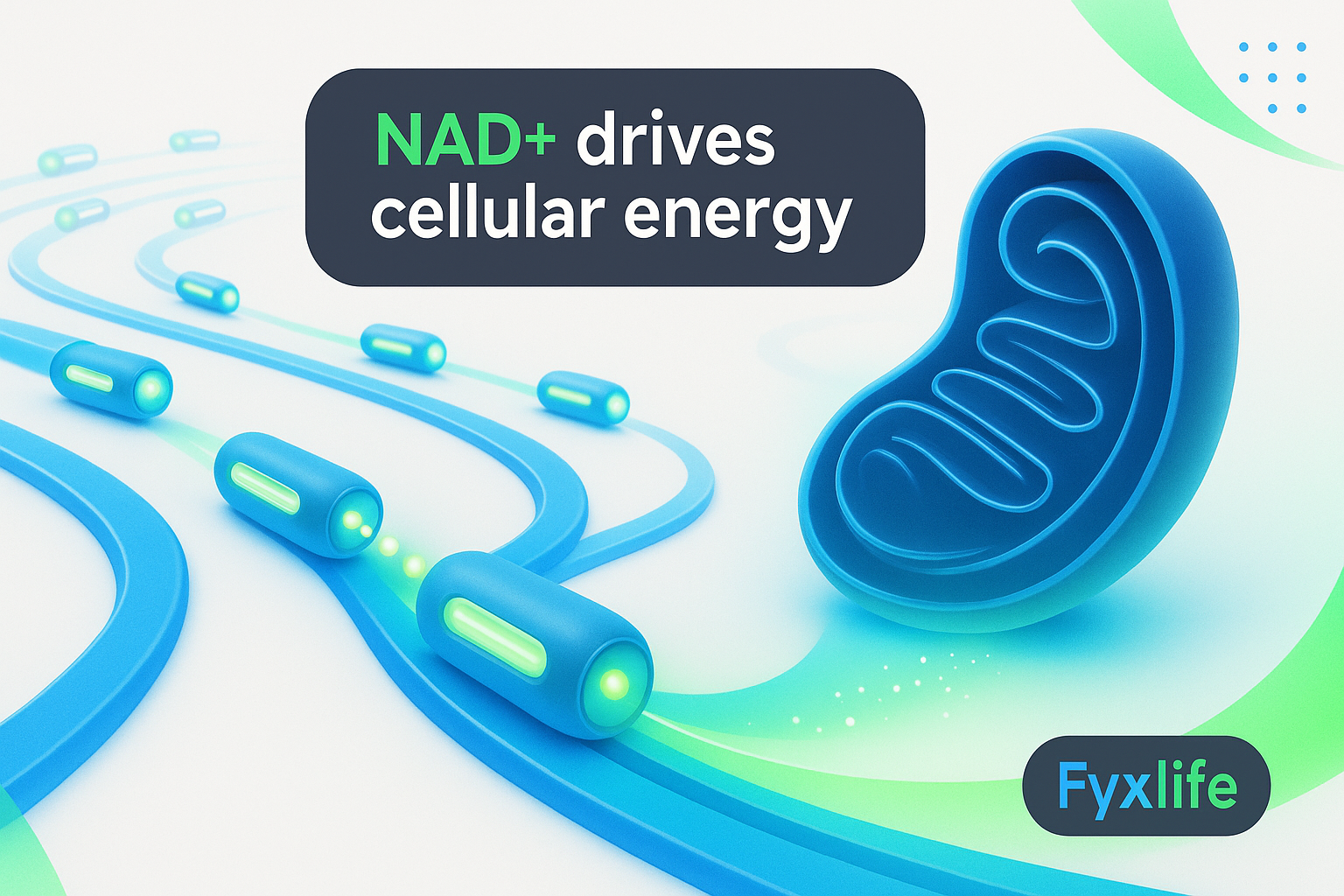
Think of NAD+ as a rechargeable shuttle bus running inside every cell. Its job is to pick up energy passengers — electrons — from the food you eat and ferry them to the mitochondria, your cells’ power stations, where those electrons are converted into ATP (adenosine triphosphate), the molecule your body uses as its primary cellular fuel currency. NAD+ converts nutrients into ATP — the molecule the body uses as its primary cellular fuel. Without adequate NAD+ running those shuttle routes, the conversion process stalls upstream — long before you experience anything you can consciously label as fatigue.
When you’re young, you have thousands of buses running efficient routes. As you age, the fleet shrinks. Fewer buses means fewer energy deliveries, slower repairs, and a cellular infrastructure that starts operating on reduced capacity — even when the roads (your diet and lifestyle) are in good condition. This is the key insight: NAD+ decline can make a healthy lifestyle less effective at the cellular level, not because your habits are wrong, but because the machinery processing those habits is degrading.
Why tissues with the highest energy demand (heart, brain, muscle) are hit hardest when NAD+ drops
NAD+ plays a central role in converting nutrients into usable energy inside cells, particularly in tissues that require consistent, high-volume energy output. Your heart muscle contracts roughly 100,000 times per day. Your brain consumes approximately 20% of your body’s total energy despite representing only 2% of its weight. Your skeletal muscle turns over ATP at extraordinary rates during exercise. These are the tissues with the most shuttle buses running — and therefore the tissues that notice earliest when the fleet starts shrinking. The dimmer feeling you notice in your forties often originates here, at the mitochondrial level, in the tissues with the least tolerance for reduced delivery capacity.
The Age Problem — Why NAD+ Declines and What That Costs You
The measurable drop: what research shows happens to NAD+ levels across decades
NAD+ is essential for cellular energy production and declines significantly with age — a finding that has positioned research into NAD+ precursors as a cornerstone of longevity science. The decline is not subtle. Studies measuring NAD+ levels across age groups find meaningful drops from middle age onward, driven by multiple factors: increased consumption of NAD+ by DNA-repair enzymes responding to accumulated cellular damage, declining synthesis efficiency, and rising activity of an enzyme called CD38 that degrades NAD+ as part of immune signalling. The result is a system under increasing demand with a diminishing supply.
Downstream consequences — impaired mitochondrial function, slower DNA repair, reduced metabolic efficiency
The reduction in NAD+ levels with age is associated with impaired mitochondrial function and reduced genomic stability — your cells’ ability to maintain accurate DNA copies. Research shows that NAD+ decline potentially causes increased levels of DNA damage and decreased cellular metabolism. Those consequences compound. Mitochondria that are running inefficiently produce more cellular waste, damage more surrounding structures, and trigger more inflammation. Slower DNA repair means accumulated errors persist longer. Reduced metabolic efficiency means the same caloric inputs produce less functional output. This is ageing at the molecular level — not one thing failing, but an interconnected system degrading because a shared input has declined.
The cognitive angle — low NAD+ and mental sharpness
The energy-production story gets most of the attention, but the cognitive implications deserve equal weight. Low levels of NAD+ have been implicated in reduced mental ability, lack of energy, and cognitive decline as people age. This is not a separate mechanism — it is the same one. The brain is an extraordinarily energy-hungry organ. When mitochondrial function degrades in neurons, the first things to erode are the highest-order functions: working memory, processing speed, the sustained focus that used to come easily. If you’ve noticed that your cognitive performance fluctuates more than it did a decade ago, NAD+ biology is a plausible part of that picture worth understanding.
NAD+’s Three Jobs: Energy, DNA Repair, and Longevity Signalling
Job 1 — Shuttling electrons to produce ATP
This is the role described above — the shuttle bus function. NAD+ accepts electrons from broken-down glucose and fats (becoming NADH), then delivers them into the electron transport chain inside mitochondria, where the energy is captured as ATP. Without this continuous cycling, the entire downstream energy system loses pressure. It is the most fundamental job, and it operates continuously in every cell you have.
Job 2 — Fuelling PARP enzymes that patch damaged DNA
Your DNA sustains thousands of strand breaks every day from normal metabolic processes, environmental exposures, and replication errors. The repair crew responsible for patching those breaks is a family of enzymes called PARP enzymes (poly ADP-ribose polymerases). PARP enzymes depend on NAD+ as a direct substrate and are involved in initiating DNA repair processes — disruption of NAD+ availability directly affects these repair mechanisms. Here is the tension this creates: as you age and accumulate more DNA damage, PARP enzymes ramp up their activity and consume more NAD+. But that increased consumption accelerates the NAD+ decline, which in turn reduces the capacity to make more ATP — a competition between repair and energy production, both drawing from the same shrinking pool.
Job 3 — Activating sirtuins, the longevity-linked protein family
Sirtuins (a family of proteins associated with longevity and metabolic regulation) require NAD+ to function. When NAD+ is available, sirtuins are active. When it declines, they go quiet. Active sirtuins regulate gene expression, suppress inflammation, improve mitochondrial efficiency, and support cellular stress responses. They are among the most studied targets in ageing biology — and their activity is directly gated by NAD+ availability. This is why NAD+ sits at the intersection of so many longevity pathways simultaneously: it is not just fuel, it is the switch that determines whether the cellular maintenance programme runs at full capacity or at reduced power.
NMN, NR, and the Precursor Question — What the Science Actually Shows
Why you can’t just swallow NAD+ directly — the precursor strategy explained
NAD+ molecules cannot survive digestion intact or cross cell membranes in their complete form — they are too large and too structurally specific to be absorbed directly. So the strategy researchers have pursued is to supply precursors (smaller molecules that cells can absorb and convert into NAD+ through existing metabolic pathways). The two most studied are NMN (nicotinamide mononucleotide) and NR (nicotinamide riboside), both of which sit one or two steps upstream of NAD+ in the synthesis pathway.
What research into NMN and NR currently supports, and what it cannot yet prove
Human trials on NMN and NR have consistently demonstrated that oral supplementation raises NAD+ levels in the blood and in certain tissues. That part is established. What remains less clear is the translation from elevated NAD+ levels to measurable functional outcomes — improved cognitive performance, extended healthspan, reduced biological age markers — at the scale and duration needed to draw firm conclusions. Animal studies are compelling. Early human trials are promising. But the longevity endpoint data in humans is not yet there. This is not a reason to dismiss the research. It is a reason to read it accurately.
How to read the supplement hype without being misled
A question circulating in longevity communities captures the real uncertainty well: is NAD+ decline something you can actually feel day to day, or is it just popular? The honest answer is both. The mechanism is real and well-supported. The commercial claims layered on top of it frequently outrun the evidence. When evaluating any NAD+ precursor product, the questions worth asking are: does the trial measure NAD+ levels in tissues, not just blood? Are the human participants in a relevant age group? What functional outcomes were actually measured, and were they statistically significant? The challenge is that this is exactly the kind of nuanced appraisal a routine annual check-up was not designed to provide — not because clinicians don’t care, but because population-level supplement guidance was never built to account for your specific metabolic baseline or what your NAD+ biology is actually doing.
What Healthy NAD+ Levels Are Actually Associated With
Healthy NAD+ levels are associated with efficient metabolism, stronger cellular stress responses, and more effective DNA repair. In practical terms, this means cells that respond well to exercise-induced stress, recover efficiently, maintain genomic accuracy over time, and produce energy at a rate that matches the demands placed on them. It does not mean invincibility. It means a system operating closer to its designed capacity rather than progressively below it. That distinction matters when you’re trying to understand why the basics — sleep, diet, exercise — feel less leverage-able than they used to. They may be delivering diminishing returns not because they’re inadequate, but because the cellular machinery processing their benefits is running with a depleted NAD+ pool.
The One Mechanism Insight to Apply This Week
Take the mechanism insight about NAD+’s role in mitochondrial function and apply it to one decision you’re already making this week: if you’re evaluating whether to add an NMN or NR supplement, check whether your current stack already includes the lifestyle inputs — exercise, adequate sleep, and low-grade chronic stress management — that are known to support NAD+ biology at the upstream level. If those aren’t in place, address them first. If they are, you now have the mechanistic framework to assess any precursor supplement claim against what the science actually shows, rather than what the marketing says.