
You’ve probably seen CoQ10 marketed as the supplement that ‘powers your cells’ — and maybe you’ve already bought a bottle, wondering if it was worth it. The mechanism sounds convincing: your mitochondria need CoQ10 to make energy. But convincing mechanisms don’t always translate into clinical results, and for a skeptic, that gap matters enormously. Here’s what the controlled trial evidence actually says.
The problem with most supplement categories is that the marketing runs years ahead of the science. CoQ10 is unusual because the underlying biology is genuinely well-established. This is not a fabricated mechanism. The molecule is real, its role inside your cells is documented, and the research interest is legitimate. The harder question — does taking it as a supplement actually do anything useful for a reasonably healthy person — is where the evidence becomes considerably more complicated.
The Study at a Glance — What Researchers Were Actually Testing
The population studied and why it matters for generalising to healthy adults
The controlled trial literature on CoQ10 is not one clean story. It is a collection of studies across very different populations — people with heart failure, people taking statins, people with diagnosed mitochondrial disorders, people with chronic fatigue, and yes, some healthy adults engaged in exercise training. A 2023 systematic review of controlled trials published in the journal Nutrients examined antioxidants including CoQ10 specifically in the context of exercise and mitochondrial adaptation, which represents one of the more rigorous attempts to evaluate the supplement in a non-diseased population.
This matters for how you read the evidence. A trial showing benefit in someone with documented heart failure cannot be directly applied to a 45-year-old who feels tired in the afternoons. The biological context is completely different, and the leap from “CoQ10 helps sick hearts” to “CoQ10 will give you more energy” is precisely the kind of extrapolation that supplement marketing relies on.
What outcome measures were used (and their limitations)
Across the trial literature, researchers have measured plasma CoQ10 levels, exercise performance markers, cardiac output, and various signals of cellular stress reduction (what scientists call oxidative stress biomarkers). Blood CoQ10 levels reliably go up when you supplement — that part is consistent. The more contested question is whether rising blood levels correspond to meaningful changes in how cells actually function. Performance outcomes and subjective energy ratings have been far less consistent, and this disconnect is central to understanding why the evidence resists a clean verdict.
The Core Mechanism — Why CoQ10 and Mitochondria Are Genuinely Linked
What ubiquinone does inside the mitochondrial membrane
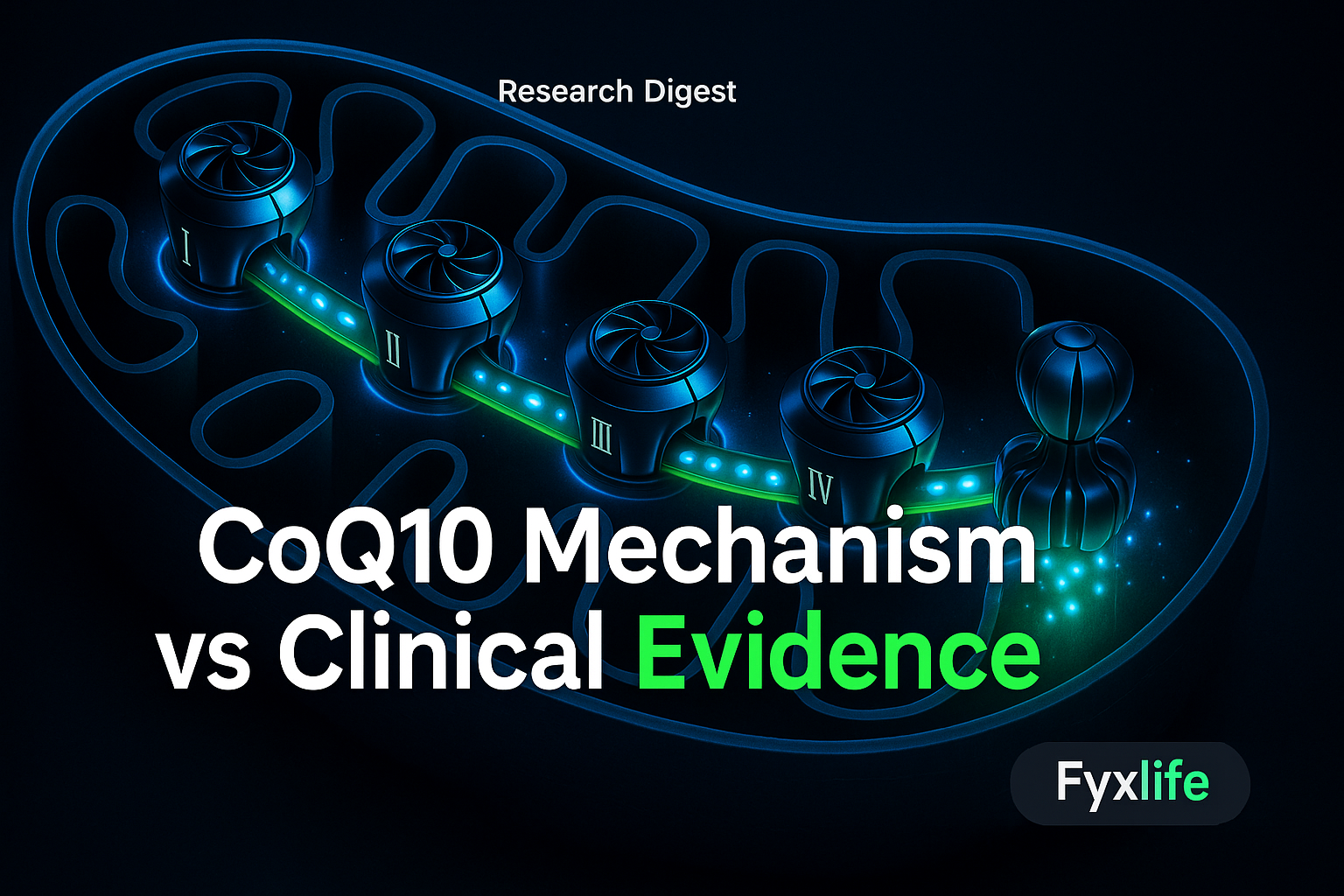
Think of your mitochondria as a factory assembly line that converts fuel into usable energy (the molecule your cells run on is called ATP, or adenosine triphosphate). CoQ10 — also called ubiquinone, from the word “ubiquitous” because it appears throughout living tissue — is the conveyor belt: a molecule that physically shuttles electrons along the production line. Without enough conveyor belt, the whole factory slows down. CoQ10 is described in research as an important antioxidant under active investigation as a potential treatment for conditions involving mitochondrial dysfunction and oxidative stress.
What makes this mechanism credible is its specificity. CoQ10 operates within the inner membrane of the mitochondria itself — not floating around in the cytoplasm, not circulating in the bloodstream, but embedded in the exact location where energy production happens. It moves electrons between the protein complexes that form the cell’s energy-generating machinery. When those electrons leak out of the process before completing it, they create damaging molecules known as reactive oxygen species. CoQ10 intercepts those too.
Why this makes it different from a generic antioxidant pill
CoQ10 is classified by researchers as a mitochondrial or membrane-localised antioxidant agent — a mechanistically distinct category from water-soluble antioxidants like vitamin C. Vitamin C works in fluid outside cells. CoQ10 works inside the mitochondrial membrane. That is not a marketing distinction — it is a real biological one that determines what the molecule can and cannot do. CoQ10 and mitochondria-targeted quinones such as MitoQ are frequently grouped together under the broad antioxidant umbrella in research literature, a classification that can obscure their distinct mechanisms of action.
The practical implication is that comparing CoQ10 to your vitamin C tablet as “just another antioxidant” misses what is actually interesting about it — and why the research community has taken it seriously enough to run controlled trials at all.
What the Controlled Trial Evidence Found
Where the signal is strongest (cardiac function, specific disease populations)
The most consistent clinical evidence for CoQ10 sits in cardiovascular medicine. CoQ10 is well-documented for its ability to protect cells from oxidative damage and has been studied specifically for its effects on heart health across the published literature. Trials in heart failure patients have shown improvements in ejection fraction — the measure of how effectively the heart pumps blood — along with reductions in hospitalisation in some studies. The heart is one of the most mitochondria-dense tissues in the body, which makes biological sense: if CoQ10 genuinely improves mitochondrial output, a high-demand organ with dense mitochondrial populations is where you would expect to see the effect first.
The signal also appears in populations with documented mitochondrial disorders and in statin users, for reasons we will return to. In these groups, the depletion rationale has a clear mechanistic foundation.
Where the evidence is weak or absent (healthy adults, fatigue, general energy)
Here is where the honest verdict gets uncomfortable for anyone who bought CoQ10 hoping to feel more energetic. In healthy adults without diagnosed mitochondrial dysfunction, the trial evidence for improved energy, reduced fatigue, or enhanced exercise performance is inconsistent at best. Many people who have tried CoQ10 — particularly those with chronic fatigue conditions, where the motivation to experiment is highest — report that it simply did not move the needle. That experiential reality aligns with what the controlled trial data suggests: the conveyor belt analogy only applies to a factory that is running short of belts. If your factory already has adequate supply, shipping in more belts changes nothing on the production floor.
The research on CoQ10 and exercise performance reflects this. The 2023 systematic review examining antioxidants including CoQ10 in the context of exercise and mitochondrial adaptation returned mixed, context-dependent results — not the clean positive signal that supplement marketing implies.
What This Research Cannot Prove
The bioavailability problem — does swallowing CoQ10 actually get it into mitochondria?
This is the central unresolved variable in the entire CoQ10 literature. Supplemental CoQ10 elevating blood levels does not automatically mean it reaches mitochondria inside cells in meaningful concentrations — bioavailability remains a key unresolved variable in the research. CoQ10 is a large, fat-soluble molecule. Getting it from a capsule into your bloodstream is already a challenge — absorption varies widely depending on formulation, food intake, and individual gut function. Getting it from the bloodstream into a cell, and then specifically into the mitochondrial membrane where it actually needs to function, is a further set of barriers the oral supplementation literature has not convincingly demonstrated it clears.
This is why researchers have developed mitochondria-targeted delivery systems like MitoQ — the explicit attempt to engineer a molecule that actually gets to the right address. That research exists precisely because standard CoQ10 supplementation does not reliably solve the delivery problem.
Correlation between blood CoQ10 levels and intracellular mitochondrial function
Plasma CoQ10 levels are measurable and do rise predictably with supplementation. But plasma is not mitochondria. The gap between circulating levels in the blood and actual functional concentrations inside the mitochondrial membrane is a measurement problem the field has not fully resolved. Studies showing elevated blood CoQ10 after supplementation cannot conclude from that data alone that mitochondrial function improved. That inference requires a separate chain of evidence — and in healthy populations, that chain remains incomplete.
The Honest Verdict — Who Might Benefit, Who Is Probably Wasting Money
Statin users: a specific case where depletion is documented
Statins — the cholesterol-lowering medications taken by a substantial proportion of adults over 45 — work by blocking an enzyme called HMG-CoA reductase, which sits upstream in a biochemical pathway that produces both cholesterol and CoQ10. Blocking that pathway reduces cholesterol synthesis, but it also reduces the body’s own CoQ10 production as a documented side effect. CoQ10 is identified in research as relevant to conditions involving oxidative stress responses where mitochondrial dysfunction plays a documented role in disease progression — and statin-induced CoQ10 depletion is one of the more mechanistically grounded reasons a person’s CoQ10 status might genuinely be compromised.
If you are on a statin and experiencing muscle aches (the technical term is statin-associated myopathy), the CoQ10 depletion hypothesis is not fringe thinking. It has a credible mechanism and has been investigated in trials, though results have been mixed enough that no major cardiology guideline currently makes routine supplementation a formal recommendation. That gap between plausible mechanism and inconsistent trial evidence is exactly the kind of question that needs someone looking at your specific situation — your dose, your symptoms, your lipid history — rather than population-level averages.
The challenge is that this is precisely the kind of nuanced, individual question a routine annual check-up was not designed to answer. Not because doctors don’t care, but because a 10-minute appointment optimised for population-level risk management rarely has room for “let’s think through whether your specific statin dose is affecting your CoQ10 status and whether a monitored supplementation trial is warranted.”
Healthy adults under 50 with no diagnosed mitochondrial dysfunction
Mitochondria-targeted antioxidant agents like CoQ10 are positioned in research as distinct from general antioxidant supplementation because of their specific site of action within the mitochondrial membrane — but that distinction only translates into benefit when the site is compromised in the first place. For a healthy adult under 50 whose mitochondria are functioning adequately, the evidence for meaningful benefit from CoQ10 supplementation is thin. The factory has enough conveyor belts. Sending more does not speed up production. If your motivation is general energy optimisation or fatigue reduction without any underlying diagnosis, the honest reading of the current literature does not support spending money on this.
One Biomarker to Watch If You’re Already Taking CoQ10
If you want to move beyond faith-based supplementation and actually evaluate whether CoQ10 is doing anything for you, plasma CoQ10 levels are measurable through a standard blood test. A baseline before you start, followed by a retest after 8–12 weeks of consistent supplementation, tells you whether your formulation is being absorbed at all. If your plasma levels have not changed, you have answered one part of the question definitively: something in the delivery chain is failing, and paying more for a better-formulated product or taking it with a fat-containing meal may change that result. What plasma levels cannot tell you is whether the CoQ10 is reaching your mitochondria — but knowing whether it is even getting into your blood is a necessary first step that most people taking the supplement have never checked.
If you are already taking CoQ10 or considering it, check whether you have a recent lipid panel that includes a note on statin use. If you are on a statin and your doctor has never mentioned CoQ10 depletion, bring it up at your next visit and ask whether your symptoms (if any) and current dose warrant a monitored trial — this is the one population where the depletion rationale has the clearest documented basis.