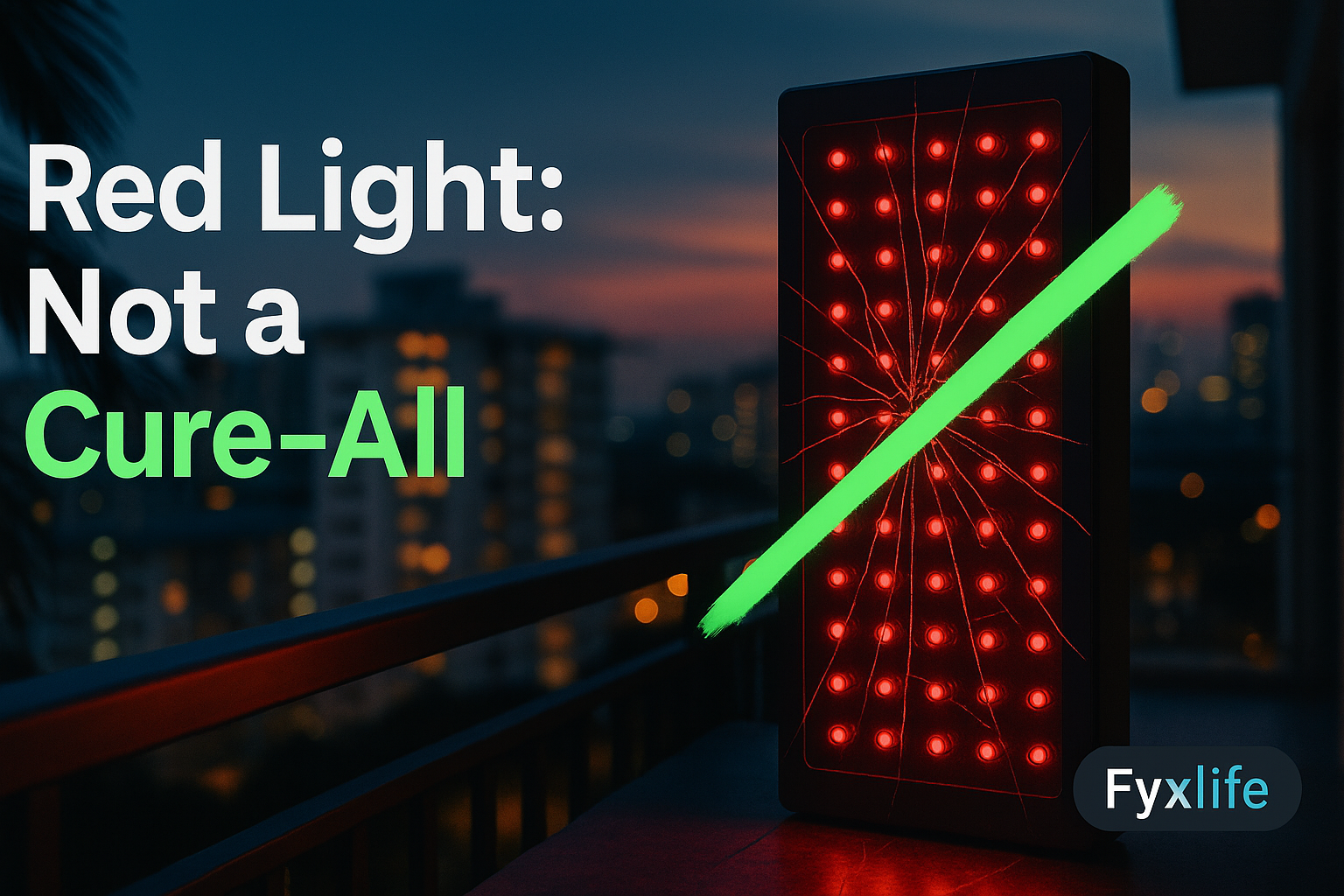
You have seen the panels, the pods, the sauna blankets — and the claims that go with them: faster muscle recovery, better sleep, sharper brain, thicker hair. If you are a busy professional spending real money on recovery, you deserve a straight answer. The truth is that red light therapy is neither a scam nor a cure-all — but the myths surrounding it are costing people money and, in some cases, steering them away from what actually works.
The Myth Stack — What Red Light Therapy Is Being Sold As
The single device that promises sleep, recovery, skin, brain, and more
Browse any premium wellness retailer and you will find a red light panel claiming to do approximately everything. Sleep. Athletic recovery. Skin rejuvenation. Cognitive performance. Hair regrowth. The copy is confident, the before-and-after photos are striking, and the price tag — often several hundred to several thousand dollars — signals that this is serious technology, not a gimmick. That combination is extremely effective marketing. It is also where the problems begin.
The wellness industry has built a category around photobiomodulation — the use of specific wavelengths of light to produce biological effects in tissue — and then proceeded to sell it as though all light, all devices, and all applications were interchangeable. They are not. The underlying science is real. The way it is being packaged and sold to you frequently is not.
Why busy, health-optimising people are the primary target
Many people arrive at red light therapy after months or years of trying conventional approaches to sleep, pain, or fatigue — and finding them either inadequate or unsustainable. They carry both genuine hope and genuine scepticism simultaneously. That combination makes you an ideal target for marketing that sounds scientific: it addresses the sceptic with studies while feeding the hope with dramatic outcome language. Understanding what the research actually says is the only way to cut through that.
Myth 1 — ‘Red Light’ and ‘Infrared’ Are the Same Therapy
Three distinct wavelength categories, three different mechanisms
Think of red light therapy like a precision screwdriver set: each wavelength is a different screwdriver size. Using the wrong one — wrong wavelength, wrong power, wrong depth — does nothing, no matter how hard you turn. The marketing tells you it is a universal tool. The science says it is a specialist set, and you need to know which job you are actually doing before you pick one up.
There are three meaningfully distinct categories being sold under the broad banner of “red light and infrared therapy.” First, visible red light — typically in the 630 to 660 nanometre range — which penetrates superficial tissue and has the strongest evidence base in skin and wound applications. Second, near-infrared light — roughly 800 to 850 nanometres — which penetrates deeper into muscle and joint tissue and shares the same cellular mechanism as red light. Third, far infrared radiation, which operates at wavelengths well beyond what the eye can detect and works almost entirely through heat rather than direct cellular photochemistry. Research confirms that the primary cellular targets for visible red and near-infrared light are the copper centres of mitochondrial enzyme complexes — meaning the therapy works by stimulating the cell’s own energy-production machinery from the inside. Far infrared, by contrast, has demonstrated cardiovascular benefits in trials — including improving arteriovenous fistula function in randomised studies — but through a mechanistically different process entirely. Same broad category on a product page. Completely different tools.
Why conflating them leads to wrong device choices
When you buy a device without understanding which wavelength you are actually getting, you are guessing. A far infrared sauna blanket will not stimulate mitochondrial enzyme complexes in your muscles after a hard workout — it will warm your tissue, which has its own value, but it is not the same mechanism. A near-infrared LED panel will not produce the cardiovascular effects studied in far infrared trials. Conflating these is not a minor semantic issue. It determines whether what you bought can actually do what you bought it to do.
Myth 2 — The Light Penetrates as Deep as the Marketing Claims
The skull penetration problem: what the PMC research actually shows
A significant and growing category of consumer devices claims to deliver red or near-infrared light therapy directly to your brain — improving cognition, mood, or neuroprotection through a wearable headset or cap. The concept is called transcranial photobiomodulation — delivering light energy through the skull to reach brain tissue. It is genuinely being studied in clinical research. The consumer devices claiming to do it, however, face a basic physics problem that most of their marketing materials do not mention. Extensive prior research has confirmed that infrared light from a 0.5-watt LED will not penetrate the scalp and skull of a human. That is not a technicality. Most consumer devices operate at or near that power threshold. The skull is not a window — it is a barrier, and low-power consumer LEDs largely cannot cross it.
Power density and distance: the variables no marketing material mentions
Even in well-supported applications — skin, muscle, tendon — the variables of power density (the intensity of light delivered per unit of skin surface) and treatment distance matter enormously. A panel used at double the recommended distance delivers roughly a quarter of the intended dose. A device without adequate power will not stimulate the cellular mechanism regardless of how long you sit in front of it. These are the parameters that distinguish a clinical protocol from an expensive lamp. When you look at a product listing and see wavelength without power density, and a claimed benefit without a cited dose protocol, you are looking at marketing dressed as science.
Myth 3 — Red Light Therapy Will Improve Your Sleep
The alertness and anxiety finding that reverses the popular narrative
The sleep benefit claim is probably the most aggressively marketed application of red light therapy for the demographic reading this article. It is also the application with the most complicated evidence picture. Research shows that red light exposure can increase subjective alertness, anxiety, and negative emotions in both healthy subjects and people with intellectual disability — a direct physiological response that can worsen sleep quality rather than improve it. That finding does not get featured in device advertisements. It should.
When timing makes it work against you
This does not mean red light is uniformly bad for sleep. Some studies have explored red light’s effects on athletic recovery and found indirect sleep benefits — but the mechanism there is likely muscular repair and reduced soreness rather than a direct sedative effect on the nervous system. The point is that red light exposure is not a uniform sedative signal. Used in the wrong context — at high intensity, too close to bedtime, or by someone already running an elevated stress response — it may actively increase arousal when what you need is the opposite. Timing and context determine the outcome. “Point it at yourself before bed” is not a protocol. It is a guess.
What the Evidence Actually Supports
Skin and dermatology — the strongest clinical signal
If you are interested in the evidence base for red light, start here, because this is where it is most robust. Phototherapy using LEDs is clinically supported for a range of medical and aesthetic skin conditions in dermatology practice — including wound healing, acne, psoriasis management, and photorejuvenation. The tissue depth here matches the penetration capacity of red and near-infrared light precisely. Skin is where the screwdriver fits the screw.
Tendinopathy and joint pain — modest but real
For those using red light to accelerate recovery from exercise, tendon stress, or joint pain, the evidence is genuinely there — but it requires honest framing. The current evidence quality for photobiomodulation in tendinopathy is rated as very-low-to-moderate, supporting its use as a standalone or adjunct therapy but falling short of robust proof. It is a tool worth having. It is not the slam dunk the marketing suggests. Used alongside load management and appropriate movement, there is a reasonable case for it. Used as a substitute for those things, the evidence does not support that.
Hair loss — the FDA-approved use almost no one mentions
Here is the application that receives the least marketing attention relative to its regulatory standing. Low-level light therapy for androgenetic alopecia — the most common form of male and female pattern hair loss — received US FDA approval in 2007, making it one of the most credentialled regulatory endorsements anywhere in the photobiomodulation space. If you are experiencing hair thinning and have been ignoring this application in favour of sleep panels and brain headsets, the evidence hierarchy suggests you may have that backwards.
Brain applications — genuinely promising, not yet proven at consumer level
Photobiomodulation is being studied for its ability to stimulate, heal, regenerate, and protect brain tissue that has been injured or is at risk — and the preclinical science is genuinely interesting. The problem is the gap between the clinical research protocols and what consumer devices can deliver. The power, placement precision, and wavelength control used in serious neurological research are not what you are getting in a wearable LED cap purchased online. The science is moving. The consumer devices are, for now, ahead of where the clinical evidence actually stands for this application.
The Verdict — Drop the Hype, Keep the Tool
When red light therapy is worth your time and money
Red light therapy earns its place in a serious recovery toolkit when you are using the right wavelength, at adequate power density, at the correct distance, for an application with actual clinical support. Skin conditions and wound healing: yes. Hair loss: yes, with an FDA endorsement behind it. Tendon and joint recovery as part of a broader protocol: probably, with realistic expectations. These are the jobs the precision screwdriver was built for.
When it is not, and what to do instead
If you are buying a device primarily for sleep improvement, reconsider the evidence before you spend. If you are buying a headset to improve brain function through your skull using a consumer LED, the physics do not currently support that claim regardless of what the product page says. The money and attention spent on those applications would likely produce better returns invested in sleep hygiene, morning light exposure, or a structured recovery protocol with an evidence base that does not require you to ignore inconvenient studies.
One Belief to Drop, One to Replace It
Drop this one belief before your next purchase or session decision: that red light therapy has a uniform effect regardless of wavelength, power, and target tissue. Replace it with this evidence-based question: “What specific condition am I targeting, and does the clinical evidence support this wavelength at this power level for that application?” If you cannot answer it from the device specs, the burden of proof sits with the seller, not your body.