The Study That Should Have Settled the Testosterone Debate
You’ve read the headlines — testosterone fixes everything from brain fog to body fat. But in 2018, the largest coordinated set of testosterone trials ever conducted quietly published results that didn’t match the hype. Here’s what 788 real men revealed about what TRT actually does, and more importantly, what it doesn’t.
If you’re a man in your forties or fifties who’s noticed his energy isn’t what it was, whose focus drifts more than it used to, who wonders whether something hormonal is going on — you are not imagining things. Something is changing. The question is whether testosterone replacement therapy (TRT) is the answer, and whether the headlines you’ve been reading are telling you the full story. They aren’t.
What the Testosterone Trials Were Designed to Test
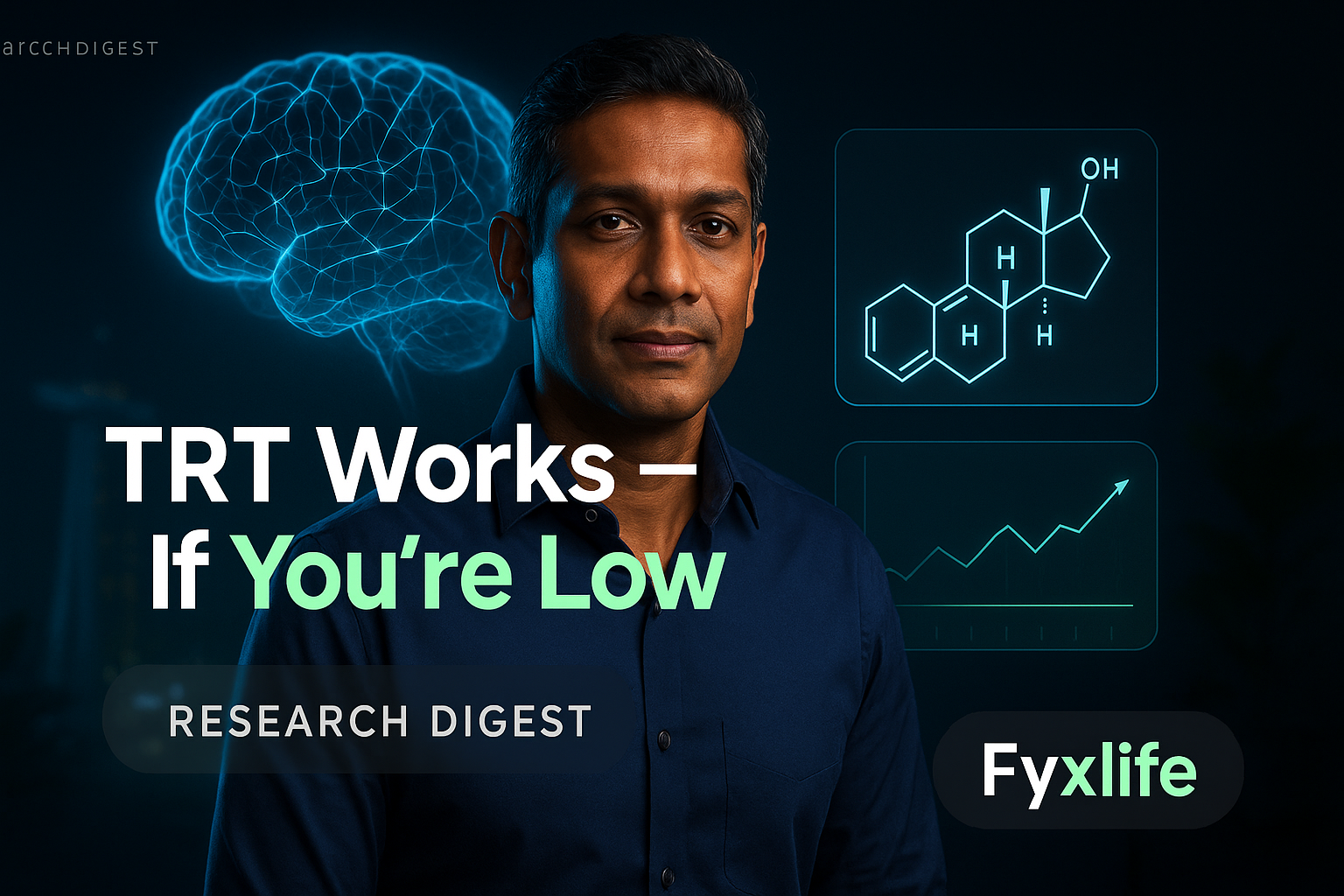
The Testosterone Trials — known in the clinical literature as the TTrials — were not a single study. They were seven coordinated, placebo-controlled, double-blind trials involving 788 men with a mean age of 72, making them the most rigorous clinical investigation of TRT in older men conducted to date. Each of the seven trials examined a different outcome: sexual function, physical function, vitality, cognitive function, bone density, cardiovascular health, and anaemia. The design was serious. The intent was to settle the debate. The results were considerably more complicated than either the advocates or the sceptics predicted.
Who the 788 Men Actually Were — and Why That Matters for You
Here’s the first thing you need to understand before applying any of these findings to yourself: the men in the TTrials had confirmed low testosterone — specifically, levels below 275 ng/dL on two separate morning measurements. They were older than you, likely less active, and clinically hypogonadal. That’s the technical term for the condition in which the body genuinely fails to produce adequate testosterone (clinical hypogonadism). If you’re 42 and feeling flat, you probably don’t fit that profile. That gap between who was studied and who’s reading TRT articles online is where most of the misinformation lives.
What the Evidence Shows TRT Can — and Cannot — Do
The Benefits That Held Up Under Scrutiny
Some findings from the TTrials were genuinely meaningful. In men confirmed as hypogonadal, TRT improved muscle mass, strength, and physical function. These aren’t trivial outcomes — for older men at risk of falls and functional decline, they matter significantly. A study of older men in a rehabilitation setting found that those who received intramuscular testosterone showed a significant increase in grip strength compared to controls — a finding that speaks to the genuine physiological effect of restoring testosterone when it has fallen below a functional floor. Sexual function also improved in the TTrials, particularly in men whose low libido was linked to confirmed hormonal deficiency rather than relationship, psychological, or metabolic factors.
But here is the critical qualifier: a systematic review found no beneficial effect of TRT in most men — meaning the population most likely to be seeking TRT right now, men with normal-to-low-normal testosterone who are experiencing age-related decline — may see little to no clinical return from treatment. That’s not a minor caveat. That’s the central finding.
The Cognitive and Mood Claims: Where the Evidence Gets Thin
The brain fog, the flattened motivation, the sense that your mental edge has dulled — these are real experiences. They are also among the most difficult symptoms to attribute to testosterone specifically. The TTrials’ cognitive trial found no meaningful improvement in memory or executive function among men who received testosterone versus placebo. This matters, because cognitive improvement is one of the most commonly cited reasons men in their forties seek TRT. The mechanism people imagine — testosterone acting as some kind of neural performance enhancer — doesn’t hold up when you run the experiment properly. What you feel is real. What’s causing it may not be your testosterone level.
The mood and vitality findings were similarly underwhelming in men who weren’t severely deficient. Mild improvements in energy and depressive symptoms appeared in some analyses, but were not robust enough to represent a clear treatment signal for men with borderline levels.
The Cardiovascular Signal You Should Not Ignore
This is where the conversation becomes genuinely important, and where the hype starts to carry real cost. A meta-analysis found that testosterone therapy was associated with a statistically significant increase in cardiovascular-related events, with an odds ratio of 1.54 (95% CI 1.09–2.18). An odds ratio above 1.0 means increased risk. A confidence interval that doesn’t cross 1.0 means the finding is statistically reliable, not a noise artefact. This is not a fringe concern raised by testosterone sceptics — it is a signal that appeared in the formal literature and has never been fully resolved.
The UK Health Technology Assessment found that the lack of robust evidence on TRT’s effects and safety has polarised clinical and scientific communities — there is no settled consensus on when and for whom TRT is appropriate. If your understanding of testosterone therapy came primarily from wellness podcasts or men’s health forums, this is the fact most likely to have been left out.
The Hypogonadal Threshold Problem — Are You Actually Low?
Why ‘Low-Normal’ Is Not the Same as Clinically Low
Think of testosterone like the voltage running through your home’s electrical system. If the voltage genuinely drops below the minimum threshold, appliances stop working properly — that’s clinical hypogonadism. But if your voltage is already in the normal range, boosting it further doesn’t make your appliances run better; it just risks blowing a fuse. The TTrials essentially tested whether turning up the voltage in men who were already running low-normal could restore function — and the results were far more nuanced than the headlines suggest. The answer, broadly, is that low-normal is not the same clinical situation as genuinely low. The body is still functioning. The intervention logic doesn’t apply in the same way.
After age 40, testosterone levels naturally decline approximately 1–3% per year — a gradual, physiologically normal process. Feeling different at 48 than you did at 32 is not automatically a disease state. The challenge is that many men experiencing this normal change are being evaluated — and sometimes treated — against population reference ranges that were never designed to distinguish normal ageing from pathological deficiency.
The Danger of Self-Diagnosing From Symptoms Alone
The symptoms most commonly attributed to low testosterone — fatigue, reduced libido, difficulty concentrating, mood changes, reduced muscle mass — are also symptoms of sleep deprivation, metabolic dysfunction, insulin resistance, thyroid issues, depression, and simple sedentary living. Many motivated, intelligent men spend years researching their symptoms online before getting a blood panel. The mismatch between what they feel and what their numbers actually show is one of the most consistently contested areas in men’s preventive health. Symptom-based self-diagnosis, without blood confirmation, is how men end up treating a condition they may not have — and potentially exposing themselves to cardiovascular risk in the process.
This is also the kind of question a routine annual check-up was not designed to answer well — not because doctors don’t care, but because a ten-minute appointment built around population-level reference ranges was never equipped to interpret your specific hormonal picture in the context of your age, lifestyle, family history, and metabolic health simultaneously.
What About Testosterone Booster Supplements?
What 90% of T-Booster Products Claim vs. What 24.8% Can Prove
Before you spend money on the supplement aisle, consider this: 90% of commercially available testosterone booster supplements claimed to raise testosterone levels, but only 24.8% had any data to support those claims. That is not a rounding error. That is the overwhelming majority of products making promises the evidence cannot back. Several ingredients common in these formulations — zinc, vitamin D, ashwagandha — have some mechanistic plausibility in men who are genuinely deficient in those micronutrients. But taking a supplement to raise a hormone that isn’t clinically low, on the basis of marketing copy that was written without reference to the published literature, is not a strategy. It’s wishful thinking with a price tag.
What This Research Actually Means for a 40-Something Professional in Singapore
The One Biomarker Decision the Evidence Supports Right Now
Singapore’s working professional demographic — high stress load, frequent travel, disrupted sleep, desk-bound hours interrupted by intense gym sessions — creates exactly the conditions that produce symptoms indistinguishable from low testosterone. Before any intervention is considered, what the evidence supports is measurement. Not self-assessment. Not symptom checklists from supplement websites. Actual blood panels, interpreted properly.
Total testosterone alone is insufficient. Free testosterone — the fraction of testosterone not bound to proteins and therefore biologically active — tells a meaningfully different story in some men. Sex hormone-binding globulin (SHBG), the protein that binds testosterone and reduces its availability, rises with age, which means your total testosterone reading can look normal while your free testosterone is actually low. NIH committees have emphasised the need for large-scale, long-duration clinical trials in older men before stronger conclusions about TRT’s efficacy and safety can be drawn — which means the evidence base you would be acting on today is still, technically, incomplete. That’s worth knowing before you make a decision.
The Bottom Line — A Verdict That Respects the Uncertainty
The TTrials gave us the most rigorous testosterone data we have ever had — and what they revealed is a story of specific, conditional benefit rather than broad hormonal optimisation. TRT works when testosterone is genuinely, clinically low. The cardiovascular signal is real and unresolved. The cognitive and mood benefits, for most men, are not supported by controlled evidence. The supplement industry is operating almost entirely outside the evidence base. And the gap between feeling suboptimal at 45 and having a clinical indication for hormone therapy is wider than most TRT content online would have you believe.
None of this means your symptoms aren’t real. It means they deserve a proper diagnosis before they receive a treatment.
Pull your last testosterone result — both total and free testosterone — and ask specifically whether your levels fall below the clinical hypogonadism threshold, typically defined as below 300 ng/dL (or 10.4 nmol/L), rather than simply whether you are “in range.” If your result is below that threshold, the TTrials data gives you something concrete to discuss with a specialist. If you’re low-normal, the same evidence suggests the more productive conversation is about sleep quality, resistance training, body composition, and metabolic health — not a prescription. That’s not the answer the headlines promised. It’s the one the evidence actually supports.