
Most health optimisers track their lifespan inputs obsessively — VO2 max, sleep scores, fasting windows. But a growing body of research is exposing a harder question: are you actually extending the years you live well, or just the years you live? New research directions in aging science are drawing a sharp line between the two, and the gap may be larger — and more measurable — than you realise.
If you grew up watching people in their 50s and 60s slow down dramatically — stiff joints, foggy thinking, chronic conditions stacking up — you probably assumed that was just aging. What’s becoming clear is that it doesn’t have to be. But the science also shows that simply doing the right things to live longer doesn’t automatically mean you’ll live better. The optimisation target has shifted. And if you haven’t updated your framework to match, you may be training hard for the wrong race.
What the Research Actually Defines — Lifespan, Healthspan, and Why the Gap Matters
The formal distinction: total years alive vs. functional disease-free years
Lifespan is simply the total number of years a person is alive. Healthspan is something more specific — the period of those years characterised by vitality, full physical and cognitive function, and the absence of serious chronic disease. Longevity medicine specialists define the gap between the two as the key metric to close — not life expectancy itself. You can live to 90 with a decade of meaningful functional decline already behind you. That last decade counts toward your lifespan. It does not count toward your healthspan.
Harvard Medical School frames the central challenge of modern aging as precisely this divergence — we are living longer than ever before, but not necessarily living well. The optimisation target for preventive medicine, they argue, should be the quality and function of added years, not the count alone. That framing has serious implications for how you evaluate almost every intervention in your current health stack.
Why most longevity studies in model organisms miss this distinction entirely
Here is the uncomfortable methodological truth: most of what we know about aging interventions comes from studies in model organisms — worms, flies, mice — where the primary outcome measured is how long they live. Not how well. Research reviewing new directions in aging science confirms that alterations in average, median, and maximal longevity provide important signals, but the field increasingly recognises these must be separated from healthspan outcomes — which require entirely different measurement frameworks. A mouse that lives 20% longer but spends its final months frail and sedentary has extended its lifespan. Its healthspan may not have moved at all.
This distinction matters for you directly, because interventions that reach popular longevity discourse — caloric restriction, rapamycin analogues, certain senolytics — have largely been validated on lifespan data. The healthspan data is newer, thinner, and far more complicated. Research in comparative aging models is actively grappling with the clinical and ethical question of how to prioritise healthspan over lifespan when the two objectives genuinely conflict. They do conflict. More often than most longevity content acknowledges.
The Finding That Changes How You Should Think About Aging Interventions
Extending maximal longevity vs. compressing morbidity — what the data actually shows
There are two fundamentally different things an aging intervention can do. It can push out the upper limit of how long you live — what researchers call extending maximal longevity. Or it can compress the period of disease and functional decline into a shorter window at the end of life, so that you function well right up until close to the end. The second approach is called morbidity compression — the idea that the goal isn’t to live forever, but to spend the smallest possible proportion of your life unwell.
These two goals are not the same, and they are not always achieved by the same interventions. Researchers are now calling explicitly for formal definitions that separate healthspan extension from lifespan extension, acknowledging these are measurably different outcomes requiring different interventions — and warning that conflating them creates conceptual ambiguity that distorts how we evaluate what actually works. If you’re choosing interventions based on lifespan data and hoping for healthspan results, you may be optimising the wrong variable entirely.
Skeletal muscle strength research as a case study in healthspan measurement
Want a concrete example of why this matters? Look at skeletal muscle. Grip strength, lower body power, and muscle mass are among the strongest predictors of functional independence in later life — stronger predictors, in many studies, than conventional cardiovascular risk markers. Research by Blake Rasmussen’s group on skeletal muscle strength and healthy aging demonstrates directly that the physiological context of living longer — specifically whether extra years are healthy or simply longer — is systematically overlooked in longevity model studies. You can extend an organism’s lifespan without preserving the muscle quality that makes those extra years functional. The two require different inputs.
This is also one of the most actionable edges in healthspan science right now. Strength training preserves the physical substrate of independence. But the dosing, timing, and type of training that maximises healthspan outcomes may differ from what maximises performance metrics. The research is still resolving this — which is why the measurement frameworks themselves matter so much.
The Biological Clock You Can Actually Measure
CpG methylation-based epigenetic clocks as healthspan proxies
Think of lifespan as the total runtime of a car, and healthspan as the miles driven smoothly — without breakdowns, warning lights, or needing to be towed. Most longevity research has focused on keeping the engine running longer. The newer science is asking whether the car is actually driveable for those extra miles. An epigenetic clock is the equivalent of a diagnostic dashboard: it doesn’t just show fuel level, it tells you how hard the engine has aged relative to its calendar age.
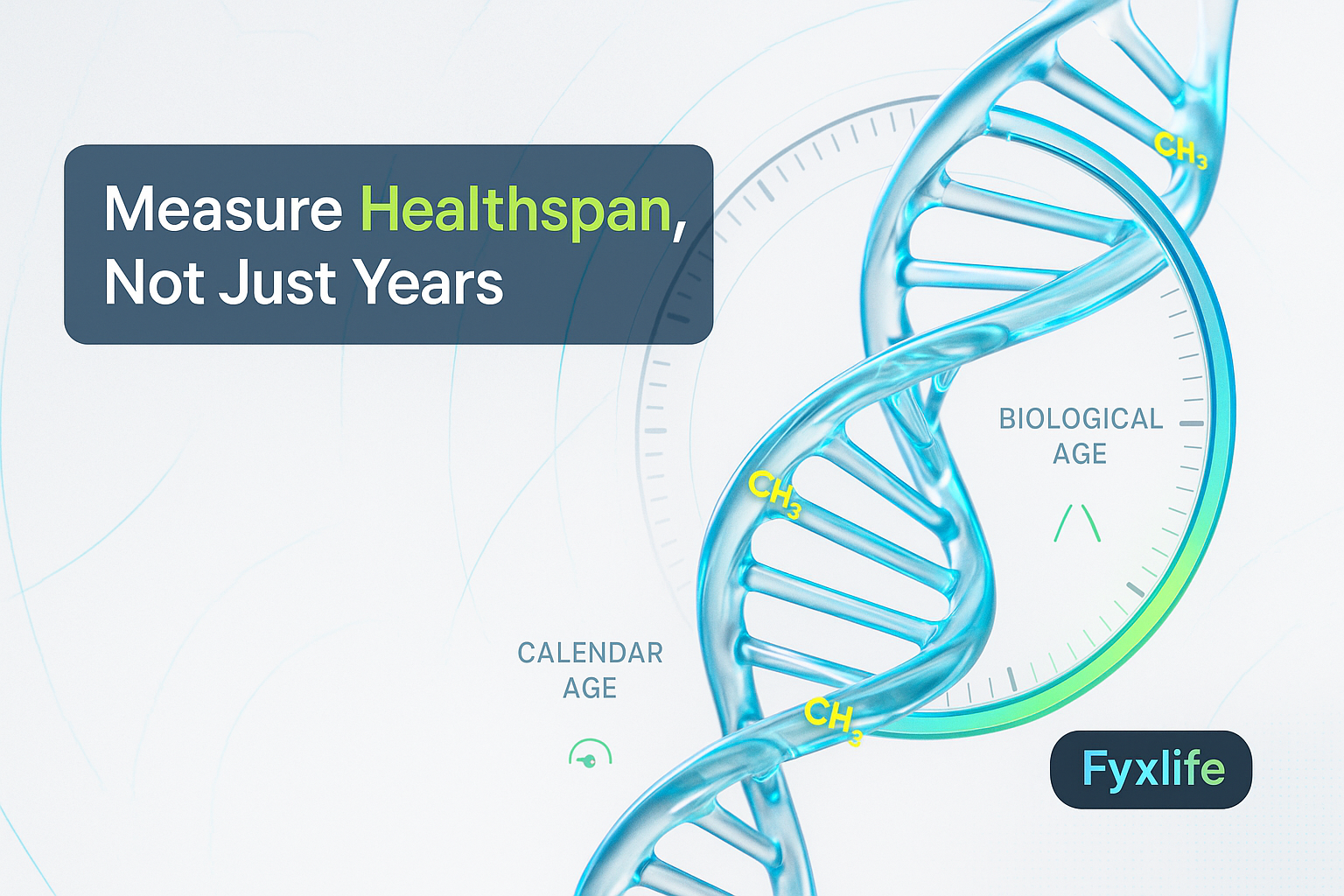
Specifically, these clocks measure CpG methylation — chemical modifications that attach to specific sites on your DNA and accumulate in patterns that reliably track biological aging. They don’t measure how old you are. They measure how old your biology is behaving. Research now uses CpG methylation-based epigenetic clocks as biomarkers to correlate with and distinguish healthspan from raw lifespan — giving researchers, and increasingly individuals, a trackable biological signal that sits far closer to actual health trajectory than a birth certificate does.
What biological age markers can and cannot tell you about your healthspan trajectory
A biological age that tracks younger than your calendar age is a meaningful signal. It suggests your cellular and epigenetic machinery is aging more slowly than average — which correlates with lower risk of the chronic diseases that erode healthspan. A biological age that tracks older is a signal worth taking seriously, even if every other metric looks clean. But precision matters here. Epigenetic clocks are proxies, not prophecies. They measure a signal that correlates with healthspan trajectory. They do not tell you which specific system will decline first, or by how much, or when.
The challenge — and this is worth naming plainly — is that this is exactly the kind of nuanced, individual-specific interpretation that a routine annual check-up was not designed to provide. Not because clinicians don’t care, but because population-level reference ranges were never built to account for your specific combination of biological age, functional markers, lifestyle inputs, and risk profile. Getting a personalised answer to what your biological age data actually means requires someone looking at your numbers in context — and that context takes longer than a standard appointment allows.
What This Research Cannot Prove (Yet)
The limits of current biomarkers in predicting functional decline
Epigenetic clocks are the most promising healthspan proxy currently available. They are not complete. The correlation between biological age and specific functional outcomes — cognitive decline, mobility loss, cardiovascular events — is real but imperfect. Different clock algorithms (Horvath, GrimAge, DunedinPACE, among others) weight different methylation sites and predict different downstream outcomes with varying accuracy. The field has not yet converged on a single gold-standard clock. What you get from a biological age test today is a strong signal, not a sentence.
Why ‘healthspan extension’ interventions still lack a gold-standard definition in clinical research
The deeper limitation is definitional. Researchers are actively calling for a formal roadmap to resolve the conceptual ambiguity between healthspan extension and lifespan extension in longevity science — because without agreed definitions, clinical trials cannot be designed, outcomes cannot be compared, and interventions cannot be validated properly. This is not a minor methodological footnote. It means that when a supplement, protocol, or therapy is marketed as “extending healthspan,” there is currently no regulatory or scientific standard that claim is being measured against. The science is real. The rigour around translating it into specific interventions is still being built.
What It Means for You — Translating the Science Into One Measurable Decision
The single biomarker question worth asking at your next health review
The optimisers who will navigate the next decade of longevity science most effectively are not the ones tracking the most metrics. They are the ones asking the most precise questions about the right metrics. Healthspan and lifespan are not the same variable. They do not always respond to the same inputs. And the research is now clear that extending one without the other is not only possible — it is the default outcome of most conventional medical care, which focuses on keeping you alive rather than keeping you functional.
The shift in the field is real and it is accelerating. Epigenetic biological age testing is moving from research tool to clinical instrument. Morbidity compression is becoming a legitimate design criterion for interventions, not just an aspirational concept. The measurement frameworks are still maturing — but they are maturing fast. If you are already optimising for longevity, the question worth asking now is not “how long will I live?” It is “how hard is my biology actually aging, relative to my calendar age?”
At your next blood panel or health review, ask your doctor or clinic to include an epigenetic biological age test (such as a methylation-based clock test, now available through several longevity clinics in Singapore). If your biological age tracks older than your calendar age, that single data point is the most direct signal currently available that your healthspan trajectory needs active intervention — not just continued maintenance. One number, one decision.