You’ve optimised your sleep, cleaned up your diet, and still find yourself dragging through the afternoon with a fog you can’t explain — irritable, unmotivated, and not quite yourself. Before you chalk it up to stress or age, consider what’s happening in your neck: a small butterfly-shaped gland whose hormones quietly govern almost every aspect of how you think and feel. Understanding the thyroid-mood connection isn’t just biochemistry trivia — for professionals in their 40s and 50s, it may be the missing piece behind cognitive symptoms that look a lot like early decline.
Most people never think about their thyroid until something goes visibly wrong. But the evidence is clear: thyroid function is essential in mood regulation, and alterations in thyroid hormone levels can have profound effects on both mood and cognition. That’s not a minor footnote. It means the gland you’ve never once consciously considered may be quietly shaping how you experience your days.
What Your Thyroid Actually Does (And Why Your Brain Depends On It)
The butterfly gland with an outsized job
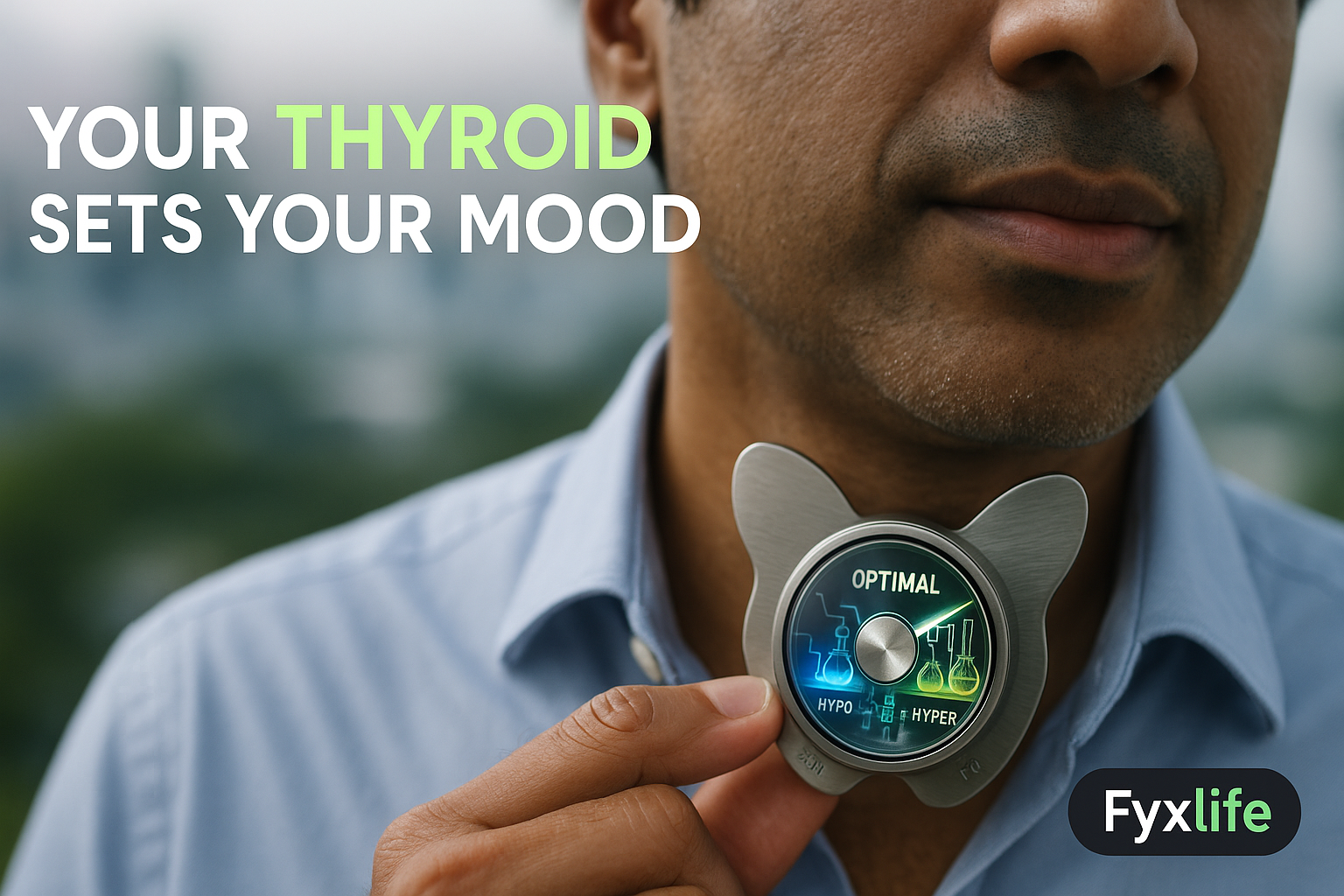
Your thyroid sits at the base of your throat, wrapping around your windpipe in a shape that looks, on an anatomy diagram, uncannily like a butterfly. It weighs less than 30 grams. And yet it produces hormones that reach virtually every cell in your body, influencing heart rate, body temperature, digestion, and the speed at which you convert food into usable energy. For a structure you could hold in your palm, its reach is extraordinary.
The thyroid doesn’t act alone. It operates within a feedback loop involving the brain itself — specifically the hypothalamus and pituitary gland, which monitor circulating thyroid hormone levels and signal the thyroid to produce more or less as needed. This loop is called the hypothalamic-pituitary-thyroid axis, and it runs continuously in the background, calibrating your body’s baseline operating state. When the loop functions well, you rarely notice it. When it doesn’t, almost everything is affected.
T3 and T4 — the two hormones that set your mental thermostat
The thyroid produces two primary hormones. The first is thyroxine, abbreviated as T4 — a storage and transport form that circulates widely in the blood. The second is triiodothyronine, or T3 — the biologically active form that actually enters cells and does the work. Most T4 gets converted into T3 in peripheral tissues, including, critically, in the brain itself.
Think of your thyroid as the thermostat for your brain’s chemistry lab. When it’s set correctly, every reaction runs at the right speed — neurotransmitters are produced and cleared on schedule, energy is available when needed, and your mood stays within a functional range. Turn the thermostat down too far — the condition called hypothyroidism, meaning underactive thyroid function — and the whole lab slows: reactions stall, output drops, everything feels grey and heavy. Turn it up too high — hyperthyroidism, meaning overactive thyroid function — and the lab overheats: reactions happen too fast, nothing stabilises, and anxiety becomes the default state. The problem is that most people blame the lab technician — their mindset, their stress levels, their sleep — without ever checking the thermostat.
How thyroid hormones reach and reshape the brain
T3 doesn’t just influence the brain indirectly through metabolism. It crosses the blood-brain barrier and binds directly to receptors inside neurons, affecting how those cells behave. T3 has been intimately associated with depression and anxiety due to its regulatory effects on brain chemistry and neurological function — including the pathways that control serotonin and dopamine, the two neurotransmitters most closely associated with mood, motivation, and reward. This is not a loose association. It’s a direct regulatory relationship, which is why thyroid dysfunction so consistently produces symptoms that look psychiatric rather than hormonal.
The Mood Dial: How Too Little or Too Much Thyroid Hormone Changes You
Hypothyroidism — the low-slow-grey feeling that looks like depression
When your thyroid produces insufficient hormone, the downstream effects on brain chemistry are pervasive. Serotonin synthesis slows. Dopamine signalling weakens. The brain’s metabolic rate drops. What you experience is something that feels indistinguishable from clinical depression: persistent low mood, loss of motivation, blunted emotional responses, difficulty concentrating, and a kind of flatness that doesn’t lift no matter what you do or how much you sleep. People living with hypothyroidism consistently describe the mood dimension as the hardest thing to explain to others. It’s not sadness exactly — it’s an absence. A stopping of interest in things that used to matter.
The relationship between thyroid function and depression has long been recognised, with patients who have thyroid disorders being more prone to developing depressive symptoms. And acquired hypothyroidism has been associated with an increased risk of developing psychiatric comorbidities, including depression and anxiety. These aren’t rare outcomes. They are expected features of thyroid underfunction that simply don’t get named as thyroid symptoms often enough.
Hyperthyroidism — the wired-but-exhausted anxiety that looks like burnout
The other end of the dial produces a different but equally disruptive set of experiences. In adults, thyroid hormone directly affects mood, and hyperthyroidism can lead to psychiatric manifestations distinct from those seen in hypothyroidism. The overheated lab generates symptoms that closely resemble anxiety disorder or burnout: racing thoughts, restlessness, difficulty staying still, emotional volatility, irritability, and a persistent sense of internal pressure that doesn’t match external circumstances. You feel wired but not sharp. Activated but not productive. The heart pounds. Sleep fragmenting further accelerates the cycle.
Because these symptoms align so closely with the experience of high-functioning professionals under sustained workload pressure, they are routinely attributed to work stress rather than investigated as a potential hormonal pattern.
The spectrum in between: subclinical dysfunction and subtle mood shifts
Between outright disease and perfect function lies a wide grey zone. Subclinical thyroid dysfunction — meaning lab values that fall outside optimal range but not yet into the range labelled clinically abnormal — is more common than most people realise, and its effects on mood are real. Observational studies suggest that even minor variations in thyroid function — not just overt disease — are associated with the risk of mood disorders including major depressive disorder. This matters enormously if you are a person who feels subtly off but gets told your results are “normal.” Normal for a population average is not the same as optimal for your brain.
Why the Thyroid-Mood Connection Gets Missed
Symptoms that mimic psychiatric disorders
Hypothyroidism or hyperthyroidism may cause mood disorders, dementia-like symptoms, confusion, and personality changes — and most of these disorders are usually reversible with treatment. That last clause deserves emphasis: reversible. But only if the correct cause is identified. The misdiagnosis pathway is well-established. A person presents with low mood, fatigue, and difficulty concentrating. They are assessed for depression. They may be prescribed an antidepressant. Their thyroid is never tested. The underlying driver remains unaddressed while the psychiatric label accumulates in their medical record.
In some countries, clinical practice now includes thyroid screening before referring patients to a psychologist for depression — a recognition that the biological check should precede the psychological referral. This is not yet universal, and it is not yet standard practice in most of Southeast Asia’s general healthcare system.
The bidirectional trap: when depression disrupts thyroid function too
The relationship runs in both directions, which creates a diagnostic trap. Depression has itself been linked to developing hypothyroidism, with the most widely accepted explanation being disruption of the thyroid axis. This means that by the time a person is assessed, the question of which came first — the thyroid dysfunction or the mood disorder — may be genuinely difficult to untangle. Chronic psychological stress also suppresses thyroid function through its effects on the same hypothalamic-pituitary axis that regulates hormone output. The thermostat and the room temperature influence each other.
What standard screening often doesn’t catch
Standard thyroid screening typically measures a single marker: thyroid-stimulating hormone, or TSH — the signal sent from the pituitary to the thyroid telling it to produce more hormone. TSH is a useful proxy, but it tells you about the demand signal, not the actual hormone levels reaching your brain. A TSH result within range does not guarantee adequate T3 at the cellular level. The challenge is that this is exactly the kind of nuance a routine annual check-up was not designed to address — not because clinicians don’t care, but because standard reference ranges were built on population distributions, not on the specific hormonal environment your brain needs to function optimally. The genetically determined relationship between hypothyroidism and mood and anxiety disorders may not be entirely mediated through thyroid hormone levels directly, suggesting shared biological pathways that go beyond simple hormone replacement — which adds another layer of complexity that a single screening number cannot capture.
Thyroid Dysfunction and Cognitive Decline: What the Evidence Says
Brain fog, memory gaps, and personality changes as thyroid signals
The cognitive symptoms of thyroid dysfunction are frequently the first to appear and the last to be attributed correctly. Slow processing speed, difficulty retrieving words, impaired working memory — the kind of short-term memory that holds a thought in place while you act on it — and a general sense of mental heaviness that makes complex thinking feel effortful. These are not vague complaints. They are consistent features of hypothyroid brain function, arising directly from reduced cerebral metabolism and disrupted neurotransmitter kinetics. When T3 levels drop, the brain’s chemistry lab genuinely slows down. The technician is not at fault. The thermostat needs adjusting.
The dementia overlap — and why it matters for your 40s and 50s
For professionals in their 40s and 50s with a family history of dementia, the overlap between thyroid-driven cognitive symptoms and early neurodegenerative change is not academic. The presentation can look nearly identical: memory lapses, personality shifts, reduced executive function, and withdrawal from complex tasks. The critical difference is that thyroid-related cognitive change is, in most cases, reversible. Identifying and addressing thyroid dysfunction in this decade is therefore a meaningful preventive lever, not just a treatment for current symptoms. The neuropsychiatric manifestations of thyroid disease span depression, anxiety, and cognitive impairment — and catching them in their reversible phase is the entire opportunity.
What This Means for You: Applying the Mechanism
Key symptoms worth tracking before your next check-up
If you are a professional in your 40s or 50s noticing persistent low mood, cognitive sluggishness, emotional flatness, or anxiety that doesn’t track logically with your life circumstances — and particularly if lifestyle interventions haven’t shifted the pattern — your thyroid deserves serious consideration as a contributing variable. The symptom profile worth noting includes: fatigue that is disproportionate to your sleep, brain fog that is worse in the morning, unexplained weight changes, sensitivity to temperature, low motivation that feels biological rather than psychological, and mood instability that seems to have arrived rather than developed. None of these symptoms are diagnostic on their own. But they are signals worth documenting and bringing to a clinical conversation with the right tests specified.
The one insight to carry into your next health decision
This week, apply one mechanism insight to a decision you’re already making: if you have an upcoming GP or health screening visit and you’re experiencing unexplained low mood, brain fog, fatigue, or cognitive sluggishness that hasn’t responded to lifestyle changes, specifically ask for a full thyroid panel — TSH, Free T3, and Free T4 — rather than accepting a general “you seem fine” or jumping straight to a mental health referral. Knowing your thyroid numbers gives you a biological baseline that no amount of self-reflection can provide.