
You may have heard that a single gene can significantly raise your Alzheimer’s risk — and if you have a family history of dementia, you’ve probably wondered whether you carry it. The APOE ε4 variant is the strongest known genetic risk factor for sporadic Alzheimer’s disease, but carrying it is not a sentence. Understanding exactly what it does — and what it doesn’t determine — is the most important cognitive health conversation most people in their 40s and 50s aren’t having.
If you’ve watched a parent’s memory begin to slip in their 70s, the questions that follow are not abstract. They are personal, quiet, and urgent. You find yourself paying closer attention to your own moments of forgetfulness. You do your own research before your GP visit, not sure what you’re hoping to find. This article is written for exactly that moment — because the science is more nuanced, and more actionable, than the headlines suggest.
What Is the APOE Gene — And Why Should You Care?
Its day job: moving fat around your body
Before APOE became famous for brain risk, it had a perfectly ordinary job. Apolipoprotein E — the protein this gene encodes — is primarily a lipid transporter, responsible for moving cholesterol and fats between cells and organs throughout your body. This is why its effects extend across both cardiovascular and neurological health. It is not, at its core, a brain gene. It is a logistics gene. The brain just happens to depend on that logistics network more than almost any other organ.
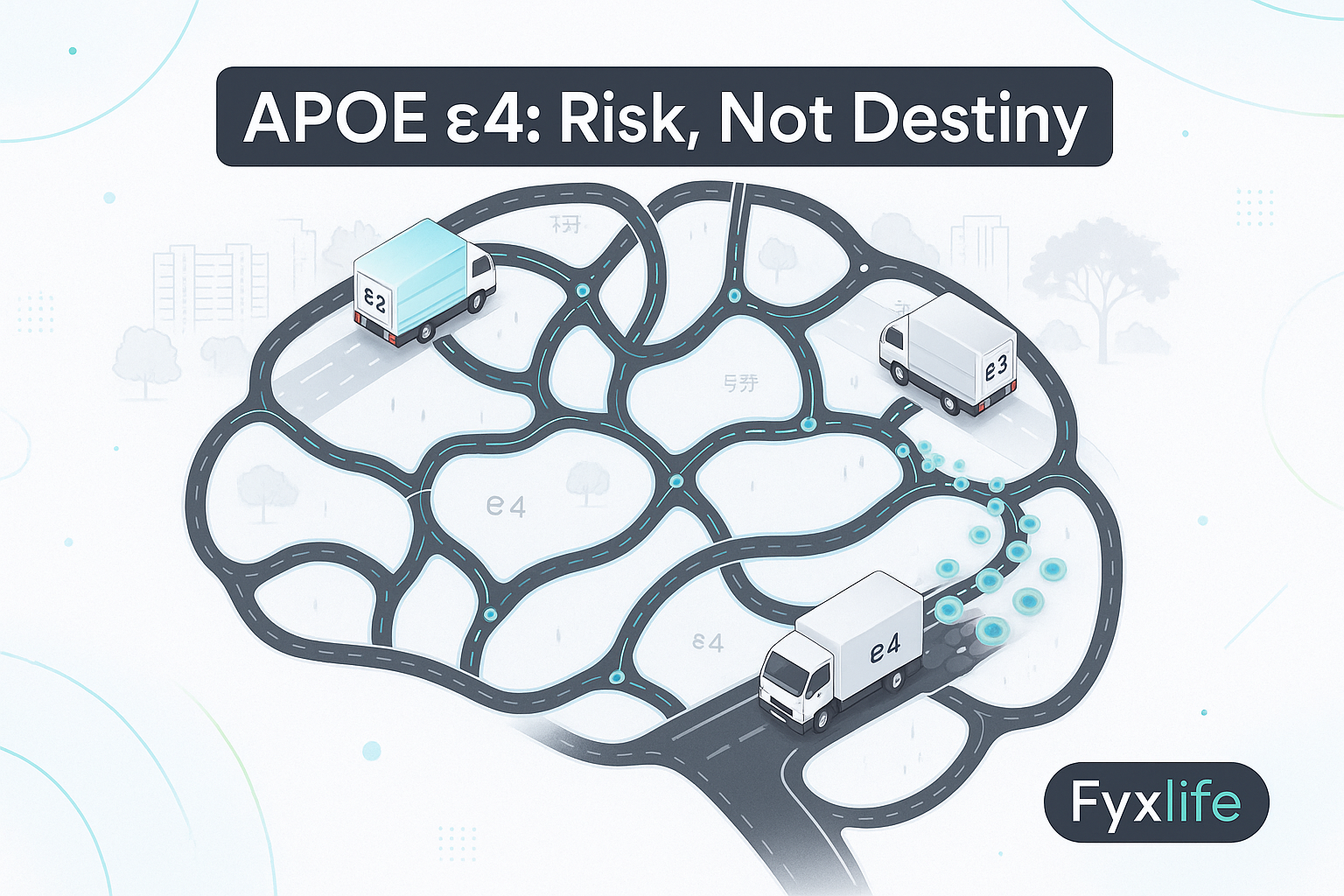
Your brain is roughly 60% fat by dry weight. It requires a constant, well-managed supply of lipids for building cell membranes, insulating nerve fibres, and repairing damage. APOE is central to that supply chain. Think of it as a fleet of delivery trucks responsible for transporting cholesterol and fats to brain cells that need them for repair. The variant you carry determines what kind of truck you’re running.
Why it became famous for brain risk
When researchers began mapping the genetics of late-onset Alzheimer’s disease — the kind that develops after age 65 and accounts for the vast majority of cases — one gene kept appearing. Not because it directly causes Alzheimer’s the way a broken light switch causes darkness, but because one of its variants interacts badly with the specific proteins that accumulate in the ageing brain. The result is a risk profile that is statistically significant, clinically meaningful, and — critically — modifiable in ways that most people haven’t been told.
The Three Variants: ε2, ε3, and ε4 Explained
ε3 — the common baseline
The ε3 variant is the most common version of the gene worldwide. It drives what you might call a reliable truck — it does its job moving fats around the brain without causing particular problems and without offering particular advantages. If you carry two copies of ε3, you sit at average population risk for Alzheimer’s disease. Most people do. This is the genetic baseline against which the other variants are measured.
ε2 — the protective variant
The ε2 variant is rarer and, in terms of brain health, more desirable. APOE ε2 is the strongest known genetic protective factor against sporadic Alzheimer’s disease — the upgraded truck in the analogy, running more efficiently with fewer breakdowns. Carriers of ε2 tend to have lower rates of amyloid accumulation and a meaningfully reduced risk of developing the disease compared to ε3 carriers. It is not a guarantee of cognitive longevity, but it is a biological advantage.
ε4 — the risk-elevating variant and what it actually means to carry it
The ε4 variant is where the conversation gets serious. APOE ε4 is the strongest known genetic risk factor for sporadic Alzheimer’s disease. The ε4 truck still delivers fuel, but it runs with a faulty exhaust system — it leaks toxic residue along the route. Over decades, that residue accumulates along the brain’s highways, gradually slowing traffic and damaging the road itself. The truck doesn’t cause an accident on day one. But the slow build-up of damage is what makes ε4 a risk factor, not a death sentence. Carrying one copy raises your lifetime risk. Carrying two copies raises it further still. But most people who carry this variant will not develop Alzheimer’s disease — a point that tends to get lost in how the gene is discussed.
How APOE ε4 Damages the Brain: The Mechanism in Plain English
The amyloid problem — how plaque builds up faster
The brain naturally produces a protein fragment called amyloid-beta as a byproduct of normal neural activity. In healthy brains, this fragment is cleared away efficiently. In APOE ε4 carriers, that clearance system is less effective. The ε4 variant of the apoE protein is less efficient at binding to amyloid-beta and escorting it out of brain tissue — and the result is accelerated accumulation of sticky amyloid-beta deposits, or plaques, along the walls of brain blood vessels and between neurons. The interaction between apoE and pathological amyloid-beta deposition is considered a central mechanism by which apoE contributes to Alzheimer’s disease risk. This is the exhaust residue building up along the brain’s highways — and it starts accumulating long before any symptoms appear.
The mitochondrial problem — how brain cells age faster
APOE ε4 doesn’t only create an amyloid problem. It also affects the energy supply of neurons themselves. The hippocampus — the brain’s primary memory-formation centre, the structure you rely on to lay down new memories and navigate space — appears particularly vulnerable. ApoE4 exacerbates the accelerated ageing — what researchers call senescence — of hippocampal neurons, and is linked to spatial cognitive impairment. The energy factories inside brain cells, known as mitochondria, appear to function less efficiently in ε4 carriers, creating a cellular environment where neurons are both more poorly fuelled and less able to repair damage.
The tau and inflammation connection
Alzheimer’s disease has two hallmark features, not one. The first is amyloid plaques. The second is tau tangles — abnormal protein structures that form inside neurons and disrupt their internal transport system, eventually killing the cell. ApoE4 has been associated with multiple pathological processes linked to cognitive impairment, including both amyloid-beta and tau pathologies. The gene appears to worsen both pathways simultaneously. And layered on top of these is chronic neuroinflammation — a low-grade, persistent activation of the brain’s immune cells (called microglia) that, over decades, contributes to the kind of cumulative neural damage that precedes clinical symptoms by years.
Risk Is Not Binary — It’s a Spectrum
One copy vs. two copies: why dose matters enormously
This is one of the most important pieces of information that rarely makes it into a GP’s waiting room conversation. APOE ε4 shows a clear gene dose effect: carrying two copies dramatically increases Alzheimer’s risk compared to one copy and is associated with an earlier age of disease onset. One copy — what geneticists call being heterozygous for ε4 — elevates risk meaningfully. Two copies — being homozygous — changes the risk landscape significantly and shifts the probable window of onset earlier. These are not the same situation, and they warrant different conversations about surveillance and lifestyle prioritisation.
Cognitive decline before dementia: what ε4 carriers experience in normal ageing
This is where the story becomes relevant to someone in their 40s or 50s who does not have — and may never develop — Alzheimer’s disease. The APOE ε4 allele is associated with increased risk for cerebral amyloid angiopathy and age-related cognitive decline even during normal ageing — not only in diagnosed Alzheimer’s patients. The brain fog, the slower word retrieval, the attention inconsistency that many people dismiss as ordinary middle-age tiredness — in ε4 carriers, these may reflect a biological trajectory rather than just life stress. That doesn’t make them inevitable. But it makes them worth taking seriously earlier.
Age and sex as modifiers of your actual risk
Risk is not static across a lifetime. The ε4 variant’s effect on Alzheimer’s risk appears to be most pronounced in middle age and early older age, and then its relative impact levels off in those who reach their late 80s without having developed the disease. Sex also matters: women who carry ε4 appear to face a higher lifetime risk than men with the same genotype, a difference that researchers believe is partly related to hormonal changes during and after menopause. Your risk at 50 is not your risk at 75, and your risk as a woman is not identical to your risk as a man carrying the same variant.
What APOE ε4 Does NOT Mean
It is not a deterministic gene — most carriers do not develop Alzheimer’s
Here the distinction is critical and worth stating plainly. APOE is classified as a non-deterministic gene for Alzheimer’s disease — it raises risk but does not guarantee the disease will develop, distinguishing it from rare deterministic mutations such as those found in the PSEN1 or APP genes, which cause early-onset familial Alzheimer’s with near-certainty. The ε4 variant changes probabilities. It does not write a fixed outcome. Many people who carry one or even two copies of ε4 live into their 80s and 90s with their cognition intact.
The difference between risk factor and diagnosis
A risk factor tells you where to pay attention. A diagnosis tells you what is happening. These are different categories of information, and conflating them causes unnecessary distress and, paradoxically, inaction. Knowing you carry ε4 is more like knowing you have elevated blood pressure than knowing you have had a stroke. It changes what you should monitor and what interventions deserve your attention. It does not tell you what will happen.
What Can Actually Modify Your Risk?
Diet — the evidence on Mediterranean-style eating and ε4 carriers
Diet is one of the most studied lifestyle variables in APOE research, and the findings are meaningful. Cognitive functions are influenced by complex interactions of APOE genotype with obesity, and these interactions differ by sex, age, and co-inherited gene variants — meaning lifestyle factors genuinely modulate genetic risk. The Mediterranean dietary pattern — high in olive oil, oily fish, leafy vegetables, legumes, and nuts, with limited processed food and refined carbohydrate — has demonstrated the strongest dietary signal in this population. The mechanism is partly anti-inflammatory, partly metabolic. The brain’s fat transport system runs better when the fats being transported are the right kind.
Obesity, metabolic health, and gene-environment interaction
The relationship between APOE ε4 and cognitive risk is not purely genetic — it is a conversation between your genes and your metabolic environment. Insulin resistance, visceral adiposity (the deep abdominal fat surrounding your organs), and chronic metabolic inflammation all appear to amplify the ε4 risk profile. This matters practically: it means that the standard cardiovascular health targets — fasting glucose, insulin sensitivity, body composition — are not just heart health numbers for ε4 carriers. They are brain health numbers too. The challenge is that this is exactly the kind of nuanced, personalised connection a routine annual check-up was not designed to make — not because your GP doesn’t care, but because a ten-minute appointment built around population averages cannot account for your specific genetic and metabolic profile together.
What the research currently supports vs. what remains unproven
Sleep quality, aerobic exercise, and cardiovascular fitness all show meaningful associations with reduced cognitive decline in ε4 carriers, and the mechanistic rationale is plausible — better cerebral blood flow, improved amyloid clearance during deep sleep, reduced neuroinflammation from regular physical activity. What remains less established is precise dosing: how much exercise, what sleep architecture targets, what specific dietary thresholds constitute a meaningful intervention for someone with one versus two copies. The direction of the evidence is clear. The precise calibration is still being worked out.
Should You Get Tested? What to Know Before You Do
Genetic testing for APOE status is available through several routes — direct-to-consumer platforms, specialist genetic testing services, and increasingly through preventive medicine practitioners. The decision to test is not purely medical. It carries psychological weight. Some people find that knowing motivates them to make changes they had been postponing. Others find uncertainty easier to live with than a confirmed elevated risk. Neither response is wrong. What matters is that you make the decision consciously, not by default.
If you do test, the result needs context to be useful. A positive ε4 result without understanding the dose effect, the sex and age modifiers, the non-deterministic nature of the gene, and the specific lifestyle levers available to you is more likely to generate anxiety than action. That context is what this article has tried to provide. A single positive test result handed to you by a consumer platform without clinical interpretation is not the same as understanding your actual risk trajectory.
Apply this mechanism insight to one decision you are already facing: if you have a first-degree relative with Alzheimer’s and you have not yet had a conversation with your doctor about APOE genotyping, use what you now know about the ε4 dose effect and its interaction with metabolic health to decide whether that conversation is worth having — and if so, book the appointment this week. Knowing your status does not change your genes, but it changes the interventions worth prioritising.


