
The reason you’re tired isn’t what you think
You’re in bed for seven or eight hours, you’ve cut the caffeine, you’ve dimmed the lights — and you still wake up exhausted. The problem isn’t how long you sleep. It’s whether your brain is actually doing what sleep is biologically designed to do.
This is the frustration that no amount of sleep hygiene advice seems to fix. You already know the advice. You’ve probably tried most of it. You go to bed at a reasonable hour, you avoid the obvious mistakes, and yet something isn’t working. The exhaustion isn’t a willpower problem or a discipline problem. It’s a mechanism problem — and once you understand the mechanism, the question changes entirely.
Why ‘I got eight hours’ is often the wrong question
Eight hours of disrupted, poorly sequenced sleep is not the same as six hours of deep, well-structured sleep. Growing consumer interest in sleep tracking technology reflects exactly this shift — from measuring duration to measuring what the brain actually does with the time. Duration is what you can count. Quality is what determines how you feel. These are not the same number, and treating them as if they are is where most self-diagnosis of sleep problems breaks down.
What your brain actually does while you sleep
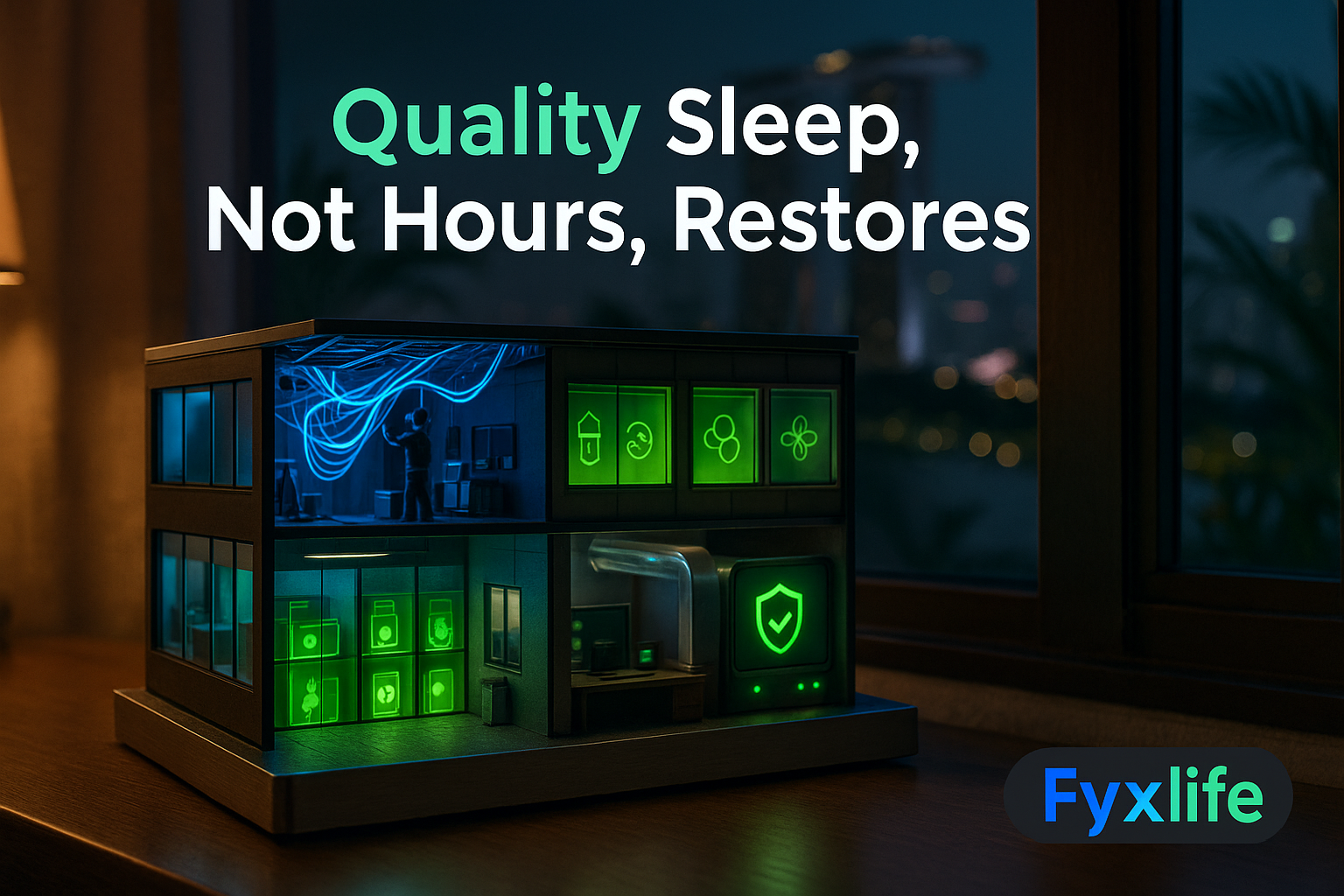
Think of sleep as a nightly building maintenance shift. During the day, the building runs at full capacity — lights on, people working, systems under load. At night, the maintenance crew comes in: they repair the wiring (what sleep scientists call neural consolidation), restock supplies (hormone release), clean the air ducts (glymphatic brain waste clearance), and run security updates (immune reinforcement). If you kick the crew out after four hours, or keep interrupting them, the building opens the next morning with yesterday’s damage still unrepaired. Do that for weeks, and the structure starts to show it.
That maintenance work is not one job — it’s several distinct jobs, done by different crews at different times of the night. Which is why the sequence of what happens matters just as much as how long you’re in bed.
Stage 1 and 2 — Light sleep, the transition zone
The first thing your brain does when you fall asleep is shift into light sleep — the transitional phases where your body temperature drops, your heart rate slows, and your brain begins to disengage from its waking-state processing. Stage 2 is particularly important for motor memory consolidation (the process of embedding physical skills and procedural learning into long-term storage). This is unglamorous work, but it sets the stage for everything that follows. Miss this transition — or spend too long stuck in it due to stress or fragmented sleep — and the deeper stages never arrive properly.
Stage 3 — Deep sleep, the body’s repair shift
Stage 3 is what most people mean when they talk about truly restorative sleep, even if they’ve never heard the clinical term. This is slow-wave sleep — named for the large, slow electrical patterns the brain produces during it — and it is the phase where the body does its most critical physical repair work. Growth hormone is released in its largest pulse of the entire day. Muscle tissue is rebuilt. The immune system reinforces itself. And the brain’s internal waste-clearance network, the glymphatic system, becomes highly active — flushing metabolic byproducts from the brain, including the proteins associated with Alzheimer’s disease. If you are training hard, managing chronic work stress, or simply trying to keep your brain sharp into your fifties and sixties, slow-wave sleep is not optional. It is the shift that does the work everything else depends on.
REM sleep — the brain’s overnight therapy session
Later in the night comes REM sleep — rapid eye movement sleep — which looks almost like waking brain activity on a scan, but serves entirely different functions. This is where emotional memory consolidation happens: the brain processes the emotional charge of the day’s experiences, strips out the distress, and files the information. It’s also when the brain runs what neuroscientists describe as threat-response recalibration — essentially reviewing difficult experiences in a neurochemically safe environment, which is thought to be why a bad situation often genuinely feels more manageable after a night’s sleep. Creative and associative thinking — the ability to connect unrelated ideas — also depends heavily on REM. Skip it consistently, and you accumulate what researchers describe as a cognitive and emotional debt that doesn’t announce itself loudly. It just slowly degrades your capacity to handle complexity, regulate mood, and think flexibly under pressure.
Sleep architecture — why sequence matters as much as duration
These stages don’t happen randomly. They follow a structure — and that structure is precisely what your tiredness depends on.
How a normal night is supposed to unfold
A healthy night moves through cycles of roughly 90 minutes, each containing light sleep, slow-wave sleep, and REM, repeated four to six times. The critical detail is that these cycles are not evenly distributed. Slow-wave deep sleep is concentrated heavily in the first half of the night. REM sleep dominates the second half, with each REM period growing longer as the night progresses. This means that cutting sleep short by even 90 minutes doesn’t just reduce sleep proportionally — it disproportionately eliminates the REM phases that accumulate late in the night. You lose the maintenance crew that handles emotional regulation and cognitive repair first. This is sleep architecture — the sequencing and proportion of stages — and it is the metric that duration alone cannot capture.
What destroys the architecture: alcohol, stress, screens, late meals
Alcohol is perhaps the most misunderstood sleep disruptor in this age group. It genuinely does help you fall asleep faster — which is exactly why it feels like it’s working. But alcohol suppresses REM sleep and causes sleep fragmentation (repeated micro-arousals that prevent deep sleep from completing) in the second half of the night. The maintenance crew arrives, gets sedated, and leaves before the job is done. Screens before bed elevate alertness through both the blue light that suppresses melatonin (the hormone that signals your brain it is time to sleep) and the cognitive stimulation of the content itself. A large meal within two hours of bed redirects metabolic resources toward digestion at exactly the time the body should be shifting into repair. And elevated stress — specifically, chronically high cortisol (the body’s primary stress hormone) — directly suppresses the ability to enter and sustain slow-wave sleep. Each of these disrupts the architecture. Together, they systematically dismantle it.
The circadian clock — your body’s internal 24-hour scheduler
Layered over all of this is a system that operates entirely on schedule, whether or not you respect it.
What happens when your schedule fights your biology
Your circadian rhythm is the brain’s internal 24-hour timer that governs when every organ in your body is primed to work, rest, and repair. It controls the timing of cortisol release, body temperature fluctuation, melatonin secretion, and the scheduling of sleep stages themselves. When your sleep window aligns with this clock, the architecture unfolds as designed. When it doesn’t — when you go to bed at midnight on a biological clock that wants to wind down at ten — the stages arrive out of sequence, get cut short, or fail to deepen properly. Total hours can look adequate on paper while the underlying quality is systematically compromised.
Why night owls in a 9-to-5 world pay a hidden health tax
People whose natural chronotype (the biological tendency toward earlier or later sleep timing) runs late face a structural penalty in a world that starts early. Going to bed late and waking early doesn’t just mean less sleep — it means the clock-dependent phases arrive at the wrong biological time and are cut short by the alarm. Researchers call this social jetlag: the chronic misalignment between your internal clock and your social schedule. The cumulative effect mirrors what shift workers experience — degraded sleep quality, elevated metabolic risk, and impaired cognitive performance — even when the person believes they are simply a “night person” functioning normally.
What poor sleep actually does to your body over time
This is where the conversation shifts from performance to health — and the stakes become harder to ignore.
Brain health — the neurodegeneration link
The glymphatic system that clears waste from the brain during deep sleep is not clearing decorative byproducts. It is clearing amyloid proteins — the toxic accumulations associated with Alzheimer’s disease. When deep sleep is chronically disrupted, this clearance is impaired. A review of over 100 studies suggests that inadequate sleep could contribute to neurodegeneration — meaning the professional who has spent a decade sleeping poorly is not just tired. They may be accumulating risk for cognitive decline at a pace their annual check-up will not detect until it is already significantly advanced.
Metabolic and cardiovascular consequences
Poor sleep directly impairs insulin sensitivity — the body’s ability to manage blood glucose — and promotes storage of visceral fat (the metabolically active fat that accumulates around internal organs, distinct from the fat you can pinch). This matters everywhere, but it matters with particular urgency in Singapore and Southeast Asia, where metabolic risk emerges at lower body weight thresholds than Western reference ranges account for. The professional who is not overweight by any clinical definition may still be carrying significant metabolic risk, and chronically poor sleep is accelerating it silently. Cardiovascular risk follows a similar pattern: elevated resting heart rate, disrupted blood pressure regulation, and heightened systemic inflammation are all documented consequences of sustained sleep disruption.
Why stress and sleep deprivation form a self-reinforcing loop
Here is the mechanism that traps most busy professionals: cortisol rises in response to stress, elevated evening cortisol prevents deep sleep, poor sleep impairs the brain’s emotional regulation (which depends on REM), impaired emotional regulation makes the next day’s stress feel more acute, which raises cortisol further. Each part of the loop feeds the next. This is not a metaphor for a vicious cycle. It is the actual neurochemical mechanism by which work stress becomes a sleep disorder becomes a stress disorder — and why people who are doing everything else right still feel chronically exhausted. The challenge is that this is exactly the kind of pattern a routine annual check-up was not designed to untangle — not because doctors don’t care, but because a ten-minute appointment was built to identify disease, not to map the interaction between your stress hormones, sleep architecture, and metabolic markers over time.
What good sleep quality actually looks like
Quality sleep is not the absence of waking. It is the successful completion of the maintenance cycle — enough slow-wave sleep in the early hours to complete physical repair, enough REM in the later hours to complete emotional and cognitive processing, and enough uninterrupted continuity for the architecture to unfold as designed.
The biomarkers and signals worth tracking
Subjectively, genuinely restorative sleep leaves you waking before the alarm feels necessary, with a mind that reaches clarity within minutes rather than an hour. Objectively, wearables that estimate heart rate variability (a marker of how well your autonomic nervous system recovered overnight) and time spent in slow-wave and REM stages can reveal patterns invisible to your conscious experience. You may believe you slept well — and your data may tell a different story. That gap between perceived and actual sleep quality is where most self-diagnosis fails, and where tracking earns its utility. What 2025’s convergence of sleep science and consumer tracking technology offers is not perfection — it is the ability to see the architecture rather than just count the hours.
One thing to change this week
This week, apply the sleep architecture insight to one decision you are already making: pick the single behaviour most likely to be fragmenting your sleep stages — most commonly alcohol in the evening, screens past 10pm, or eating a large meal within two hours of bed — and eliminate just that one for five nights. Do not change anything else. At the end of five nights, notice one thing: whether you feel more restored in the morning. You are not optimising yet. You are running a baseline experiment on your own architecture.


