
You’ve done the math: 12-15 hours of training per week, years of discipline, and a race day that pushes your body to its absolute limit. The question serious age-group athletes quietly ask but rarely say out loud is this — does Ironman training make you healthier, or does it slowly break you down in ways your race photos don’t show?
It’s a fair question. And it deserves a straight answer rather than the kind of motivational deflection you’ll get from most triathlon content. You’re not looking for permission to train. You’re looking for an honest accounting of what this actually costs your body — and whether the investment compounds over time or quietly erodes something you can’t see yet.
The Verdict Upfront — Ironman Training Is Worth It, But Race Day Is Not the Health Event You Think It Is
Here’s the core finding, stated plainly: a well-structured Ironman build, executed by a 35-60-year-old athlete who monitors recovery and manages load intelligently, is one of the most health-positive things you can do with your body. The multi-year training process delivers genuine, measurable adaptations across cardiovascular, metabolic, and musculoskeletal systems that most people never achieve.
Race day, however, is not part of that health story. It is an acute physiological stressor — the endpoint that gives the training meaning, but not a health event in its own right. The finish line is the destination. The training year is the medicine. Conflating the two is where most of the confusion about Ironman and health begins.
What ‘worth it’ actually means for a 45-year-old training 12 hours a week
At 45, the health calculus for high-volume endurance training is different from what it was at 28. Recovery is slower. The margin between productive stress and accumulated damage is narrower. But the upside is also more meaningful — because the diseases Ironman training protects against are exactly the ones that start becoming relevant in your fifth decade. The question isn’t whether you can handle the load. It’s whether you’re managing it with the same precision you bring to your pacing strategy.
The Real Health Case for Triathlon — Why Three Disciplines Beat One
Cancer risk, body composition, and cardiovascular adaptation
The evidence for triathlon as a health-protective activity is genuinely strong. A review of 170 studies published in the Journal of Nutrition found that swimming, cycling, and running reduce the risk of cancer and other diseases — which is a remarkable finding given that single-sport studies rarely reach that scale of evidence. The same research documents that triathlon training has documented benefits for maintaining healthy body composition through the combination of three distinct aerobic disciplines.
Body composition matters here not just aesthetically but metabolically. Maintaining lean mass while limiting visceral fat — the fat stored deep around your organs — is one of the most reliable predictors of long-term metabolic health. Triathlon training, with its high caloric demand and multi-modal stimulus, is unusually effective at achieving this balance.
Why the swim-bike-run combination creates a multi-system stimulus single-sport athletes miss
There’s a specific physiological advantage to combining three disciplines that pure runners and cyclists don’t capture. The multi-discipline structure of triathlon — particularly the cycle-run combination — has implications for aerobic capacity development that pure run training cannot match. The reason is mechanical: cycling builds your aerobic engine with minimal eccentric load on your joints, while running applies that engine to weight-bearing movement. Swimming adds upper body cardiovascular demand and active recovery that running and cycling cannot provide.
The result is a cardiovascular system trained across a wider range of movement patterns, heart rate zones, and metabolic demands than any single sport can create. For a 45-year-old optimising for both performance and longevity, that breadth is a feature, not a compromise.
The Hidden Cost — What High Training Loads Actually Do to Your Body
The immune suppression window: what happens in the weeks of peak training
Think of your body during an Ironman build like a high-performance engine running close to redline for months. The engine can absolutely handle it — but only if the oil is changed regularly, the temperature is monitored, and you don’t ignore the warning lights. The training stimulus is the point. The damage accumulation is the price. Whether the trade is worth it comes down entirely to how well you manage what happens between sessions, not what happens during them.
During peak training blocks — typically the 8-12 weeks before taper — your immune system is operating under sustained pressure. The literature on triathlon training and racing loads documents measurable effects on the immune system and oxidative stress, both from training volume and from the race itself. This suppression window is real. It’s the reason experienced Ironman athletes get sick in the final weeks before a race at a rate that surprises them every time. The training is working exactly as intended — and the immune cost is the price of that adaptation.
Oxidative stress — the chain reaction of damage that accumulates across a full Ironman build
Sustained endurance training at high volume generates oxidative stress — a chain reaction of cellular damage caused when the body produces more reactive oxygen molecules than its repair systems can neutralise. In moderate doses, this is adaptive. In sustained high doses across a multi-month build, it accumulates. The scientific literature specifically reviews triathlon training loads and their effects on cardiovascular health, immune function, and oxidative stress — recognising these as distinct but interacting systems under stress from endurance sport.
The critical insight is that oxidative stress and immune suppression don’t announce themselves loudly. They show up as slightly elevated resting heart rate, slightly degraded sleep quality, slightly slower recovery between sessions. Athletes who are tracking nothing miss the accumulation entirely — until a race goes wrong, or something breaks.
Race day physiology: why crossing the finish line is an acute stressor, not a health milestone
Race day in an Ironman is medically not healthy in the conventional sense — it represents an acute physiological stressor that should not be conflated with the long-term health benefits of the training process itself. The 226 kilometres compress months of accumulated fatigue into a single sustained effort. Inflammatory markers spike. Cardiac enzymes that indicate stress on the heart muscle elevate. The immune suppression that built across your peak training weeks reaches its deepest point in the 48 hours after the finish.
This doesn’t mean race day is harmful in isolation. It means understanding what the finish line actually represents: not the health reward, but the proof of concept. The health happened in the training year. The race is the test.
The Masters Athlete Risk Profile — Does Age Change the Equation?
What the literature says about prolonged intense endurance training in the 35-60 age group
Months and sometimes years of training are required to reach an Ironman start line — which means the health impact of doing an Ironman is almost entirely determined by the multi-year training process, not the single race event. For athletes in the 35-60 range, this timeline matters because it intersects with natural age-related changes in recovery capacity, hormone profiles, and cardiovascular baseline.
The honest answer from the literature is nuanced: prolonged intense endurance training in masters athletes produces significant health benefits when properly managed, and legitimate risks when it isn’t. The risks aren’t hypothetical. Experienced athletes in online communities openly debate whether years of high-volume racing affects long-term health — and the discussion splits sharply between those citing performance longevity and those flagging cardiac and immune concerns. Both sides have data worth taking seriously.
Cardiac considerations and cumulative load over years of racing
The cardiac question deserves honest treatment rather than reassurance. The community debate and emerging research both flag whether sustained high-volume training and racing creates cardiac and systemic risks that outweigh the benefits for masters athletes. Structural adaptations to the heart from decades of endurance sport — including changes to chamber size and electrical conduction — are documented in long-term studies. Whether these adaptations are uniformly benign, particularly in athletes with underlying cardiac risk factors, remains an open and important question.
This is where the gap between population-level research and individual application becomes genuinely consequential. A routine annual check-up was not designed to answer “what does my cumulative training load mean for my specific cardiac profile” — not because the system fails, but because population reference ranges were never built with masters endurance athletes in mind. The question is real. Getting a personalised answer requires someone looking at your specific data, not the general population average.
The Training Architecture Question — How You Build It Matters More Than the Distance
Volume vs. intensity distribution — the polarised model and why most age-groupers get this wrong
Most age-group athletes train in a way that accumulates the worst of both worlds: too hard to be truly easy, too easy to be truly hard. The polarised training model — where roughly 80% of training is done at genuinely low intensity and 20% at genuinely high intensity — has a strong evidence base in elite endurance sport and is increasingly applied to masters athletes. The insight is counterintuitive: doing more of your training slower preserves your capacity for the hard efforts that drive adaptation, while reducing the accumulated oxidative and immune cost of grinding in the moderate zone.
Most age-groupers overtrain the moderate zone because it feels productive. It isn’t — not for adaptation, and especially not for recovery capacity at 45 or 50.
AI-adaptive training tools: are they changing outcomes or just convenience?
AI-adaptive training systems such as TrainerRoad are being used by age-group athletes in full Ironman builds, with users reporting that structured adaptive plans are improving bike fitness outcomes — though triathlon-specific adaptive features remain in development. The honest verdict on these tools is that they are genuinely useful for managing load on the bike and preventing the common mistake of progressing intensity too quickly. Their limitation is that they optimise for performance metrics, not health metrics — and for masters athletes, those two targets are not always aligned.
Used well, adaptive training platforms reduce one of the most common errors in Ironman prep: accumulated fatigue that looks like undertraining on paper but is measurable physiological debt in practice. Used uncritically, they become sophisticated ways to dig a deeper hole.
What smart recovery monitoring actually looks like in a full Ironman build
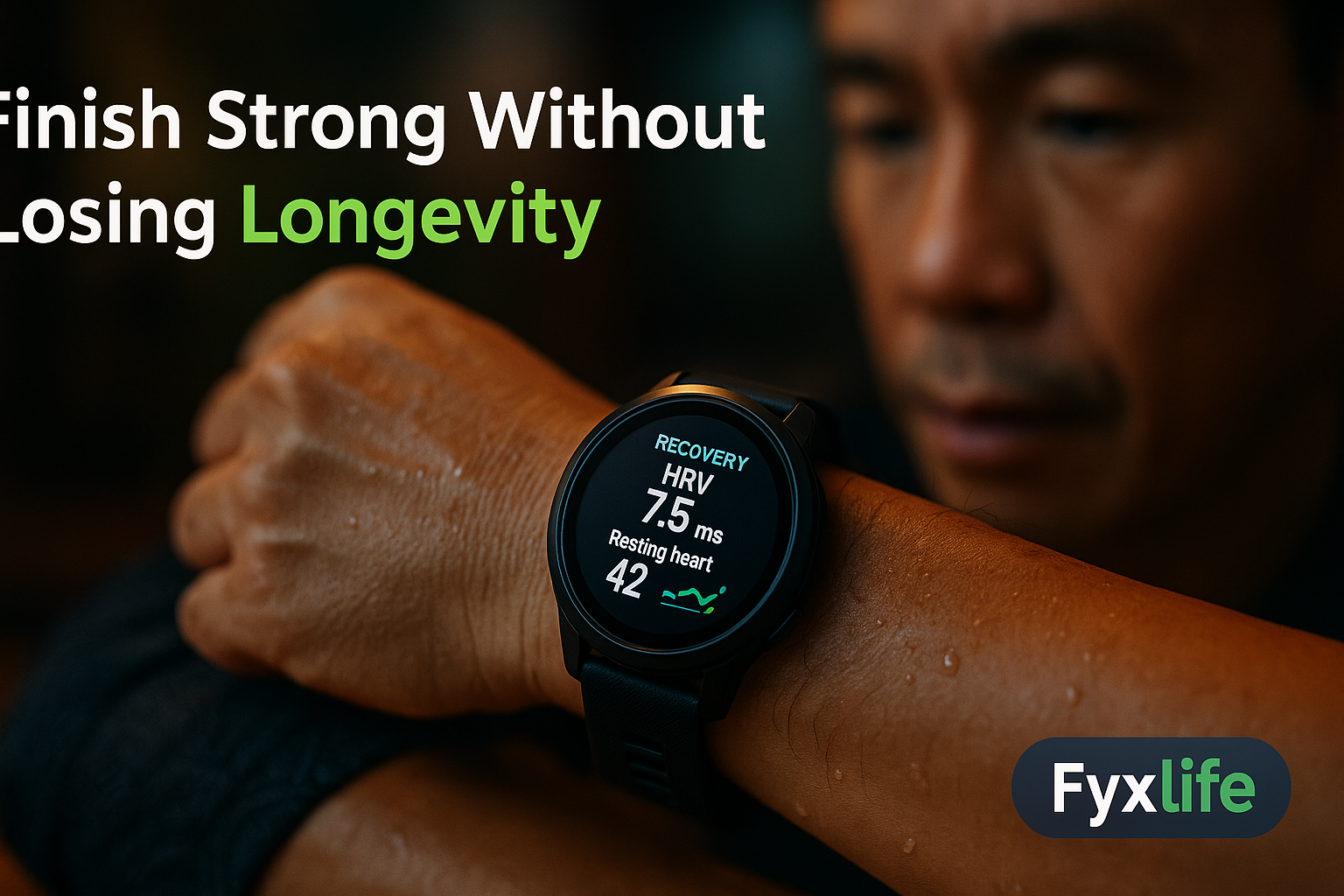
Heart rate variability (the variation in time between consecutive heartbeats, measured each morning — a sensitive proxy for nervous system recovery state) and resting heart rate trend are the two most accessible and reliable recovery metrics available to age-group athletes without clinical infrastructure. A rising resting heart rate across a training block, or a sustained downward trend in HRV, is not noise. It is signal. It indicates that the load is outpacing the recovery — which is the exact condition that transforms a health-positive build into a health-negative one.
The Evidence-Based Conditions That Make Ironman Training Health-Positive
Recovery infrastructure, load periodisation, and the non-negotiables
The evidence is consistent: Ironman training produces health benefits when certain conditions are met, and it produces harm when they aren’t. Those conditions are not complicated, but they require actual discipline rather than aspirational intention. Sleep of seven to nine hours — not six with a nap — is the foundational recovery intervention. Nutrition that supports training volume, including adequate protein for muscle protein synthesis (the process by which your body rebuilds damaged muscle tissue), is non-negotiable at training loads of 12-15 hours per week. Structured recovery weeks — genuine reductions in volume, not just skipping one session — allow the adaptations from hard training blocks to consolidate rather than simply compound.
Biomarkers worth tracking across a build — what to watch before problems compound
Beyond resting heart rate and HRV, the biomarkers that matter most across a full Ironman build include serum ferritin (your iron storage levels — a reliable early indicator of the iron depletion that sustained endurance training drives, particularly in female athletes), creatine kinase (an enzyme that leaks into the bloodstream when muscle is damaged — useful for tracking whether your training load is exceeding your repair capacity), and markers of systemic inflammation (a chain reaction of immune signalling throughout the body, measured via C-reactive protein) that distinguish productive training stress from harmful accumulation.
These are not exotic tests. They are available through standard blood panels. The challenge is that most athletes only test when something goes wrong — by which point the accumulation has already been significant for weeks.
Final Verdict — Continue, Stop, or Restructure?
Continue, for almost every athlete reading this. But restructure, almost certainly. The evidence does not support abandoning Ironman training as a health practice — it is one of the most demanding and rewarding forms of preventive medicine available to a motivated 40-something. What the evidence does not support is the assumption that more training, harder training, or simply crossing the finish line is the health event. The build is the medicine. How you build it determines whether that medicine works.
First-time Ironman finishers consistently report the same surprise: the race itself felt destructive, not triumphant. It was the training year that changed them. That experience isn’t incidental. It’s the data.
The athletes for whom this calculus turns negative are not the ones who trained too much. They’re the ones who trained without monitoring, without adequate recovery infrastructure, and without honest accounting of what the accumulated load was doing across weeks and months. Those athletes are often the most disciplined in the field — and the most vulnerable to the specific failure mode that discipline enables.
Based on this verdict, make one decision: if you are currently in an Ironman build, identify whether you have any objective recovery metric — resting heart rate trend, HRV, or sleep quality score — that you are tracking across your training weeks. If you don’t have one, start tracking resting heart rate daily this week. A rising resting heart rate across a training block is one of the earliest signals that your training load is outpacing your recovery capacity — the exact condition that turns a health-positive build into a health-negative one. One number, tracked consistently, changes the equation.


