
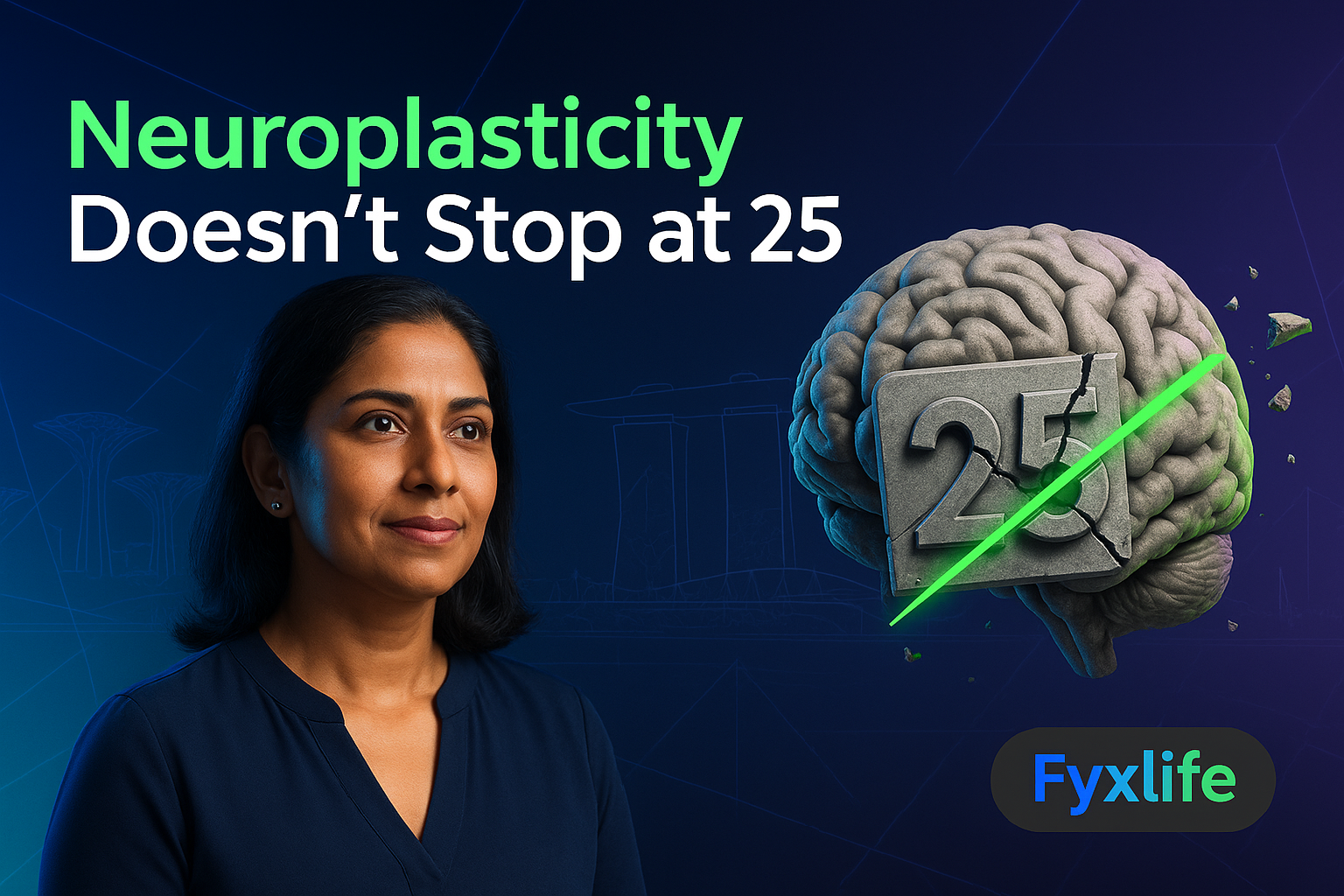
You’ve probably said it — or at least thought it: ‘I’m too old to learn new things the way I used to.’ It feels true. But it’s one of the most consequential myths in brain health, and neuroscience has been quietly dismantling it for decades. If you’re 35-60 and quietly worried your brain’s best days are behind it, the evidence says otherwise — but only if you understand what neuroplasticity actually is, and isn’t.
The problem isn’t your age. It’s the story you’ve inherited about what age means for your brain. That story is built on a stack of myths — each one plausible enough to feel like common sense, each one wrong in ways that have real consequences for how you learn, recover, and protect your cognitive health over the next twenty years.
The Myth Stack: What Most People Believe About Brains and Age
Myth 1 — ‘My brain stopped being plastic in my mid-20s’
This is the foundational myth, and it has a grain of truth wrapped inside a significant distortion. Your brain does undergo a major phase of structural development through your mid-20s — synaptic pruning, myelination, prefrontal maturation. But the conclusion that plasticity ends there is not what the research shows. Adult neuroplasticity is well-established, not disputed — the active scientific debate is about how age and experience interact to shape it, not whether it continues to exist. The adult brain changes structurally and functionally in response to learning, injury, environment, and behaviour throughout life. What shifts with age is the efficiency of those changes, and the conditions required to trigger them.
Myth 2 — ‘I can rewire my brain in 21 days’
The 21-day habit claim has been shared so many times it now feels like physiology. It is not. It originated from a plastic surgeon’s casual observation in the 1960s about how long it took patients to adjust to post-operative changes in appearance — not from any neuroscience of learning. What the evidence actually shows is more nuanced and more durable: repeated cognitive exercises can strengthen neural pathways, and this is the theoretical basis of cognitive remediation therapy — but the timelines are individual, driven by the complexity of what’s being learned, the consistency of practice, and the neurochemical conditions present during that practice. Three weeks might be meaningful for a simple habit. For genuine neural rewiring, the timeline is longer, more variable, and not something a viral formula captures.
Myth 3 — ‘Passive exposure is enough to learn and change’
This one costs people the most time. The belief that listening to a podcast at 1.5x while answering emails, or leaving a language-learning app running in the background, produces meaningful neuroplasticity is not supported by the science. Neuroplasticity encompasses not only the brain’s inherent capabilities but also the conditions — including attention state and task demands — that govern whether learning actually rewires neural circuits. Passive exposure without focused attention simply doesn’t meet those conditions. The brain registers the input. It doesn’t restructure around it.
Myth 4 — ‘Brain fog just means I’m getting older — nothing I can do’
This is the myth with the most personal cost, because it leads directly to resignation. There is a real and important difference between normal age-related cognitive slowing — slightly longer retrieval times, reduced multitasking speed — and actual neurological decline. The interaction between aging and neuroplasticity across the lifespan remains an active area of research, but the consistent finding is that many of the factors people attribute to aging are actually attributable to modifiable conditions: sleep debt, chronic stress, sedentary behaviour, and attentional fragmentation from constant digital interruption. That’s a meaningfully different problem — because those conditions can be changed.
The Verdict: What the Evidence Actually Shows
Older brains retain meaningful neuroplasticity — but the conditions matter more with age
Think of your brain less like a whiteboard that gets harder to write on as you age, and more like a garden. The soil doesn’t become infertile — but it does become less forgiving if you ignore it. The fertiliser is a protein called BDNF (brain-derived neurotrophic factor), which supports the growth and maintenance of new neural connections. The water is focused attention. And sleep is when the roots take hold. The garden analogy also explains why passive exposure fails: you can’t grow a plant by leaving seed packets next to dry soil. A younger brain might produce some growth anyway, under suboptimal conditions. An adult brain requires that the conditions are actually right.
Repeated cognitive effort strengthens neural pathways — but timelines are individual, not viral
Educational neuroscience research has identified optimal physical and behavioural conditions for neuroplasticity and learning — and the consistent finding is that environment and behaviour around learning materially affect outcomes, independently of age. Structured, effortful, repeated practice works. The timeline depends on your starting point, your stress load, your sleep quality, and the complexity of what you’re trying to learn. There is no universal number of days. There is a set of conditions — and when those conditions are met consistently, change happens.
Focused attention is the gating mechanism — without it, the plasticity window doesn’t open
This is the finding that changes how you should think about every learning session you design for yourself. Neuroplasticity and learning windows are available for a period of time following specific neurochemical triggers — and one of the most important of these is the release of acetylcholine (a chemical messenger in the brain that signals “this matters — pay attention”). When acetylcholine is released during a state of focused alertness, it effectively tags the neural activity happening at that moment as worth reinforcing. Without that signal, the brain processes information but doesn’t restructure around it. This is why the quality of your attention during learning matters more than the quantity of time you spend exposed to material.
The Mechanism in Plain English
BDNF — your brain’s fertiliser, and how to trigger it
BDNF — the protein that enables new neural connections to form and existing ones to strengthen — doesn’t accumulate from wishful thinking or passive consumption. It is triggered by specific behaviours. Both aerobic exercise and certain dietary factors, including leafy greens, improve BDNF levels — but exercise is the most reliable and well-evidenced lever available to you. Twenty to forty minutes of aerobic activity produces a meaningful increase in BDNF, effectively preparing the brain for the learning that follows. This is not a metaphor. It is the physiological mechanism by which movement primes neural plasticity. The brain-training app you downloaded is not doing this. A brisk run before a focused study session might be.
The acetylcholine window — why alertness and attention are prerequisites, not nice-to-haves
The release of acetylcholine — the brain’s attention-signalling chemical — during focused engagement opens what researchers describe as a neuroplasticity window: a period during which the brain is primed to encode and restructure. This window doesn’t stay open indefinitely, and it doesn’t open at all if you’re distracted, fatigued, or running on chronic stress. Vagal nerve stimulation research shows direct effects on neuroplasticity and learning, indicating that the body’s autonomic nervous system — regulated by breathing, stress management, and physiological state — directly modulates the brain’s capacity to rewire. Managing your nervous system is not a wellness luxury. It is a prerequisite for the plasticity you’re trying to trigger.
What Actually Drives Neuroplasticity in Adults Over 35
Aerobic exercise — the most evidence-supported lever
Of all the behaviours linked to adult neuroplasticity, aerobic exercise has the most consistent and robust evidence base. It raises BDNF. It reduces the stress hormone cortisol. It improves sleep architecture. And it does all three things simultaneously — which matters, because the conditions for neuroplasticity are cumulative. Twenty to forty minutes of moderate-intensity aerobic activity — fast walking, cycling, swimming — is enough to produce a measurable neurochemical effect. You don’t need a performance training programme. You need to elevate your heart rate consistently.
Novelty and challenge — why comfort is the enemy of neural growth
The brain does not restructure around familiar tasks done automatically. Learning a new language, picking up an instrument, navigating an unfamiliar environment, taking on a genuinely difficult intellectual problem — these create the kind of effortful, error-driven engagement that forces the brain to build new pathways rather than rely on existing ones. Structured, intentional learning design — not passive exposure — is what practitioners use to leverage neuroplasticity in applied settings. The same principle applies to self-directed learning: if it doesn’t feel slightly hard, it probably isn’t producing much structural change.
It’s worth naming something directly here: adults are often taught as though they are simply slower versions of children — a framing that misses the actual neuroscience. Adult brains don’t learn worse. They learn differently. They require clearer context, stronger motivation, and better-designed conditions. When those conditions are met, adult learning is not inferior. It is different in character, and often more durable precisely because the effort is higher.
Sleep — when consolidation actually happens
The learning doesn’t happen during the learning session. It happens during sleep, when the brain replays the day’s experiences, clears metabolic waste through a system called the glymphatic pathway (the brain’s overnight cleaning mechanism), and transfers information from short-term to long-term storage. Skipping or fragmenting sleep doesn’t just make you tired. It interrupts the consolidation step that turns effort into durable neural change. This is not a soft recommendation. Sleep is structurally required for the process to complete.
Stress management — why chronic stress is the off-switch
Cortisol — the body’s primary stress hormone — at chronically elevated levels actively suppresses neuroplasticity. It shrinks the hippocampus (the brain region central to memory formation and new learning), impairs the release of BDNF, and narrows the attentional focus needed to open the acetylcholine window. Acute, manageable stress can sharpen performance. Chronic, unresolved stress is, neurologically speaking, the direct opposite of the conditions required for your brain to grow. If you are operating under sustained high stress, you are working against the mechanism you are trying to activate.
The challenge is that this is exactly the kind of question a routine annual check-up was not designed to answer — not because doctors don’t care, but because population-level reference ranges were never built to account for your specific cognitive environment, stress load, and sleep architecture. Knowing that neuroplasticity is possible is not the same as knowing which conditions in your specific daily life are currently blocking it.
The One Belief to Drop This Week
Replace ‘my brain is fixed’ with ‘my brain requires the right conditions’ — and here’s what that means in practice
The shift in framing matters more than it might seem. A fixed brain is a reason to stop trying. A brain that requires conditions is a design problem — and design problems are solvable. Neuroplasticity is not simply a property of the brain — it is a state the brain enters when the right conditions are present. That means every decision about how you structure your mornings, manage your stress, protect your sleep, and allocate your attention is a neuroplasticity decision, whether you frame it that way or not.
Drop the belief that your brain fog or slower recall is proof of irreversible decline. Replace it with this evidence-based alternative: your brain retains the capacity to rewire, but it requires the right conditions — and the next time you make a decision about how you spend your mornings, ask whether you’re creating a neuroplasticity window (focused effort, novel challenge, aerobic movement) or closing one (passive scrolling, chronic stress, no sleep buffer). One condition changed is enough to start.