The Hormone You’ve Heard About but Probably Misunderstand
You sleep eight hours and wake up exhausted. You eat well, exercise, and still carry weight around your middle that wasn’t there five years ago. The problem may not be your habits — it may be a hormone that’s been quietly running in the background, stuck in the ‘on’ position.
Cortisol has become shorthand for stress, burnout, and everything that feels wrong with modern life. That framing is both accurate and misleading. It’s accurate because cortisol is genuinely central to how chronic stress damages the body. It’s misleading because cortisol itself isn’t the villain. Cortisol is an essential hormone involved in energy availability and blood pressure regulation — a biological tool your body cannot function without. The problem is what happens when that tool gets left running.
Cortisol’s legitimate job — what it does when it’s working correctly
When you encounter a genuine stressor — a near-miss on the highway, a high-stakes presentation, a loud noise at 2am — your brain triggers the release of cortisol from your adrenal glands, two small structures that sit just above your kidneys. Cortisol floods your system with purpose. It raises blood sugar so your muscles have fuel. It sharpens focus. It suppresses non-essential functions — digestion, reproduction, tissue repair — to free up energy for the immediate threat. Then, when the threat passes, cortisol levels drop and your body returns to baseline. This is the system working exactly as designed.
The daily rhythm: why cortisol should be high in the morning and low at night
Cortisol also follows a natural daily pattern, a cycle tied to your body’s internal clock (what scientists call the circadian rhythm). Levels peak sharply in the first 30 to 45 minutes after waking — a burst often called the cortisol awakening response — and gradually decline throughout the day, reaching their lowest point around midnight. This pattern is not incidental. The morning spike is what gets you out of bed with energy and focus. The evening drop is what allows your nervous system to quieten so you can fall and stay asleep. When that rhythm is intact, cortisol is your ally. When it gets disrupted, almost everything downstream goes with it.
What Chronic Stress Does to the System
How the HPA axis gets stuck in the ‘on’ position
The control tower for your stress response is a communication loop between three structures: the hypothalamus and pituitary gland in your brain, and the adrenal glands above your kidneys. Together, these form what researchers call the HPA axis (short for hypothalamic-pituitary-adrenal axis). Under normal conditions, the HPA axis operates like a thermostat — it detects threat, fires cortisol, then registers that cortisol has risen and shuts the signal off. Under chronic stress, that feedback loop gets stuck. Research consistently shows that chronic stress leads to sustained elevation of cortisol, distinguishing it from the normal short-term cortisol spikes that are healthy and necessary.
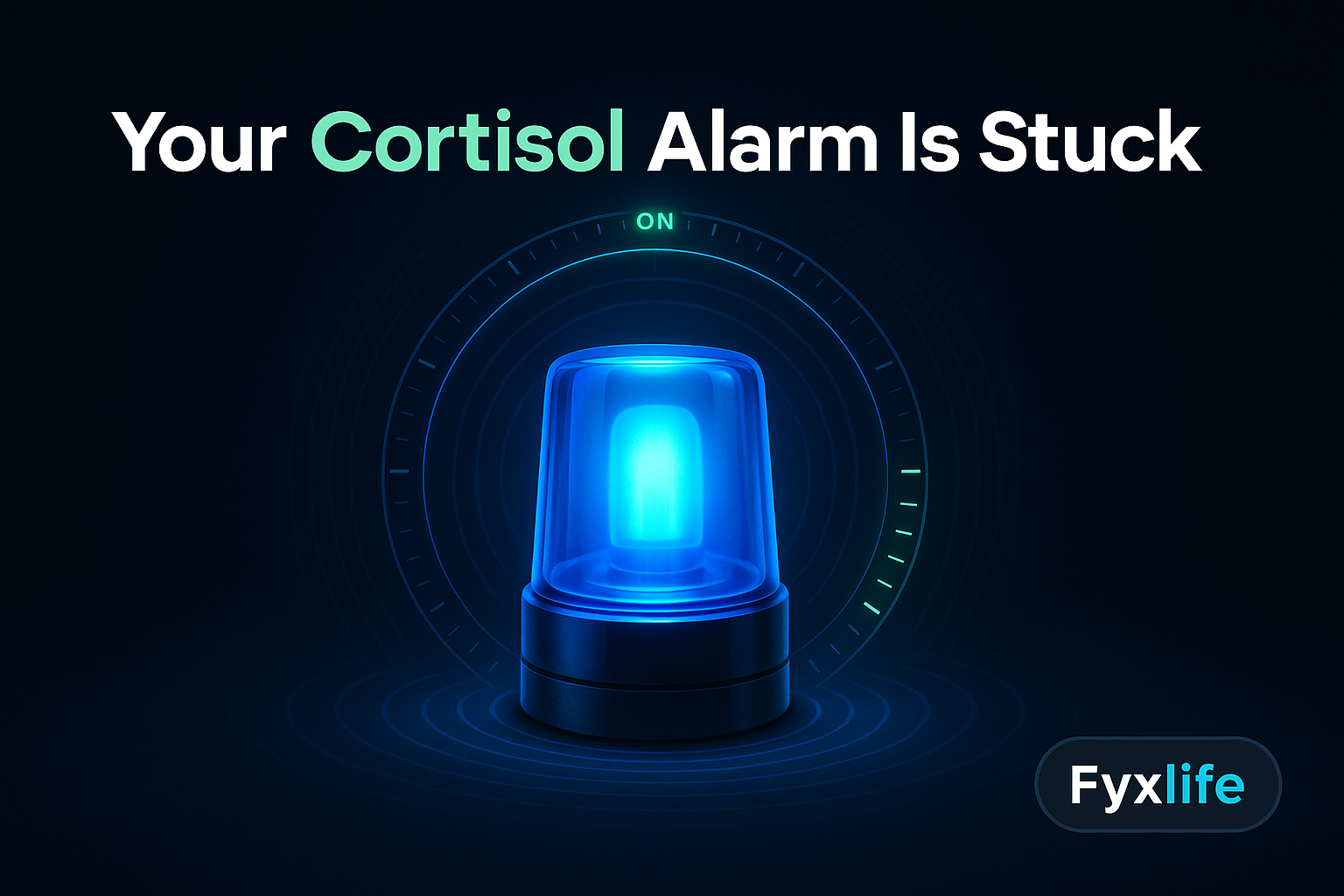
Think of cortisol like a car alarm. It’s designed to fire loudly for a short burst when there’s a real threat, then shut off. In chronic stress, the alarm never shuts off — it just keeps blaring, day and night. Eventually, the neighbours stop reacting (your body adapts and stops responding normally), the battery drains (your energy reserves collapse), and the constant noise starts damaging the surrounding structure (your organs, brain, and immune system). The alarm itself isn’t the problem. The problem is that it was never designed to run indefinitely.
What ‘chronically elevated cortisol’ actually means — and what it doesn’t
Chronically elevated cortisol doesn’t necessarily mean your blood cortisol level would show up as dangerously high on a standard test. In many people, it means the rhythm is wrong: cortisol is higher than it should be at night, lower than it should be in the morning, or responding disproportionately to minor stressors. The dysregulation is often in the pattern, not simply the absolute number. This is why a single fasting cortisol measurement can be misleading — it captures a snapshot, not the full story of how the system is behaving across 24 hours.
The Downstream Effects You Can Feel
Sleep disruption — why you can’t switch off
Permanently elevated cortisol levels are associated with belly fat accumulation, sleep problems, and exhaustion — three symptoms that often appear together in chronically stressed individuals. The sleep disruption is mechanistically direct. Cortisol and melatonin — the hormone that triggers sleepiness — are essentially antagonists. When cortisol remains elevated into the evening, melatonin cannot rise properly. You lie in bed with your mind running. You fall asleep eventually but wake unrested. The deep, slow-wave sleep your body uses for physical repair gets crowded out. And because poor sleep itself triggers cortisol release the next morning, the cycle reinforces itself.
Fat storage around the middle — the cortisol-insulin connection
Visceral fat — the kind stored deep around your abdominal organs, as opposed to the fat just under the skin — has a particular sensitivity to cortisol. Cortisol drives the body to store energy in preparation for ongoing threat, and visceral fat tissue has a high density of cortisol receptors. The mechanism doesn’t stop there. Research examining cortisol and appetite-related hormones found complex interactions between cortisol, insulin resistance (measured via HOMA-IR), and weight regulation — suggesting cortisol’s metabolic effects are mediated partly through its impact on insulin signalling. In plain terms: chronically elevated cortisol pushes your cells toward insulin resistance, which drives more fat storage and makes it harder to lose the fat already there. This effect is compounded during hormonally shifting periods such as perimenopause, when cortisol dysregulation stacks on top of declining oestrogen to accelerate abdominal weight gain and energy disruption simultaneously.
Immune suppression — why you keep getting sick
One of cortisol’s short-term jobs is to suppress inflammation — useful when you need to run from a threat, counterproductive when it runs for months. Chronic stress and elevated cortisol suppress immune system function, increasing vulnerability to illness — a pattern observed across multiple species and considered a conserved biological response. The result is what many people under sustained stress report anecdotally: they catch everything going around. Recovery takes longer. Minor infections linger. The immune system hasn’t failed — it’s been deliberately downregulated by the same hormone that was trying to protect them.
Energy and exhaustion — the tired-but-wired paradox
One of the most disorienting features of cortisol dysregulation is the coexistence of deep exhaustion and an inability to rest. Your body is physically depleted — glycogen stores are disrupted, muscle repair is suppressed, mitochondrial function degrades — but your nervous system is still receiving the signal to stay alert. You are tired but cannot switch off. This is not a mindset failure. It is a physiological state driven by an HPA axis that has lost its ability to return to baseline. People experiencing this often describe feeling like they’re running on fumes with the engine still revving.
The Brain Is Not Exempt
What sustained cortisol exposure does to memory and cognition
The hippocampus — the brain structure most critical for forming and retrieving memories — is particularly vulnerable to sustained cortisol exposure. It contains a high concentration of cortisol receptors, which makes it responsive to stress signals in ways that are useful short-term and damaging long-term. Prolonged cortisol elevation shrinks hippocampal volume, impairs the formation of new memories, and makes it harder to distinguish genuine threats from neutral events. The brain, in effect, gets trained to stay on alert. Concentration suffers. Word retrieval slows. The fog you attribute to aging or screen time may have a hormonal root.
The emerging link to Alzheimer’s-related pathology
The stakes extend beyond cognitive performance. High levels of cortisol and chronic stress activate the HPA axis, which may in turn exacerbate amyloid and tau pathology — two hallmarks of Alzheimer’s disease — and promote hippocampal changes associated with cognitive decline. This research is still developing, and no one is claiming that stress alone causes Alzheimer’s. But the finding that chronic cortisol elevation appears to accelerate the biological markers of the disease is significant. It reframes how seriously we should take sustained stress exposure — not as a quality-of-life inconvenience, but as a potential contributor to neurological disease decades later.
Why This Is a Medical Issue, Not a Mindset Issue
Chronic stress as a precursor to disease — what the research actually says
Chronic stress is classified as a significant precursor to various diseases and health conditions, consistently leading to poor health outcomes across multiple biological systems. That classification matters. It means that when your body is under sustained stress, you are not simply feeling bad — you are running a biological process that has measurable consequences for cardiovascular health, metabolic function, immune competence, and neurological integrity. The framing of stress as something to manage through willpower or positive thinking is not just insufficient — it misidentifies what is actually happening at a physiological level.
Many people living with the symptoms described here — the exhaustion, the middle weight, the sleep that doesn’t restore, the recurring infections — have been told, implicitly or explicitly, that they need to stress less. That advice is like telling someone with a broken thermostat to just wear a lighter jacket. The problem isn’t the perception of stress. It’s a regulatory system that has been pushed beyond its capacity to self-correct. That is a medical reality, and it deserves to be treated as one.
The challenge is that this is exactly the kind of question a routine annual check-up was not designed to answer — not because doctors don’t care, but because population-level reference ranges were never built to account for your specific cortisol rhythm, your sleep architecture, your metabolic response to sustained HPA activation. A 10-minute appointment that reviews a single fasting blood draw cannot tell you whether your cortisol system is dysregulated in the ways that matter.
How to Tell If Your Cortisol System Is Off
The signs — and why they’re easy to misattribute
The pattern worth paying attention to is not any single symptom in isolation, but the cluster. Waking unrefreshed despite adequate sleep hours. Abdominal weight that resists dietary changes. A second wind of alertness arriving at 10 or 11pm. Recurring illness. Difficulty concentrating in the afternoon. Heightened irritability in response to minor stressors. A sense of never fully recovering from exercise. Individually, each of these has a dozen possible explanations. Together, they describe a cortisol system that has lost its rhythm — the alarm that won’t stop blaring.
What testing can and cannot tell you
Testing for cortisol dysregulation is more nuanced than a single blood draw. A serum cortisol test taken at one point in time tells you relatively little about the full picture. More informative options include a four-point salivary cortisol test (which measures levels at waking, noon, late afternoon, and night to map the daily curve), or a 24-hour urinary free cortisol assessment. These give a view of the rhythm rather than just a number. Even then, interpretation requires context — cortisol levels interact with sex hormones, thyroid function, sleep quality, and training load in ways that make single-marker analysis insufficient. The test is a starting point, not a verdict.
What Actually Moves the Needle
The evidence-backed interventions for cortisol dysregulation are not glamorous. Consistent sleep and wake times — even on weekends — are among the most powerful tools for restoring HPA rhythm because the cortisol awakening response is directly entrained to your wake time. Sustained moderate exercise reduces cortisol reactivity over time, though intense training late in the day can temporarily spike levels and worsen sleep. Practices that activate the parasympathetic nervous system — slow breathing, cold exposure, extended exhales — have measurable short-term effects on cortisol and accumulate over time. Reducing chronic background stressors (not eliminating all stress, which is neither possible nor desirable) gives the HPA axis the recovery window it needs to recalibrate.
None of this requires a supplement protocol or a biohacking budget. Most of it requires protecting time that chronic stress is currently consuming. That is harder than it sounds — which is why the entry point matters. Not a full overhaul. One change, repeated consistently, until the system has evidence that the alarm can stop.
This week, apply the cortisol rhythm insight to one decision you’re already making: look at what happens in the last 90 minutes before you sleep. If you’re exposing yourself to bright screens, work email, intense news, or hard training after 9pm, you are likely signalling your HPA axis to stay elevated at precisely the time your cortisol should be falling. Pick one of those inputs and remove it tonight — not as a lifestyle overhaul, but as a single experiment to see whether your sleep onset or morning energy shifts within seven days.