
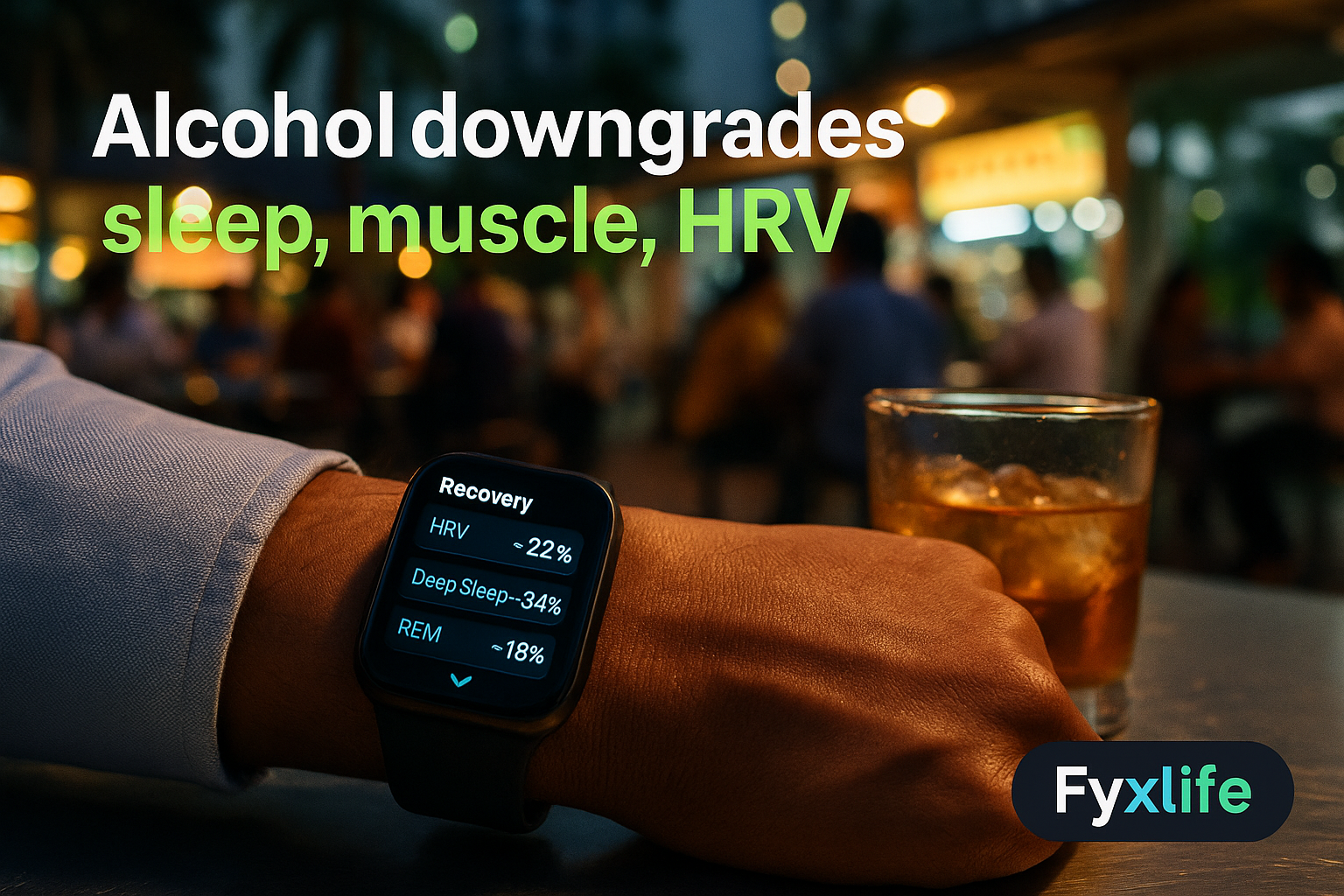
You train hard, sleep seven hours, and still wake up feeling like you did neither. If you had two or three drinks the night before, that feeling has a measurable explanation. The question is not whether alcohol affects recovery — it does — but how much, at what dose, and whether the damage is as catastrophic as the wellness internet suggests.
The honest answer is somewhere between “don’t worry about it” and “never drink again.” And getting to that honest answer requires understanding what recovery actually is, what alcohol actually does to it, and where the real leverage points sit — because most of the nuance gets lost in the noise between abstinence evangelists and people who would rather not think about it at all.
The Verdict Up Front — Alcohol Damages Recovery, but the Dose Is the Poison
Alcohol disrupts recovery. That is not contested. But the disruption is dose-dependent, timing-dependent, and context-dependent — and for most busy professionals drinking socially, the damage is real but manageable if you know where the levers are. Growing clinical interest in the interaction between social drinking and physical adaptation reflects just how seriously the research community now takes this question. What the data shows is not a binary warning — it’s a gradient. Two drinks on a rest-day evening is not the same as three drinks two hours after a hard training session. The distinction matters.
What ‘recovery’ actually means biologically
Recovery is not just rest. It is a cascade of coordinated biological processes that happen almost entirely while you sleep. Your heart rate variability — the beat-to-beat variation in your heart rate that your wearable uses as a proxy for nervous system readiness (the technical term is HRV, or heart rate variability) — rises as your body shifts into the parasympathetic state associated with deep repair. During slow-wave sleep and rapid eye movement sleep (what researchers call sleep architecture — the structured progression through sleep stages your brain cycles through every 90 minutes), your pituitary gland releases growth hormone, your muscles rebuild damaged fibres through a process called muscle protein synthesis, and your immune system clears the inflammatory debris from the day’s stress. Miss those stages, and the hours in bed are largely cosmetic. You were present, but the work was not done.
How Alcohol Disrupts the Recovery Process — The Mechanisms
Sleep architecture: you sleep, but your body doesn’t repair
Think of your body’s overnight recovery as a building crew that shows up at midnight to repair the day’s damage. Alcohol is like sending the foreman home early and cutting the crew in half — the workers who arrive (sleep hours) look fine on paper, but the most skilled specialists (deep sleep and REM) never showed up, so the structural repairs never got done. You wake up eight hours later in a building that looks the same but has unfinished work hidden inside the walls.
This is the primary mechanism, and it is why the feeling is so recognisable. Alcohol suppresses REM sleep and deep slow-wave sleep — meaning you clock the hours but miss the repair. In the first half of the night, alcohol’s sedative effect accelerates sleep onset, which is why it feels like it helps. In the second half, as your liver metabolises the alcohol, your brain rebounds into a lighter, more fragmented state. The restorative stages get compressed or skipped entirely.
Muscle protein synthesis: the cell growth switch gets turned off
Exercise breaks muscle fibres down. Recovery builds them back stronger — but only if the biological signalling cascade that triggers rebuilding stays switched on. Alcohol blunts muscle protein synthesis — the process by which your cells rebuild damaged muscle tissue — precisely when post-exercise recovery demands it most. The molecular pathway responsible is called mTOR (mechanistic target of rapamycin), the cell’s growth and repair signalling system. Alcohol suppresses mTOR activation. The result is that the training stimulus was delivered, but the adaptation is partially blocked. You did the work. The gains were discounted.
HRV and the nervous system: why your wearable tanks the morning after
Among people who track their recovery with wearables, the pattern after drinking nights is strikingly consistent: HRV drops, resting heart rate rises, and the device flags low recovery — even after what many describe as just two or three drinks. One user tracking their data put it plainly: “I thought I slept well. The data disagreed.” This is not a calibration error. Alcohol activates the sympathetic nervous system — the branch associated with stress and alertness — when it should be handing over to the parasympathetic state that drives overnight repair. Your resting heart rate rises because your heart is working harder to process the metabolic load. Your HRV falls because the nervous system is not in the balanced, recovered state it needs to be. The numbers reflect real physiology.
Inflammation: adding fuel when the fire needs to go out
Exercise creates controlled inflammation — a necessary signal that triggers adaptation. Recovery is the process of resolving that inflammation so the next session can build on a clean foundation. Alcohol adds to the inflammatory burden at exactly the wrong moment. It elevates pro-inflammatory cytokines — the immune system’s chemical alarm signals — at a time when your body is trying to reduce them. The result is a longer resolution window, higher baseline soreness, and a blunted adaptation signal. You are not recovering slower because you are unfit. You are recovering slower because you introduced competing signals into the process.
Does Timing Change the Damage?
The post-workout window — the highest-risk window explained
Timing is not a minor variable. It may be the most important one. Alcohol consumed within hours of exercise causes more measurable damage than alcohol consumed the following evening. The reason is that the post-exercise window — roughly the four to six hours after training — is when muscle protein synthesis is most elevated and the adaptation signal is at its peak. Introducing alcohol during this window suppresses the exact biological process you just trained to trigger. It is the equivalent of switching off the building crew during their most productive shift.
Drinking the night before a hard session vs. after a rest day
Context shifts the calculus significantly. Drinking on a rest-day evening, when no training stimulus is in the system and the next session is 24 hours away, gives your body more recovery runway. The sleep disruption still occurs, but the downstream cost — blunted muscle protein synthesis, suppressed adaptation — is lower when there is no acute training load to adapt from. Drinking the night before a hard session compounds the problem in the other direction: you arrive at that session with depleted HRV, disrupted sleep architecture, and an elevated inflammatory baseline. The session is harder, the adaptation is weaker, and the recovery from it takes longer.
Light Drinking vs. Heavy Drinking — Is the Damage the Same?
What the dose-response evidence actually shows
The evidence is clear that this is not a binary relationship. Light social drinking likely causes modest, temporary recovery suppression for most people, while chronic or heavy drinking compounds into systemic hormonal and inflammatory damage that extends well beyond individual recovery windows. The mechanisms are the same — sleep architecture disruption, mTOR suppression, sympathetic nervous system activation — but the magnitude and duration of the effect scale with dose and frequency. One drink on a Friday evening and six drinks three nights a week are genuinely different physiological events.
Where the threshold appears to sit for recovery-relevant harm
The honest answer is that the threshold is lower than most people assume and more individual than any population study can specify. For sleep architecture disruption, even one to two standard drinks appears to meaningfully suppress slow-wave sleep in sensitive individuals. For muscle protein synthesis, the blunting effect has been demonstrated at doses achievable in a normal social evening. The point is not to manufacture anxiety about a single glass of wine — it is to discard the idea that there is a safe number below which alcohol has no effect on recovery. There likely is not. The question is whether the effect is meaningful enough, in your specific context, to change behaviour.
Special Case — Alcohol After Surgery or Injury
Wound healing, immune suppression, and medication risks
If you are recovering from surgery or a significant injury, the calculation changes entirely. Alcohol impairs wound healing through multiple pathways: it reduces the activity of immune cells responsible for clearing infection, disrupts the collagen synthesis that rebuilds connective tissue, and increases bleeding risk by interfering with platelet function. Add medication interactions — many post-surgical analgesics and antibiotics carry explicit contraindications with alcohol — and the risk profile moves from “manageable” to genuinely harmful. The post-surgical recovery context makes alcohol a separate risk category entirely, beyond fitness considerations. This is one area where the guidance is not about optimisation — it is about not actively undermining the healing process.
The Tech Verdict — Worth It, Conditionally Harmful, or a Hard No?
Verdict by use case: occasional social drinker, regular trainer, post-surgery recovery
For the occasional social drinker who is not in an intensive training block and has no injury or surgery in the picture: the damage is real but modest, and the right response is awareness rather than abstinence. For the regular trainer who is serious about adaptation and performance: timing and dose are the variables worth managing, and the post-workout window is the one to protect. For anyone in post-surgical or injury recovery: alcohol should be minimised or eliminated for the duration of the healing window, full stop. These are not the same situation, and they do not deserve the same answer.
The three levers that actually change the outcome: timing, dose, sleep protection
If you are not going alcohol-free — and most people are not — the three levers with the most evidence behind them are timing, dose, and sleep protection. Shift drinking to rest-day evenings where possible. Keep dose below the threshold where sleep architecture disruption becomes severe for you personally. And if you do drink, protect sleep duration aggressively: the partial recovery available from a full eight hours of disrupted sleep is meaningfully better than six hours of disrupted sleep. Managing alcohol intake alongside training and diet is increasingly recognised as a key lever for professionals in their 40s and 50s seeking to reverse metabolic decline — not because alcohol is uniquely toxic, but because at this life stage, recovery capacity is the limiting factor. Protecting it has compounding returns.
What To Do Instead of Quitting Entirely
One practical protocol for the professional who is not going alcohol-free
The goal is not perfection. It is deliberate management. Reserve drinking for evenings that follow rest days or light activity days — not the nights after hard sessions or before early morning training. When you do drink socially, set a dose ceiling before you arrive rather than in the moment. Prioritise sleep quantity on nights after drinking, since you cannot fully recover the quality but you can extend the window. And use your wearable data honestly — not to punish yourself, but to build a personal dose-response picture that is more accurate than any population-level guideline. The challenge is that this kind of individual-level analysis — mapping your specific recovery suppression against your specific drinking patterns — is exactly the kind of question a routine annual check-up was not designed to answer. Not because doctors do not care, but because a ten-minute appointment and a standard blood panel were never built to interrogate your HRV data on drinking nights versus non-drinking nights. That gap is real, and the data you already have on your wrist is the most direct way to close it.
Check your last three nights of wearable data (HRV, resting heart rate, sleep score) and tag which nights followed alcohol. If you see a consistent pattern of suppressed recovery on drinking nights, you now have your personal dose-response signal — use it to decide whether to shift the timing of your next drink to a rest-day evening rather than a training-day night.


