
What This Research Is Actually About
The study and its key finding in plain English
You used to start things easily. Now the same tasks feel heavier — not because you’ve lost discipline, but because the brain chemistry that once made effort feel worthwhile is quietly changing. New research is revealing exactly how the dopamine system shifts with age, and what that means for anyone trying to protect their focus, motivation, and long-term cognitive health.
For most people, the first explanation they reach for is psychological: stress, burnout, distraction, a lack of willpower. What the emerging science suggests is more specific — and more useful. New research points to declining levels of a brain protein called BDNF (brain-derived neurotrophic factor) as a key driver of age-related motivational loss, with BDNF acting directly on the same pathways that govern how dopamine signals are processed and reinforced. This is not a metaphor for getting older. It is a measurable neurochemical shift — and, critically, one the research suggests may be partially reversible.
Why this matters specifically for adults over 35
The dopamine system does not collapse suddenly. It recalibrates gradually, over years, in ways that are easy to misread as personality changes or life circumstances. You become harder to excite. Meaningful projects feel like they require more activation energy than they used to. You notice that the tasks you once started without thinking now require negotiation with yourself. If you are in the 35–60 range and you have a family history of cognitive decline, this is not background noise. This is signal.
Understanding the mechanism matters because the intervention looks nothing like what most people try. More effort does not fix a miscalibrated system. Knowing what does is the starting point.
The Mechanism — How Dopamine Actually Builds (and Breaks) Habits
Dopamine as a salience signal, not a pleasure button
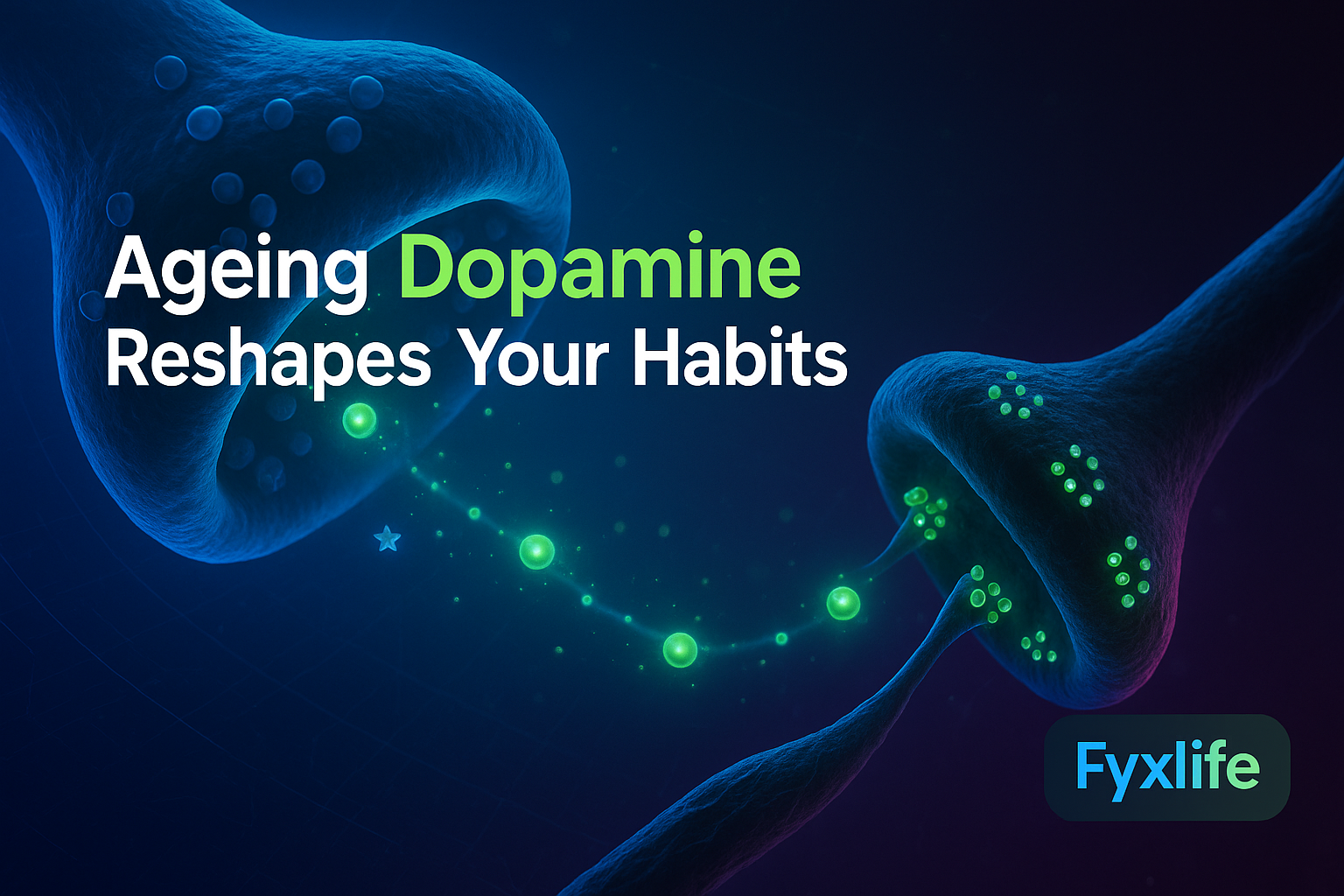
Here is the most important correction most people need: dopamine is not primarily about pleasure. It is a salience signal — the brain’s way of flagging what is worth learning, what is worth repeating, and what deserves your future attention. When this signal degrades, the problem is not laziness — it is a miscalibrated learning system. Your brain is no longer accurately distinguishing between experiences that deserve repetition and those that do not.
This distinction matters enormously. The question is not “why don’t I feel good enough?” It is “why has my brain stopped accurately flagging what is worth the effort?”
How the brain learns what is worth repeating
Every time you complete a meaningful action — a hard conversation, a long run, a focused work session — your brain runs a rapid internal evaluation. Did that deliver? Was the effort proportionate to the outcome? Dopamine is the signal that encodes that answer and determines whether the behaviour gets filed as “worth doing again.” Research shows that dopamine does not simply amplify the sensation of reward — it directly alters how the brain evaluates trade-offs, shaping the actual decision-making architecture beneath conscious thought. This is why dopamine system health is inseparable from cognitive health: what you are capable of reasoning through clearly is partly a function of what your dopamine system has learned to value.
The plain English analogy: the star-rating system in your brain
Think of your dopamine system as a restaurant rating app in your brain. Every time you complete an action, your brain gives it a star rating — and dopamine is what determines how high that rating goes. Finishing a hard project, completing a workout, sustaining focus for ninety minutes: these earn high ratings, and your brain books them again. But if you flood the app with junk reviews — constant scrolling, instant gratification, low-effort stimulation — the ratings get inflated and distorted. Eventually, the hard-but-valuable experiences get buried under noise, and your brain stops booking them. You have not lost discipline. Your rating system has been gamed.
A healthy, selective dopamine system connects motivation to meaningful action and learns when a behaviour is not worth repeating — but when the system is flooded by low-effort, high-stimulation inputs, this selectivity breaks down. The person who described themselves online as feeling like a “dopamine zombie” for two years — not from any clinical diagnosis but from a slow erosion of motivation they traced to constant low-effort entertainment — was describing, without the vocabulary, exactly what the neuroscience of neuroadaptive changes predicts.
What the Research Found
BDNF decline and age-related motivational loss
BDNF (brain-derived neurotrophic factor) is a protein that supports the growth, maintenance, and survival of neurons — particularly in regions central to learning, memory, and reward. As levels of BDNF fall with age, the dopamine reward pathways they support begin to operate less efficiently. Research now links this BDNF decline directly to age-related motivational loss — and, importantly, suggests the system may be restorable rather than simply accepted as inevitable. This reframes the entire conversation. The brain fog and motivational flatness that many people in their forties and fifties attribute to stress or getting older may have a more specific, addressable neurobiological basis.
Neuroadaptive changes from repeated dopamine surges
The same system that can be supported through meaningful activity can also be progressively destabilised through the opposite. Repeated high-stimulation inputs — whether from social media, ultra-processed food, or other rapid-reward sources — produce neuroadaptive changes in the brain regions governing motivation and salience, effectively rewiring how the brain assigns importance to experiences. These are not dramatic or sudden changes. They accumulate over months and years. The result is a baseline recalibration: experiences that would once have felt engaging now barely register, and the gap between where your attention naturally goes and where your goals actually live grows wider.
Sustained activities — exercise, learning, deliberate practice — create long-term dopamine system stability, in contrast to the short-term spikes from quick-fix stimulation that destabilise baseline motivation over time. This is not a wellness platitude. It is a description of how the system responds differently to different input types at the neurochemical level.
How stress quietly undermines the dopamine system
Chronic stress and motivational decline are often treated as separate problems — one psychological, one neurochemical. The research suggests this distinction is artificial. Despite strong evidence that chronic stress disrupts dopamine signalling, the dopaminergic system has received remarkably little attention in both clinical and preclinical stress research. This is a meaningful gap. The brain fog, the difficulty initiating tasks, the sense of effort without return that many high-performing adults report after sustained periods of pressure — these may be more accurately understood as dopamine system disruption than as purely psychological symptoms. Treating them as purely psychological may explain why the usual interventions — mindset work, better sleep habits, more exercise — sometimes help partially but rarely resolve the full picture.
What This Research Cannot Prove
Limitations: what was studied vs. what was not
The research on BDNF, dopamine, and motivational decline is directionally compelling — but it is not yet a clinical protocol. The connection between BDNF decline and dopamine pathway deterioration is real and measurable; the question of how to restore it reliably in humans, at what stage, and through which specific interventions remains open. Studies examining pharmacological approaches to dopamine restoration — particularly in the context of the inability to feel reward or pleasure (the clinical term for this is anhedonia) — are ongoing, with researchers now looking at how dopamine restoration influences reward-related cognitive tasks. These are promising early directions, not established treatments.
The gap between animal models and human clinical application
Much of the foundational work on dopamine system recalibration and neuroadaptive changes comes from animal models. The mechanisms translate convincingly to human neuroscience — but the dose, duration, and individual variability questions are substantially less resolved in humans. Research also shows that the endocannabinoid system modulates dopamine release, suggesting that multiple intersecting biological pathways influence how habits form and how motivation is sustained — which means the system is more complex and more individually variable than any single model captures. The honest summary: the mechanism is well-supported; the optimal intervention strategy for a specific person at a specific age is not yet standardised.
This is precisely the kind of question a routine annual check-up was not designed to answer — not because doctors don’t care, but because population-level reference ranges were never built to account for your specific age-related BDNF trajectory, stress history, and stimulation environment simultaneously.
What It Means For You — The Practical Translation
Why willpower alone fails when the system is recalibrated
When the dopamine system’s baseline has shifted, applying more willpower to the same problem is like trying to fix a distorted compass by walking more confidently. The instrument is the issue, not the effort. The person who described noticing “if you scroll while you work, that’s a clear sign” was identifying something real: the act of interleaving low-effort stimulation with high-effort tasks does not just divide attention — it actively feeds the rating system the wrong data, teaching your brain that even your most important work happens in a low-value context. Willpower works when the system is calibrated. Recalibration is a different project.
Sustained activities vs. quick-fix inputs: the stability trade-off
The practical implication is not that you need to eliminate pleasure or live an ascetic life. It is that the type of input matters structurally. Activities that require sustained engagement — physical exercise, skill acquisition, extended creative or analytical work — are not just good for you in a general sense. They are the specific inputs that reinforce the selectivity of the dopamine system, teaching it to hold high ratings for high-effort experiences. Quick-fix inputs do the opposite. The question to ask about any habitual activity is not whether it feels good in the moment, but whether it is calibrating your brain toward harder things or away from them.
One measurable signal to watch in your own cognitive health
Motivational decline rarely announces itself clearly. It arrives as friction — the sense that tasks require more activation energy, that focus dissolves faster, that what used to feel engaging now feels flat. If that pattern is present and has been building over months rather than days, the research suggests it is worth tracking rather than explaining away. Your own longitudinal data — not population averages — is the most relevant signal you have.
The Single Action This Week
Pull up whatever habit tracker, calendar, or wearable data you already have and look at one metric tied to sustained effort — workout consistency, deep work blocks logged, or even sleep quality scores — over the past 90 days. If you see a declining trend alongside growing difficulty initiating tasks, this research suggests your dopamine system’s baseline selectivity may be worth discussing with your doctor, particularly in the context of BDNF-related motivational decline and whether any restorative interventions are appropriate for your age and health profile.


