
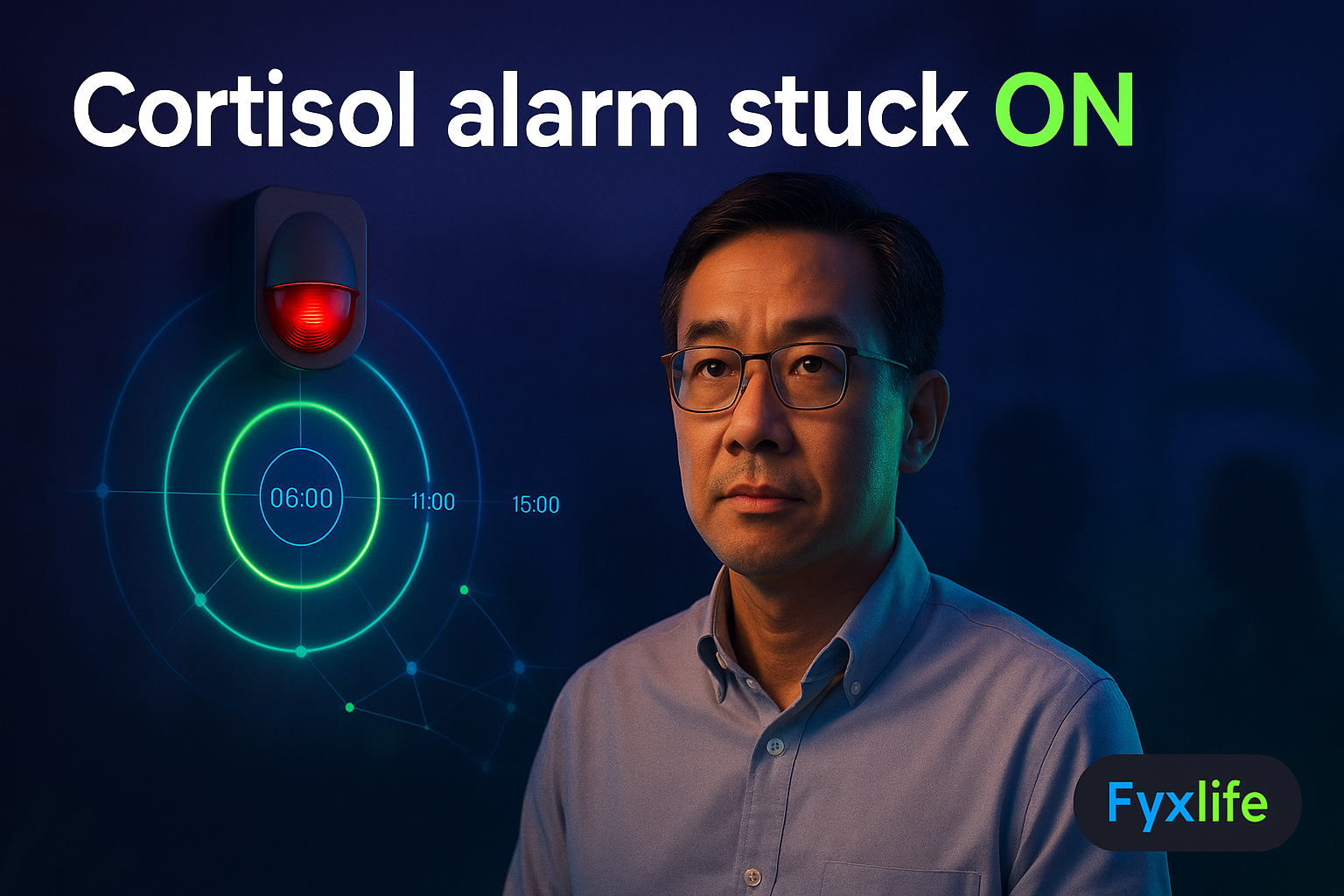
You sleep seven hours, eat reasonably well, and exercise when you can — yet you wake up exhausted, carry weight around your middle that won’t budge, and feel one bad meeting away from a complete crash. The problem may not be your habits. It may be a hormone that was designed to save your life, now stuck in the ‘on’ position — cortisol.
Most people have heard the word. Fewer understand what it actually does — or why the same hormone that kept your ancestors alive on the savannah is now quietly dismantling your sleep, your metabolism, and your ability to recover from a hard week at work.
What Is Cortisol — And Why Does Your Body Make It?
The adrenal glands and the HPA axis: your internal alarm control centre
Cortisol is a steroid hormone produced by the outer layer of the adrenal glands — two small but extraordinarily powerful organs that sit on top of your kidneys — and it is so central to the body’s stress response that it has earned the nickname ‘the stress hormone.’ But the adrenal glands don’t act alone. They are the final link in a chain of command called the HPA axis — the communication loop running between your hypothalamus (the brain’s command centre), your pituitary gland (its executive assistant), and your adrenal glands (the hormone factory that takes the order and ships the product). When your brain perceives a threat, it fires a signal down this chain, and cortisol is released into your bloodstream within seconds.
The speed of this system is the point. You were never supposed to think carefully about running from a predator. You were supposed to run.
The diurnal rhythm — why cortisol is supposed to peak in the morning and fall by night
Cortisol follows a precise daily pattern — a diurnal rhythm, meaning a biological cycle tied to the 24-hour day. Under normal, healthy conditions, cortisol peaks sharply in the first 30 to 45 minutes after you wake up. This is called the cortisol awakening response, and it is not a stress reaction — it is your body’s natural ignition sequence, preparing your cells for the demands of the day ahead. From that morning peak, cortisol is supposed to gradually decline through the afternoon and fall to its lowest point in the hours around midnight, allowing your nervous system to downshift into recovery mode. When this rhythm is intact, you wake alert, function clearly, and wind down naturally. When it breaks down — as it does under chronic stress — the consequences ripple across every system in your body.
What Cortisol Actually Does In Your Body
The six systems it governs: stress response, blood sugar, blood pressure, metabolism, sleep, and mood
Cortisol is not a niche hormone. It helps regulate at least six major systems: your body’s response to stress, internal balance (what physiologists call homeostasis), metabolism, blood sugar levels, blood pressure, sleep, and mood. That breadth matters, because it means when cortisol is dysregulated, you do not feel one thing going wrong. You feel everything going slightly wrong at the same time — and the diffuse nature of that experience makes it easy to chalk up to ageing, overwork, or just life.
When cortisol is working correctly: the short spike that saves you and then switches off
In its intended role, cortisol is remarkably elegant. A threat appears. Cortisol surges, rapidly raising blood sugar to fuel your muscles, elevating blood pressure to push oxygen to your limbs, sharpening your focus by suppressing non-essential functions like digestion and immune activity, and flooding your system with the energy to act. The threat resolves. Cortisol drops. Your body returns to baseline. Recovery begins. The whole system is designed around one critical assumption: that the spike will be followed by a fall. The alarm goes off, the building clears, and then the alarm switches off.
The Double-Edged Sword — When Protection Becomes Damage
Acute stress vs chronic stress: same hormone, completely different outcome
Cortisol serves as a double-edged sword — its effects are protective when elevation is short-term and acute, and destructive when it is ongoing and chronic. The distinction is not metaphorical. It is biochemical. A single cortisol spike activates your immune system. Sustained cortisol elevation suppresses it. A single spike sharpens memory formation. Sustained elevation shrinks the part of your brain responsible for memory and emotional regulation — a region called the hippocampus. The same molecule, the same receptor, the same signalling pathway. The difference is duration.
How modern work creates the worst-case scenario for cortisol regulation
Think of cortisol as a fire alarm in your building. When there’s a real fire, it’s the most useful system you have — it wakes everyone up, clears the building, and saves lives. But imagine the alarm starts going off every morning at 6am, again at 11am, again at 3pm — triggered by smoke that isn’t really there. Nobody gets hurt in any single incident. But after months of interrupted sleep, blaring noise, and constant low-grade panic, the building’s residents are exhausted, their concentration is shot, and the alarm itself starts malfunctioning. That is your HPA axis on chronic stress. The alarm was never the problem. It is that it was never allowed to switch off.
This is precisely what the modern professional environment creates. Constant low-level threat signals — email notifications, approaching deadlines, financial pressure, unresolved workplace conflict — keep the alarm activated without ever providing the physical resolution the system was built around. Your ancestors ran from the threat or fought it. Their cortisol had somewhere to go. Yours accumulates through back-to-back video calls and a phone that never goes silent, with no physical discharge on the other side.
What Chronic High Cortisol Actually Does To You
The inflammation chain reaction — low-grade, tissue-wide, invisible
Chronically elevated cortisol levels cause a chain reaction of damage throughout the body — what researchers call systemic inflammation — that gradually deteriorates tissues across multiple organ systems. This is not the acute inflammation you feel when you sprain an ankle. It is quieter and more insidious: a persistent, low-grade immune activation that operates below the threshold of obvious symptoms while progressively wearing down cardiovascular tissue, gut lining, joints, and brain function. You do not feel it happening. You feel the cumulative result — years later, in the form of conditions that seem to have appeared out of nowhere.
Why you gain weight around your organs even when your diet hasn’t changed
Elevated cortisol levels caused by chronic stress drive weight gain, tiredness, and long-term health deterioration — and the weight pattern is specific. Cortisol preferentially promotes the accumulation of visceral fat, the fat stored around your abdominal organs rather than under your skin. This type of fat is metabolically active in the worst possible way: it secretes its own inflammatory signals, worsens insulin sensitivity (your cells’ ability to respond to the blood sugar-regulating hormone insulin), and increases cardiovascular risk. This is the weight around your middle that doesn’t shift with calorie restriction alone, because it is not primarily a calorie problem. It is a hormonal environment problem.
The sleep-cortisol trap: high cortisol disrupts sleep, poor sleep raises cortisol
Chronic high cortisol has a direct negative relationship with the hormones that regulate your sleep cycle — most critically melatonin, the hormone that signals darkness and initiates sleep onset. Cortisol and melatonin are designed to be inversely matched: as one rises, the other falls. When cortisol remains elevated into the evening, melatonin is suppressed, sleep onset is delayed, and the restorative deep sleep phases are shortened. The cruel feedback loop is that poor sleep then drives cortisol higher the following day. You cannot sleep because cortisol is elevated. Your cortisol is elevated partly because you cannot sleep. Neither problem fixes itself without deliberate interruption.
The fatigue paradox: why being tired but wired is a cortisol signature
If you have ever found yourself physically exhausted at 10pm but mentally unable to switch off — scrolling, ruminating, getting a second wind you did not ask for — that is not a caffeine issue or a screen time issue, though both can amplify it. It is the cortisol rhythm broken at its most fundamental point. Much of the real damage attributed to stress comes not from the stressful events themselves, but from the body’s prolonged cortisol response failing to return to baseline. The ‘tired but wired’ state is your nervous system caught between two competing signals: a body depleted from months of sustained activation, and a stress hormone that has lost its timing cues and is still firing when it should have gone quiet hours ago.
How To Know If This Is Happening To You
Symptoms that cluster together in high-cortisol states
No single symptom confirms cortisol dysregulation, but certain clusters are telling. Waking unrefreshed despite adequate sleep hours. Difficulty falling asleep despite genuine exhaustion. Abdominal weight that persists regardless of diet effort. Afternoon energy crashes followed by late-evening alertness. Increased susceptibility to colds and infections. Brain fog and reduced capacity for complex thinking by mid-afternoon. Heightened irritability in response to minor stressors. Craving for salt and sugar — both driven by cortisol’s effect on blood sugar and adrenal signalling. The individual symptoms are easy to explain away. The pattern is harder to ignore.
What testing can and cannot tell you
Cortisol can be measured through blood, saliva, or urine — each capturing a different slice of the picture. A single morning blood cortisol gives you one data point in a hormone that fluctuates across the entire day. A diurnal salivary cortisol test — samples taken four times across the day — is more clinically informative because it reveals the shape of your cortisol curve, not just one moment in it. A 24-hour urinary free cortisol test captures total daily output. The challenge is that standard annual health screens rarely include any of these. They are designed to catch pathology — conditions like Cushing’s syndrome (dangerously high cortisol) or Addison’s disease (insufficient cortisol production) — not to identify the functional dysregulation that sits in the space between clearly sick and clearly well. The kind of question this article is asking you to consider — whether your cortisol rhythm is subtly broken in a way that explains years of fatigue — is exactly the kind of question a routine appointment was not designed to answer. Not because doctors don’t care, but because population-level reference ranges were never built to reflect your specific pattern across a full day.
The Good News — Cortisol Is Modifiable
What the evidence supports for bringing cortisol back into rhythm
Cortisol responds to behaviour in a way that few hormones do as reliably. The body’s cortisol adaptation mechanism was built for short-term survival — sustained activation is not its intended state, which means there is a genuine return path. Regular aerobic exercise produces a temporary cortisol spike followed by a steeper-than-baseline fall, gradually recalibrating the HPA axis’s sensitivity over weeks. Consistent sleep and wake times reinforce the diurnal rhythm by giving cortisol its strongest environmental cue. Diaphragmatic breathing — slow, deliberate breathing that activates the parasympathetic nervous system (the body’s rest-and-recover state, the biological counterpart to the stress response) — has been shown to lower cortisol within a single session. Social connection and time in natural environments both reduce the background rate of low-level threat perception that keeps the HPA axis primed. These are not alternative medicine suggestions. They are mechanisms acting on a system that is physiologically responsive to exactly these inputs.
The key insight is this: the cortisol system was not broken by a single event. It was gradually shifted out of rhythm by sustained signals that told it the threat never ended. Bringing it back into rhythm works the same way — not through a single intervention, but through repeated signals that tell the system it is safe to switch off.
This week, apply one mechanism insight to a decision you are already making: if you notice the ‘tired but wired’ feeling — exhausted but unable to wind down after 9pm — treat it as a cortisol timing signal rather than a willpower problem. Instead of working through it or scrolling to decompress, choose a 10-minute physical wind-down — a short walk, gentle stretching, or slow breathing — that gives your nervous system the physical resolution it was designed to receive after a stress spike. You are not fixing cortisol in a week, but you are interrupting the loop once — and noticing whether it shifts how quickly you fall asleep that night.


