
QUICK ANSWER
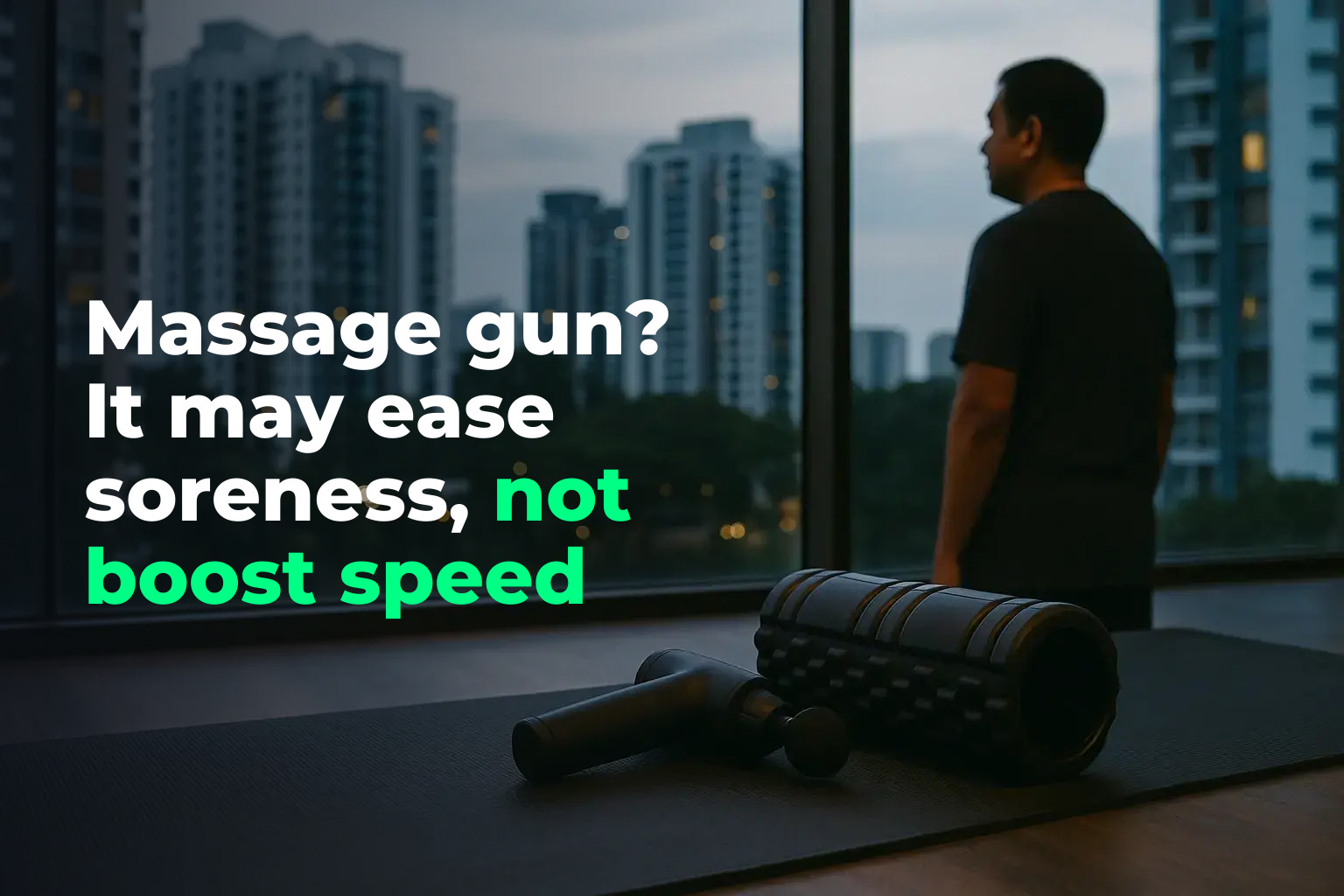
A massage gun may ease tightness and soreness, but it has not been proven to improve speed, power or endurance. Foam rolling gives a similar short-term flexibility boost. A short warm-up gave a similar immediate flexibility gain in one trial, so buy a device only if you will use it.
Key takeaways
- Both tools give a short-term boost in flexibility. The evidence is small and mixed.
- In young active men, a massage gun eased muscle soreness better than static stretching.
- In one small trial, neither tool improved explosive strength or endurance.
- A Cleveland Clinic guide suggests up to about 10 minutes per muscle group. That is practical advice, not a proven safety limit.
- A massage gun helps you feel looser, not run faster.
At a glance
Massage gun vs foam rolling: how strong is the evidence? Grades reflect how many studies there are, how well they agree and how relevant they are to you.
| Claim | Massage gun | Foam rolling | Evidence grade |
|---|---|---|---|
| Short-term flexibility | Helps in small trials | Helps | Mixed |
| Soreness after exercise | Beat static stretching in one trial | Not covered here | Weak |
| Explosive strength and endurance | No gain in one small trial | No gain in one small trial | Weak |
| Aerobic fitness | Not covered here | No improvement | Mixed |
| Versus an 8-minute dynamic warm-up (immediate sit-and-reach only) | Similar | Similar | Weak |
| Feeling less fatigued | May help | Not covered | Weak |
Is a massage gun actually helpful?
A massage gun may help with tightness, flexibility and soreness after exercise. It has not been proven to improve speed, power or endurance [1].
Singapore’s HealthHub advises 150 to 300 minutes of moderate activity a week, plus muscle-strengthening on at least two days [2]. A massage gun is an optional extra on top of that routine. It does not replace the training itself.
A massage gun delivers rapid, repeated taps to soft tissue. Foam rolling means rolling your body weight over a firm cylinder.
In a small group of young men, a massage gun improved hamstring flexibility more than foam rolling or no treatment. Neither tool improved explosive strength or endurance [3].
A physical therapist at the Cleveland Clinic says guns may also help you feel less fatigued [1]. Treat that as a nice extra, not a promise.
A massage gun helps you feel looser, not run faster. That surprises many buyers.
For example, if your hips are stiff after a day of back-to-back video calls, a few minutes with the gun before your 8 pm condo gym session is a sensible use.
What does the research say about soreness and recovery after training?
The research points to less soreness and better flexibility, with no clear gain in performance.
In young active men, percussion massage worked better than static stretching for easing soreness after hard exercise [4]. Foam rolling raised flexibility but did not improve aerobic fitness [5]. A single rolling session also improved flexibility in recreational runners [6].
Feeling better is not the same as faster recovery
The studies reported soreness, flexibility and immediate performance results. The reviewed evidence does not show that either tool heals muscle faster [4] [5].
So a tool may make a sore leg feel better, and that can be reason enough to use it.
What the studies actually used
It helps to know who was tested and how:
- Soreness trial: active young men had percussion massage in two sessions of either 25 or 40 minutes. The 40-minute sessions gave more benefit [4].
- Warm-up trial: active young adults had 8 minutes of rolling, percussion or a leg-cycling warm-up, then a sit-and-reach test [7].
- Runner trial: recreational runners had a single foam rolling session [6].
- Strength and endurance trial: a small group of active young male students had one session of each tool [3].
Most of these trials were small, short and in active young people, so the results are early.
Why this varies from person to person
The studies so far involved active, relatively young adults [3] [4] [6] [7]. Your results may differ if you are older, new to exercise or coming back from an injury.
Foam rolling: what does it do, and is it better than stretching?
The reviewed evidence supports a short-term increase in flexibility from foam rolling. It does not show faster tissue healing or better aerobic fitness [5].
No source here shows that foam rolling beats stretching. The only stretching comparison is for a massage gun, which eased soreness better than static stretching in young men [4].
A warm-up is a different comparison. An 8-minute dynamic warm-up produced a similar immediate sit-and-reach improvement to 8 minutes of foam rolling or a massage gun in one trial [7]. That result says nothing about soreness or muscle repair over the next days.
Before a run along the park connector, a short roll of calves and thighs is one easy option. A few leg swings are another.
How often and for how long can you use a massage gun or foam roller?
A Cleveland Clinic guide suggests using a massage gun for up to about 10 minutes on one muscle or muscle group [1]. This is practical guidance, not a proven daily safety limit.
For a tender trigger point, Cleveland Clinic advises pressing with a roller or massage ball for up to 90 seconds [8]. A chiropractor there suggests repeating this for three to five minutes at a time, up to five or six times a day [8].
Those figures come from trigger-point self-massage. They are not a tested daily limit for full foam-rolling or massage-gun sessions.
If you are short on time after a late evening, 5 minutes on your tightest area is a reasonable place to start.
Press firmly rather than hard. Sharp pain, or skin that looks bruised, is a sign to stop.
Who should avoid massage guns and foam rolling?
Some people should skip them or ask a clinician first. The sources are clearest on the groups below.
Ask your healthcare team first:
- You have a medical condition, or an injury you are still recovering from. That includes bone and joint problems [1].
- You are pregnant. The one trial here used supervised foam rolling in pregnant women on bed rest, so it does not apply to general use [9].
Hold off until it is checked:
- Unexplained swelling or pain behind the knee or in the calf. A blood clot in a leg vein can look similar to other conditions behind the knee, so doctors rule it out first [10]. Do not massage that area in the meantime.
- Your neck, if you have had a tear in a neck artery. Deep neck massage is listed as a possible trigger, and people who have had one are advised to avoid it [11] [12].
Severe muscle pain, dark urine and weakness after intense strain can signal a serious muscle injury called rhabdomyolysis. Symptoms may start hours or days later [12]. That calls for medical care, not more massage.
Is a massage gun worth the cost?
Only if you will use it. An 8-minute warm-up gave a similar immediate flexibility gain to a gun or roller in one trial [7].
A device may offset the cost of regular massage visits [1]. If you already pay for physio or massage sessions, that is where it could pay back. Prices vary widely by brand, so check current Singapore listings before you decide.
Rest days and the activity guidance on HealthHub cost nothing [2].
Here is a simple test. Try a foam roller first, or borrow a gun for two weeks. If you keep reaching for it, buying one makes sense. If not, a warm-up and rest cost nothing.
When to see a doctor
- Muscle pain much worse than you would expect after hard exercise, dark urine or new weakness, even if it starts hours or days after the session
- Swelling or pain behind the knee or in the calf that you cannot explain
- Sharp pain, or an injury that is still healing
- A past tear in a neck artery, or any doubt about using a device near your neck
- Pregnancy: ask your doctor before using a device
HOW FIYA HELPS
Recovery that fits your week
Knowing when to push and when to rest is the hard part. Fiya is Fyxlife’s personal health manager. She syncs with your wearable through Apple Health or Google Fit and adapts the plan around long workdays and travel weeks. Fyxlife sells no devices, so it has nothing to push.
Frequently asked questions
People use it to loosen tight muscles, gain flexibility for a short time and ease soreness after exercise. Think of it as a way to feel looser before or after a session, not as a way to perform better.
No source sets a proven daily limit. Many people start with a few minutes on each tight area and see how the muscle feels the next day. If an area is sore or bruised, give it a rest.
No source sets a safe daily limit for foam rolling. Keep sessions short, ease off if a spot feels sharp rather than just tender, and ask a clinician if soreness is unusual or does not settle.
Tender spots can feel uncomfortable, but the pain should not be sharp. Rolling slowly with moderate pressure is a sensible start. If pain builds or you feel numbness, ease off and stop for the day.
It is safest not to use a massage gun directly over the front or sides of your neck. Deep neck massage is listed as a possible trigger for a neck artery tear. If you are unsure, ask a clinician first.
Related reading
- Cortisol & Chronic Stress: What’s Actually Happening
- Cortisol & Chronic Stress: What It Does To Your Body
- Alcohol and Recovery: The Evidence Verdict
- Rest Days & Periodisation: Are They Worth It?
References
- Do Massage Guns Actually Work?, Cleveland Clinic, 2023
- How Much Exercise Is Enough for a Healthier You, HealthHub (Health Promotion Board), 2023
- Acute effect of percussion and foam roller massage: crossover pilot, PeerJ, 2025
- Percussion massage therapy on DOMS recovery RCT, Frontiers in Public Health, 2025
- Myofascial release strategies for athletic performance: systematic review, Journal of Bodywork and Movement Therapies, 2023
- Self-Myofascial Release on Muscle Flexibility in Long-Distance Runners, IJERPH, 2022
- Dynamic warm-up vs self-massage tools on sit-and-reach, PloS one, 2024
- For Relief, Pull the Trigger on a Trigger Point Massage, Cleveland Clinic, 2025
- Foam rolling in pregnant women requiring bed rest: RCT, BMC Pregnancy and Childbirth, 2024
- Popliteal Aneurysm: Symptoms & Treatment, Cleveland Clinic, 2023
- Vertebral Artery Dissection: Symptoms & Treatment, Cleveland Clinic, 2022
- Signs and Symptoms of Rhabdomyolysis, CDC NIOSH, 2026
Sources checked on 2026-10-18.
This article is general information, not medical advice. Talk to your doctor about your own results and before changing any medicine.

