You’ve optimised your sleep, tracked your steps, and cut the sugar — but your mood still feels like it’s running on fumes. A growing body of research now suggests the missing variable isn’t in your head: it’s in what you’re feeding it. Nutritional psychiatry, one of the fastest-moving areas in mental health science, is rewriting the rules on how diet shapes depression, anxiety, and cognitive resilience.
If you’ve spent any time reading about this topic, you’ve likely encountered two completely opposite positions. One camp insists that food has nothing meaningful to do with mental health — that depression is a brain disease, full stop, and diet is a lifestyle distraction. The other camp sells you a green smoothie as a substitute for a therapist. Neither is right. The actual science lives in a more useful, more complicated place: diet is a real and modifiable lever for mood and mental function, but it’s not a cure. Understanding exactly what it can and cannot do is where the value lies.
What This Research Area Actually Found
The study landscape — from single-nutrient trials to whole-diet interventions
Nutritional psychiatry isn’t a fringe pursuit. It now spans decades of research across multiple study designs — epidemiological surveys, cohort studies, controlled feeding trials, and randomised interventions. Epidemiological research has consistently shown associations between dietary quality and mental health outcomes, including depression and anxiety, with higher-quality diets linked to lower risk. That consistency across populations and methodologies is what moved this from “interesting hypothesis” into genuine scientific credibility.
The picture that emerged from early studies was correlational: people who ate better reported better moods. Useful, but not definitive. Correlation doesn’t tell you which came first — the poor diet or the poor mental health. Researchers knew they needed something harder. The relationship between nutrition and mental health conditions including depression, anxiety, and ADHD has since been demonstrated across multiple study designs, including cohort studies and intervention trials, making the case progressively more difficult to dismiss.
The SMILES trial: the RCT that changed how researchers think about diet and depression
The trial that shifted the conversation most decisively was the SMILES trial — Supporting the Modification of lifestyle In Lowered Emotional States. What made it different was its design: a randomised controlled trial (RCT), the gold standard of clinical evidence, rather than an observational study.
The trial found that a structured dietary intervention produced significant reductions in depressive symptoms in adults with major depressive disorder, compared to social support alone. Participants who improved their diet — moving toward a Mediterranean-style pattern rich in vegetables, legumes, whole grains, fish, and olive oil — showed meaningfully better outcomes. The control group received the same amount of professional attention, which ruled out the “just having someone care about you” effect. Diet, specifically, was doing something. That result challenged the implicit assumption that mental health is exclusively a pharmaceutical problem — and it pointed researchers firmly toward understanding the mechanism.
The Mechanism in Plain English
How your gut bacteria manufacture mood chemicals
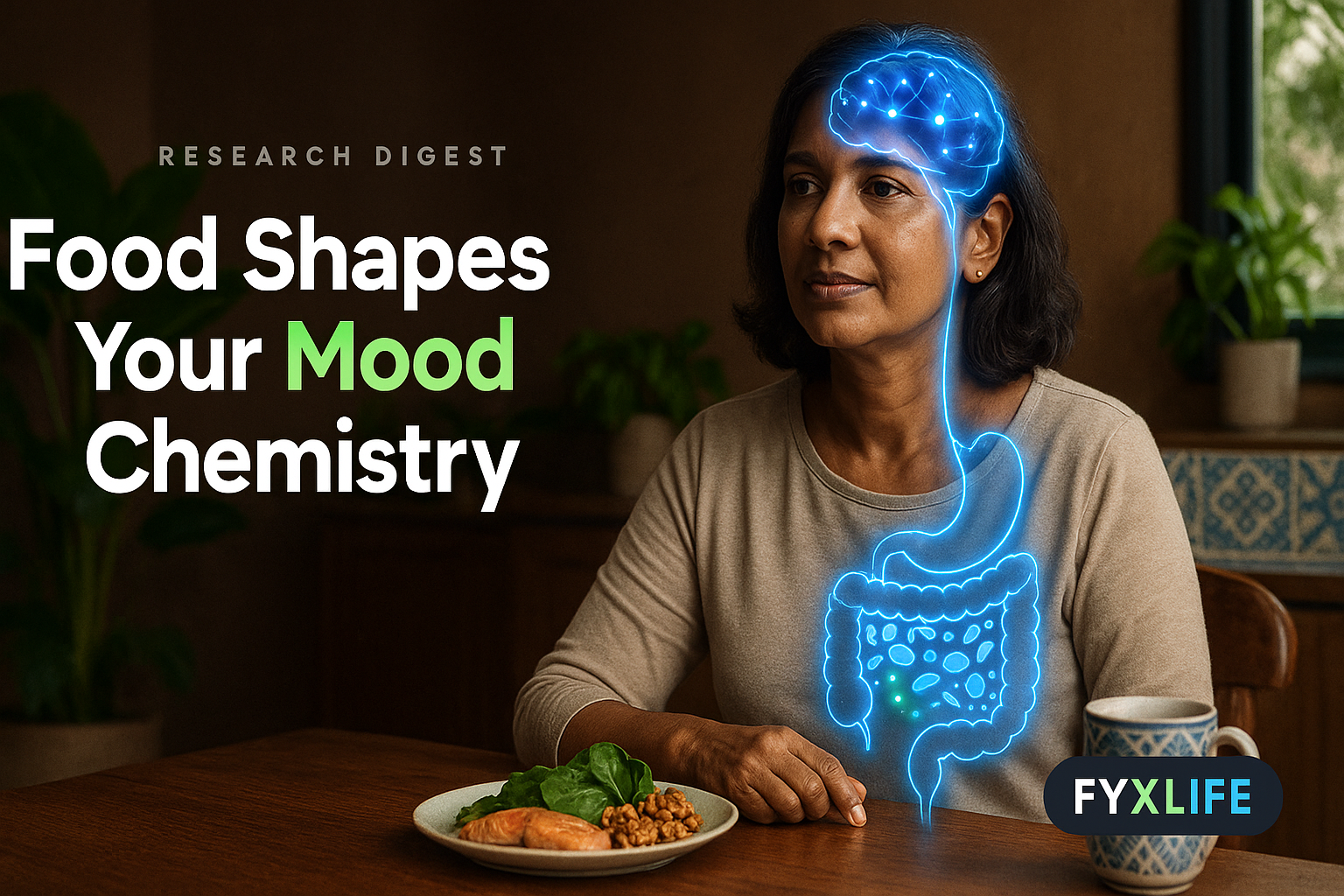
Think of your gut microbiome — the ecosystem of trillions of bacteria living in your digestive tract — as a chemical factory staffed by billions of workers. When you feed the factory high-quality raw materials — fibre, healthy fats, micronutrients — the workers produce the mood-regulating chemicals your brain depends on, including serotonin and GABA. Feed the factory ultra-processed inputs and the workers get replaced by less skilled substitutes, output drops, and your brain starts running on a reduced supply of the chemicals it needs to stay stable. Diet isn’t just fuel for your body — it’s the staffing decision that runs your brain’s chemistry lab.
This pathway has a name: the gut-brain axis, the two-way communication network linking your digestive system directly to your central nervous system via the vagus nerve and circulating chemical signals. The gut microbiota is now recognised as a key mediator in the relationship between nutrition and mental health, with gut bacteria influencing neurotransmitter production and the brain’s stress-response systems. Approximately 90% of the body’s serotonin — the neurotransmitter most associated with mood stability — is produced in the gut, not the brain. That number reframes everything. Your intestinal lining isn’t just processing lunch. It’s running a significant portion of your neurochemistry.
When dietary quality drops — particularly with high consumption of ultra-processed foods, defined as industrially manufactured products containing additives, preservatives, and little intact nutritional structure — the diversity of gut bacteria degrades, and with it the factory’s capacity to produce the signals the brain relies on. Mediterranean-style dietary patterns, by contrast, consistently show the opposite effect across epidemiological studies.
The four nutrients with the strongest mental health signal
Omega-3 fatty acids, alpha-tocopherol (the form of vitamin E most active in the body), magnesium, and folic acid have all been identified in research as nutrients with a measurable influence on stress response and mental health preservation or restoration. Each works through a different mechanism. Omega-3s — found in oily fish, walnuts, and flaxseed — reduce the kind of chronic low-grade inflammation throughout the body (what researchers call systemic inflammation) that has been consistently linked to depression. Magnesium is involved in over 300 enzymatic reactions and plays a direct role in regulating the body’s stress-response system (the hypothalamic-pituitary-adrenal axis). Folic acid is required for the production of the mood-regulating neurotransmitters serotonin and dopamine. Alpha-tocopherol functions as an antioxidant, protecting brain cells from oxidative stress — the cellular damage caused by unstable molecules (called free radicals) that accumulate under chronic stress and poor diet.
None of these are exotic supplements. They’re found in whole foods. The issue, for most people eating a modern diet heavy in refined foods, is that they’re consistently under-consumed.
What It Means — And What It Cannot Prove
Association vs causation: why epidemiological data has limits
It’s worth being precise about what the evidence does and doesn’t establish. A systematic review confirms a direct relationship between nutrition and mental health, but the word “direct” in research doesn’t always mean “proven cause-and-effect in every individual case.” Much of the foundational data is observational, meaning researchers measured what people ate and how they felt, without controlling every variable in between.
Depression can reduce appetite and motivation to cook, which means poor diet might partially be a consequence of low mood rather than its driver. Poverty, sleep deprivation, and social isolation all worsen both diet quality and mental health simultaneously. Researchers work hard to statistically control for these confounders — variables that muddy the relationship between two things you’re trying to measure — but they can’t eliminate them entirely in population studies. The SMILES trial addressed this most directly. But one trial, however well-designed, isn’t the end of the story. The research is strong enough to act on. It isn’t strong enough for absolute certainty.
Why restrictive dieting may be making your mood worse, not better
Here is the tension that rarely gets named clearly: the people most likely to be reading about nutrition and mental health are also the people most likely to be on some form of caloric restriction. Emerging evidence suggests that low-calorie diets may negatively impact mental health, with caloric restriction potentially increasing depression risk. That’s a finding with direct relevance if you’re using aggressive dietary restriction for weight management — and it’s almost never part of the conversation about dieting.
Severe caloric restriction can deplete the very micronutrients — magnesium, folate, omega-3s — that the gut-brain factory needs to function. It can disrupt gut microbiome diversity. It can elevate cortisol, the primary stress hormone. You may be optimising your body composition while inadvertently degrading your neurochemistry. The research isn’t saying don’t manage your weight. It’s saying that how you eat matters as much as how much you eat — and that the mental health cost of extreme restriction is real, even if it’s invisible on a DEXA scan.
What This Means For You Right Now
The one biomarker worth checking if this research resonates with you
A scoping review of current nutritional psychiatry literature calls for dietary assessment to become a standard component of mental health evaluations in clinical practice — which means most clinicians are not yet doing this routinely. If you’re experiencing persistent low mood, flat energy, or anxiety that hasn’t fully responded to other interventions, your diet quality is a legitimate clinical variable. And there are two specific data points that can make this conversation concrete rather than abstract.
Serum magnesium — the amount of magnesium circulating in your blood — is included in many standard blood panels and is chronically low in people eating highly processed diets. The omega-3 index — a measure of the concentration of omega-3 fatty acids in your red blood cell membranes — is a more specialised test but increasingly available, and it gives you a direct window into whether your gut-brain factory is receiving the raw materials it needs for anti-inflammatory signalling. Both numbers are actionable. Both are modifiable through diet before supplements are even considered.
Single action ending
If your mood, energy, or sleep quality has felt consistently flat despite other lifestyle optimisations, check your last blood panel for serum magnesium and omega-3 index (if tested). If magnesium is in the lower third of the reference range or you have no omega-3 data at all, bring this research to your next GP visit and ask specifically whether dietary quality — not just calories — has been factored into your mental health picture. That one conversation is the clinical bridge this research is pointing toward.