
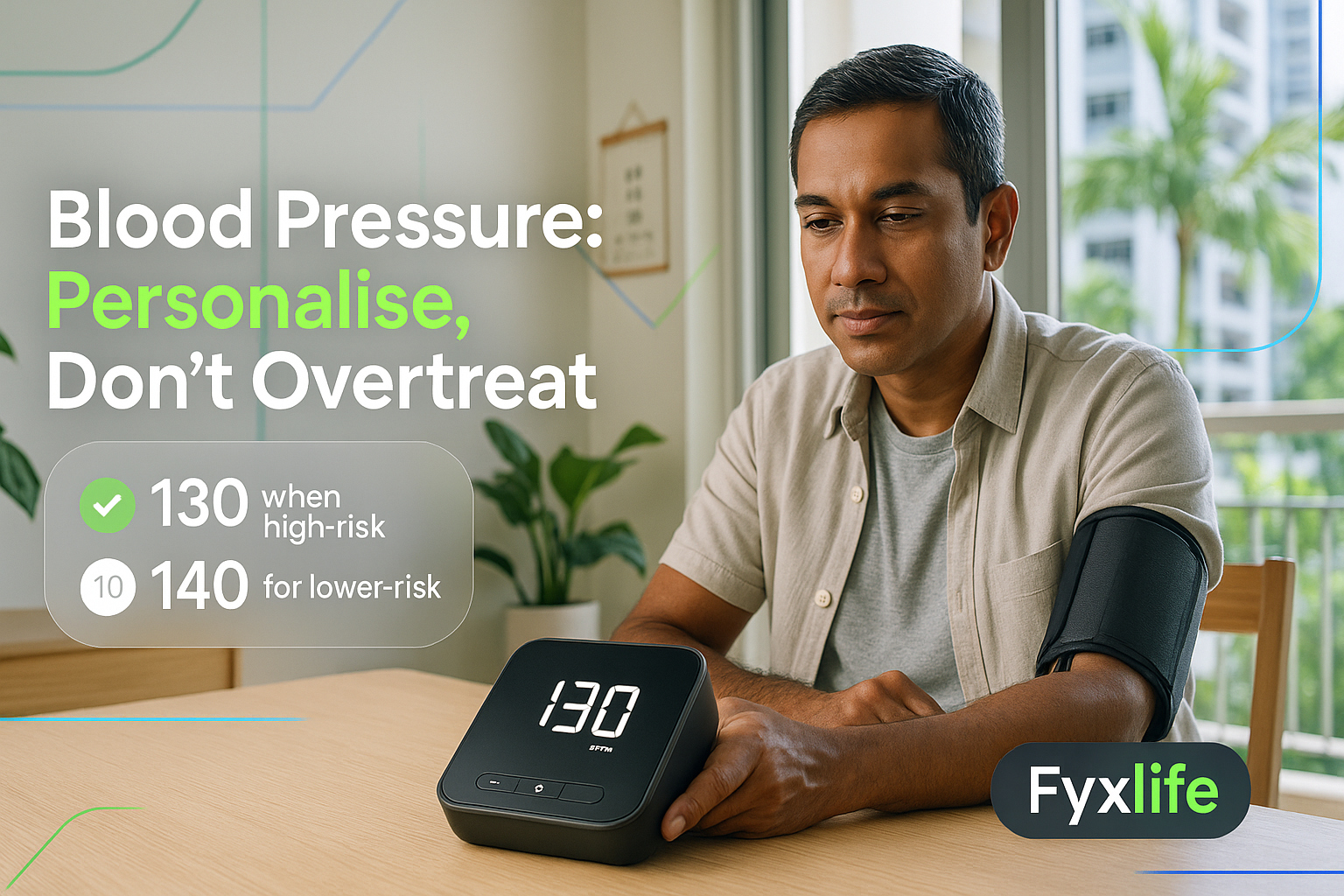
The Verdict Up Front (Because You Deserve One)
Your doctor says 140/90 is fine. The cardiologist on YouTube says anything above 120 is quietly killing you. And the research — once you actually read it — says something far more complicated than either of them. If you have a family history of heart disease and you’re watching your blood pressure numbers obsessively, this verdict is for you.
The truth is that your blood pressure target is not a universal number. It is a clinical judgement call that depends on what condition you are trying to prevent, what other risk factors you carry, and whether your road — to use the right analogy here — qualifies as a school zone. The answer changes the prescription entirely. And right now, millions of adults are either being under-treated because their doctor is anchored to an outdated standard, or over-treated because an aggressive number got applied without the context that makes it meaningful.
Intensive targets (<130 mmHg) reduce cardiovascular events in high-risk patients — but mortality benefit is weaker than the headlines suggest
Here is the honest summary of what the evidence shows: pushing your systolic blood pressure — the top number in a reading, representing the pressure your arteries feel when your heart beats — below 130 mmHg does reduce cardiovascular events, particularly heart attacks, in people who are genuinely high-risk. An updated systematic review and meta-analysis found that achieving a systolic target of under 130 mmHg yields significant cardiovascular benefits, particularly in reducing events in higher-risk populations. But — and this is the part that rarely makes headlines — the survival benefit, what researchers call all-cause mortality reduction, does not follow as clearly. A separate systematic review found that lower blood pressure targets do not reduce overall mortality or serious adverse events, though a small reduction in heart attack incidence was observed. Fewer heart attacks. Not necessarily longer lives. That distinction matters enormously when you are deciding whether to add a second medication and accept its side effects.
What the Standard Target (140/90) Gets Right — and Where It Falls Short
The evidence base behind 140/90 as the historical benchmark
Think of your blood pressure target like a speed limit on a highway. The standard 140/90 limit was set for average traffic conditions and keeps most people safe. It reflects decades of population-level data showing that people who consistently read above that threshold face meaningfully higher rates of stroke, heart failure, and kidney disease. The number did not come from nowhere. It came from large outcome trials that proved intervention at that threshold saved lives across broad, heterogeneous populations. For the average 55-year-old with no significant family history and no other metabolic complications, it remains a clinically defensible target.
Why ‘normal’ on a standard reading may not mean low risk for your profile
Where 140/90 fails you is in the middle ground — the readings that sit between 130 and 140 systolic, a zone sometimes called high-normal or stage 1 hypertension. If your family history includes premature heart disease, your father had a stroke at 58, or you carry insulin resistance alongside those numbers, a reading of 135 is not the same as a reading of 135 in someone without those compounding factors. An evidence review confirmed that different blood pressure targets are warranted for people with hypertension who also have comorbid conditions, explicitly rejecting a one-size-fits-all number. The standard target keeps most people safe on the highway. It was not designed for your specific risk profile.
The Case For Going Lower — What Intensive Targets Actually Proved
The SPRINT trial: what it found, why it matters, and why the methodology debate matters too
The landmark study that shifted the entire conversation was SPRINT — the Systolic Blood Pressure Intervention Trial — which assigned high-risk adults without diabetes to either a standard target of below 140 mmHg or an intensive target of below 120 mmHg. The intensive group had significantly fewer cardiovascular events and lower mortality. It was a dramatic result and it drove a wave of updated clinical guidelines pushing toward 130 as the new threshold. But the methodology debate that followed is not a minor footnote — it is central to interpreting those results. A Cochrane systematic review of SPRINT trial evidence examined whether that landmark trial should change the overall approach to blood pressure targets and raised important caveats about the trial’s methodology and generalisability. The way blood pressure was measured in SPRINT — using an unattended automated method that consistently produces lower readings than the standard clinical measurement — means the 120 mmHg target in that trial likely corresponds to something closer to 130-135 in a typical doctor’s office. The benefit was real. The number was not directly portable.
Updated meta-analyses: where <130 shows real benefit and where it doesn’t
A study on blood pressure targets in adults with hypertension found that the only significant benefit in the group assigned to lower targets was a small reduction in heart attack incidence — with no significant reduction in mortality. That is a consistent finding across the literature. Intensive targets move the needle on non-fatal myocardial infarction — heart attacks that you survive — more convincingly than they move the needle on whether you ultimately live longer. If preventing a heart attack is your primary goal, the aggressive target has a real evidence base. If you are trying to maximise longevity as a primary endpoint, the case is softer than the guidelines imply.
The Complication No One Talks About: Your Goal Depends on What You’re Preventing
Stroke prevention vs heart attack prevention vs mortality — the targets are not the same
This is where the conversation gets genuinely sophisticated — and where most clinical encounters fall short. The optimal blood pressure target for preventing a stroke is not the same number as the optimal target for preventing a heart attack, and neither is identical to the target that best reduces your overall risk of dying. Research directly comparing intensive systolic targets found that different intensive targets produce different outcome profiles depending on whether the endpoint is stroke, heart attack, or all-cause mortality. If your family history is dominated by stroke — a pattern common in Southeast Asian families — your target calculation looks different than if your father died of a heart attack. Treating these as equivalent is like applying the same speed limit to a school zone and a motorway because both are roads.
The ACCORD-BP lesson: intensive targets failed in diabetic patients where SPRINT succeeded in others
The ACCORD-BP trial tested essentially the same intensive target logic in a different population: adults with type 2 diabetes. The result was strikingly different. Intensive targets in diabetic patients failed to demonstrate a clear mortality benefit, and in some analyses increased the risk of adverse events including kidney injury and dangerous drops in blood pressure — what clinicians call hypotensive episodes. The same aggressive number that showed promise in SPRINT produced no meaningful mortality benefit in ACCORD-BP. A study on intensive versus standard blood pressure control confirmed that cardiovascular benefits from intensive targets are not uniformly distributed across patient populations. The target that protects one patient profile can be unnecessary — or actively harmful — in another.
The Asian Risk Profile Factor
Why metabolic risk at lower BMI and stroke-dominant cardiovascular disease patterns in Southeast Asia make this target debate especially relevant for this audience
Southeast Asian adults face a risk profile that does not map cleanly onto the Western populations where most of this research was conducted. The pattern here is distinctive in two important ways. First, cardiometabolic risk at lower body weight — the tendency to develop insulin resistance, visceral fat accumulation, and metabolic syndrome at body mass index levels that Western risk calculators still classify as healthy — means that a 68-kilogram Singaporean may carry significantly more cardiovascular burden than their weight suggests. Second, the regional disease pattern skews toward stroke rather than heart attack as the dominant cardiovascular killer. That matters because, as the evidence above shows, the case for aggressive blood pressure targets is strongest in stroke prevention and in high-risk patients with established cardiovascular risk factors. If you are of Chinese, Malay, or Indian descent and carry a family history of stroke or early-onset diabetes, the argument for pushing below 130 is likely stronger for you than for a low-risk Western patient your age.
Home Monitoring — The Underrated Variable That Changes Everything
The evidence that self-monitoring with a personal target reduces blood pressure significantly, regardless of which target number you are assigned
Before the debate about 130 versus 140 consumes your next doctor visit, there is something more fundamental to get right: the quality of the measurement itself. A single reading in a clinical setting is a notoriously unreliable basis for treatment decisions. What you experience as white coat hypertension — the phenomenon where anxiety in a medical setting artificially elevates your reading — can push a truly normal pressure into treatment range. The inverse, masked hypertension, hides genuinely elevated pressures that only appear when you are sitting quietly at home. A randomised trial on self-monitoring found that giving patients their own blood pressure targets and encouraging them to monitor their own blood pressure resulted in a significant reduction in blood pressure — suggesting the act of monitoring itself is a meaningful intervention. The device on your wrist is not vanity. It is clinical data that your doctor cannot generate in a ten-minute appointment.
The Tech Verdict — Is Targeting <130 Worth It For You?
Who should push for the aggressive target
The evidence supports pursuing a systolic target below 130 mmHg if you are in a genuinely high-risk category. That means: a strong family history of premature cardiovascular disease or stroke, established chronic kidney disease — where pressure control directly slows the progression of kidney damage — existing coronary artery disease, or a calculated ten-year cardiovascular risk score above 10%. The SPS3 randomised trial, examining blood pressure targets specifically in patients with recent lacunar stroke, further supports tighter targets in those with established cerebrovascular disease. For this group, the school zone speed limit is appropriate. The risk of the road justifies the tighter constraint.
Who is likely being over-treated
If you are otherwise healthy, your only risk factor is a mildly elevated reading in your late 40s, you have no family history of early cardiovascular events, and your doctor is recommending medication to push your 135 reading down to 125 — the evidence base for that intervention is thin. The mortality data does not support it. The side effect profile of antihypertensive medications — including fatigue, dizziness, electrolyte disturbances, and the compounding risk of falls from over-lowering — is not trivial. Chasing a number without a clear outcome rationale is not optimisation. It is anxiety dressed as medicine.
The one question to ask your doctor at your next visit
At your next doctor visit, ask specifically: “Given my cardiovascular risk profile and family history, should my personal systolic target be below 130 or is 140 appropriate for me — and what outcome are we primarily trying to prevent?” That one question shifts the conversation from generic reassurance to a target built around your actual risk. If your last recorded systolic reading is sitting between 130 and 140, bring it with you — that is the range where this debate is most clinically relevant for you.