You sleep eight hours and still wake up exhausted. You do the workouts, manage the stress, tick every box — and yet recovery feels like it’s running a lap behind. A growing body of clinical research is now asking whether a specific type of light exposure, applied at the right wavelength, might accelerate what your body is already trying to do overnight. The therapy in question is called photobiomodulation (PBM) — the use of red and near-infrared light as a biological signal, not heat — and if you have spent any time in fitness or longevity circles recently, you have almost certainly heard someone either swear by it or roll their eyes at it.
Both responses are understandable. The devices look like something between a tanning panel and a sci-fi prop. The claims range from carefully qualified to wildly overblown. And the research, while growing, is still finding its footing. What this digest does is strip the noise back to what the clinical literature actually shows — where the signal is strong, where it is weak, and what a sceptical, health-literate person should do with the information.
The Study at the Centre of This Digest
What researchers were actually testing — and on whom
Most early red light research focused on small treatment areas — a wounded knee, an arthritic joint, a patch of skin. The study anchoring this digest asked a different question. A controlled trial published in PMC specifically investigated the safety and efficacy of two novel light sources designed for large-area and full-body application — a meaningful evolution beyond localised spot treatment. This matters because the way most people experiencing general fatigue or systemic post-exercise soreness would actually use these devices is whole-body, not targeted. Testing a spot treatment and extrapolating to full-body use is a methodological gap the study begins to address, even if it does not fully close it.
What ‘large-area, full-body application’ means in practice
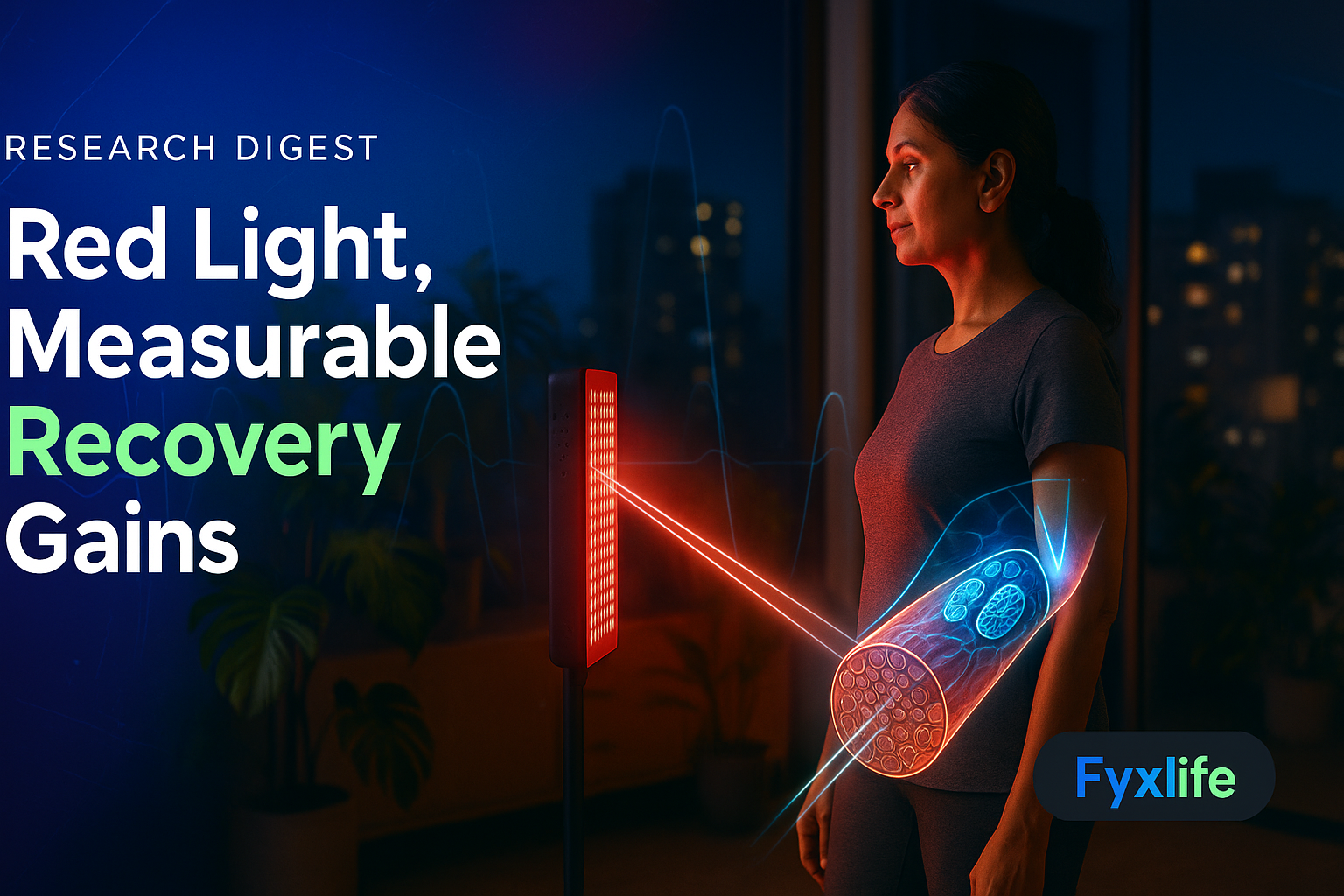
Full-body application means the device — typically a floor-standing panel or mat — exposes a broad surface area of skin simultaneously rather than directing light at a single joint or wound site. The clinical significance is that systemic recovery, unlike wound healing, presumably requires systemic signal delivery. Whether the mechanism scales this way is one of the open questions the evidence is still working through. What the trial established is that large-area application is safe and well-tolerated — a prerequisite before efficacy questions can be meaningfully pursued.
The Mechanism — How Light Talks to Your Cells
Cytochrome c oxidase: the cellular receiver that responds to specific wavelengths
Think of your cells like a rechargeable battery that has been partially drained for months. Red and infrared light — at the right wavelengths — appears to act like a charger plugged directly into the battery’s terminal, stimulating the mitochondria (your cells’ energy factories) to produce more ATP (adenosine triphosphate — the molecule your body uses as cellular fuel). It does not add new energy from outside; it helps the existing machinery run more efficiently. The question the research is now trying to answer is: how much charge, how often, and in which batteries does this actually make a measurable difference?
The proposed mechanism centres on a protein called cytochrome c oxidase — an enzyme that sits within the mitochondrial electron transport chain and appears to absorb red and near-infrared photons directly. A PMC review covering both laser therapy and LED-based approaches confirms that low-intensity light at these wavelengths interacts with biological systems through this pathway, nudging cellular energy production upward in tissue that is stressed, inflamed, or under-recovered. It is a plausible and increasingly well-mapped mechanism — which is one reason the research community takes PBM seriously even when individual study quality remains inconsistent.
Red vs near-infrared: same device, different depth, different job
This is a distinction that almost every consumer-facing description of red light therapy collapses — and it matters. Red light at around 630 nm penetrates the surface layers of skin, making it relevant for skin-level repair, collagen production, and surface wound healing. Near-infrared light at around 850 nm travels deeper — reaching muscle tissue, joints, and nerve structures. These are two distinct biological mechanisms operating at different depths, not two versions of the same therapy. Infrared radiation has documented photostimulation effects that particularly benefit neural stimulation and wound healing, while red light’s primary action is closer to the surface. A device that delivers both wavelengths simultaneously is not redundant — it is targeting two different tissue layers at once.
What the Evidence Shows — and What It Cannot Prove
The honest evidence quality rating: very-low-to-moderate, and why that still matters
A systematic review rates the quality of evidence for low-intensity red and near-infrared PBM as ‘very-low-to-moderate’ for both standalone and exercise-adjunctive recovery use. Sit with that for a moment before dismissing it or overselling it. Very-low-to-moderate does not mean the evidence is negative. It means the studies are often small, inconsistently designed, and difficult to blind properly — because it is genuinely hard to run a placebo-controlled trial when your intervention is visible light. The signal in the data is real. The certainty around its magnitude is not yet high enough to make strong population-level recommendations. That is a calibration, not a rejection.
Where the signal is strongest: inflammation, muscle recovery, wound healing
The clearest evidence clusters around three domains. First, inflammation: a comprehensive review systematically summarised the mechanisms of PBM in arthritis treatment, including its effects on the inflammatory cascade in joint tissue — relevant to anyone carrying chronic post-exercise joint load or the low-grade inflammation that accumulates under sustained work stress. Second, muscle recovery: the exercise-adjunctive literature suggests that PBM applied before or after resistance training may reduce markers of muscle damage and accelerate strength recovery between sessions. Third, tissue repair: infrared photostimulation has documented effects on wound healing and neural tissue, which translates in practice to the kind of slow-resolving musculoskeletal complaints — shoulder tension, hip stiffness, persistent lower back tightness — that accumulate in high-performing professionals whose stress load lives in their bodies.
What this study cannot tell us about long-term recovery outcomes
What the current body of evidence cannot establish is whether consistent PBM use over months produces meaningful improvements in systemic recovery — the kind measurable as sustained HRV improvement, reduced subjective fatigue, or better training adaptation over a full competitive season. The trials are mostly short, mostly small, and mostly focused on acute endpoints like next-day soreness or single-session inflammation markers. The long-term recovery question — which is the one the exhausted high-performer actually cares about — remains genuinely open.
Why This Is Relevant to the Exhausted High-Performer
The recovery debt problem — doing everything right and still running slow
There is a specific kind of fatigue that does not respond to more sleep or a rest day. You have probably felt it. Sleep trackers say you hit eight hours. Training load looks fine on paper. Stress management is in place. And yet the tank reads low. This is not laziness or hypochondria — it is what happens when the cellular machinery responsible for repair and regeneration is running below capacity without a clear acute cause. The biological framing PBM research offers is that mitochondrial efficiency in chronically stressed tissue may decline in ways that standard recovery interventions do not fully address. Whether PBM can meaningfully intervene in that process at scale is what the next generation of trials needs to establish.
PBM as an adjunct, not a replacement for sleep and training fundamentals
Nothing in this research suggests that red light therapy compensates for poor sleep, inadequate protein, or chronic overtraining. The clinical evidence rates PBM as safe, well-tolerated, and effective within its studied parameters — but always in the context of it adding to a recovery stack that is already functional, not substituting for one that is broken. Low-energy red and near-infrared light has a reasonable body of trial data behind it for skin-level and surface tissue treatment, and near-infrared PBM is described as a promising method to mediate biological functions across the red to near-infrared spectrum — but promising is doing real work in that sentence. The honest framing is: this is an adjunct with a plausible mechanism and a growing but still developing evidence base. It belongs in the conversation. It does not yet dominate it.
It is worth naming something plainly here. The question of whether PBM belongs in your specific recovery protocol — given your training load, your baseline HRV trend, your inflammatory markers, your history of musculoskeletal complaints — is not a question a standard annual check-up was designed to answer. Not because doctors don’t care, but because population-level reference ranges and ten-minute appointment slots were built for acute care, not for optimising the recovery ceiling of someone who is already doing most things right.
What to Do With This Information
One biomarker to connect this research to your own data
If you already track HRV (heart rate variability — a measure of the variation in time between heartbeats, used as a proxy for autonomic nervous system recovery and readiness) or resting heart rate through a wearable, you have a recovery baseline. This research suggests PBM may act as an exercise-adjunctive recovery tool — meaning its signal, if real, should show up in those numbers. If your HRV has been trending flat or downward despite consistent sleep and training, bring this research to your next conversation with a sports medicine doctor or physiotherapist and ask whether a structured trial of red or near-infrared light therapy — at verified wavelengths of 630 nm or 850 nm — is worth adding as a measured variable for 8 to 12 weeks.