You’ve seen zinc lozenges at every pharmacy counter and zinc supplements stacked next to vitamin C every cold season — but most people buying them have no idea what zinc actually does inside the body. It’s not a vitamin, it’s not a herb, and it doesn’t work the way the marketing implies. Here’s the real mechanism, and why it matters more after 35 than most people realise.
What makes zinc genuinely interesting is that it sits at the intersection of structure and signalling inside your immune system — not as a passive nutrient that gets used up, but as an active gatekeeper that controls whether your immune response gets built correctly in the first place. That distinction changes everything about how you should think about dosing, food sources, and whether a supplement actually makes sense for you.
What Zinc Actually Is (And Why It Belongs In A Different Category From Vitamins)
Mineral, Not Vitamin — Why The Distinction Changes How You Think About Dosing
Vitamins are organic compounds — they contain carbon and can be broken down. Minerals are inorganic elements that your body cannot make or destroy, only use, store, or excrete. Zinc is the second most abundant trace mineral in the human body after iron, and unlike most vitamins, small excesses or deficits have significant downstream consequences. This is not a nutrient where a little more is harmless and a little less is mildly suboptimal. The dose window matters in a way that is rarely communicated on supplement packaging.
How Much Zinc Is In Your Body And Where It Lives
Your body contains roughly two to three grams of zinc at any given time. It is not floating freely in your bloodstream waiting to be used — most of it is locked inside muscle tissue, bone, the liver, the prostate, and the retina. Only about 0.1% circulates in plasma at any moment, which is one reason that standard blood zinc tests can miss functional deficiency. Your body has no dedicated zinc storage depot the way it does for fat-soluble vitamins. This means your supply depends heavily on consistent dietary intake, and any disruption — poor diet, high stress, infection — can deplete functional zinc surprisingly quickly.
The Gatekeeper Mechanism — How Zinc Controls Immune Function
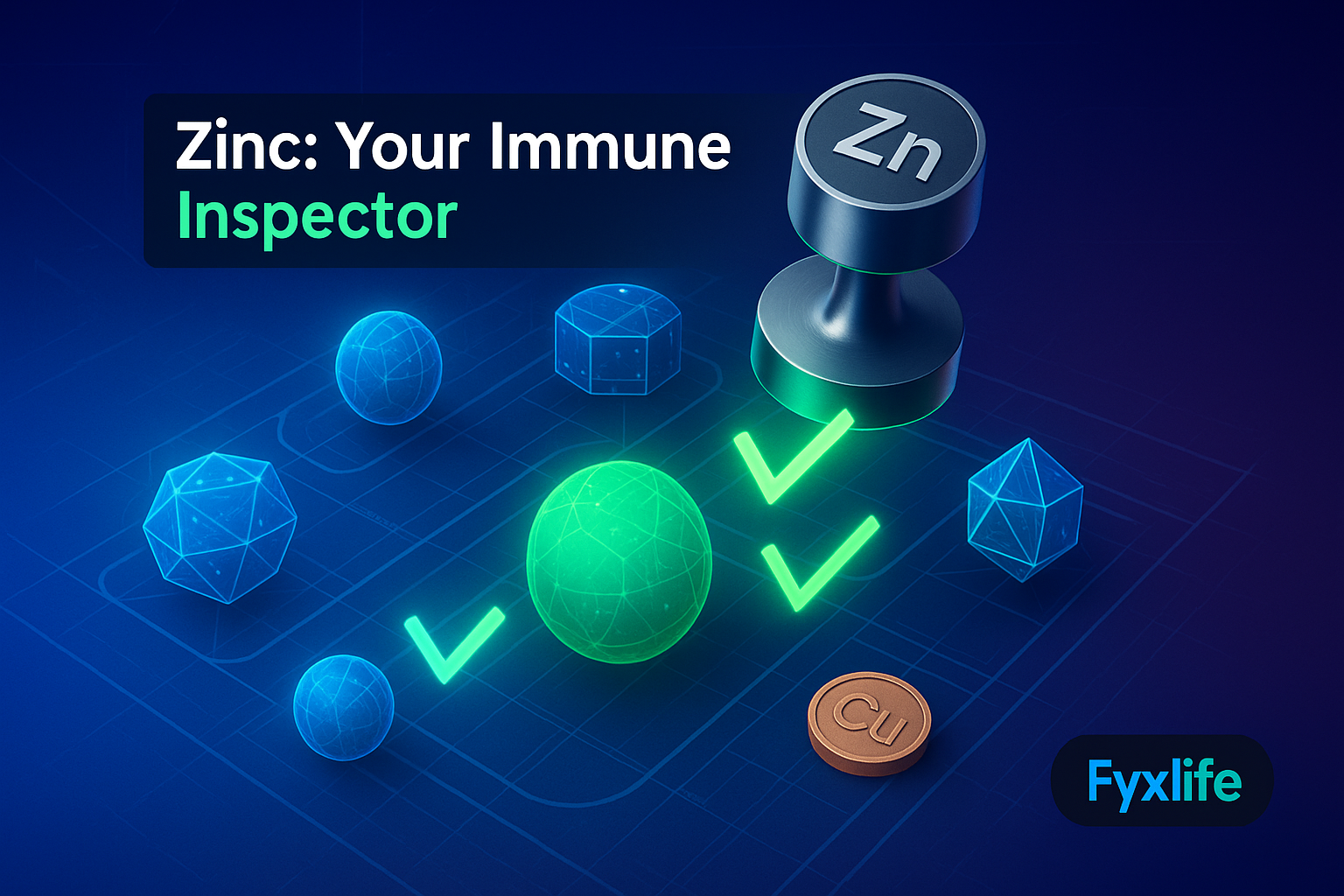
Think of zinc as the building inspector for your immune system’s construction site. Before any immune cell can be built, deployed, or given orders, zinc has to sign off. Without enough zinc on site, construction slows, communication breaks down, and the workers — your immune cells — show up under-equipped. Too much zinc and you flood the site, blocking other essential materials like copper from getting in. The job isn’t to dump more zinc in and hope for the best. It’s to maintain the right supply so the whole operation runs on schedule.
Zinc As A Structural Component Of Immune Cell Development
Research identifies zinc as central to both the development of immune cells and the regulation of immune signalling processes — functioning less like a fuel and more like a foundational material. Zinc is a structural component of over 300 enzymes and more than 1,000 proteins that regulate gene expression. Many of these proteins — a class called zinc finger proteins (proteins that depend on zinc to fold into a functional shape) — are directly involved in controlling how immune cells mature and divide. When zinc is inadequate, these proteins cannot maintain their correct structure. The cellular machinery that produces your immune cells starts making errors, or simply slows down.
Zinc Signalling: The Chemical Messaging System Inside Your Immune Cells
Zinc signalling inside immune cells acts as an intracellular messenger system — the internal communication network that tells a cell what to do when a threat is detected. When a pathogen enters your body, immune cells need to rapidly coordinate a response: release alarm chemicals, replicate, attack. Zinc ions (electrically charged zinc atoms released within the cell) are part of that coordination signal. Disrupt this signalling — through insufficient zinc — and the alarm is blunted or mistimed. Your immune cells detect the threat but respond too slowly, or with the wrong intensity. The infection gains time it should never have had.
The Antiviral Role — How Zinc Disrupts Viruses At The Cellular Level
Zinc’s role in fighting viruses is more specific than general immune support. Oxidative stress — the kind triggered by viral infection — causes the body to release zinc from storage proteins called metallothioneins, deploying it as part of the immediate immune response. Zinc interferes directly with viral replication: it inhibits the enzyme machinery that viruses use to copy their genetic material inside your cells. This is why zinc lozenges — if used correctly — are thought to work differently from a general supplement. Direct contact with the mucous membranes of the throat may allow zinc ions to interfere with viral replication at the point of entry, before the virus can establish itself deeper in the respiratory tract.
What Zinc Deficiency Actually Looks Like
The Immune Cells That Break Down First
Zinc deficiency impairs multiple branches of immunity simultaneously — altering the development and function of T cells (the immune cells that coordinate adaptive immune responses), macrophages (the large cells that engulf pathogens), natural killer cells (which destroy infected cells without prior activation), and neutrophils (the first responders that arrive at infection sites). That breadth is important. This is not a deficiency that weakens one part of your immune system while leaving others intact. It degrades the whole system at once. Mild zinc insufficiency — which can occur without any obvious clinical symptoms — is enough to measurably impair your resistance to infection.
Why Adults Over 35 Are More Vulnerable Than They Think
Zinc absorption decreases with age, and the threshold at which this becomes clinically meaningful is lower than most people expect. Absorption can be further reduced by high-phytate diets — phytates are compounds found in wholegrains and legumes that bind to zinc and prevent it from being absorbed — as well as by alcohol consumption, prolonged stress, and certain medications including diuretics and antacids that are common in this age group. You can eat a reasonably healthy diet and still be running on a functional zinc deficit without knowing it.
Zinc And Ageing: Why Your Requirements Don’t Stay The Same
Immunosenescence — When Your Immune System Ages Faster Than You Do
The gradual decline of immune function with age has a name: immunosenescence (the progressive deterioration of immune competence that occurs as the body ages). It is not simply about getting more colds. Immunosenescence means reduced vaccine effectiveness, slower wound healing, impaired surveillance of abnormal cells, and a greater risk of severe outcomes from infections that a younger immune system would handle without incident. Research on immunosenescence identifies zinc insufficiency as one factor in the declining immune competence seen in older adults — not the only factor, but a modifiable one.
What The Research On Older Adults Actually Shows
Zinc supplementation has been studied specifically in adults aged 55 to 70 in the ZENITH Study, examining its effect on immune status in healthy older individuals — a population with documented risk of zinc insufficiency. The question being asked was not whether zinc supplements could turn back the clock, but whether correcting insufficiency in this age group produced measurable immune improvements. The evidence suggests it can — particularly in those who were genuinely deficient to begin with. This distinction is not a technicality. It is the entire logic of supplementation: correction of a deficit, not enhancement beyond baseline.
The Cold Remedy Question — Does Zinc Supplementation Work?
What The Evidence Supports
A review examining zinc and common cold duration found roughly two days shorter symptoms in people who took zinc at the onset of illness. That finding is meaningful. Two days of a cold is not trivial — it is the difference between a manageable week and a miserable one. The mechanism is plausible given what we know about zinc’s antiviral role at the mucosal level. Lozenges or nasal sprays, used early and at adequate doses, are the delivery methods with the most coherent mechanistic rationale, because they provide direct contact at the site where cold viruses replicate first.
What It Does Not Support
The same review notes the evidence is not yet conclusive. Form matters — not all zinc compounds release zinc ions effectively in the body. Timing matters — starting supplementation a day or two after symptoms begin appears to significantly reduce any benefit. And the two-day reduction in symptom duration is an average across studies with variable quality. What the evidence does not support is the idea that taking zinc supplements daily throughout the year provides meaningful cold prevention in someone who is not deficient. Prevention is a different biological question from early-illness intervention, and the evidence for the former is considerably weaker.
How Much Is Enough, How Much Is Too Much
Dietary Sources Vs Supplementation
The recommended daily intake for zinc is approximately 8mg per day for adult women and 11mg for adult men, though some researchers studying ageing populations argue these figures may underestimate the needs of adults over 55. Micronutrient reviews consistently identify zinc alongside vitamins C and D as one of the key nutrients whose deficiency is associated with impaired immune defence across multiple cell types and immune pathways — which reflects how foundational it is, not how much more of it you need to consume. The richest dietary sources are oysters (by a significant margin), red meat, crab and other shellfish, pumpkin seeds, hemp seeds, and legumes. A diet that includes these regularly is likely maintaining adequate zinc status in most healthy adults under 50.
The Toxicity Risk Nobody Talks About
The upper tolerable intake for zinc is 40mg per day for adults. Many zinc supplements sold over the counter contain 25–50mg per dose, and some people stack them during cold season without realising that excess zinc has been identified as producing new toxic mechanisms, including disruption of copper metabolism, which can itself impair the immune function zinc is supposed to support. Copper deficiency induced by chronic high-dose zinc supplementation can cause anaemia, neurological symptoms, and — ironically — reduced immune competence. This is the building inspector flooding the construction site. The toxicity risk is real, it is dose-dependent, and it is almost never mentioned at the pharmacy counter.
The Bottom Line — What To Do With This Information
Zinc’s role in immune function is not wellness marketing — it is one of the better-characterised nutrient-immunity relationships in the research literature. Research has moved beyond observational association toward mechanistic understanding of exactly how zinc affects immune cell development, signalling, and antiviral response. That mechanistic clarity is what makes it worth taking seriously — and also what makes the nuance important. Zinc works when it is present at the right level. Below that level, immune function degrades in measurable, documented ways. Above that level, you start creating new problems.
The challenge is that this is exactly the kind of question a routine annual check-up was not designed to answer well — not because doctors don’t care, but because standard blood panels rarely include serum zinc unless there is an obvious clinical reason to test it, and the reference ranges used were built on population averages that may not reflect your specific absorption capacity, dietary pattern, or age-related decline. Knowing whether you are actually deficient requires asking the question explicitly.
Zinc status has been examined as a relevant variable in the severity of infectious disease outcomes, which means this is not purely a cold-season conversation. It sits within the broader question of how well your immune system is equipped for the infections that matter most — and whether the answer to that question changes as you age.
Apply this mechanism insight to a decision you are already making: before buying a zinc supplement this week, check whether you are eating zinc-rich foods regularly — red meat, shellfish, pumpkin seeds, legumes. If your diet is already varied and you are not in the 55+ age bracket, the mechanism evidence suggests your money is better spent elsewhere unless a doctor identifies a deficiency. If you are over 45, vegetarian, or frequently ill, that is the moment to ask your GP for a serum zinc test rather than self-supplementing blind.