The Study That Started This Conversation
What the 8-trial meta-analysis actually measured — and what it found
You’ve seen ashwagandha on every wellness shelf and in every supplement stack. The claim is always the same: it lowers cortisol, so it kills stress. Except a meta-analysis of 8 randomised controlled trials just complicated that story — and if you’re about to spend money on this, you deserve to know what the data actually says.
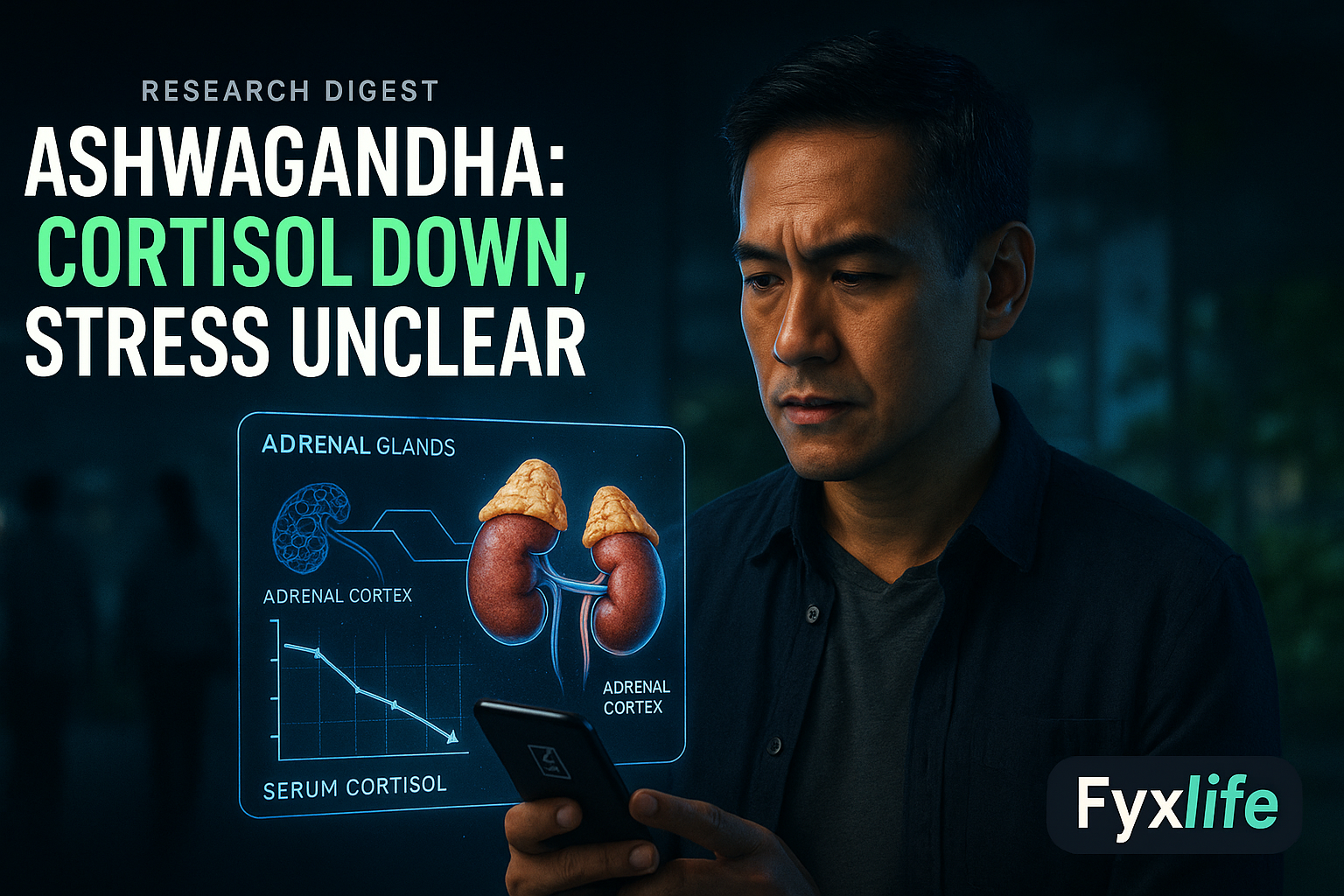
The meta-analysis in question pooled results from 488 adults across 8 randomised controlled trials. The headline finding was real: ashwagandha did reduce cortisol levels in the blood (serum cortisol) compared to placebo. That part of the marketing claim holds up. But here is where it gets more interesting. That same meta-analysis found ashwagandha did not reduce self-rated perceived stress scores — meaning participants’ lab results moved, but their own felt experience of stress did not meaningfully change. The biomarker and the lived experience parted ways.
That gap deserves your attention. It is not a reason to dismiss the supplement. It is a reason to ask a more precise question before you buy it.
Why cortisol in a blood test and stress you feel are not the same thing
Think of cortisol like your body’s internal alarm volume. Ashwagandha appears to turn the dial down measurably on a lab test. But whether you actually hear less noise in your daily life — feeling calmer, sleeping better, thinking more clearly — depends on why the alarm was loud in the first place. If the volume was at 9, dropping it to 6 matters. If it was already at 4, turning it to 3 might just make you feel flat.
This distinction matters because cortisol is not simply a stress hormone that needs to be suppressed. It is a signal. It drives alertness in the morning. It helps you respond to deadlines, physical exertion, and genuine threats. Perceived stress — the crushing weight of a difficult week, the low-grade anxiety that follows you into sleep — is shaped by cortisol but also by your brain’s interpretation of events, your sleep debt, your serotonin availability, and dozens of other variables a blood test does not capture. Suppressing the signal is not the same as solving the problem the signal was pointing to.
What the Broader Trial Evidence Shows
Trials where ashwagandha moved cortisol significantly
Across multiple independent trials, the cortisol-lowering effect is consistent enough to be taken seriously. A prospective randomised double-blind placebo-controlled study found that high-concentration full-spectrum ashwagandha root extract significantly reduced serum cortisol levels elevated by stress — this was not a marginal finding. A separate published randomised controlled trial found ashwagandha was associated with significantly greater reductions in morning cortisol compared to placebo, with a p-value below 0.001 — a threshold that means there is less than a one-in-a-thousand chance the result was due to chance. Another study found a significant decrease in serum cortisol levels in ashwagandha treatment groups compared to placebo at study end, supporting its classification as an adaptogen — a substance that helps the body maintain balance under stress rather than simply sedating it.
The signal is real. The question is what it means for you specifically.
The one trial where it didn’t — and why that matters
Not every study tells the same story. A randomised double-blind placebo-controlled crossover trial found no statistically significant effects on morning salivary cortisol levels, even though the same trial did find ashwagandha increased levels of DHEA-S (a hormone produced by the adrenal glands, often used as a marker of adrenal reserve) and testosterone. The design of this trial was rigorous. The null result on cortisol is not noise to be explained away.
What this trial illustrates is that the supplement does not work identically in every person or every protocol. Study populations differed. Extract concentrations differed. The time of day cortisol was measured differed. A crossover design — where the same person receives both the supplement and the placebo in sequence — controls for individual variation in a way most parallel-group trials cannot. When a well-controlled study finds no effect, that is information worth holding alongside the positive findings, not discarding.
Anxiety scores, sleep quality, and serotonin: the fuller biomarker picture
The more compelling evidence may not actually be the cortisol numbers. An 8-week randomised double-blind placebo-controlled study found ashwagandha was associated with greater reductions in anxiety scores on the HAM-A scale (a standardised clinical tool for measuring anxiety severity) and improved sleep quality alongside cortisol reductions. Those are outcomes you can feel, not just measure.
Beyond cortisol, one study found a mechanism picture that goes considerably wider. Ashwagandha reduced cortisol substantially, but also increased serotonin by approximately 32 ng/mL and slightly raised serum T4 — the primary hormone produced by the thyroid gland. That profile suggests ashwagandha is doing something more complex than simple cortisol suppression. It appears to be influencing multiple hormonal axes simultaneously, which may explain why some people report clear improvements in mood and sleep rather than just a number on a lab panel. It also means the mechanism is not fully understood, and for anyone with thyroid conditions, that T4 signal is worth discussing with a doctor before starting.
What This Research Cannot Prove
Why study populations, extract types, and dosing protocols make direct comparisons difficult
Here is the honest limitation the supplement industry never puts on the label. The NIH Office of Dietary Supplements acknowledges directly that while ashwagandha extracts may help reduce anxiety, stress, and improve sleep, developing specific usage recommendations is difficult because trial protocols vary significantly in extract concentration, dosing, and duration. Some trials used 240mg of a standardised extract daily. Others used 600mg. Some ran for 8 weeks, others for 12. Some measured morning salivary cortisol, others measured serum cortisol at different time points. When you try to compare those studies directly, you are not comparing the same thing.
This also means the ashwagandha product on the shelf at your pharmacy may bear little resemblance to the extract used in a specific positive trial. Standardisation of the active compounds — primarily a group of molecules called withanolides — varies considerably between brands and formulations. A product that says “ashwagandha” on the label and a product used in a rigorous RCT are not automatically the same intervention.
The difference between statistical significance and clinical meaningfulness
A result being statistically significant means it is unlikely to be due to chance. It does not mean it is large enough to change how you feel on a Tuesday afternoon. One study found statistically significant reductions in both Perceived Stress Scale scores and HAM-A anxiety scores, which is encouraging. But the meta-analysis finding — that cortisol moved while perceived stress did not — is a reminder that moving a number and improving an experience are not the same outcome. Both matter. They are not interchangeable.
Who Is Most Likely to Benefit — And Who Should Be Cautious
Elevated cortisol confirmed vs. normal-range cortisol
The trials with the clearest positive cortisol findings tended to recruit participants who were under confirmed stress or had elevated baseline cortisol. That is not coincidental. When the alarm volume is genuinely elevated, turning the dial down produces a detectable difference. When your cortisol is already within normal range, the same dial-turn may produce a result that is visible on a lab panel but imperceptible in daily life. Interestingly, ashwagandha supplementation has also been shown to outperform placebo for variables related to physical performance in healthy men and women — suggesting its strongest evidence base may actually be in exercise and recovery contexts rather than pure stress management. That is an underreported finding that shifts how you might think about who this supplement is genuinely for.
The challenge is that this is exactly the kind of question a routine annual check-up was not designed to answer — not because doctors don’t care, but because population-level reference ranges were never built to account for your specific stress profile, cortisol pattern across the day, or the particular mechanism driving your fatigue or anxiety.
Reddit reality check: when lowering cortisol too much backfires
Anecdotally, a pattern has emerged among people who tried ashwagandha and reported not feeling calmer but feeling flat — unmotivated, slightly dulled, disengaged. The proposed explanation is mechanistically coherent: ashwagandha lowers cortisol non-selectively. If your cortisol was already sitting at the lower end of the normal range, further suppression does not produce calm. It produces a loss of the alertness and drive that cortisol was providing. Separately, some individuals report sleep disruption rather than improvement — the opposite of what trials measuring group averages found. These are not clinical evidence, but they point to individual cortisol baseline as the variable that matters most. The supplement does not read your chart before it acts.
The Verdict in Plain English
What to take from this research if you’re deciding whether to try ashwagandha
Ashwagandha is one of the better-studied adaptogens, and the evidence for cortisol reduction across multiple RCTs is real enough to take seriously. The honest picture is more specific than the marketing implies: it appears to help people whose cortisol is genuinely elevated, and the benefits extend beyond cortisol alone — anxiety scores, sleep quality, and physical performance all have meaningful trial support. The supplement does not appear to be a wellness myth. But it is also not a universal stress solution for every person who feels overwhelmed.
The failure point in most supplement decisions is buying something because the category sounds plausible, not because there is evidence it addresses your specific physiological situation. Ashwagandha is no different. The question is not whether it works in general. The question is whether it works for the particular reason your alarm volume is high.
The one biomarker to track if you do
If you try it, morning serum cortisol is the right marker to measure before and after an 8-week trial. Not perceived stress scores alone — those are subjective and drift with life events. The lab number gives you a baseline the supplement’s effect can be measured against. Without it, you are guessing.
Before deciding whether to try ashwagandha, get a morning cortisol test — either via your GP or a private panel. If your result comes back elevated above the reference range, this research gives you a reasonable biological rationale to trial a standardised root extract for 8 weeks. If your cortisol is already normal or low, the evidence suggests you are more likely to move a number on a lab report than feel meaningfully better — and the signal on motivation loss is worth taking seriously.