
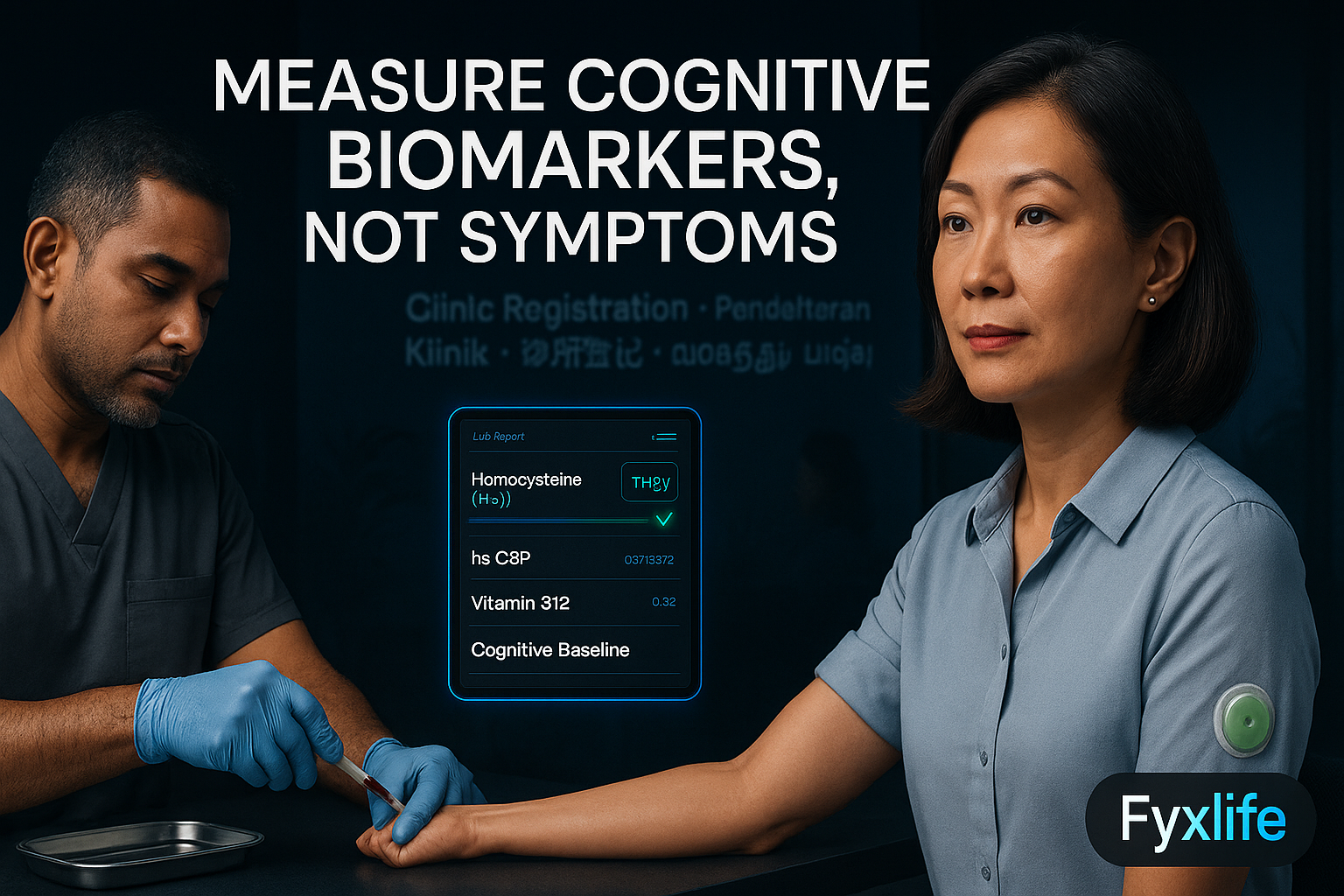
You’ve noticed it — the sentence you have to re-read twice, the meeting you left without retaining a single decision, the name that vanished mid-conversation. Before you chalk it up to stress or screen time, consider this: the biomarkers that predict cognitive decline exist, many are measurable today, and almost nobody in their 40s is tracking them. This guide tells you exactly what to test, how often, and what to do with the numbers.
The frustrating truth is that what you feel about your own cognitive performance and what is actually happening inside your brain are often two completely different stories. You might feel sharp on a good night’s sleep. You might dismiss the fog as temporary. But the systems involved in focused attention, processing speed, and working memory begin to shift years — sometimes decades — before the changes become obvious. The question is whether you want to find out about those shifts on your own timeline, or wait until someone else notices them for you.
Why Your Feelings About Your Own Focus Are Not a Reliable Test
The gap between perceived and measured cognitive performance
Here is the uncomfortable irony of cognitive decline: the very faculty you would use to assess your own mental performance is the one being quietly affected. People consistently overestimate their attentional capacity during periods of gradual decline — not because they are in denial, but because the brain is remarkably good at compensating, rerouting, and masking early deficits. You work harder to get the same output, but the output looks the same. Until it doesn’t.
Subjective brain fog — that thick, cotton-wool feeling that makes you feel like you are thinking through static — is real and worth taking seriously. But it is not a diagnostic tool. It doesn’t tell you whether the cause is metabolic, inflammatory, structural, or simply the consequence of six nights of broken sleep. Objective biomarkers and neuropsychological tests are the evidence-based alternative — tools that measure what is actually happening rather than what you perceive to be happening.
Why retrospective diagnosis misses early symptoms in adults
There is a clinical pattern that shows up repeatedly in cognitive health research. By the time a formal assessment happens — triggered by a crisis at work, a partner’s concern, or a car incident that finally prompted the GP visit — the signs have often been present for years. Research shows that retrospective diagnosis eliminates early symptoms, especially in adults, where attention dysfunction has often been present but undetected for years before clinical presentation. The healthcare system is generally designed to respond to problems, not to detect them in their earliest, most treatable form. This is the gap that proactive testing is designed to close.
The Test Stack — What to Actually Measure
Think of your cognitive biomarkers like the dashboard warning lights in a car. Most people only look at the engine when the car stops moving — but a well-maintained vehicle has sensors tracking oil pressure, battery health, and tyre wear long before anything fails. Your homocysteine level, inflammatory markers, and cognitive test baseline are those sensors. They don’t tell you the car is broken; they tell you which systems are under stress, years before the breakdown.
Tier 1 — Blood Biomarkers You Can Order Today
The first tier is the most accessible and the most neglected. These are blood tests — available at any private lab in Singapore, often covered under standard health screenings — that give you a metabolic and inflammatory picture of what your brain is operating inside. None of them require a specialist referral. All of them can be added to a standard annual panel.
Homocysteine (one-carbon metabolism): the attention biomarker most doctors skip
Homocysteine is an amino acid produced naturally during protein metabolism. When it accumulates — due to poor methylation, low B-vitamin status, or genetic variation in how your body processes folate — it becomes toxic to blood vessels and nerve tissue. It is also, specifically, linked to attention. Research found that the rate of decline in both focused attention and sustained attention was slower in individuals with higher quartiles of total homocysteine (tHcy), establishing it as a measurable one-carbon metabolism biomarker linked to attention trajectory over time. This is not a marker most GPs will think to include in a routine panel. You will need to ask for it. It costs very little. The information it gives you is disproportionately valuable.
Inflammatory markers (hsCRP, IL-6): the chain-reaction-of-damage link to brain fog
Chronic low-grade inflammation — a slow, persistent activation of the immune system with no single obvious cause — is one of the most well-established contributors to cognitive impairment. High-sensitivity C-reactive protein (hsCRP) and interleukin-6 (IL-6) are two markers that measure this inflammatory load in the body. When these are elevated, the brain is operating in an environment of ongoing chemical stress. Biomarkers of oxidative stress and inflammation — measurable in both blood and cerebrospinal fluid — show a meaningful relationship with cognitive function, suggesting inflammatory load is a trackable upstream contributor to attention decline. Brain fog, in many cases, is not a mystery. It is inflammation with a signal.
Oxidative stress markers: what your brain’s ‘rust level’ tells you about attention
Your brain consumes roughly 20% of your body’s oxygen supply despite representing only 2% of your body weight. That metabolic intensity makes it uniquely vulnerable to oxidative stress — the accumulation of unstable molecules (what researchers call reactive oxygen species) that damage cell membranes, mitochondria, and DNA if left unchecked. Markers including 8-OHdG (a marker of DNA oxidation) and F2-isoprostanes (a marker of fat oxidation in cell membranes) can be measured in urine and blood. They give you a read on your brain’s “rust level” — how much cellular wear and tear is accumulating in the tissue that runs your thinking. Biomarkers are used not only to monitor disease development but also for screening and risk assessment before any diagnosis is made — meaning they have a legitimate preventive role in cognitive health monitoring.
Tier 2 — Neuropsychological and Cognitive Performance Tests
Blood work tells you about the environment your brain is operating in. Cognitive performance tests tell you how the brain itself is actually functioning. These two tiers together give you a picture that neither can provide alone.
Baseline cognitive testing: why your 40s is the right time to start
The most strategically valuable thing you can do in your 40s is establish a cognitive baseline — a formal snapshot of your current processing speed, working memory, executive function, and attention performance. Not because something is wrong. Because when something does change, you want to measure it against your own prior data, not against a population average for your age group. Baseline cognition scores and short-term practice effects on cognitive tests appear to be sensitive early markers for late-life cognitive disorders, and were shown to separate clinical groups better than other measures. Starting in your 40s gives you a decade of data before the period when risk accelerates. That is an enormous clinical advantage.
Sustained vs. focused attention tests: what each measures and what decline looks like
Focused attention — the ability to selectively process one target while filtering out distractions — and sustained attention — the ability to maintain consistent performance over a prolonged period — are distinct cognitive capacities that decline at different rates and for different reasons. Tests like the Continuous Performance Test (CPT) and Trail Making Test are standardised tools that measure these separately. Decline in sustained attention often shows up first as increased error rates over time in a task — you start well, but your accuracy degrades. Focused attention decline looks more like increased susceptibility to interference. Knowing which is changing tells you something meaningful about where to look for cause.
Tier 3 — Emerging and Specialist Tests (When to Go Further)
The third tier is where testing becomes more specialised, more expensive, and in some cases more contested. These are not first-line assessments — but for some readers, they will be the right next step after Tier 1 and Tier 2 findings raise specific questions.
ADHD biomarker panels: when to pursue a structural diagnosis vs. lifestyle optimisation
A growing number of adults reaching their 40s are encountering, for the first time, the possibility that their lifelong pattern of attention difficulty has a structural basis — not just the accumulated burden of modern overstimulation. A series of biomarkers identified in the literature are promising as objective parameters to more accurately diagnose attention dysfunction, particularly in adults with comorbidities where symptoms overlap with other conditions. These panels — which may include markers related to dopamine metabolism, thyroid function, iron status, and cortisol patterns — help distinguish between attention difficulty that is lifestyle-responsive and attention difficulty that is neurobiological in origin. Treatment biomarker research for attention dysfunction is moving toward personalised medicine models, where individual biomarker profiles may guide both intervention selection and monitoring of treatment response. If your Tier 1 and Tier 2 results come back unremarkable but your attention difficulties persist, this is the direction worth exploring with a specialist.
EEG-based attention markers: what the research shows and what’s clinic-ready
Electroencephalography (EEG) — a non-invasive measurement of electrical activity across the scalp — is beginning to enter the conversation around cognitive performance assessment. Specific frequency patterns in the brain’s electrical activity have been linked to attentional states. Frontal beta power patterns in EEG have been hypothesised as a biomarker for effortless attentive states, suggesting neurological markers of attentional capacity may one day be measurable in clinical settings. This technology is not yet standard in outpatient cognitive health assessments in Singapore, but it is available in specialist and research settings. For most readers, it belongs on the radar rather than the immediate checklist.
How Often to Test — The Monitoring Schedule
Annual blood biomarker review: what belongs on your longevity panel
Homocysteine, hsCRP, and a full metabolic panel — including fasting glucose, HbA1c, vitamin B12, folate, vitamin D, and thyroid function — should be reviewed annually. These are not exotic requests. In Singapore’s private healthcare system, a comprehensive longevity blood panel covering all of these typically runs between SGD 200 and 500 depending on the provider and whether IL-6 and oxidative markers are included. That is the cost of a business dinner in exchange for a year’s worth of biological intelligence.
Cognitive baseline every 2 years: how to track and what change is clinically significant
Formal neuropsychological testing — or structured digital cognitive assessments — should be repeated every two years once a baseline is established. What you are tracking is not a single score but the trajectory. A drop of one standard deviation on a sustained attention test over two years is a signal. A stable score across five years, even if below population average, is reassuring in a different way. The numbers matter less than the direction.
When to test sooner: red flags that warrant an unscheduled assessment
Three patterns warrant an earlier, unscheduled assessment: a noticeable and persistent change in your ability to retain information in meetings or conversations over a period of weeks; new difficulty with tasks that were previously automatic (navigation, routine calculations, familiar names); or a significant life stressor — prolonged sleep disruption, a serious infection, a period of extreme psychological stress — that is followed by cognitive symptoms that do not resolve. These are not panic signals. They are data points that shift the calculus on timing.
How to Interpret Your Results — A Plain English Decoder
Homocysteine: what the numbers mean for your attention trajectory
The conventional laboratory reference range for homocysteine typically flags anything above 15 µmol/L as elevated. But for cognitive health optimisation, many longevity-focused clinicians treat anything above 10 µmol/L as worth addressing — particularly if you have other risk factors including family history of dementia, cardiovascular disease, or confirmed MTHFR gene variants (a genetic variation that affects how the body processes folate and B vitamins). A result in the 10–15 µmol/L range is not a diagnosis. It is a signal to act on B-vitamin status, dietary protein, and monitoring frequency.
Inflammatory markers: the threshold where brain fog becomes a clinical signal
For hsCRP, a result below 1.0 mg/L is considered low cardiovascular and inflammatory risk. A result between 1.0 and 3.0 mg/L is moderate. Above 3.0 mg/L is elevated — and in the context of persistent brain fog or attention difficulty, warrants investigation into source. Elevated hsCRP combined with elevated homocysteine is a combination that should prompt a broader workup, not a “wait and see” response.
Cognitive test scores: what ‘normal’ actually means at your age
Population norms for cognitive tests are stratified by age and education level. A score that is “normal for your age” may still represent a meaningful decline from your personal peak. This is why the baseline matters more than the normative comparison. If you score in the 45th percentile for your age group and two years later score in the 28th percentile, that trajectory is more important than the absolute position at either time point. The question is not whether you are normal. The question is whether you are stable.
What to Bring to Your Doctor — The Conversation Starter
The exact tests to request and how to frame the ask
When speaking to your GP or ordering a health screening, the specific additions to request beyond a standard metabolic panel are: total homocysteine (tHcy), high-sensitivity CRP (hsCRP), interleukin-6 (IL-6) where available, vitamin B12, folate, vitamin D (25-OH), fasting insulin, and thyroid-stimulating hormone (TSH). Frame the request as part of a longevity and preventive monitoring plan rather than as a response to a specific symptom — this makes the conversation easier and increases the likelihood of cooperation from a time-pressured clinician.
What a good cognitive health workup looks like in Singapore’s healthcare system
In Singapore, comprehensive cognitive health assessments are available through private neuropsychology clinics, some polyclinics with specialist referral pathways, and longevity-focused medical practices. A complete workup — blood panel, structured cognitive assessment, and a consultation to interpret results in the context of your personal history — is increasingly available as a single integrated service. Cognitive longevity and brainspan are becoming central to preventive aging strategies and whole-patient care models, with 2026 identified as an inflection point for integrating cognitive health testing into mainstream preventive medicine. The honest challenge is that a standard 10–15 minute GP appointment was not designed to have this conversation in depth. Population-level reference ranges were never built to account for your specific risk profile, family history, and trajectory. Getting a genuinely personalised interpretation of these results requires someone with the time and framework to do it properly — something worth factoring into how you choose where to have this conversation.
What These Tests Cannot Tell You — The Honest Limits
Biomarkers as risk signals, not diagnoses
An elevated homocysteine result does not mean you are developing dementia. An hsCRP above 3.0 mg/L does not mean your brain is damaged. Biomarkers are tools for screening and risk assessment — they shift probabilities, they identify systems under stress, and they guide where to look next. They do not deliver verdicts. A clinician who presents a single biomarker result as a definitive answer is overstating what the science supports. A clinician who dismisses an out-of-range result as “nothing to worry about” without context is understating it. The value is in the pattern across multiple markers over time — not any single number.
Why a single normal result is not a clean bill of cognitive health
Cognitive health is not a binary state that one test can confirm or rule out. A normal homocysteine result today does not account for your inflammatory load, your sleep architecture, your metabolic flexibility, or your genetic predispositions. A normal cognitive test score today tells you where you are now — not where you are going. The entire premise of this guide is that surveillance over time is what generates meaningful intelligence. A single normal result is reassuring. A series of stable normal results over five years is informative. The difference is the discipline of returning to measure again.
At your next GP or health screening visit, ask for a homocysteine (tHcy) test to be added to your standard blood panel — it is inexpensive, widely available in Singapore, and directly linked to your attention trajectory over time. If your result comes back elevated (above 10–15 µmol/L), that is your signal to request a cognitive baseline assessment and a broader conversation about your brain health monitoring plan.