
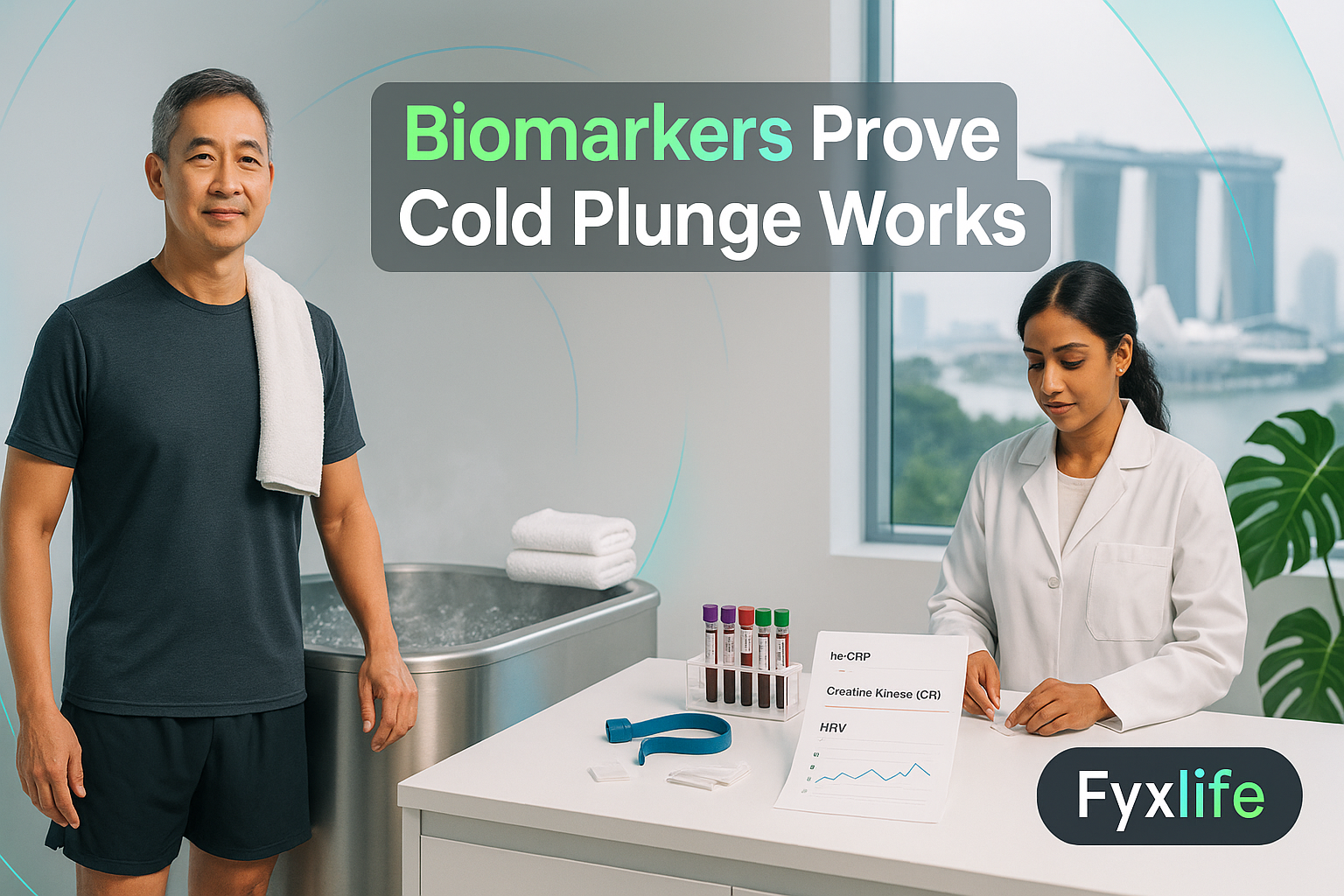
You have been getting in the cold water regularly — maybe for recovery, maybe for stress, maybe because everyone seems to be doing it. But how do you actually know if it is working? Here is the testing framework that separates genuine physiological benefit from expensive placebo.
The honest answer is that most people doing cold water immersion are tracking the wrong thing. They are tracking how they feel walking out of the plunge. Which is not nothing — but it is also not a recovery strategy. It is a vibe. And vibes, however compelling, do not tell you whether the cold is actually shifting your inflammation markers, restoring your nervous system, or accelerating muscle repair. For that, you need data.
Why “I Feel Better” Is Not a Testing Strategy
The problem with vibe-based recovery tracking
The post-plunge feeling is real. The sharpened alertness, the mood lift, the sense that something meaningful just happened to your body — these are not fabricated. But they are also not proof of the physiological outcomes you are probably after. Feeling energised after cold exposure is partly a norepinephrine response — a rapid nervous system reaction to thermal stress that produces an immediate and convincing sense of wellbeing. The problem is that this response happens regardless of whether the cold is producing lasting benefit. You can feel great and still be chronically inflamed. You can feel recovered and still be suppressing the muscle adaptation you worked hard to create in the gym.
Vibe-based tracking also has a calibration problem: over time, you adapt to the discomfort. The subjective intensity decreases. Most people interpret this as progress. It might be. Or it might just mean you have gotten used to being cold.
What cold water immersion is actually doing inside your body
When you submerge in cold water, several physiological systems respond simultaneously. Your blood vessels constrict sharply — a process called vasoconstriction — which redirects blood flow away from the skin and peripheral tissue. Your sympathetic nervous system, the part responsible for the fight-or-flight response, activates hard. Your body releases a cascade of chemical messengers including norepinephrine, dopamine, serotonin, and beta-endorphins. Your immune cells, which normally line the interior walls of blood vessels in a resting state, get flushed back into circulation — a short-term shift known as demargination.
This demargination effect is worth understanding before you ever take a post-plunge blood test. A standard blood draw shortly after a cold session can show a striking spike in white blood cell count that looks, on paper, alarming. It is not. It is a normal physiological redistribution. The cells were not created — they were displaced. Understanding the difference matters, and it is worth flagging with your doctor before interpreting any results taken close to a cold exposure session.
The question is not whether these responses are happening. They are. The question is whether they are producing durable, measurable benefit at the tissue and system level. That is what biomarker testing answers.
The Biomarker Stack — What to Test and Why
Think of your biomarkers as the dashboard of a car you have been driving blind. You might feel like the engine is running well — smoother ride, better fuel economy — but until you plug into the diagnostics, you do not know if you are actually improving performance or just getting used to the discomfort. CRP, CK, and HRV are that diagnostic readout. They tell you whether the cold is tuning the engine or just making the driver feel tough.
Test 1 — C-reactive protein (CRP): your inflammation signal
C-reactive protein, or CRP, is a protein produced by your liver in response to inflammation anywhere in the body. When tissue is damaged, infected, or under stress, CRP rises. When your body is recovering well and inflammatory signalling is being resolved efficiently, CRP stays low. It is the most accessible blood-based marker of your overall inflammatory state, and it is the primary biomarker for tracking whether cold water immersion is doing what proponents claim — modulating chronic, low-grade inflammation.
The version you want is high-sensitivity CRP (hsCRP), which detects levels in the range relevant to chronic disease risk rather than acute infection. Standard CRP tests are calibrated for detecting illness. hsCRP is calibrated for detecting the quieter, persistent inflammation that accelerates ageing, impairs recovery, and underlies most cardiovascular and metabolic risk. The difference matters enormously for this application.
Timing matters as much as the test itself. CRP peaked at 24 hours after exercise in both cold water immersion and control groups in research — meaning a single blood draw immediately after a session misses the full inflammatory picture entirely. Test too early and you are measuring the wrong moment in the physiological curve.
Test 2 — Creatine kinase (CK): your muscle stress and recovery signal
Creatine kinase (CK) is an enzyme released into the bloodstream when muscle fibres are damaged. After hard training, CK rises. The rate at which it returns to baseline is a direct reflection of how well your recovery is working. Cold water immersion is widely used to accelerate this return — and CK testing is the way to confirm whether it is actually doing so for you specifically.
CK levels were among the primary outcomes measured in cold water immersion research, alongside delayed onset muscle soreness and functional performance markers like jump height — which tells you something about how seriously exercise scientists take it as a recovery proxy. If your CK remains persistently elevated between sessions despite regular cold exposure, that is a signal that your protocol — the temperature, duration, or frequency — is not calibrated correctly for your training load.
Test 3 — Heart rate variability (HRV): your nervous system recovery proxy
Heart rate variability (HRV) measures the variation in time between successive heartbeats. Higher variability generally reflects a nervous system in a well-recovered, parasympathetically dominant state — the biological equivalent of being ready to perform. Lower variability suggests sympathetic dominance: the system is still under load, still fighting something, still not recovered.
HRV is the one marker in this stack you can track daily without a blood draw. A wearable that measures overnight HRV gives you a continuous trend line rather than a snapshot — which is exactly what you need when evaluating a recovery intervention over weeks. Cold exposure triggers the release of neurotransmitters including serotonin, dopamine, norepinephrine, and beta-endorphins — none of which are easily measured in routine blood panels, making HRV, sleep latency, and morning energy ratings the practical proxy metrics between blood tests. Watch the trend, not the daily number.
Test 4 — Subjective mood and affect scoring: the research-backed self-report tool
Self-reported mood is not soft data. Used systematically, it is a validated biomarker — and the research bears this out. Participants reported feeling more active, alert, attentive, proud, and inspired, and less distressed and nervous after cold water immersion — measurable psychological shifts that can be tracked systematically using validated mood scales. The key word is systematically. A number logged daily is data. A feeling remembered vaguely is not.
Use a simple 1–10 scale across four dimensions each morning: energy, mood, motivation, and sleep quality. Score before checking your phone. Log it. Over a four-week testing cycle, the trend matters far more than any single morning’s reading.
When to Test — Timing Is Everything
Why the 30-minute and 24-hour windows change everything
The timing of your blood draw relative to your cold session is not a minor logistical detail. It fundamentally changes what you are measuring. Blood samples collected before a cold bath, 30 minutes after, and 24 hours after revealed meaningfully different biochemical states — underscoring that timing of measurement is as important as what you measure. A 30-minute post-session draw captures the acute stress response: elevated cortisol, shifted white cell count from demargination, early oxidative markers. A 24-hour draw captures the recovery response: how well the body has resolved the acute stress and whether adaptation is occurring.
Single-point testing misleads you. If you test once and call it done, you are almost certainly measuring the wrong part of the curve.
How to structure a 4-week testing cycle around your cold exposure habit
Establish your baseline before you begin or change your protocol. Take an hsCRP and CK blood draw on a rest day, at least 48 hours from any cold exposure or hard training. Log your baseline HRV average over seven days. Record your daily mood scores for the same week.
Run your cold exposure protocol consistently for four weeks without changing the dose. In week four, time a blood draw 24 hours after a cold session — not 30 minutes after, not the morning of. Compare hsCRP and CK against your baseline. Layer your HRV trend and mood score trend across the same period. The pattern across all four markers tells a more complete story than any one alone. A systematic review confirmed that cold water immersion produces measurable psychological, cognitive, and physiological effects in healthy adults — validating multi-domain tracking rather than relying on one biomarker alone.
How to Read Your Results
What a positive CWI response looks like across biomarkers
A genuine positive response across the stack looks like this: hsCRP trending down or holding below 1.0 mg/L; CK returning to baseline within 48 hours of a hard training session; HRV trending upward or stable across the month; and mood scores showing consistent improvement in at least two of the four tracked dimensions. You do not need all four moving in the right direction simultaneously. But if none of them are shifting after four consistent weeks, the protocol is not working — or is not being applied correctly.
Red flags: when the numbers suggest your dose, timing, or frequency is off
Persistently elevated CRP despite regular cold exposure suggests one of three things: your inflammation load from other sources — poor sleep, high stress, processed food, excessive training volume — is too high for cold alone to resolve; your cold exposure dose is insufficient; or the timing is wrong and you are testing at the acute spike rather than the recovery phase. Persistently high CK between sessions, especially if accompanied by declining HRV, suggests you are under-recovering regardless of the cold. The cold may not be enough, or it may be adding physiological load rather than removing it.
The muscle-building conflict: how to spot cold exposure blunting your training gains
This is the finding that most ice bath enthusiasts do not want to hear, but the evidence is clear. A systematic review found evidence that post-exercise cold exposure may blunt hypertrophy adaptations — meaning if you are getting into the cold immediately after resistance training, you may be suppressing exactly the cellular signalling that drives muscle growth. The mechanism involves inhibiting the inflammatory cascade that, in moderate amounts, is part of the adaptation signal — not just damage to be resolved.
The biomarker signal to watch here is a combination of persistently modest CK reduction alongside stalled strength or lean mass gains over several months. If your cold exposure is keeping CK unusually low post-training, it may be doing so by blunting the training stimulus itself. Research also shows cold water immersion is no more effective than active recovery for minimising inflammatory and stress responses in muscle — which means if you are hypertrophy-focused, a 20-minute walk after training may serve your adaptation better than an ice bath.
The practical fix: separate your cold exposure from resistance training by at least four to six hours, or shift it entirely to non-training days. Then retest CK and track strength progression over six weeks.
What to Ask Your Doctor
The exact panel to request at your next blood test
- High-sensitivity CRP (hsCRP) — not standard CRP
- Creatine kinase (CK) — total CK, ideally with isoenzyme breakdown if available
- Full blood count (FBC) — to contextualise any white cell shifts from demargination
- Cortisol — morning fasting draw; useful if fatigue or poor HRV trend persists
- Fasting glucose and insulin — cold exposure has metabolic implications, and these provide a useful baseline
Tell your doctor you practise cold water immersion regularly and ask them to note this on your file. It is relevant context for interpreting white cell count and CK, both of which can look unusual in isolation if the clinical picture does not include your cold exposure habit.
Context flags for Singaporeans and Southeast Asians: what additional markers matter at lower BMI thresholds
If you are of Chinese, Malay, or Indian ethnic background, the standard Western reference ranges for inflammatory markers, metabolic risk, and cardiovascular risk may not be the right benchmark for you. Asian populations tend to carry greater visceral fat — the metabolically active fat stored around organs — at lower BMI thresholds than Western reference ranges assume. This means your CRP can be meaningfully elevated at a body composition that looks unremarkable on a standard chart. Ask for waist circumference to be measured and recorded alongside your bloods. Ask whether your hsCRP result is being interpreted against population-appropriate risk thresholds, not just a universal normal range. Research has found that an acute bout of cold water immersion decreases shear stress in the brachial artery alongside measurable cardiovascular and psychological effects — suggesting that vascular health tracking is a legitimate dimension of cold exposure assessment, particularly in populations with higher baseline cardiovascular risk at lower BMI.
The challenge is that this is exactly the kind of question a routine annual check-up was not designed to answer — not because doctors do not care, but because population-level reference ranges were never built to account for your specific ethnic risk profile, training history, and cold exposure protocol simultaneously.
What These Tests Cannot Tell You
The limits of current CWI research and why n=1 tracking still matters
The research on cold water immersion is real, growing, and genuinely promising. It is also still incomplete. Most studies use short intervention windows, heterogeneous protocols, and populations that do not reflect the range of people now regularly using cold plunge. The optimal temperature, duration, frequency, and timing relative to training remains an open question for most subpopulations — including regular exercisers in tropical climates where baseline thermal stress already differs from the Nordic populations that dominate the research literature.
What the tests in this guide cannot tell you is whether cold exposure is the right recovery tool for your specific physiology over the long term. They can tell you whether it is working right now, for your current protocol, against your current baseline. That is not a limitation — that is exactly the kind of data most people never bother to collect. In the absence of a clinical trial designed around your exact profile, consistent n=1 tracking is the closest thing to personalised evidence you have access to. Use it.
At your next routine blood test, ask your doctor to include high-sensitivity CRP and creatine kinase (CK) on the panel — and time your cold exposure session 24 hours before the draw, not the morning of. If your hsCRP comes back above 1.0 mg/L despite consistent cold water immersion over four or more weeks, that is a meaningful signal worth discussing: either your protocol dose, frequency, or timing is not producing the anti-inflammatory response the research suggests it should.


