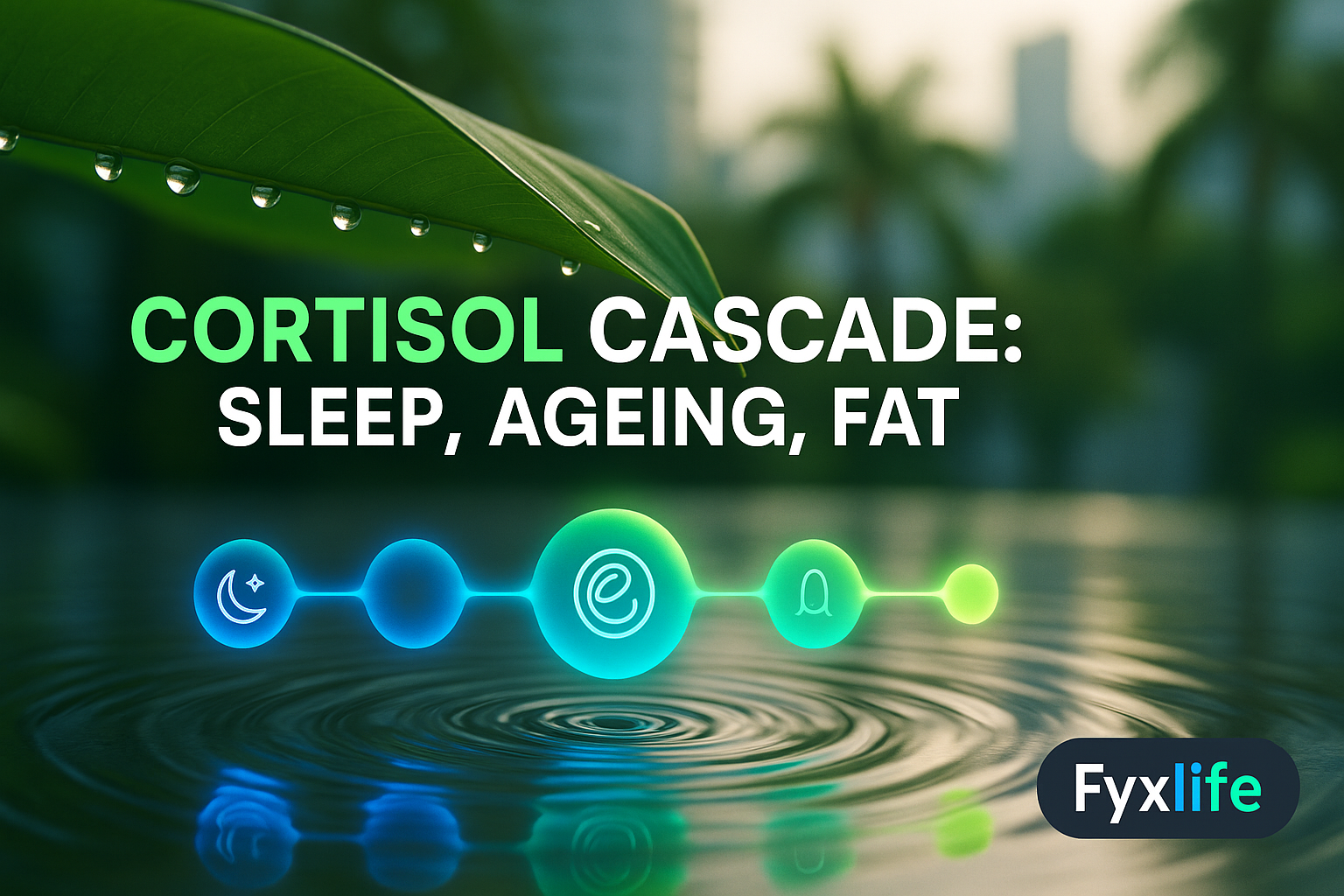
You already know stress feels bad. What most people don’t realise is that chronically elevated cortisol isn’t just uncomfortable — it silently triggers a chain reaction that disrupts your sleep, accelerates cellular ageing, and drives fat to accumulate around your organs. The question isn’t whether this cascade is happening. If you’re under sustained stress in your 40s, it almost certainly is. The question is whether ashwagandha is a legitimate brake on the system — or just expensive reassurance.
Many people arrive at that question the same way: years of fragmented sleep, a sense of being wired but exhausted, and a growing suspicion that something systemic is off. They’ve tried sleep hygiene, cut caffeine, downloaded meditation apps. Some have cautiously added ashwagandha, tracking their own results with a rigour that most clinical trials would respect. The frustration is real. So is the mechanism behind it. Understanding one gives you a genuinely better framework for evaluating the other.
Your Stress Hormone Has a Chain Reaction Problem
What the HPA Axis Is and Why It Gets Stuck
Your body manages stress through a three-part communication system called the HPA axis — a shorthand for the hypothalamus, pituitary gland, and adrenal glands working in sequence. When you perceive a threat, your hypothalamus sends a signal to your pituitary, which releases a messenger hormone called ACTH (adrenocorticotropic hormone) — essentially a chemical instruction telling your adrenal glands to produce cortisol. Cortisol then floods the bloodstream, sharpening focus, raising blood sugar, and preparing you to act.
Think of the HPA axis as a car alarm system. A genuine threat — a deadline, a conflict, a physical danger — triggers the alarm: cortisol floods the system, you get sharp and ready. Normally, the alarm turns off once the threat passes. Chronic stress is like a faulty sensor that keeps the alarm blaring even when the car is safely parked in your garage. The neighbours lose sleep. The battery drains. The engine components start to corrode. Ashwagandha doesn’t rip out the alarm — it recalibrates the sensor so the threshold for triggering it goes back to where it belongs.
The problem is that once this feedback loop gets stuck open, the body struggles to self-correct. Cortisol is supposed to signal back to the hypothalamus to turn production down — a self-regulating mechanism called negative feedback. But under chronic stress, this feedback becomes blunted. The alarm stays on. The body treats every small stressor as an emergency. And the downstream consequences accumulate silently.
Why Modern Chronic Stress Is Especially Good at Breaking This System
The HPA axis evolved for acute, physical threats — the kind that resolve in minutes or hours. What it was never designed for is the unrelenting low-grade pressure of modern professional life: the inbox that never empties, the financial anxiety that wakes you at 3am, the background hum of too many responsibilities and not enough recovery. These stressors don’t spike and resolve. They persist. And persistent activation is precisely what prevents the negative feedback mechanism from doing its job. The sensor never gets a chance to reset.
Cascade Link 1 — High Cortisol Destroys Your Sleep Architecture
How Cortisol Suppresses the Brain’s Calming Signals at Night
Cortisol and sleep are designed to work in opposition. Cortisol should be at its lowest in the late evening, allowing your brain’s calming systems to take over. But when the HPA axis is dysregulated, cortisol levels remain elevated at night — keeping your nervous system in a state of low-level alert when it should be winding down.
The mechanism is specific. Elevated cortisol suppresses the expression of GABA-A, GABA-B1, and serotonin receptors — the brain’s primary inhibitory and mood-calming signalling systems. Think of GABA as your brain’s volume-down button. When cortisol is chronically high, it interferes with the receptors that let GABA do its job. The result isn’t just difficulty falling asleep — it’s fragmented, shallow sleep that never reaches the deep restorative stages your brain and body need.
The Vicious Loop: Poor Sleep Raises Tomorrow’s Cortisol
Here’s where the cascade compounds. Poor sleep doesn’t just leave you tired — it directly elevates cortisol the following day. Your body interprets sleep deprivation as a physiological stressor and responds accordingly: more ACTH, more cortisol, more suppression of your calming systems the next night. You enter a self-reinforcing loop where stress disrupts sleep and disrupted sleep worsens stress. Breaking this loop requires intervening at the source, not just at the symptom level — which is exactly what makes the point of intervention matter so much.
Cascade Link 2 — Disrupted Sleep Accelerates Cellular Ageing
What ‘Biological Clock Ticking Faster’ Actually Means at the Cellular Level
When researchers talk about cellular ageing accelerating under chronic stress, they are referring to something measurable, not metaphorical. Telomere shortening — the progressive erosion of the protective caps on your chromosomes (the technical term for this process is telomere attrition) — is one of the primary mechanisms. Every time a cell divides, telomeres get slightly shorter. Stress accelerates this erosion. The result is that your cells age faster than your chronological age would predict.
Chronically elevated cortisol accelerates cellular ageing, and this compounding effect operates over years, not days. The damage doesn’t announce itself. It accumulates in tissue quality, immune function, and eventually in the conditions associated with biological age outpacing the calendar.
Why This Matters More After 40
Before 40, your body has more biological resilience — repair mechanisms are more robust, recovery from stress is faster. After 40, the baseline rate of cellular repair begins to slow. Chronic cortisol elevation on top of that natural decline is not additive — it’s multiplicative. The same stress load that your body managed at 32 lands differently at 47. This is not pessimism. It is physiology. And it is why understanding the cascade matters more the older you are when you encounter it.
Cascade Link 3 — Sustained Cortisol Drives Visceral Fat and Chronic Inflammation
How a Stress Hormone Becomes a Metabolic Problem
Cortisol has a direct effect on fat storage — specifically on where in the body fat accumulates. Visceral fat — the metabolically active fat that deposits around your internal organs (as opposed to the subcutaneous fat just under your skin) — is preferentially increased by sustained cortisol elevation. This is not cosmetic. Visceral fat is hormonally active in ways that worsen insulin resistance, raise cardiovascular risk, and drive further inflammation.
The mechanism involves cortisol’s role in regulating blood glucose. When cortisol is chronically elevated, it keeps blood sugar raised — a useful emergency response, but damaging when sustained. The pancreas responds by producing more insulin. Insulin signals the body to store energy. And cortisol, acting specifically on visceral fat cells, makes those cells more responsive to that storage signal. The result is fat accumulation around the organs driven not by diet alone but by the hormonal environment that chronic stress creates.
The Inflammation Connection: Cortisol Activates Its Own Damage Cascade
Here the cascade turns on itself in a particularly damaging way. Cortisol was originally an anti-inflammatory hormone — it is what your body deploys acutely to suppress immune overreaction. But chronic elevation paradoxically produces the opposite effect. Sustained cortisol activates protein kinase signalling cascades — a family of molecular switches that sit at the centre of inflammatory pathways. The stress hormone that was supposed to protect you from inflammation becomes one of the drivers of it. This is the point at which a psychological stress response becomes a whole-body inflammatory problem, with implications that reach into cardiovascular risk, immune dysfunction, and cognitive decline.
Where Ashwagandha Intervenes — and Why the Entry Point Matters
Acting on the Root Cause: HPA Axis Dampening vs. Symptom Masking
Most interventions for stress-related symptoms work downstream: sleep aids target GABA receptors directly, anti-inflammatories block inflammatory signals, anxiolytics dampen neural activity. These approaches address symptoms without touching the faulty sensor. What makes ashwagandha worth taking seriously — at least according to the current evidence — is where it appears to act: at the level of the HPA axis itself.
In chronically stressed adults, Withania somnifera (ashwagandha) extract produced measurable reductions in both blood cortisol and ACTH after 8 weeks of use. The ACTH finding is significant. ACTH is the upstream signal — the message from your pituitary telling your adrenal glands to produce cortisol. Reducing ACTH suggests the intervention is working further up the cascade, not just blocking cortisol after it has already been released. That is the difference between recalibrating the alarm sensor and simply turning down the volume on a speaker while the alarm continues to blare.
The Adaptor Mechanism — Modulation, Not Suppression
One of the more counterintuitive findings in adaptogen research is that ashwagandha does not simply suppress cortisol production. Adaptogens exhibit what researchers call a biphasic dose-response: at low doses, they function as mild stress mimetics — substances that activate the body’s own adaptive stress-response pathways rather than overriding them. The analogy is closer to exercise than to medication. Exercise is a controlled stressor that makes you more resilient to future stress. Ashwagandha appears to operate on a similar principle, training the system rather than simply numbing it.
This modulation extends to specific molecular targets. Under stress conditions, ashwagandha has been shown to decrease nitric oxide, cortisol, and JNK — a stress-activated protein kinase involved in inflammatory signalling — while simultaneously stimulating expression of protective heat shock proteins (Hsp70) and stress-resistance factors. The result is a recalibrated stress response rather than a blunted one — which matters if you still need to be sharp, functional, and appropriately responsive to real threats.
What the Evidence Actually Shows (and What It Does Not Prove)
Cortisol and ACTH Reductions: The Clinical Trial Data
The clinical trial data on cortisol and ACTH is the strongest signal in the ashwagandha evidence base. The 8-week reduction findings in chronically stressed adults are meaningful precisely because they measured both cortisol and its upstream driver, ACTH — giving a more complete picture of HPA-axis modulation than cortisol alone would provide. The effect is not dramatic, but it is consistent across multiple studies and biologically coherent with the proposed mechanism.
Sleep, Inflammation, and Ageing: Downstream Signal vs. Proven Outcome
Sleep quality improvement is one of the more consistently documented downstream benefits of ashwagandha, observed in both athletic and general adult populations, and the likely mechanism — modulation of GABA-A, GABA-B1, and serotonin receptor expression — is biologically plausible given what we know about cortisol’s effect on those same receptors. The inflammation and cellular ageing connections are supported by mechanism research: ashwagandha’s cortisol-modulating effect has been described in research as a cornerstone of its anti-ageing action, and its ability to block the protein kinase signalling cascades at the centre of inflammatory pathways suggests that cortisol reduction carries downstream metabolic benefits. There is also evidence that aqueous ashwagandha extract can improve memory retention in stress models by reducing cellular stress — a signal that the cognitive toll of the cascade may also be a viable target.
The Honest Limits of Current Research
What the evidence does not yet provide is long-term human trial data on hard clinical outcomes — cardiovascular events, telomere length, visceral fat mass — attributable specifically to ashwagandha intervention. The cascade logic is mechanistically strong. The downstream trial data is still maturing. Many existing studies are small, short in duration, or conducted in populations that do not perfectly represent the 45-year-old professional under sustained occupational stress. The sleep and cortisol findings are the most robust. The ageing and inflammation findings are compelling but require larger, longer trials to confirm what the mechanism research predicts.
This is precisely the kind of nuance that a standard annual check-up is not designed to help you navigate. Reference ranges for cortisol are built for population averages — not for identifying the subclinical HPA-axis dysregulation that sits upstream of the symptoms you are actually experiencing. Getting a meaningful answer requires looking at your specific pattern over time, not a single fasting cortisol number against a broad normal range.
The Single Intervention Decision: Is Ashwagandha Worth Adding to This Cascade?
The honest answer is: for some people, at the right moment, with a measurable baseline, probably yes. The evidence base is not pharmaceutical-grade in scale, but the mechanism is sound, the cortisol and ACTH findings are real, and the safety profile of standardised ashwagandha extract is well-established at typical doses of 300–600mg of root extract daily. It is not a cure for a dysregulated life. It does not replace sleep, exercise, or the structural removal of stressors where possible. But as an adjunct intervention aimed specifically at HPA-axis recalibration, it has earned a more serious hearing than most supplements in this category.
What it is not is a reason to skip the diagnostic step. The cascade described in this article is real — but it is not happening at the same intensity in every stressed adult. Before spending eight weeks on any supplement, know whether your system is actually showing signs of dysregulation. The evidence should follow the signal, not precede it.
This week, track your morning cortisol proxy: note your waking heart rate and your subjective alertness score (1–10) for 7 consecutive mornings before you consider adding any supplement. If your resting heart rate on waking is consistently elevated above your personal baseline and your alertness score on waking is low despite adequate time in bed, that pattern is consistent with a dysregulated HPA axis — and gives you a measurable baseline to compare against if you do introduce ashwagandha over 8 weeks. If your numbers look normal, the cascade described in this article may not be your current problem, and no supplement is needed.