Cortisol Is Not the Problem. Cortisol Never Switching Off Is.
What cortisol is actually for — the protective baseline
You are tired, your waistline is expanding despite eating well, and your motivation has quietly disappeared — and you have been told it is probably just stress. It is stress. But “just stress” is doing a lot of heavy lifting: chronically elevated cortisol does not stay in one lane. It quietly dismantles your metabolism, your immune system, and your hormonal balance in a specific, predictable sequence — and understanding that sequence changes what you do about it.
Before it becomes the villain in every wellness newsletter, cortisol deserves a fairer introduction. It is your body’s primary stress hormone, produced by the outer layer of your adrenal glands (the adrenal cortex), and it is genuinely useful. It sharpens focus under pressure. It mobilises energy when you need it. It regulates your sleep-wake rhythm. And critically, it inhibits immune overreaction and keeps inflammation from running unchecked — making it one of the body’s most important internal regulators, not merely a marker of feeling frazzled.
Think of your stress response system as a fire alarm wired to a sprinkler. In a real fire, the alarm triggers the sprinkler — cortisol floods your system, you respond, the threat passes, and the sprinkler shuts off. That is the system working perfectly. The problem arrives when the alarm is faulty. Chronic stress is like a sensor that never resets: the sprinkler runs continuously. Your metabolism, immune system, and hormonal output are all getting soaked — not because the fire is real, but because the shutoff valve is broken.
How modern chronic stress turns a useful hormone into a slow-acting poison
The shutoff mechanism for cortisol is a feedback loop called the hypothalamic-pituitary-adrenal axis (the HPA axis) — the three-part command chain that runs from your brain to your adrenal glands. Under healthy conditions, rising cortisol sends a signal back up the chain to say: enough, stand down. Under chronic psychological stress — the kind generated by a relentless inbox, financial anxiety, or years of poor sleep — that feedback signal weakens. The brain learns to ignore it. Cortisol stays elevated not because the threat demands it, but because the regulatory system has been trained to tolerate the alarm.
This matters far beyond mood. Chronically elevated cortisol accelerates cellular ageing — which reframes the entire conversation. This is not simply a story about feeling stressed. It is a story about a hormone that, when left running too long, degrades the biological infrastructure underneath you. That makes cortisol modulation a genuine longevity question, not a wellness trend.
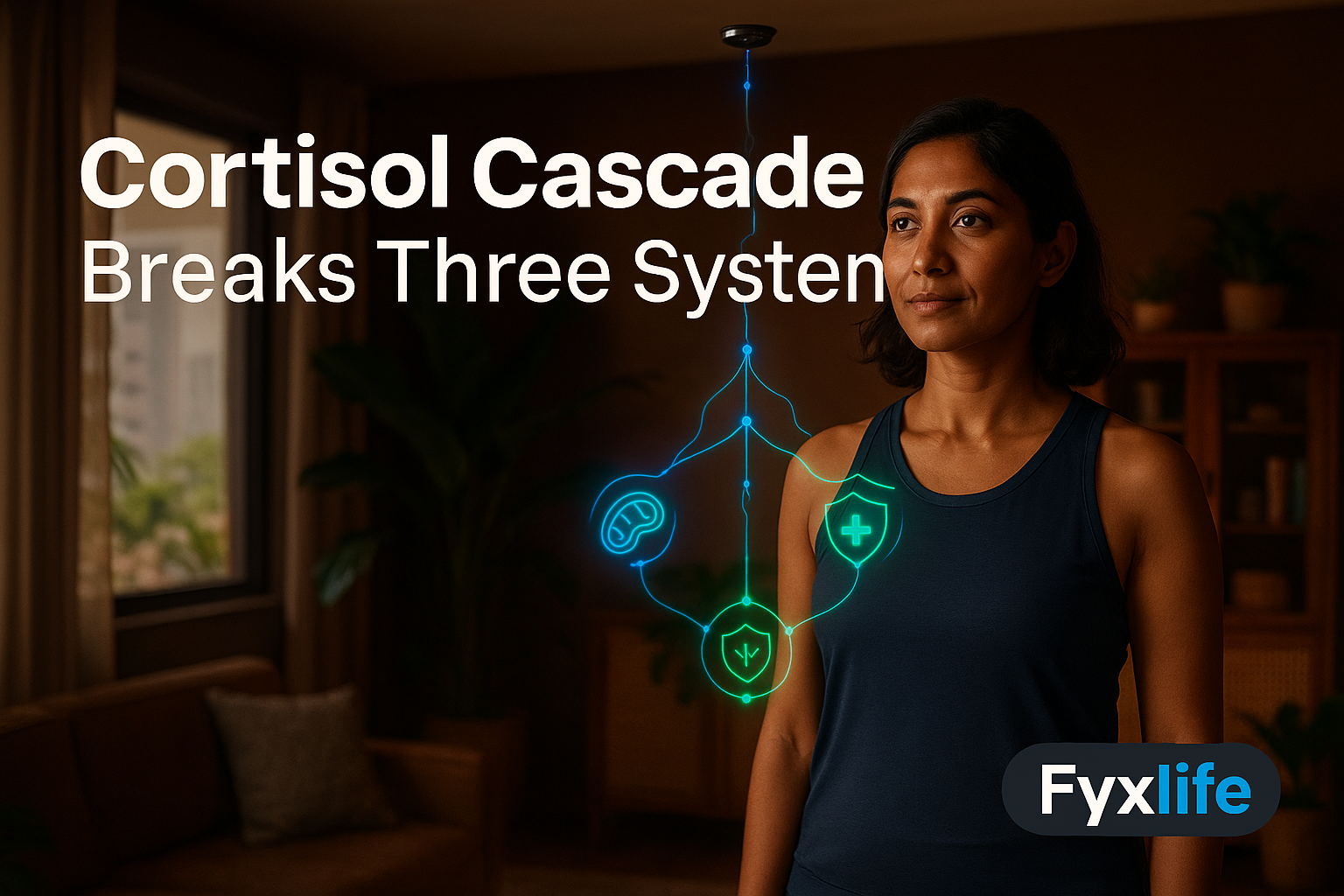
The Cascade: How One Hormone Breaks Three Systems
System 1 — Metabolism: how chronically high cortisol drives fat storage around your organs and promotes insulin resistance
Cortisol’s evolutionary job during stress is to get glucose into your bloodstream fast — so your muscles can run or fight. It does this by signalling the liver to release stored glucose and by making your cells less responsive to insulin, the hormone that normally clears glucose from the blood. In a genuine emergency, this is brilliant. Over months and years of chronic low-grade stress, it is metabolically catastrophic.
Research directly links stress-induced cortisol elevation to fat accumulation and obesity — and the relationship is causal, not merely correlational. The fat that accumulates is not evenly distributed. Cortisol preferentially directs storage to the visceral region, the fat that sits around your internal organs and is metabolically far more dangerous than subcutaneous fat. This is the expanding waistline that resists calorie cuts. The cells surrounding visceral fat have a higher density of cortisol receptors, meaning they respond more aggressively to the hormone. Your body is not ignoring your diet. It is following a different set of instructions entirely.
System 2 — Immunity and inflammation: how sustained cortisol suppresses immune balance and feeds an underlying inflammatory state
Here the story becomes counterintuitive. Cortisol is anti-inflammatory — so surely more of it means less inflammation? It is more complicated than that. Acute cortisol suppresses immune overreaction, which is protective. But when cells are chronically exposed to elevated cortisol, they begin to develop glucocorticoid resistance — meaning they stop responding to the anti-inflammatory signal. The immune system, no longer receiving effective suppression, becomes dysregulated. The result is a state of persistent low-grade whole-body inflammation (what researchers call systemic inflammation) — the kind that does not show up as a fever or obvious illness, but that quietly damages tissues over years.
This is why chronic stress is associated with conditions that look, on the surface, like unrelated problems: joint pain, worsening skin conditions, gut disruption, cardiovascular risk. They are downstream of the same broken shutoff valve.
System 3 — Hormonal balance: how the cortisol burden depresses testosterone and disrupts recovery
Cortisol and testosterone share a precursor — a molecule called pregnenolone that your body uses to build multiple hormones. Under chronic stress, your body prioritises cortisol production. The result is what is sometimes called pregnenolone steal: resources that would have been allocated to testosterone synthesis get diverted upstream. Human studies confirm the connection directly — reduced cortisol is associated with increased testosterone. For men over 35 attributing low drive, reduced recovery from exercise, and declining motivation to age alone, this is worth sitting with. Some of what feels like ageing is the cascade.
Where Ashwagandha Enters the Cascade
The root mechanism — GABA, serotonin receptor modulation, and the HPA axis
Ashwagandha (Withania somnifera) is classified as an adaptogen — a term so thoroughly colonised by marketing language that it has nearly lost meaning. Set that word aside and look at the mechanism instead. Ashwagandha regulates cortisol release and modulates the protein expression of GABA-A, GABA-B1, and serotonin receptors — the receptor sites in the brain that govern the body’s ability to return to calm after arousal.
GABA (gamma-aminobutyric acid) is the brain’s primary braking neurotransmitter — the chemical signal that tells your nervous system to stand down. Serotonin receptors play a role in mood regulation and the perception of threat. By modulating both, ashwagandha appears to act directly on the HPA axis feedback loop — not sedating you, but helping the shutoff valve work more effectively. That is a plausible neurological mechanism. It is not “calming herbs.” It is receptor-level pharmacology.
Blocking the inflammatory signalling chain: what protein kinase inhibition actually means in plain English
Ashwagandha can block specific protein kinase signalling cascades — which sounds abstract until you understand what protein kinases do. Think of them as molecular relay switches: one switch activates the next, and the next, until eventually a cell gets the instruction to produce inflammatory compounds. Ashwagandha’s active compounds appear to interrupt that relay chain at specific points. This means its anti-inflammatory effect is not simply a side effect of lowering cortisol — it is operating at the molecular signalling level simultaneously. That is a meaningful distinction.
What the human evidence shows — cortisol reduction, testosterone increase, and cellular ageing slowdown
The evidence base for ashwagandha is more substantial than most adaptogens can claim. A meta-analysis of nine randomised controlled trials on ashwagandha and cortisol exists in the published literature — which places it several rungs above the single-study claims that dominate supplement marketing. Human trials show both a reduction in cortisol and an associated increase in testosterone. And the cellular ageing research suggests that addressing the cortisol cascade upstream may slow one of the key mechanisms by which chronic stress ages you at the biological level. These are not small claims. They are also not certainties.
What the Evidence Actually Supports (and What It Does Not)
Doses that worked in trials versus doses in most products
Here is the detail most product pages quietly omit. An aqueous extract of ashwagandha root and leaf safely reduced mild to moderate chronic stress at doses of 125 mg, 250 mg, and 500 mg per day over eight weeks in human trials. The lower end of that range — 125 mg — produced measurable effects. Many commercial products sell 600 mg to 1,000 mg capsules on the premise that more is better. The trial evidence does not support that logic. More is not the direction the data points. It raises the question of what optimisation beyond the effective dose actually costs you.
Who the research was conducted on — and whether that matches you
Most ashwagandha trials recruited adults with self-reported chronic stress and mild to moderate symptoms — people who would recognise themselves in the opening of this article. The trials were generally conducted over eight to twelve weeks. Extrapolating from this to long-term use, or to people with clinical anxiety disorders, adrenal dysfunction, or autoimmune conditions, is not supported by the current evidence. The research was not conducted on those populations. If your situation is more complex, the gap between what the trials show and what you can safely infer widens considerably.
This is the kind of question a routine annual check-up was not designed to answer — not because GPs do not care, but because population-level reference ranges and a ten-minute appointment slot were never built to map supplement evidence onto your specific cortisol profile and symptom history.
Side effects, Reddit reality-checks, and the motivation question
Some people who have taken ashwagandha report that it resolved years of sleep disruption. Others describe it as “destroying motivation for everything” — a cortisol-modulating effect real enough to overshoot in sensitive individuals. These accounts are not clinical evidence of efficacy or harm. But they are a useful signal: this supplement has a measurable physiological effect, and that cuts both ways. If cortisol is partly what drives you — the edge that keeps you sharp under pressure — blunting it more than necessary has a cost. Supplements that work on the HPA axis are not inert.
The Verdict — Is the Cascade Claim Earned?
What ashwagandha can plausibly do upstream
The cascade argument holds. Chronically elevated cortisol does break metabolism, immune regulation, and hormonal balance in a specific sequence. Ashwagandha has a plausible mechanism — HPA axis modulation through GABA and serotonin receptor expression — and human evidence supporting cortisol reduction, downstream testosterone recovery, and anti-inflammatory effects at the molecular level. For someone whose cortisol is genuinely elevated and whose symptoms match the cascade described here, the evidence is strong enough to take seriously. The dosing is lower than most products advertise, which is actually reassuring: the trials used the minimum effective dose, not the maximum sellable one.
What it cannot fix if the root stressor remains unchanged
Ashwagandha’s proposed role is to help repair the shutoff valve — not to remove the alarm, and certainly not to eliminate the underlying fire. If the stressor is structural — the job, the relationship, the financial pressure, the chronic sleep debt — modulating the HPA axis downstream buys you marginal relief while the system continues to be overloaded upstream. The supplement can lower the water pressure. It cannot fix a leak that is still actively running. Every meaningful outcome in the research was measured alongside an unchanged stressor load. That is the honest boundary of what the evidence supports.
One Measurable Step to Take This Week
Before spending money on ashwagandha, get a morning serum cortisol reading at your next routine blood draw — ideally between 8 and 9 am, which is when cortisol naturally peaks. If your result comes back in the upper third of the reference range alongside symptoms like central weight gain, poor sleep, or low energy, that is the data point that makes the cortisol-cascade argument personally relevant to you. If your cortisol is already normal, the cascade described here is not your current problem — and no supplement fixes a lever that is not broken.