The Verdict Up Front: Lifestyle Is Real Cancer Prevention — With Honest Limits
What the evidence confirms (and what it cannot promise)
You eat well, exercise, and avoid smoking — but a part of you still wonders: does any of it actually move the needle on cancer risk? The honest answer is yes, but not equally across all cancers, and not in the way most wellness content implies. Here is what the evidence actually says, and what it cannot promise.
Start with the most important framing you will read in this article. One woman in a community of people carrying high-risk cancer genes described her situation this way: she had less than one drink a week, practiced yoga, followed a plant-based diet, meditated, exercised regularly, never smoked, slept well, and never used recreational drugs. She still got cancer. That is not an argument against prevention. It is the honest starting point for one. Lifestyle reduces risk. It does not eliminate it. Anyone who tells you otherwise is selling something.
Research consistently demonstrates that adherence to lifestyle guidelines is associated with meaningfully lower cancer risk, with the relationship between cancer prevention and lifestyle extensively studied across multiple cancer types. That finding is real and reproducible. What it does not mean is that doing everything right makes you immune — because cancer is not a single disease with a single cause. It is dozens of diseases, with overlapping and distinct biological pathways.
Why ‘up to 30% risk reduction’ is both true and easily misread
The headline statistic that gets repeated — a cluster of ten specific lifestyle choices associated with up to 30% reduction in cancer risk — is accurate. It is also frequently misread. That figure applies to specific cancer types, not all cancers uniformly. A 30% risk reduction for colorectal cancer from diet and physical activity changes is not the same claim as a 30% reduction in your lifetime cancer risk across the board. The distinction matters enormously, especially if you have a family history of a cancer type where lifestyle is a weaker modifier.
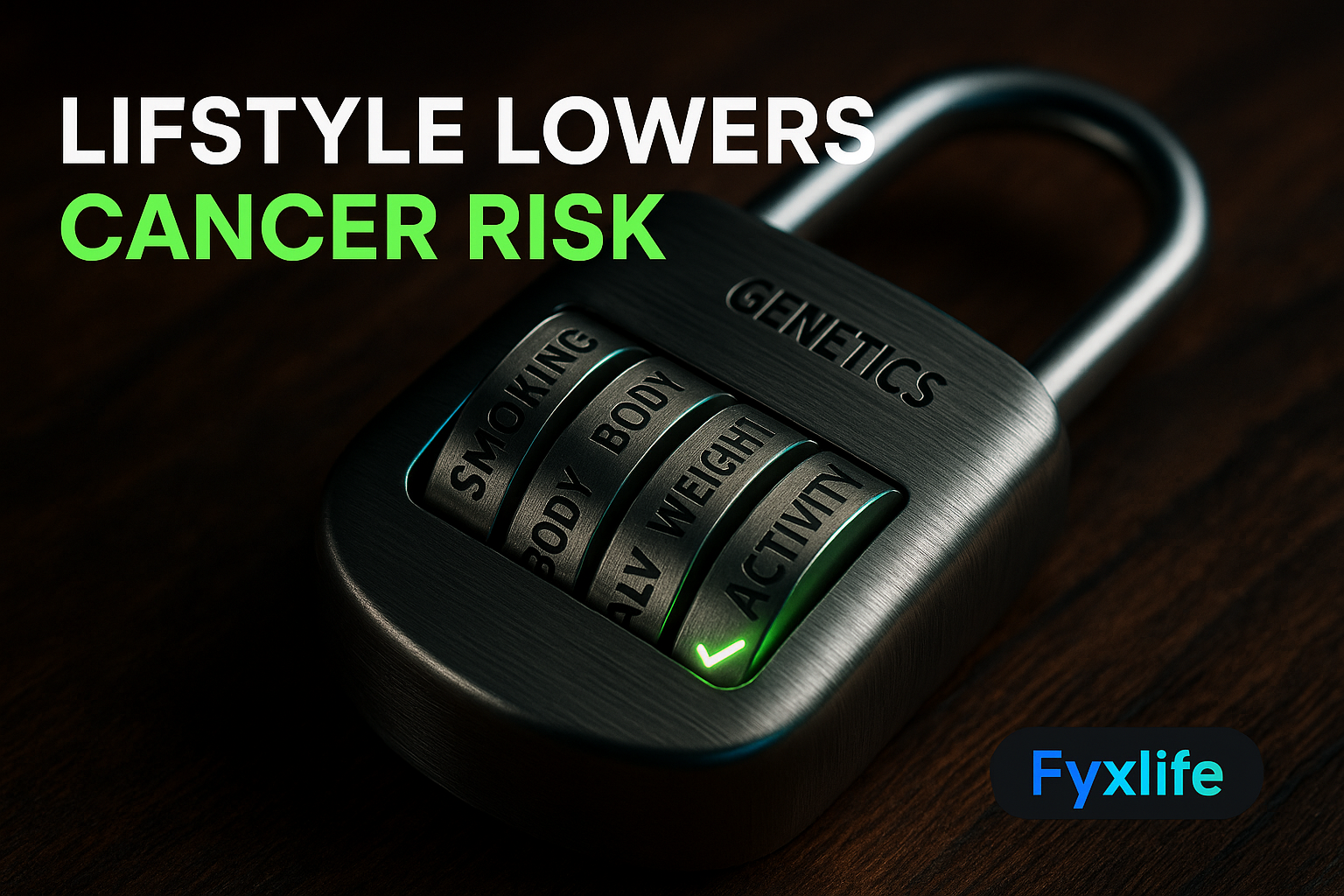
Think of your cancer risk as a combination lock with multiple dials. Genetics sets one dial permanently. Lifestyle controls the remaining four or five. You cannot pick the lock open with one dial alone, and turning all the lifestyle dials in the right direction does not guarantee the lock never opens. But it genuinely makes it harder. The goal is not perfection. It is stacking the odds — consistently, over decades.
The Five Lifestyle Levers With the Strongest Evidence
1. Not smoking — the one behaviour with unambiguous, dose-dependent evidence
Smoking is the most studied modifiable cancer risk factor in human history. The evidence is not probabilistic or context-dependent — it is dose-dependent, meaning the more you smoke and the longer you smoke, the higher your risk climbs in a measurable, predictable way. This applies most directly to lung cancer, but also to cancers of the mouth, throat, oesophagus, bladder, kidney, cervix, and pancreas. If you still smoke, this is not one lever among many. It is the lever, and everything else in this article is secondary to it.
2. Maintaining a healthy body weight — especially fat stored around organs
The relationship between excess body weight and cancer risk is not simply about the number on a scale. The more dangerous variable is visceral fat — the fat stored around your abdominal organs rather than under your skin. Visceral fat is metabolically active in ways that subcutaneous fat is not. It produces hormones and inflammatory signals that, over time, create a biological environment where abnormal cell growth becomes more likely. Cancers with the strongest associations to excess body weight include endometrial, postmenopausal breast, colorectal, kidney, and oesophageal cancers. Bringing your weight into a healthy range — and keeping it there — is not cosmetic. It is a direct reduction in several of those dials on the combination lock.
3. Physical activity — beyond weight, movement has independent cancer-protective effects
Here is something that often surprises people: physical activity reduces cancer risk through mechanisms that are entirely independent of its effect on body weight. Movement lowers the levels of hormones like insulin and oestrogen that promote certain tumour types. It reduces the chronic, low-grade bodily alarm state (what researchers call systemic inflammation) that creates fertile conditions for cancer to develop. And it speeds the transit of food through your colon, reducing how long potential carcinogens stay in contact with the bowel wall. You do not have to be an athlete. The evidence supports meaningful risk reduction from consistent, moderate activity — walking, swimming, cycling — sustained over years, not weeks.
4. Diet quality — what the evidence actually supports versus what is trending
The Anticancer lifestyle framework positions daily practice — encompassing diet, physical activity, stress reduction, and sleep — as a systemic approach to lowering cancer risk, rather than any single intervention. On diet specifically, the evidence base is strongest for foods rather than nutrients. High intake of vegetables, whole grains, and legumes. Lower intake of processed meat, alcohol, and ultra-processed foods. The superfoods narrative — the idea that any single food prevents cancer — is not well supported. What is supported is dietary pattern over time. The Mediterranean-style diet has the most consistent research behind it for multiple cancer types. No single meal prevents cancer. A decade of eating patterns might.
5. Alcohol — the underestimated carcinogen hiding in social culture
This is the lifestyle factor most likely to be underestimated by health-conscious adults. Alcohol is a Group 1 carcinogen — the highest classification used by the International Agency for Research on Cancer, placing it in the same category as tobacco and asbestos in terms of evidence certainty, not in terms of dose effect. It is directly associated with cancers of the breast, liver, colon, rectum, mouth, throat, and oesophagus. The association does not disappear at low doses. There is no confirmed safe threshold. If you are managing cancer risk as a serious long-term project, alcohol deserves more scrutiny than most wellness content gives it.
The Metabolic Cancer Theory — Promising Signal or Hype?
What the glucose-cancer connection actually says
An emerging area of cancer biology focuses on how cancer cells use energy differently from healthy cells. Normal cells primarily generate energy through oxygen-based processes (what biologists call oxidative phosphorylation). Many cancer cells, by contrast, rely heavily on glucose fermentation even when oxygen is available — a phenomenon known as the Warburg effect. The logic of the metabolic cancer theory is that interventions which lower circulating blood sugar and shift the body toward burning fat — lowering the ratio of blood glucose to the molecule produced during fat-burning (the Glucose Ketone Index, or GKI) — might starve cancer cells of a preferred fuel source. The Mitochondrial Metabolic Theory of Cancer is being explored through frameworks including the Glucose Ketone Index and metabolic therapy, but current evidence positions these as early-stage signals worth further study, not established prevention protocols.
Why ketogenic diets for cancer prevention are early-evidence, not protocol
The ketogenic diet — a very high-fat, very low-carbohydrate approach that pushes the body into a state of burning fat as its primary fuel (called ketosis) — is frequently discussed in the context of this metabolic theory. Creatine supplementation and ketogenic dietary approaches are being discussed in the context of mitochondrial metabolic health and cancer prevention by longevity researchers, though these remain emerging discussions rather than proven interventions. This is not a reason to dismiss the theory. It is a reason to be precise about what the evidence currently supports. Chronic high blood sugar and insulin resistance are genuine cancer risk factors. Addressing those through diet and exercise is well-evidenced. Whether a strict ketogenic protocol offers prevention benefits beyond what a lower-sugar, whole-food diet achieves remains an open research question.
The BRCA Reality Check: When You Do Everything Right and Still Get Cancer
What this means for people with family history — and what it does not mean
BRCA1 and BRCA2 are genes that, when mutated, substantially raise lifetime risk for breast and ovarian cancers — and to a lesser extent, prostate and pancreatic cancers. Carrying one of these mutations does not mean cancer is inevitable, but it does mean that one of the dials on the combination lock is turned significantly further toward risk than it is for the general population. Genetic predisposition remains a significant contributor to cancer risk — while lifestyle modification can lower modifiable risk factors, it does not override inherited genetic vulnerabilities.
For people with a meaningful family history — not just BRCA carriers, but anyone whose first-degree relatives have had cancer — this matters in two directions. First, lifestyle interventions still apply and still reduce modifiable risk. Second, the conversation about surveillance, screening frequency, and in some cases, preventive medical interventions, becomes more urgent. This is precisely the kind of question a routine annual check-up was not designed to answer — not because doctors do not care, but because population-level screening guidelines were built for average risk, not for your specific family history and genetic profile. The standard appointment is optimised for acute problems and population averages. It was never designed to map your personal risk landscape.
Community-Based Prevention Programs: Does Structured Lifestyle Intervention Work?
What the Total Wellness program found
Total Wellness is described as an evidence- and community-based cancer prevention and lifestyle intervention program, representing a real-world application of translating research into structured behavioural change. What programs like this test is not whether the science works — we know the biological pathways. What they test is whether structured support translates awareness into sustained behaviour change in real people with real lives, competing priorities, and years of established habits.
The gap between knowing and doing — and why programs matter
Most health-aware adults already know they should eat better, move more, and drink less. The gap is not informational. It is structural and psychological. Knowing that physical activity reduces cancer risk does not overcome the frictionless pull of a sedentary evening after a demanding workday. Programs that create accountability structures, social reinforcement, and measurable short-term feedback loops address the actual barrier — not the knowledge deficit. The evidence that structured intervention programs produce measurable outcomes tells you something important: optimising for cancer prevention is not primarily a knowledge problem. It is a behaviour architecture problem.
The Singapore and Southeast Asia Angle — Why Your Risk Profile May Be Different
Metabolic risk at lower BMI thresholds
For adults in Singapore and Southeast Asia, metabolic risk factors like obesity, sedentary behaviour, and chronic high blood sugar occur at lower BMI thresholds — meaning standard Western risk cutoffs may underestimate personal cancer risk. A BMI of 23 in a Southeast Asian adult carries metabolic risk comparable to a BMI of 25 to 27 in a European adult. If you are using Western reference ranges to assess your weight-related cancer risk, you may be reading yourself as lower risk than you actually are. The visceral fat accumulation that drives metabolic cancer risk can be substantial at body weights that Western charts still classify as healthy.
Cancer types most prevalent in the region and their modifiable risk factors
The cancer types with highest burden in Singapore and Southeast Asia include colorectal, liver, nasopharyngeal, stomach, and — increasingly — breast cancer. Several of these have meaningful lifestyle connections. Liver cancer is strongly associated with hepatitis B infection (addressable through vaccination) and with alcohol intake and fatty liver disease driven by excess body weight and high-sugar diets. Colorectal cancer has one of the strongest diet-and-physical-activity connections of any cancer type. Stomach cancer is associated with high salt intake — a dietary pattern common across much of the region. Your local risk profile is not identical to the one described in Western prevention guidelines, and it is worth understanding the difference.
The Verdict: Is Lifestyle-Based Cancer Prevention Worth Committing To?
What you should do, based on the evidence
Treat lifestyle modification as a long-term systemic practice, not a short-term intervention. The Anticancer framework is explicit about this — the mechanism is daily accumulation of lower-risk conditions in your body over years, not a single dietary change or exercise routine followed for six weeks. Prioritise the levers with the strongest evidence: smoking cessation first, body weight second, physical activity third. Audit your alcohol intake honestly. Build dietary quality as a pattern over years, not as an event. Get screened for the cancers where early detection meaningfully changes outcomes. And if you have a family history that places you in a higher-risk category, pursue a more complete picture of your personal risk profile than a standard check-up is likely to provide.
What you should stop believing
Stop believing that any single food, supplement, or dietary protocol prevents cancer. Stop believing that because you eat well and exercise, your risk is negligible — lifestyle reduces risk, it does not eliminate it, and the combination lock analogy is not motivational language, it is an accurate description of cancer biology. Stop believing that a normal result on a standard annual blood test means your cancer risk has been assessed. And stop using the complexity of cancer as a reason to do nothing — uncertainty about the exact magnitude of benefit is not the same as uncertainty about whether benefit exists. The evidence that lifestyle matters is not ambiguous. The evidence that it matters equally for all cancers, or that it provides a guarantee, is.
One single action to take this week
Based on this verdict, make one decision this week: audit the single lifestyle factor with the strongest evidence base — smoking status, body weight, or alcohol intake — and honestly assess whether your current behaviour aligns with your stated cancer prevention goals. If it does not, that is your one lever to act on first. Not a supplement, not a test, not a new diet. The highest-evidence intervention is already known.