
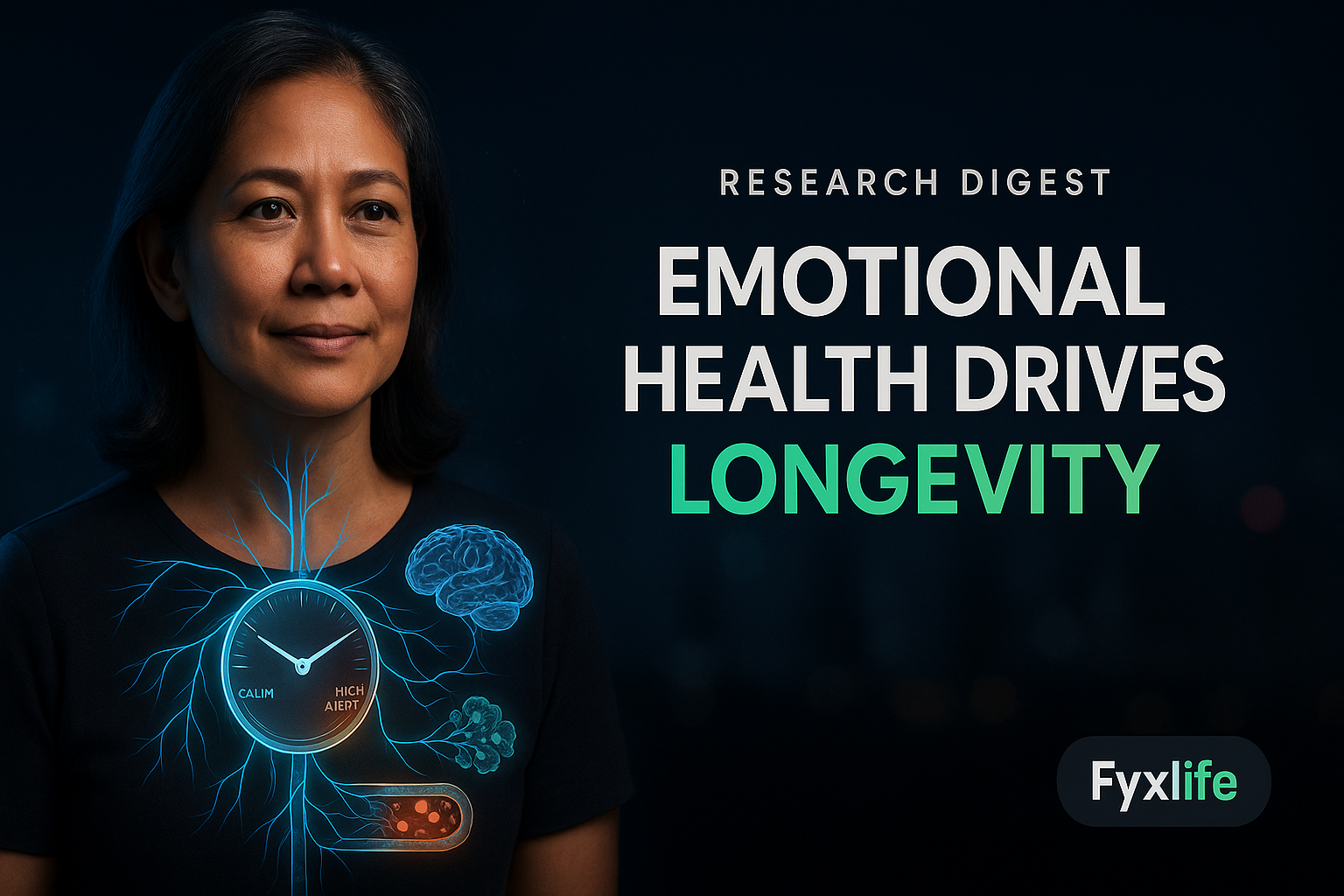
You optimise your sleep, track your VO2 max, and read every study on metabolic health — but research is now making it harder to ignore the variable you may have been quietly deprioritising: your emotional state. A growing body of evidence positions emotional health not as a soft lifestyle add-on, but as a measurable driver of how long — and how well — your brain and body hold together.
For most high-performing professionals in the 35–60 bracket, emotional health gets managed the way a slightly overdue car service does — noted, deferred, handled eventually. There’s always something more concrete to optimise first. A protocol to tighten, a lab result to chase, a habit stack to refine. But the research reviewed here suggests that deferral has a physiological cost — one that accumulates quietly, without obvious symptoms, until it doesn’t.
What the Research Actually Found
Emotional Health Classified as a Survival Metric
The strongest framing to emerge from recent work on emotional health and longevity is not that stress is bad for you — you already knew that — but that emotional dysfunction kills directly, not only as a background contributor to chronic disease. Suicide and accidental overdose rank among the leading causes of death for adults under 45 in the United States, making emotional health a survival metric in the most literal sense. This is not a wellness framing. It is a mortality framing.
The implication extends beyond crisis. Chronic despair, persistent social disconnection, and unmanaged stress — states that never reach clinical threshold but never fully resolve — operate on the same biological pathways, just more slowly. The destination is different. The direction is the same.
The Three Pillars — Relationships, Stress Reduction, and Positive Mindset
Strong relationships, stress reduction, and a positive mindset are identified together as the core triad supporting emotional health and longevity — not as isolated habits you can pick from à la carte, but as interconnected mechanisms that reinforce each other. Stress reduction without social support degrades faster under pressure. A positive mindset without genuine relational security becomes brittle. The architecture matters. You need all three load-bearing walls, not one very strong one.
What This Means in Plain English
The Biological Chain Reaction That Chronic Stress and Despair Set Off
Think of your emotional state as a thermostat for your body’s chemical alarm system. When you are chronically stressed, isolated, or despairing, the thermostat gets stuck on high alert — flooding your body with low-grade chemical alarm signals (what scientists call inflammatory markers) day after day. Just as leaving a building’s heating blasting in summer slowly breaks down the system, a permanently elevated alarm state gradually degrades your heart, brain, and immune function — long before you feel any obvious symptoms.
This is the mechanism that connects the psychological to the physiological. It is not metaphorical. Persistent emotional dysregulation produces measurable increases in signalling proteins that drive tissue damage — a process researchers call chronic low-grade inflammation — and those increases show up in blood panels, in cardiovascular risk scores, and eventually in organ function. The emotional state is not separate from the biology. It is upstream of it.
Why Relationship Quality Outranks Relationship Quantity
Not all social connection is equal. The research draws a useful distinction here. Relationships characterised by a sense of permanent security — what researchers describe as covenantal bonds, as opposed to transactional or contractual ones — are associated with stronger emotional health and longevity outcomes. This matters because it reframes the question. The goal is not to expand your network or increase social activity as a volume exercise. The goal is depth, consistency, and the felt sense of unconditional reliability in the relationships that anchor your daily life.
Regular social interaction with friends, family, and community members helps combat loneliness — but community interaction works differently from intimate relational security. Both matter. They address different parts of the biological stress response. Broad community contact reduces the background hum of isolation. Deep relational security reduces something more fundamental: the body’s assessment of whether it is fundamentally safe.
The challenge is that this is exactly the kind of question a routine annual check-up was not designed to answer — not because doctors don’t care, but because population-level reference ranges were never built to account for your specific emotional architecture or relational history. A 10-minute appointment optimised for acute presentations cannot map the slow-moving risk that chronic disconnection represents.
The Sleep-Emotion Loop — An Upstream Variable You Can Measure
How Poor Sleep Degrades Emotional Regulation (and Vice Versa)
Sleep is where the emotional health story becomes actionable in a way that is directly measurable. Good sleep improves productivity, physical health, emotional health, and longevity — and the relationship runs in both directions. Poor emotional regulation disrupts sleep architecture (the structured progression through light, deep, and rapid eye movement sleep that your brain needs to process stress hormones). Disrupted sleep architecture then degrades emotional regulation the following day. The loop tightens.
The practical detail that often gets missed: it is not just sleep duration but sleep quality that determines whether this loop is working for you or against you. You can log eight hours and still wake up with elevated cortisol — the stress hormone that drives the fight-or-flight response — if your deep sleep phases are consistently fragmented. This is why wearable data on sleep stages matters more than total hours alone.
One concrete lever the evidence points to: bedroom temperature regulation around 18°C is consistently cited as a practical, zero-cost mechanism for improving sleep quality. Small, boring, effective.
The Brain-Specific Angle — What This Means for Cognitive Decline Risk
Social Engagement, Mental Stimulation, and the Dementia Connection
For professionals with a family history of dementia or early concerns about cognitive performance, the emotional health research lands with particular force. Social connections and community interactions reduce the biological stress responses associated with loneliness — and loneliness is increasingly understood not just as an emotional state but as a driver of accelerated biological ageing, including neurological ageing.
Continuously learning new skills or engaging with new subjects is identified as a mechanism that keeps the brain healthy and structurally engaged — what neuroscientists describe as maintaining cognitive reserve, the brain’s ability to compensate for age-related changes by drawing on alternative neural pathways. This is not about doing crossword puzzles. It is about genuine novelty and challenge — the kind of learning that forces the brain to build new connections rather than rehearse existing ones.
Physical activity supports not just strength and flexibility but emotional and cognitive health across the lifespan, reinforcing a bidirectional relationship between body and mind that is more structural than motivational. One user insight that mirrors this perfectly: reframing exercise not as performance discipline but as an act of care for your own emotional quality of life changed the entire relationship with consistency. The behaviour stayed the same. The meaning of it shifted — and that shift was what made it stick. The research suggests this framing is not just psychologically convenient. It may be mechanistically accurate.
What This Study Cannot Prove
Confounders, Causality Gaps, and What Remains Open
The honest account of this evidence base requires acknowledging what it cannot yet establish. Most of the research linking emotional health to longevity outcomes is observational — meaning it identifies associations, not clean causal chains. People with strong relationships also tend to have better socioeconomic stability, better access to healthcare, and healthier baseline behaviours. Disentangling the independent contribution of emotional health from these correlated variables is genuinely difficult.
The inflammatory pathway — the mechanism connecting chronic stress to physical disease — is well-established in the biological literature. What is less established is the precise dose-response relationship: how much chronic stress, over what duration, produces clinically significant changes in which populations. The thermostat analogy is accurate in direction. The exact temperature settings remain under investigation.
What the evidence does support with confidence is the directionality. Emotional dysfunction increases biological risk. Emotional health — defined as strong relationships, managed stress, and a positive orientation toward the future — reduces it. The magnitude of effect, and the optimal interventions for specific individuals, remain areas of active research.
The One Number Worth Tracking — Connecting This Research to Your Biomarkers
If you want to connect this research to something measurable in your own body, the most accessible bridge is your sleep data. Sleep architecture — specifically the proportion of time spent in deep, slow-wave sleep and rapid eye movement sleep — is a direct readout of your nervous system’s ability to process stress and regulate the chemical alarm signals this article has described. Wearables measure this imperfectly but directionally. A consistent pattern of fragmented or truncated deep sleep, combined with high resting heart rate variability in the wrong direction, tells you something real about where your emotional-physiological thermostat is currently set.
Beyond sleep, the biomarkers most relevant to this research are those associated with chronic inflammation — specifically high-sensitivity C-reactive protein (a blood marker that rises when the body’s alarm system is chronically activated) and fasting cortisol levels. Neither is routinely ordered in a standard annual health screen. Both are worth asking about if you recognise yourself in what this article describes.
Your Single Next Step
Pull up the last 30 days of your sleep tracking data — whether from a wearable, an app, or honest self-recall. If your average sleep duration is under 7 hours or your sleep quality scores are consistently low, this research suggests that before adding another supplement or optimising another protocol, discussing sleep restoration with your doctor is the highest-leverage emotional and cognitive health intervention available to you right now. Ask specifically about sleep architecture, not just duration.


