
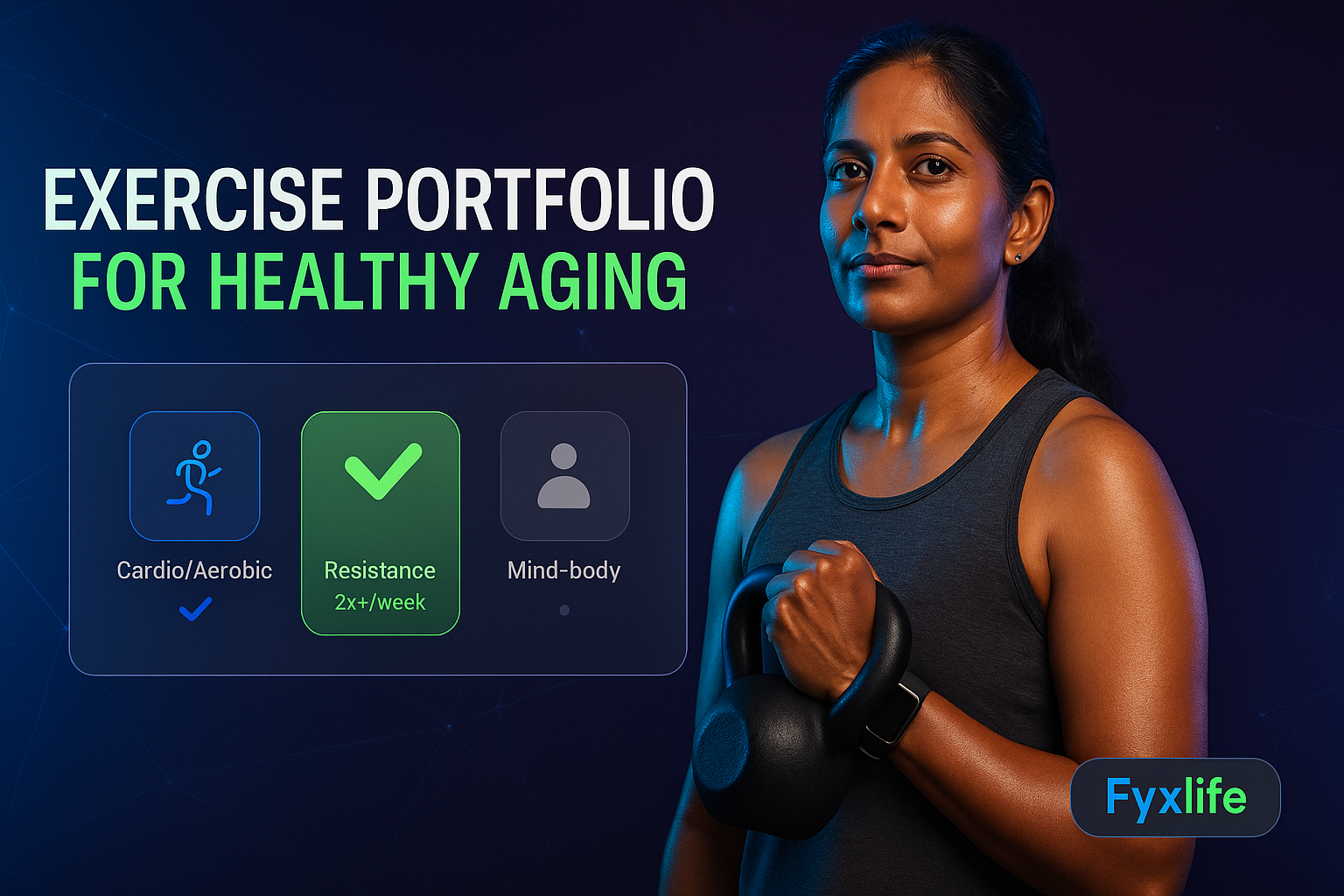
The Verdict Up Front — What Exercise Science Now Supports for Healthy Aging
Why ‘just keep training’ is no longer enough of an answer after 40
You’re already training — Hyrox blocks, long runs, heavy lifts. But is the way you’re structuring your exercise actually optimising for how well you age, or just how fit you feel right now? The evidence on exercise for healthy aging has gotten specific enough that ‘stay active’ is no longer a useful answer.
Here’s the problem with being a committed, performance-oriented athlete in your late 30s to late 50s: your fitness doesn’t protect you from making the wrong investment. You can log consistent training weeks, hit solid race times, and still be building a protocol that is quietly under-serving your long-term health. Not because you’re doing something wrong. Because you’re doing too much of one thing and not enough of another — and the research has now gotten precise enough to name exactly what that looks like.
Think of your exercise protocol like a portfolio of investments. Cardio is your index fund — reliable, broad returns, essential. Resistance training is your growth asset — higher activation cost, but it compounds over decades through muscle preservation and cellular repair. Mind-body work is your hedge — low yield day-to-day, but it pays out when the rest of the portfolio is under stress. Most performance athletes are over-invested in one asset class and wonder why their long-term returns are inconsistent. The evidence now tells us clearly what the right allocation looks like.
The four pillars of evidence-based exercise for longevity
The current evidence base points to four distinct components that a complete longevity exercise protocol needs to contain: structured aerobic training, progressive resistance training, flexibility and mobility work, and mind-body modalities. No single modality is sufficient on its own — and the distribution between them matters more than most athletes recognise. The rest of this article works through each pillar using the controlled trial data, names what each delivers, and gives you an honest verdict on where the evidence is strong versus where it’s still developing.
What the Exercise for Healthy Aging Study Actually Found
24 weeks of supervised aerobic and resistance training — the controlled trial data
The Exercise for Healthy Aging Study is one of the more rigorous controlled trials in this space. It ran participants through 24 weeks of supervised combined aerobic and resistance training, measuring physical function outcomes in a way that allows us to draw real conclusions about what structured, combined protocols actually produce — not just in theory, but in people completing a monitored programme. The supervision element matters here: most real-world exercise research suffers from adherence noise. This study controlled for it.
The findings confirmed that combined training — not cardio alone, not resistance alone — produces meaningful physical function improvements. That is the base case. But the more interesting data came from the intensity comparison and, particularly, from the heterogeneity analysis.
Physical function improvements at moderate vs. high intensity — which delivers more
When the Exercise for Healthy Aging Study compared outcomes across moderate and high intensity training groups, both produced measurable physical function gains. The finding that often surprises performance athletes — who are accustomed to the logic that harder produces better — is that moderate intensity training holds up remarkably well against high intensity when the outcome variable is long-term physical function rather than peak performance. High intensity training has a place in a longevity protocol, and we’ll address that in the aerobic section. But the evidence does not support loading your entire programme at the high end if healthspan, not race pace, is the primary objective.
The response heterogeneity problem — why the average result may not apply to you
This is arguably the most important finding for any individual trying to apply population-level research to their own training. A secondary analysis of the Exercise for Healthy Aging Study identified significant heterogeneity in individual responses to the same exercise protocol — meaning that the average outcome reported in a clinical trial may not reflect what any specific person actually experiences. Some participants improved substantially. Others, following the identical programme, showed minimal change. The ‘optimal’ protocol, strictly interpreted, does not exist at the population level. It exists at the level of your individual biology, training history, and current metabolic state. This is the honest limitation of applying any single study’s headline finding to your own programme design.
The challenge is that this is exactly the kind of question a routine annual check-up was not designed to answer — not because doctors don’t care, but because population-level reference ranges were never built to account for your specific response pattern, recovery capacity, or how your biology is actually adapting to load.
Resistance Training: The Non-Negotiable Pillar
How lifting activates the cell growth switch (mTOR) and why this slows biological aging
If you are a cardio-dominant athlete who treats resistance training as an optional add-on, this section is the one to sit with. Resistance training activates the cell growth switch — the technical term is the mTOR pathway (mechanistic target of rapamycin) — which sits at the core of the molecular biology of aging. When you load muscle under progressive tension, you trigger a cascade of repair and growth signals that maintain muscle protein synthesis, support tissue turnover, and regulate the cellular processes most closely associated with biological age. This is not a marginal benefit. It is one of the most consistent, well-supported findings in the longevity exercise literature.
The mTOR pathway works like a cellular construction crew. Without the regular signal that comes from mechanical loading — the force generated during resistance training — that crew gradually demobilises. The result, over years, is the gradual loss of muscle tissue, strength, and the metabolic resilience that underpins healthy aging.
High fat and low muscle simultaneously (sarcopenic obesity) — the hidden risk for active adults who prioritise cardio
Sarcopenic obesity — the state of carrying excess body fat while simultaneously losing muscle mass — is not a condition most performance athletes consider a personal risk. It should be. It is entirely possible to run half-marathons, maintain a healthy weight on a scale, and still be experiencing the gradual muscle loss that defines this condition. The scale doesn’t show you your muscle-to-fat ratio. Your finish time doesn’t either. Endurance athletes who chronically under-load the resistance training component of their programme and under-fuel protein intake are not immune to this trajectory — they’re just arriving at it more slowly than sedentary adults. The compounding is what makes it dangerous: each year of muscle loss makes the next year’s loss faster.
Aerobic Training for Longevity — Dose, Intensity, and the Zone 2 Question
What the evidence supports on aerobic volume for healthspan versus performance
Aerobic training remains the most evidence-supported single modality for cardiovascular health, metabolic function, and all-cause mortality reduction. For healthspan specifically — the number of years you remain healthy and functional, not just alive — the evidence consistently supports moderate-intensity continuous training at meaningful weekly volumes. Zone 2 training (the intensity level at which you can hold a conversation but are clearly working, corresponding roughly to 60-70% of maximum heart rate) has attracted particular attention for its effects on metabolic efficiency and the growth of new energy factories inside cells — a process researchers call mitochondrial biogenesis. For endurance athletes, Zone 2 is likely already a significant portion of the training week. The longevity angle simply reinforces what good periodisation already prescribes.
Where high-intensity interval training earns its place — and where it doesn’t
High-intensity interval training (HIIT) — short efforts at near-maximal intensity alternating with recovery periods — produces real cardiovascular and metabolic adaptations. It earns its place in a longevity protocol for its efficiency: meaningful stimulus in compressed time, and specific adaptations that long, slow aerobic work does not fully replicate. Where it doesn’t belong is as a replacement for the aerobic base or as the dominant training stress for athletes already carrying high competition loads. The recovery cost of chronic high-intensity training compounds with age in ways that are easy to underestimate when performance metrics are still moving in the right direction. The evidence supports HIIT as one component of a diversified aerobic portfolio — not the whole fund.
The Nutrition-Exercise Integration Problem
Why exercise without matched nutrition tips the system toward damage, not adaptation
Exercise and nutrition are not separate decisions. Research on the interplay between nutrition and exercise for healthy aging shows that when either side of the system is unbalanced relative to the other — insufficient nutrition relative to training load, or inadequate exercise relative to caloric intake — the combined system tips toward a pathological state rather than healthy aging. This is not a subtle effect. Under-fuelling relative to training load accelerates the very muscle loss, hormonal disruption, and tissue degradation that a longevity protocol is designed to prevent. For performance athletes who are also managing body composition, the temptation to run a caloric deficit against a high training load is one of the higher-risk strategies the evidence identifies.
Practical integration principles supported by the evidence
The practical implication is that your nutrition strategy needs to be designed around your training structure, not applied independently. Protein timing relative to resistance training sessions matters for mTOR activation and muscle protein synthesis. Total protein intake — most evidence points to targets well above standard population recommendations for active adults over 40 — is the single nutritional variable with the clearest impact on the muscle preservation component of healthy aging. Carbohydrate periodisation relative to training intensity affects both performance output and the quality of adaptation. These are not advanced marginal-gain topics. They are the foundation layer that determines whether your training investment is converting into adaptation or simply into load.
Technology-Assisted Training — Wearables, Apps, and Digital Coaching
What the evidence says about tech-assisted physical activity interventions
Technology-assisted physical activity interventions have been studied for feasibility and effectiveness, with emerging evidence suggesting digital delivery of exercise programmes can support adherence and behaviour change — particularly in populations who would otherwise not access supervised training. The honest assessment of this evidence is that it is early-stage. The trials that show positive outcomes for app and wearable-guided training are, for the most part, comparing digital intervention against no structured intervention. They are not comparing it against what a performance athlete already has: years of training knowledge, structured periodisation, and a history of responding to programme design.
Verdict: which tools earn their place and which are expensive noise
For the athlete who is already training consistently, wearables earn their place as data collection tools — heart rate variability as a recovery marker, sleep tracking as a load management input, GPS pace and power data for aerobic intensity prescription. These are genuinely useful feedback mechanisms when you understand what you’re measuring and why. The evidence base for technology-assisted and mind-body approaches in healthy aging continues to develop, but head-to-head comparisons with standard supervised resistance and aerobic training remain limited. Where tech becomes expensive noise is when it substitutes for the core protocol decisions — what to train, at what intensity, in what combination — that require human judgement, not a dashboard. A wearable cannot tell you your optimal split between aerobic and resistance work. It can only tell you what you did yesterday.
Mind-Body Modalities — Tai Chi and Qigong in a Performance Athlete’s Stack
What the controlled studies show beyond the wellness marketing
Pilot feasibility trials on Chinese Qigong as a mind-body exercise modality for healthy aging have shown promise for accessibility and adherence in community settings, with measurable outcomes on balance, coordination, and psychological wellbeing. The caveat that the evidence base demands honesty about: most studies in this space are pilot-scale. They are not yet powered for definitive efficacy claims against the volume of controlled trial evidence that supports aerobic and resistance training. Research on digitalized traditional Chinese exercises indicates measurable effects on aging-related outcomes, though the evidence for digital delivery specifically remains early.
Where these modalities genuinely add value and where they don’t move the needle
Back to the investment portfolio analogy: mind-body work is the hedge. Tai Chi and Qigong are evidence-supported for fall prevention, balance improvement, and stress modulation — outcomes that become increasingly valuable as training loads accumulate and recovery becomes a genuine constraint. For a 50-year-old athlete managing cumulative joint load, nervous system fatigue, and the psychological stress of competition training, a structured mind-body practice is not a soft add-on. It is the asset class that protects the rest of the portfolio under stress. It will not replace your strength sessions or your long runs. It will help you sustain them over a longer arc.
The Overall Verdict — Build Your Stack on This Evidence Hierarchy
What to keep, what to add, what to stop spending time and money on
Keep your aerobic training. Keep your competition-specific work if performance is genuinely part of your identity and motivation — there is nothing in the longevity evidence that says racing is incompatible with healthy aging. Make your resistance training non-negotiable, structured, and progressive — not an afterthought bolted onto the end of a long run day. Audit your nutrition for protein adequacy and timing against your resistance sessions. Add a mind-body modality if your current programme has no recovery-quality work — one or two sessions per week of Tai Chi, Qigong, or structured mobility practice covers the hedge position without significant time cost. Stop spending meaningful budget on technology that is producing data you are not acting on with clear decision logic.
The one variable most performance-focused adults are under-optimising
It is not aerobic fitness. Most performance athletes in this audience have that covered. It is not supplementation, periodisation complexity, or wearable granularity. The single most under-optimised variable, consistently, is structured progressive resistance training — done at sufficient volume, with sufficient load, and matched to adequate protein intake. This is where the evidence converges. The controlled trial data from the Exercise for Healthy Aging Study points here. The molecular biology of mTOR activation and muscle preservation points here. The heterogeneity finding points here too — because the one thing that appears consistently across individual response variation is that those who preserve muscle tissue age better across almost every functional measure that matters.
Based on this verdict, make one decision about your current training stack: identify whether your weekly volume is weighted toward aerobic work, resistance training, or a genuine combination of both — then check if your nutrition is matched to that load. If your resistance training volume is less than two structured sessions per week, that is the highest-return adjustment the evidence supports making before adding any technology, supplement, or modality to your protocol.