
QUICK ANSWER
High fiber foods include wholegrain rice, wholemeal bread, lentils, fruit and vegetables. Singapore recommends 20 g of fibre a day for women and 26 g for men. Swap refined grains for wholegrain ones, add pulses and vegetables, and build up slowly with plenty of water.
Key takeaways
- Singapore’s figures are 20 g a day for women and 26 g for men; the WHO says at least 25 g.
- Wholegrain swaps for rice, bread and noodles are the easiest place to start.
- Add fibre over a few weeks and drink more water to limit gas and bloating.
- Food comes first; fibre supplements have helped some adults with long-term constipation.
- Two wholegrain servings, two of fruit and two of vegetables a day is a simple daily pattern.
At a glance
High fiber foods chart for Singapore: everyday choices and higher-fibre swaps
| Food group | Everyday choice | Higher-fibre swap | Easy use |
|---|---|---|---|
| Rice | White rice | Brown or wholegrain rice | Economic rice stall; aim for 2 wholegrain servings a day |
| Bread | White bread | Wholemeal or multigrain | Kaya toast |
| Noodles and crackers | Refined versions | Wholemeal versions | Home cooking and snacks |
| Pulses | Few or none | Boiled lentils: about 8 g fibre per half cup | Add to soups and curries |
| Fruit | Occasional | 2 servings a day | Keep one at your desk |
| Vegetables | Small side | 2 servings a day | Ask for extra at the stall |
How much fibre intake do you need each day in Singapore?
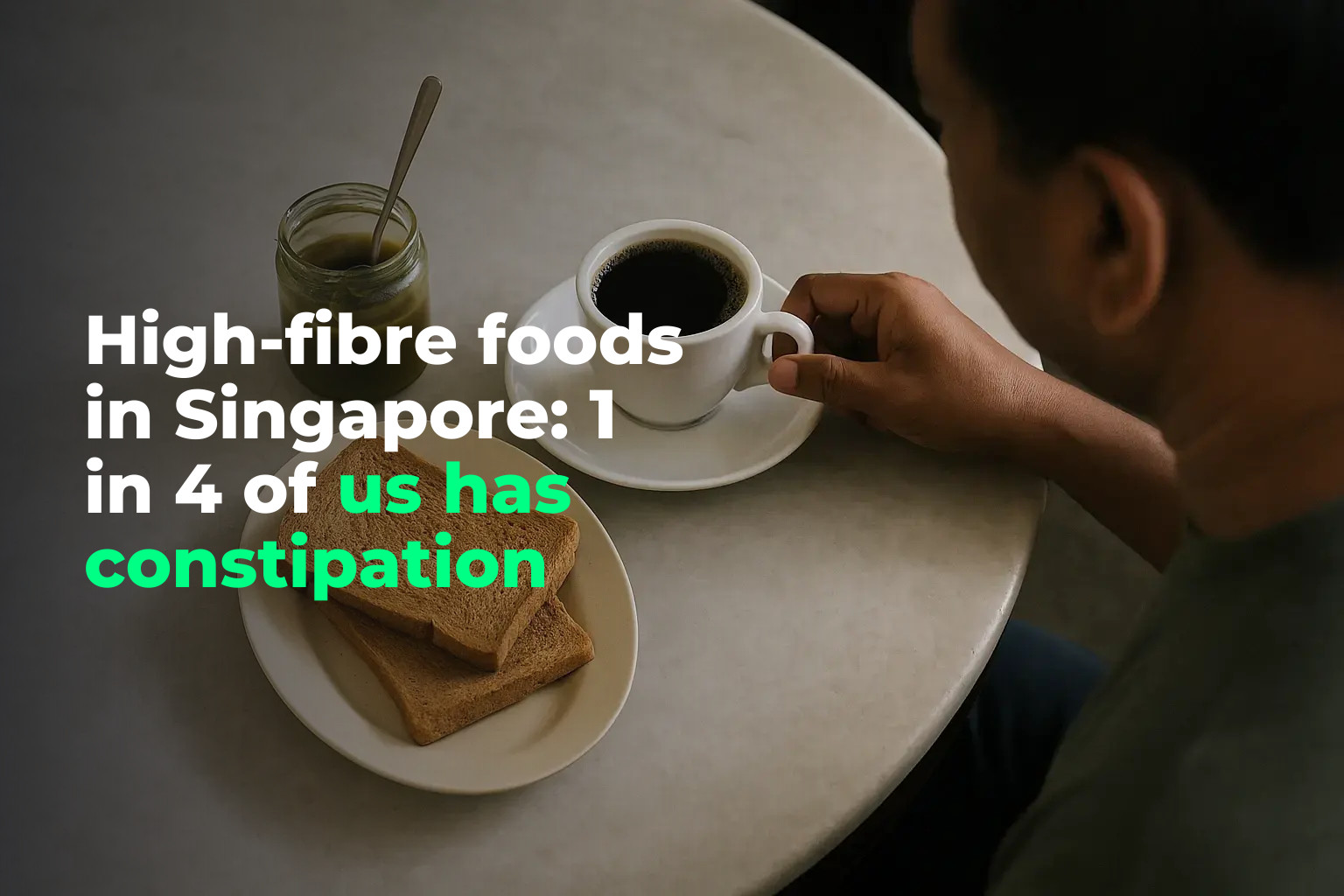
About 1 in 4 Singaporeans has chronic constipation, according to HealthHub [1]. For general health, Singapore recommends 20 g of fibre a day for women and 26 g for men [1].
The WHO gives a wider guide: at least 25 g a day of naturally occurring fibre for anyone older than 10 [2]. HealthHub’s 25 to 30 g is advice aimed at preventing constipation [3]. If you are unsure, use the Singapore figure for your sex, and build up towards it gradually [1].
In older adults in Singapore, 33% of men did not get enough fibre [4].
Fiber rich foods: which fibre foods are common in Singapore?
Wholegrain rice, bread and noodles, pulses, fruit and vegetables are the main sources [2] [5]. Singapore’s guidelines ask for at least two servings of rice and alternatives a day to be wholegrain [5].
- Rice: brown or wholegrain rice in place of white, at the economic rice stall.
- Bread: wholemeal or multigrain instead of white [6]. Kaya toast works this way.
- Noodles and crackers: wholemeal versions give more fibre [7].
- Pulses: half a cup of boiled lentils has about 8 g [8].
- Fruit and vegetables: 2 servings of each a day [5].
Hawker dishes vary by recipe and portion, so identifiable swaps work better than guesses. Asking for extra vegetables and wholegrain rice is an easy start.
What is the difference between soluble and insoluble fibre?
Soluble fibre absorbs water and turns into a gel that swells as it moves through your gut. Insoluble fibre does not absorb water [1].
Most plant foods contain a mix of both, so eating a variety covers you.
How can I increase fibre without bloating or gas?
Add fibre gradually over a few weeks and drink more water [1] [8]. Without enough water, constipation can get worse [3].
Gas from beans usually settles after 3 to 4 weeks of regular eating, so start with small portions [8]. Bloating is a common worry when fibre rises quickly [9].
Try swapping just the white rice at lunch this week, and adding lentils next week.
Can fibre help with constipation and blood sugar?
Yes, in the groups studied. Low fibre is a listed cause of constipation [3]. In adults with long-term constipation, about two in three improved with fibre, compared with four in ten on comparison treatment [10].
In adults with diabetes, higher fibre lowered HbA1c and fasting blood sugar a little [11].
How it connects
Fibre links your gut and your blood sugar, and eating more helped both in the groups above [10] [11]. See more in our gut and digestion hub.
Do I need a fiber supplement, or is food enough?
Food comes first. The WHO asks for naturally occurring fibre, with carbohydrates mainly from wholegrains, vegetables, fruit and pulses [2].
Supplements helped some adults with long-term constipation [10]. A doctor or pharmacist can say what suits you.
What does a high fiber diet look like in a week of hawker lunches?
Imagine a Tuesday lunch near the office and a client dinner on Thursday. Choose wholegrain rice with extra vegetables at lunch, and keep a piece of fruit at your desk.
It can help to raise fibre in a quieter week rather than just before travel. Carry water, and keep lentil portions small at first. Fiya can help fit this around your long days and meals out.
A simple rule: two wholegrain servings and two each of fruit and vegetables a day [5].
Raise your fibre over 21 days
- Days 1 to 7: swap one rice or bread serving a day for a wholegrain one, and keep a bottle of water on your desk.
- Days 8 to 14: add a second fruit and a second vegetable serving, so you reach two of each.
- Days 15 to 21: add a small portion of lentils, and keep it small while your gut adjusts.
- At the end, notice how your stools and bloating feel.
When to see a doctor
- Blood in your stool, or black stools: see a doctor promptly
- Unexplained weight loss: see a doctor promptly
- A new change in bowel habit that lasts: see a doctor promptly
- Severe or worsening stomach pain: seek urgent care
- Constipation or bloating that hasn’t settled after a few weeks of gradual changes
HOW FIYA HELPS
Building fibre into your real week
Adding fibre slowly is simple on paper. It is harder around a client dinner or an early flight. Fiya, Fyxlife’s personal health manager, gets to know what you actually eat, so the plan gets sharper the longer you use it. Her plans are reviewed by Fyxlife’s clinicians and nutritionists, and Fyxlife sells nothing.
Frequently asked questions
On its own, almost certainly not. Singapore’s guidelines ask for two fruit servings, two vegetable servings and wholegrains daily, against 20 g (women) or 26 g (men) of fibre. An apple is one useful part of that day, not the whole.
Spread it across meals. Choose wholegrain rice, bread or noodles, have 2 servings each of fruit and vegetables, and add lentils. Build up over a few weeks so your gut has time to adjust.
Half a cup of boiled lentils provides about 8 g of fibre. Wholegrains, fruit and vegetables add more through the day, so mix them across your meals.
The WHO prioritises naturally occurring fibre from food. Supplements have helped some adults with long-term constipation. A doctor or pharmacist can say what suits you.
Try more fibre from food, more water and gradual changes first. If constipation lasts beyond a few weeks, or you see blood or have pain, see a doctor before adding a supplement.
Related reading
- Fiber rich foods: a practical list and how much fibre you need
- Meal Timing & Circadian Rhythm: Is It Worth It?
- Meal Timing & Circadian Rhythm: Is It Worth It?
- Nutrition & Mental Health: Biomarker Test Guide
References
- Boost Your Health: The Essential Benefits of Dietary Fiber, HealthHub, Health Promotion Board, 2025
- Healthy diet (fact sheet), World Health Organization, 2020
- Constipation, HealthHub, Ministry of Health Singapore, 2025
- Adequacy of Nutrient Intake in Older Adults: Diet and Healthy Aging Cohort, Nutrients, 2023
- Dietary guidelines for adults, HealthHub, Health Promotion Board Singapore, 2024
- High Blood Pressure: Healthy Eating Guide, HealthHub, 2021
- Your Golden Years: Nutrition for the Elderly, HealthHub, 2026
- 20+ High-Fiber Foods, Cleveland Clinic, 2026
- Dietary fibers or probiotics on functional constipation RCT, Gut Microbes, 2023
- Fiber Supplementation on Chronic Constipation, Am J Clin Nutr, 2022
- Dietary fibre and whole grains in diabetes management, PLoS Medicine, 2020
Sources checked on 2026-10-19.
This article is general information, not medical advice. Talk to your doctor about your own results and before changing any medicine.