
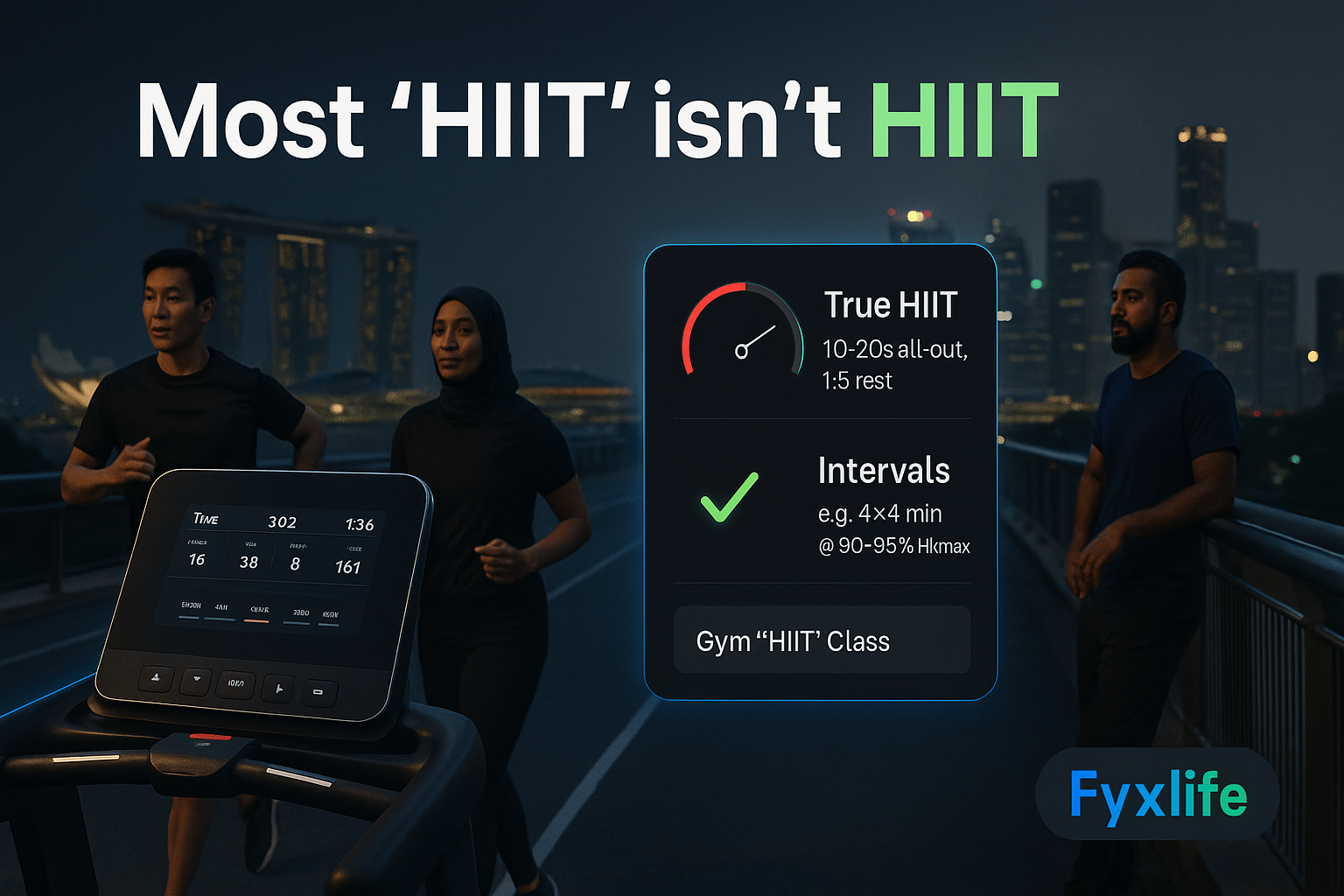
You’ve been crushing those 45-minute ‘HIIT’ classes three times a week, heart rate spiking, sweat pooling — and you’re convinced you’re optimising your cardiovascular fitness and longevity. The problem is, what most gyms, apps, and even coaches label as HIIT is not actually HIIT. And the distinction matters enormously for whether you’re building the adaptations you think you are.
This isn’t a pedantic argument about terminology. It’s about whether your training is actually doing what you believe it’s doing — and whether the recovery cost you’re paying each week is buying you the right physiological return. For anyone training with a purpose, whether that’s a Hyrox podium, a sub-4 marathon, or simply not dying early, the gap between what’s being sold and what’s being delivered is worth closing.
The Verdict Up Front — Is HIIT Worth It?
The short answer (with the important caveat about what HIIT actually is)
Yes — but only if you’re actually doing it. True high-intensity interval training has a robust evidence base for raising your body’s maximum oxygen uptake capacity (what exercise scientists call VO2max), improving the efficiency of your heart’s pumping function, and producing measurable longevity markers. The caveat is significant: true HIIT requires near-maximal physiological effort — a standard that most group fitness classes labelled ‘HIIT’ do not actually meet. Most of what is sold as HIIT is structured interval training. Which is also excellent. Just different.
The Terminology Problem Nobody Talks About
What true HIIT actually means physiologically
The word “high-intensity” has been so thoroughly diluted by the fitness industry that it now means almost nothing. In its original and scientifically precise sense, high-intensity interval training means working at or near your absolute physiological ceiling — the kind of effort where sustaining the pace for another ten seconds feels genuinely impossible. Not uncomfortable. Not challenging. Impossible. One engaged recreational athlete put it plainly in a fitness forum: “HIIT is going as hard and fast as you possibly can to the point of nausea — HIIT and interval training are two different methods.” That’s not hyperbole. That’s an accurate description of the stimulus required.
The reason this precision matters is mechanistic. When you push your cardiovascular system to genuine maximum output, you force a specific set of adaptations that moderate intensity simply does not trigger — particularly in terms of cardiac remodelling and the upward shift of your VO2max ceiling. The stimulus and the adaptation are linked. You cannot get one without the other.
What most gyms are actually selling you (and why it still has value, just different value)
In group fitness settings and among many professional trainers, HIIT and interval training are widely used interchangeably — but they are distinct training modalities with different physiological demands and outcomes. This mislabelling is not limited to commercial gyms — it occurs among professional trainers, creating widespread confusion about what adaptations a given session is actually targeting. A typical boutique fitness class runs you at 75–85% of your maximum heart rate for sustained intervals with short rests. That sits firmly in the moderate-to-high intensity zone. It is metabolically demanding. It will make you fitter. But it is not triggering the same ceiling-raising adaptation as true HIIT, and calling it such creates a false expectation about what the session is building.
The Two Tools, Clearly Defined
True HIIT — mechanism, dose, and what it trains
Think of your cardiovascular system like a car engine being tuned for a race. True HIIT is a controlled redline test — you push the engine to maximum RPM for a few seconds to find its ceiling and force an upward adaptation. In practice, this means efforts lasting roughly 10 to 30 seconds at absolute maximum output, with full recovery between each repetition — long enough that you can genuinely go to maximum again on the next effort. The dose is necessarily small. Two to four repetitions per session, once or twice a week. More than that is not more HIIT — it’s a faster road to accumulated fatigue and declining performance. The primary adaptation is a raised VO2max ceiling and improved cardiac output, specifically the volume of blood your heart ejects per beat (what physiologists call stroke volume).
Structured interval training — mechanism, dose, and what it trains
Interval training is a broader category that encompasses multiple intensity formats — it is not synonymous with maximum effort, and includes moderate-to-high intensity work-rest cycles used across endurance sports. The engine analogy continues: structured interval training is the strategic rev-and-recover work between the extremes — teaching the engine to sustain higher RPMs for longer before it overheats. This is the category that includes tempo runs, lactate threshold repeats, VO2max intervals at 90–95% effort, and yes, the kind of work that fills most commercial ‘HIIT’ classes. The adaptation here is different and, for many people, more immediately useful: you’re raising the effort level you can sustain over time, which is the engine of endurance performance.
What the Evidence Says Each One Actually Does
Cardiovascular adaptations — VO2max, stroke volume, lactate threshold
Interval training and HIIT are both recognised methods for increasing cardiovascular performance — but the mechanisms and required intensities differ between the two approaches. True HIIT’s primary effect is structural: it forces the heart to adapt to maximal demand, increasing the volume of blood the heart pumps per beat and shifting your VO2max upward. Structured interval training works a different lever — it raises the concentration of blood lactate at which your muscles begin to fatigue (your lactate threshold), which directly translates to faster sustainable race pace. For an Ironman athlete or a marathon runner, this distinction is not academic. It determines what kind of work you need more of right now.
Longevity markers — what the research links to reduced all-cause mortality
The longevity case for high-intensity work is real, but it comes with a dose-response curve that flattens quickly. The key marker is VO2max — it is one of the single strongest predictors of all-cause mortality available to a non-clinical assessment. Higher VO2max is consistently associated with lower risk of dying from cardiovascular and metabolic disease. Both true HIIT and structured interval training raise VO2max, and shorter, more intense bursts of exercise are increasingly endorsed as time-efficient tools for cardiovascular conditioning — though the evidence for this depends on correct intensity execution, not just format. The longevity benefit does not accrue from the format. It accrues from the physiological stimulus. Going through the motions of interval structure at insufficient intensity produces neither the performance nor the longevity adaptation.
Body composition — what’s real versus what’s marketing
The claim that HIIT “torches fat” and produces superior body composition results compared to other training modes is heavily marketed and moderately supported. The honest summary: the post-exercise oxygen consumption effect (the additional calories burned after a session as your body recovers, technically called excess post-exercise oxygen consumption or EPOC) is real but modest in absolute terms. The more meaningful body composition effect from interval work comes from the sustained increase in metabolic capacity — a higher VO2max supports a more active overall lifestyle and greater total energy expenditure over time. If you’re doing interval work primarily for body composition, the evidence supports it, but not for the reasons most fitness marketing suggests.
Who Should Use Which Tool (and When)
The endurance athlete (Hyrox, marathon, Ironman) — how to sequence intervals within a polarised training model
If you’re training for a structured endurance event, the framework that consistently produces elite-level results is the polarised model — roughly 80% of training volume at genuinely low intensity (Zone 2, conversational effort) and 20% at high intensity. This is not a trendy concept; it maps directly to how professional endurance athletes have trained for decades. Low intensity is the engine block work — rebuilding and reinforcing the aerobic base that everything else runs on. High intensity is the strategic stressor within that base, used sparingly and with precision. For Hyrox athletes especially, where both aerobic capacity and muscular endurance matter, structured interval training at lactate threshold and VO2max intensity sits in that 20% window. True HIIT, if included, is a small fraction of that fraction — used to test and raise the ceiling, not to fill the weekly schedule.
The longevity-focused adult — minimum effective dose and recovery cost
For a health-conscious 45-year-old who is not training for a specific event, the recovery cost question is the one that almost never gets answered in mainstream fitness content. True HIIT is genuinely demanding on the nervous system. The fatigue it produces is different in character from the fatigue of a hard run — it sits deeper, lasts longer, and compounds if sessions are stacked without adequate recovery. For adults in this age range, one session of true HIIT per week is likely sufficient to produce VO2max adaptation, provided it is preceded by a genuine aerobic base and followed by adequate recovery. More is not better. In the absence of that base, the stimulus has less to build on, and the recovery cost is proportionally higher.
The time-crunched professional — where short intense sessions actually deliver
The honest answer for someone with 30 minutes three times a week: structured interval training, executed at a genuinely high (though not necessarily maximal) effort, is one of the most time-efficient cardiovascular investments available. The key is intensity precision. Moderately hard is not enough to move the needle on VO2max. You need to be working at 85–95% of maximum heart rate during the work intervals, with genuine rest — not active recovery — between efforts. A 20-minute session of four-minute work intervals at this intensity, with two minutes rest, produces measurable cardiovascular adaptation. The format is irrelevant. The intensity is everything.
What to Stop Doing
Why doing ‘HIIT’ five days a week is likely counterproductive
This is where the terminology failure creates real harm. If you believed you were doing moderate-intensity interval training five times a week, you might hesitate — that sounds like a lot. But because the label says HIIT, it carries a halo of efficiency. Surely more maximum effort means more adaptation? It doesn’t. True high-intensity work requires the nervous system to recover between sessions. Stacking five sessions per week means you are either not actually reaching maximum intensity (in which case it’s not HIIT), or you are reaching it and accumulating fatigue faster than you can absorb adaptation. Either way, the label is not delivering the result it promises.
The recovery cost error — how chronically spiking intensity without base volume degrades rather than builds
The most common structural error in the training weeks of self-directed adults is an inverted pyramid: too much time in the moderate-to-high intensity band, not enough time at genuine low intensity, and almost no true recovery. Most commercial ‘HIIT’ classes are actually just driving fast on a motorway — higher than your usual commute speed, yes, but nowhere near the redline that triggers the specific adaptations the label promises. The result is chronic moderate stress without the base volume to absorb it or the maximal stimulus to drive upward adaptation. You get fitter initially, then plateau, then wonder why. The answer is almost always more Zone 2 and less moderate intensity, not more intensity.
The challenge is that this is exactly the kind of question a routine annual check-up was not designed to answer — not because doctors don’t care, but because population-level fitness guidelines were never built to account for your specific training load, recovery capacity, or performance goals. Applying this evidence to your own programme requires someone looking at your full picture, not the population average.
The SuperDoc Verdict
Evidence score for true HIIT
Strong evidence, narrow application. True HIIT has solid mechanistic and observational support for raising VO2max and producing cardiac adaptations. The evidence is real. The caveat is execution: most people labelling their sessions as HIIT are not performing it at the intensity required to access these adaptations. Dose matters. Correct application is uncommon. For trained adults with an aerobic base, one genuine session per week is likely the maximum effective dose before recovery cost outweighs benefit.
Evidence score for structured interval training
Strong evidence, broad application. Structured interval training at appropriate intensity targets (lactate threshold to VO2max range) has robust support across endurance performance, cardiovascular health, and time-efficient conditioning. It is more flexible, more forgiving of individual variation, and more applicable across the full range of goals — from longevity to Ironman podiums. It is also what most people are actually doing when they think they’re doing HIIT. That’s not a failure. It’s an opportunity to programme it deliberately rather than accidentally.
The single most important change to make to your current training
This week, review your last three ‘HIIT’ sessions and apply one honest test: did you hit an effort level where sustaining the pace for even 10 more seconds felt genuinely impossible? If the answer is no for all three, you’ve been doing interval training — not HIIT. That’s not a failure; interval training has strong evidence behind it. But it does mean you should decide, based on this verdict, whether to continue as-is, reframe your sessions accurately and programme them accordingly, or investigate adding one true HIIT block per week at the correct intensity before spending another dollar on a class or programme that may not be delivering what it promises.


