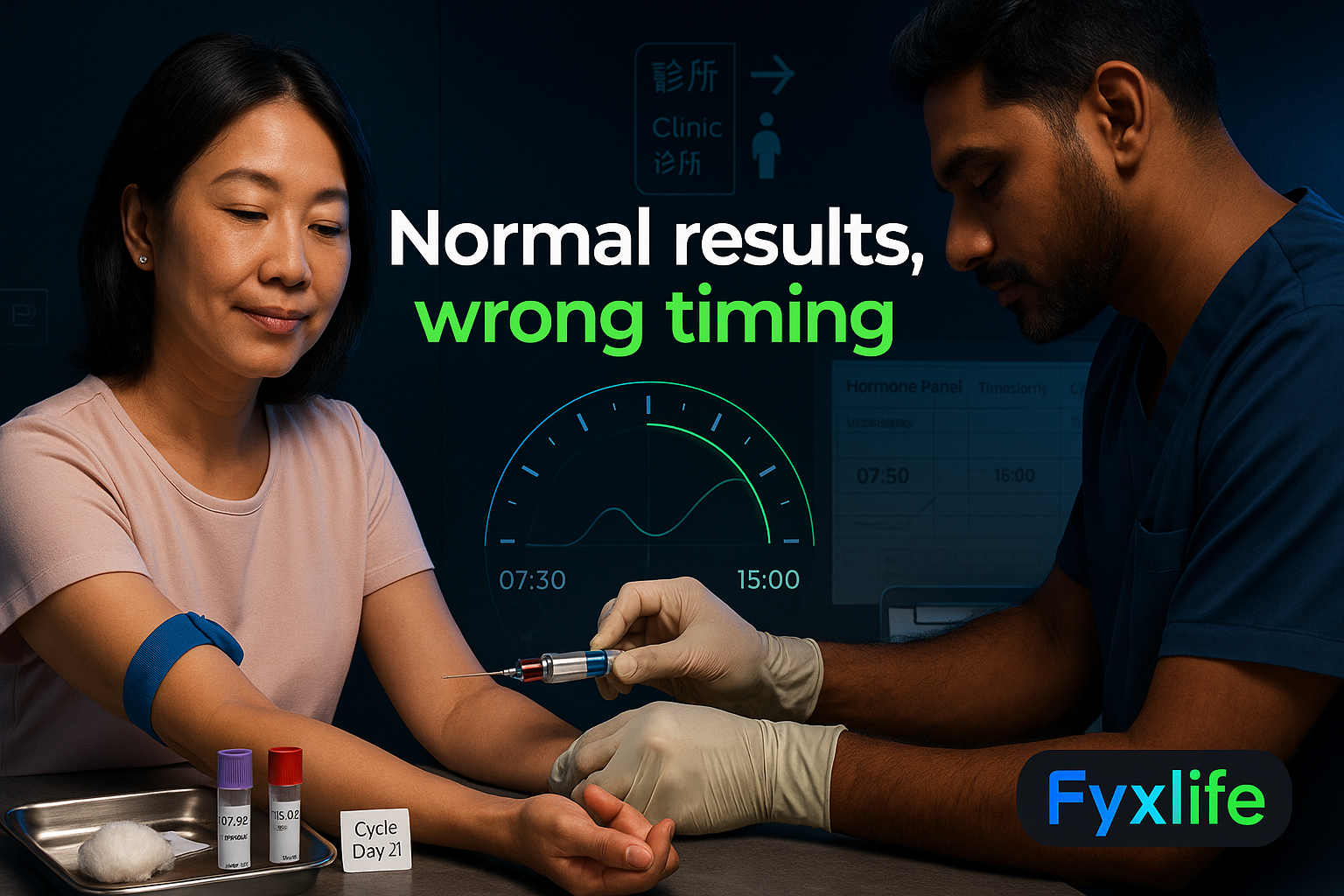
You walked out of the clinic with a ‘normal’ result and still felt exhausted, foggy, and off. The problem probably wasn’t your hormones — it was when your blood was drawn. Hormones are not static numbers; they shift by the hour, the day, and the phase of your cycle, which means a test done at the wrong time isn’t just unhelpful — it can be actively misleading.
This is the frustration that doesn’t get named in the ten minutes you spend with your GP. You feel something is wrong. The numbers say otherwise. And because the numbers have authority, you leave doubting yourself rather than doubting the methodology. What follows is a guide to doing hormonal testing properly — not just what to test, but when, how often, and how to read what comes back.
Why Your ‘Normal’ Result May Mean Nothing
Hormones change hour by hour — a single draw is just one frame of a film
Think of your hormones like the tide. If someone asked ‘what is sea level?’ and measured only once, at 3pm on a Tuesday, they’d get a number — but it would tell them almost nothing about whether the tide is rising, falling, or behaving normally. A hormonal panel drawn at the wrong time of day, the wrong phase of your cycle, or right after a stressful week is exactly that: one tide reading with no context. The test is real; the interpretation just has nowhere to stand.
This isn’t a fringe concern. Understanding the pattern of pituitary hormone secretion is considered essential before determining the optimal time to order hormonal investigations, because different hormones peak at different times of day. Testosterone peaks in early morning and drops through the afternoon. Cortisol follows the same curve. Luteinising hormone (LH) surges mid-cycle. A test that ignores these rhythms is not a health baseline — it’s a timestamp.
The difference between ‘within range’ and ‘optimal for your age and sex’
Measurement of circulating blood hormone levels has always been the cornerstone of diagnosing endocrine diseases — making the quality of that measurement foundational to any diagnosis. But there is a second problem beyond timing: the reference ranges printed on your lab report were built using population averages, which include people who are sedentary, metabolically unhealthy, and 30 years older than you. ‘Within range’ means you are somewhere in that wide band. It does not mean you are where a healthy, active 42-year-old should be.
The gap between population-level reference ranges and what is genuinely optimal for your specific age, sex, and health profile is exactly the kind of question a routine annual check-up was not designed to answer — not because doctors don’t care, but because a ten-minute appointment built around acute care cannot do the interpretive work this requires.
The Core Hormonal Panel — What to Actually Ask For
Testosterone (total and free) — for men and women
Testosterone is not just a male hormone. In women, low testosterone drives fatigue, low libido, and loss of muscle mass just as clearly as it does in men — it is simply present at lower concentrations. Key blood tests for hormonal assessment include testosterone to assess degree of hypogonadism (the clinical term for chronically low sex hormone production), and this applies to both sexes. Ask for both total testosterone and free testosterone. Total testosterone measures the full amount circulating in your blood; free testosterone (the biologically active fraction not bound to carrier proteins) is what your cells actually use. You can have a ‘normal’ total testosterone with a low free fraction and feel every symptom of deficiency.
Oestradiol — why it matters beyond fertility
Oestradiol is the primary form of oestrogen circulating in your blood, and its influence extends far beyond reproductive function. It plays a central role in bone density, cardiovascular health, cognitive function, and mood regulation — in both men and women. For women approaching perimenopause, falling oestradiol is often the first hormonal shift that produces symptoms, sometimes years before periods become irregular. For men, oestradiol that is too high or too low relative to testosterone produces its own distinct set of symptoms. Oestradiol is listed as a key component of comprehensive hormonal assessment, yet it is frequently omitted from standard panels.
FSH and LH — the signalling hormones your GP rarely orders
Follicle-stimulating hormone (FSH) and luteinising hormone (LH) are produced by the pituitary gland and act as the brain’s instructions to the gonads — the signal before the response. Testing only downstream hormones like testosterone or oestradiol without also testing FSH and LH is like measuring the temperature in a room without checking whether the thermostat is working. If your testosterone is low and your LH is also low, the problem is in the signalling; if your LH is high but testosterone is still low, the problem is in the response. These are different conditions with different implications, and you cannot distinguish them without both measurements.
TSH, Free T3, Free T4 — thyroid is not just TSH
Most standard panels test only TSH (thyroid-stimulating hormone), the pituitary signal that tells your thyroid to produce hormones. But TSH alone cannot tell you whether your thyroid is producing sufficient active hormone, or whether you are converting it properly. Free T4 is the precursor hormone your thyroid releases; Free T3 is the active form your cells use. Some people have normal TSH and normal Free T4 but poor conversion to Free T3 — and feel every symptom of thyroid dysfunction as a result. Thyroid function is identified as a core component of comprehensive biomarker assessment, precisely because no single marker captures the full picture.
DHEA-S and cortisol — the stress-hormone layer most panels skip
DHEA-S (dehydroepiandrosterone sulphate) is an adrenal hormone that serves as a precursor to both testosterone and oestrogen, and its levels decline predictably with age. Cortisol is your primary stress hormone. Neither is typically included in a standard panel, but both are essential context. Chronically elevated cortisol suppresses sex hormone production directly. Low DHEA-S in someone with fatigue and low mood can point toward adrenal insufficiency or simply the accelerated hormonal ageing that comes with sustained stress. Testing these alongside sex hormones transforms a snapshot into a system view.
HbA1c and fasting insulin — the metabolic context that makes hormones interpretable
Hormones do not operate in isolation. Insulin resistance — the condition where your cells stop responding efficiently to insulin — directly disrupts sex hormone balance, drives up cortisol, suppresses thyroid function, and accelerates the hormonal decline associated with ageing. HbA1c (glycated haemoglobin, a three-month average of blood sugar control) and fasting insulin together reveal your metabolic environment. HbA1c is listed as a standard component of comprehensive hormonal and metabolic assessment. Fasting insulin is almost never ordered in a routine check-up — but it is arguably the most sensitive early warning of metabolic disruption available.
Timing Rules by Hormone and by Sex
Men: morning draw before 10am for testosterone — why this matters
Testosterone in men follows a pronounced daily rhythm (the technical term is a diurnal pattern), peaking in the early morning and dropping by 20–40% through the afternoon. A testosterone draw at 3pm can return a result that is technically ‘normal’ while concealing a clinically significant decline from your actual morning peak. Always draw testosterone before 10am, ideally between 7am and 9am, after a night of adequate sleep and without exercise in the preceding 24–48 hours.
Women with a cycle: days 3–5 for baseline, mid-luteal for progesterone
Female hormone testing is recommended on days 3–5 of the menstrual cycle, when hormone levels are at their most stable baseline — making this the only window where FSH, LH, and oestradiol results are reliably comparable across tests and across women. Testing on day 12, day 22, or mid-cycle produces numbers that are not interpretable without knowing exactly where in the cycle you are, and even then the comparison norms are different. Progesterone is the exception: it peaks during the mid-luteal phase (approximately days 19–22 in a 28-day cycle), which is the only window where a progesterone draw is meaningful.
Women in perimenopause or post-menopause: why cycle-phase rules no longer apply but symptom context does
Once cycles become irregular or stop entirely, the day-of-cycle rules no longer apply — but this does not mean timing becomes irrelevant. It means the clinical context shifts from cycle phase to symptom pattern. Menopausal hormone therapy is considered most effective for healthy postmenopausal women aged 60 or under and within 10 years of menopause, which makes the timing of testing during the perimenopause window a genuine clinical priority — not something to defer until symptoms become severe. Testing done during a particularly difficult week of symptoms tells a different story from testing during a stable period, and both pieces of information have value.
Pituitary hormones: understanding the daily secretion pattern before you test
FSH and LH are released in pulses (the technical term is pulsatile secretion) throughout the day, with frequency and amplitude shifting based on hormonal feedback from the gonads. Growth hormone peaks sharply during deep sleep. Cortisol is highest within the first hour after waking. Understanding these secretion patterns is essential before determining optimal test timing. For most pituitary hormones, a morning draw is standard — but knowing why matters, because it determines how to interpret a result drawn at any other time.
How Often Should You Retest?
The minimum retesting interval principle — why retesting in 4 weeks produces noise
Minimum retesting intervals define the shortest time before a test should be repeated, based on the biochemical properties of the test and the clinical situation — and retesting too soon produces results that cannot reflect genuine physiological change. HbA1c reflects three months of blood sugar, so retesting it after six weeks is meaningless. Testosterone fluctuates daily, but trend-level changes from a lifestyle intervention take eight to twelve weeks to show up reliably. Retesting impulsively — after a bad week, after a new supplement, after a change in sleep — adds noise to your picture, not signal.
Baseline first, then a retest anchor: how to build a hormonal trend over time
Two to three tests during rested, healthy periods are recommended to establish a reliable personal baseline before any intervention or comparison is meaningful. Your first result is not a baseline — it is a data point. Your second and third results, taken under the same conditions and at the same time, begin to form a true baseline. Only then does a change have context. Think of each retest as adding a frame to the film rather than replacing the last one.
When a life shift warrants an unscheduled test
Blood samples should ideally be drawn in a rested state, with testing before and after major physiological shifts providing the most useful longitudinal data. A significant change in training load, a prolonged period of acute stress, a serious illness, or a menopause transition can all shift your hormonal baseline substantially. These are legitimate triggers for an unscheduled test — not to diagnose a problem, but to capture a before-and-after picture that would otherwise be lost.
How to Read Your Results Without a Medical Degree
Reference ranges vs. functional ranges — understanding the difference
The reference ranges on your lab report are statistical ranges — they capture roughly 95% of the population tested, which by definition includes people who are unwell, sedentary, and at the far ends of the health spectrum. Functional ranges are narrower targets associated with optimal physiological function, used by clinicians focused on performance and prevention rather than disease diagnosis. A testosterone of 280 ng/dL might fall within the lab’s reference range for a 55-year-old man — but it sits at the bottom of that range and is associated with fatigue, cognitive decline, and loss of muscle mass. ‘Within range’ and ‘functioning well’ are not synonyms.
Which results always need a specialist, not just a GP
Some combinations of results require specialist interpretation: significantly elevated FSH with low oestradiol in a woman under 40 (which may indicate premature ovarian insufficiency); testosterone below the functional range with low LH (which points toward a pituitary or hypothalamic cause rather than primary gonadal failure); thyroid antibodies (anti-TPO or anti-thyroglobulin) alongside abnormal Free T3 or T4; or cortisol patterns suggesting adrenal insufficiency. These are not questions for a standard GP appointment — they require an endocrinologist or a clinician trained in functional medicine who has time to map the whole system.
The three-question framework to take to your next appointment
When you sit down with your results, three questions cut through most of the ambiguity. First: was this sample drawn at the optimal time for each hormone being measured? Second: are these results within functional range for my age and sex, or just within the population reference range? Third: what would need to change in my results to warrant a different clinical response? These questions are not confrontational — they are the questions any clinician interested in precision will welcome, because they are the right questions.
What NOT to Do Before a Hormonal Draw
Avoid intense exercise 24–48 hours before — why physical stress skews results
Hard training is a physiological stressor. It transiently suppresses testosterone, elevates cortisol, and shifts inflammatory markers in ways that can persist for 24 to 48 hours. A hormonal panel drawn the morning after a heavy legs session will show a different testosterone-to-cortisol ratio than a panel drawn after two days of rest — and neither is wrong, but only one is useful as a health baseline. Rest before you test. This is not optional.
Fasting requirements vary by hormone — know which need it and which don’t
Fasting insulin and HbA1c both require a fasted state to be interpretable — eating before the draw will artificially elevate your insulin reading and make comparison across tests unreliable. Testosterone, on the other hand, is not substantially affected by food intake, though it is still typically drawn fasted as part of a comprehensive panel. Know what you are testing before you show up. Confirm fasting requirements with your lab in advance — and note that coffee, even without milk, can affect cortisol readings.
Do not test mid-illness or under acute stress — you will get a stress snapshot, not a health baseline
Acute illness and psychological stress both trigger the same biological cascade: cortisol rises, sex hormones are suppressed, thyroid function shifts, and inflammatory markers spike. Testing during a bad week at work, during a viral illness, or in the aftermath of a significant life event will produce results that reflect your stress response — not your underlying hormonal environment. If you are not in a reasonably stable period, reschedule. A bad baseline is worse than no baseline, because it will distort every comparison that follows.
Your Next Step — One Question to Bring to Your Doctor
Before your next appointment, write down the date and time of your last hormonal blood draw, what phase of your cycle you were in (if applicable), and whether you had exercised or slept poorly in the 48 hours prior. Then ask your doctor this one question: ‘Given when this sample was taken, is this result actually interpretable — and if not, what is the right timing to retest?’ That single question changes the conversation from ‘your results are normal’ to ‘let’s get a result we can actually use.’