You drink water every day and assume you’re fine — but if you’re regularly tired by 3pm, struggling to focus, or noticing your workouts feel harder than they should, your hydration status might be the last thing you’ve actually measured. Thirst is a lagging indicator, not a reliable one. Here is what to test, when to test it, and how to interpret what you find.
Most people treat hydration as a volume problem. Drink enough water, and you’re covered. But that assumption is why so many health-conscious adults — people who already track sleep, move regularly, and eat well — still hit inexplicable afternoon walls, feel mentally foggy during high-stakes meetings, and recover from exercise more slowly than they expect to. The water question is only half the question.
Why Hydration Testing Matters More Than You Think
The problem with relying on thirst alone
Think of your body’s hydration system like the coolant in a car engine. The water level matters — but so does the chemical composition of the fluid. You can have plenty of water in the tank and still overheat if the balance of dissolved minerals (the technical term is electrolyte balance) is wrong. Checking only how much you drink is like checking only whether the reservoir is full, while ignoring whether the fluid can actually do its job.
Thirst is your body’s emergency warning light, not its dashboard gauge. By the time you feel thirsty, you’re already behind. The feeling of thirst is triggered by a rise in the concentration of particles in your blood (called plasma osmolality) — a process that lags behind actual fluid loss by enough to matter, especially in conditions of heat and physical effort. In everyday life, this means that thirst-guided drinking is reactive, not proactive. You cannot optimise what you only notice when it’s already gone wrong.
What chronic underhydration actually does to energy, focus, and metabolism
This is not about avoiding headaches on a hot day. Research examining reaction time, memory, and attention has found a measurable relationship between hydration status and cognitive performance — the kind of output that determines how effective you are at work, not just how fast you run. And the effect is not reserved for athletes. A desk worker operating at 1–2% below optimal fluid balance is measurably less sharp, even if they feel functional.
The risk compounds with age. Water intake and hydration status are independently associated with cognitive function in older adults, which means that if you’re in your mid-forties or beyond, the stakes of chronic mild underhydration are higher than they were a decade ago. Your kidneys also become less efficient at conserving water as you age, your thirst sensation blunts, and your total body water percentage drops — making objective testing progressively more useful, not less.
Metabolically, poor hydration impairs the movement of nutrients into cells, slows waste removal, and places low-grade stress on organs that depend on fluid balance to function cleanly. None of this shows up acutely. It accumulates quietly, like interest on an unpaid balance.
The Hydration Biomarker Stack — What to Test
Tier 1 — Daily self-monitoring: urine colour and morning weight
Urine colour is the most accessible daily hydration marker available — pale yellow signals adequate hydration and costs nothing to monitor. The practical target is a light straw colour. Dark yellow or amber indicates concentrated urine, meaning your kidneys are working to retain fluid. Colourless urine can indicate over-hydration, which carries its own risks. This is not a precise biomarker — it’s a daily signal that tells you whether the morning requires attention before you do anything else.
Morning body weight, taken consistently at the same time after using the bathroom, gives you a second daily data point. Body weight tracking has been identified as a proxy hydration monitoring tool, because acute weight changes of more than 1% overnight — especially in hot climates — are predominantly fluid shifts, not fat. If you weigh 70kg and wake up 1.5kg lighter than your running average, you have lost fluid, not tissue. That’s actionable information before you’ve even had breakfast.
Tier 2 — Clinic lab tests: urine specific gravity, serum osmolality, and serum electrolytes (sodium, potassium, magnesium)
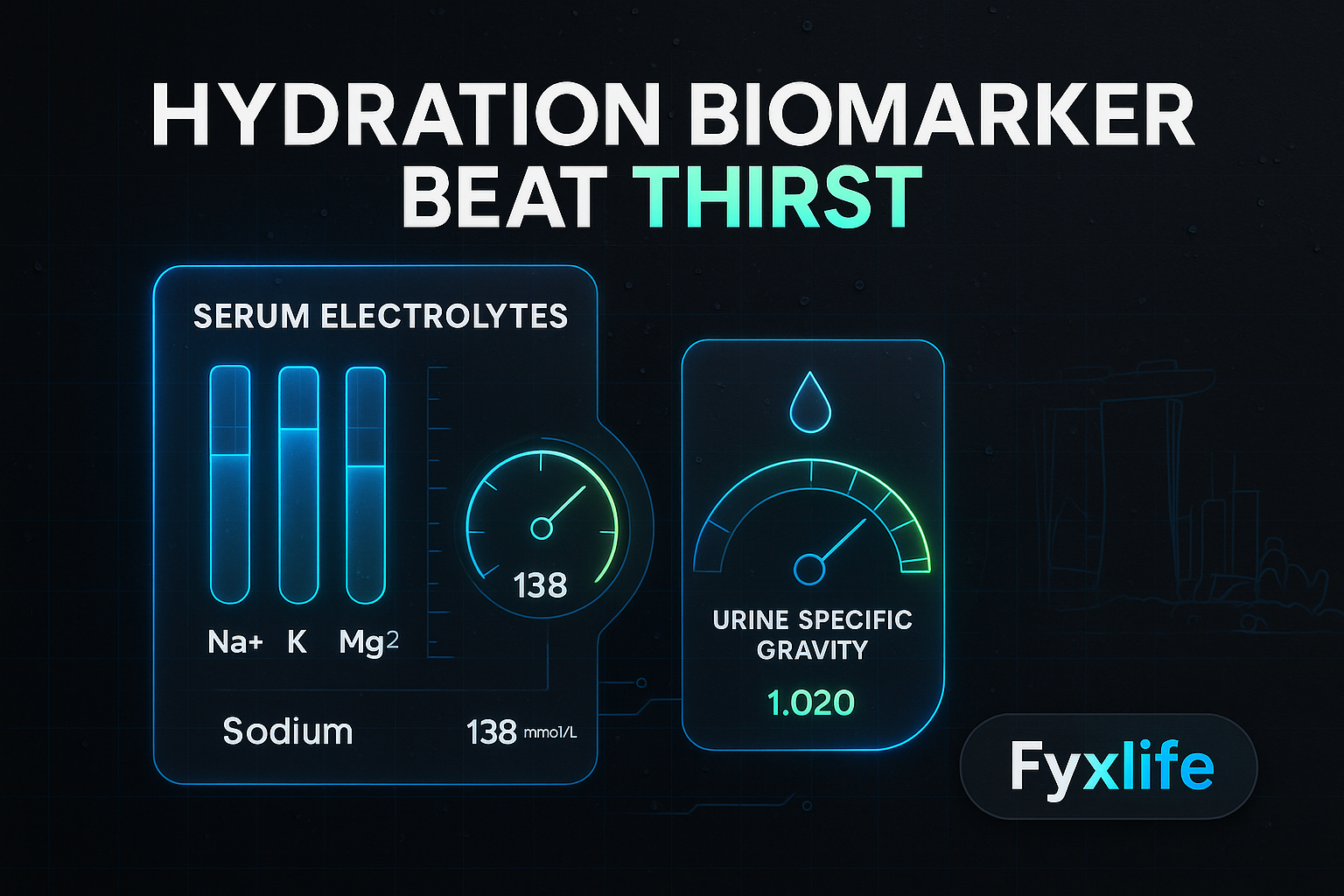
Urine specific gravity (USG) is a validated laboratory measure of how concentrated your urine is — specifically, how much heavier it is than pure water. A reading below 1.010 suggests good hydration. Above 1.020 indicates meaningful concentration, meaning your body is holding back water. USG has shown a significant association with performance outcomes in research settings, validating it as a genuine pre-performance and baseline health biomarker — not merely a clinical curiosity.
Serum osmolality — a measure of the total concentration of dissolved particles in your blood — is the reference-standard lab test for hydration. The normal range sits between 275 and 295 milliosmoles per kilogram (mOsm/kg). Values creeping toward the upper end of normal, even within range, are worth noting over time.
Equally important are serum electrolytes: sodium, potassium, and magnesium. These minerals are not incidental — they are the chemical composition of your coolant fluid. Research recognises electrolyte beverages combining water with sodium and other minerals as superior to water alone for optimising functional hydration, precisely because water volume and electrolyte status are distinct variables. Sodium governs fluid distribution between your cells and your blood. Potassium regulates cellular function and muscle contraction. Magnesium is involved in over 300 enzymatic reactions, including those governing nerve conduction and energy production.
Tier 3 — Downstream health markers: creatinine, eGFR, and kidney function panel
If Tier 1 and Tier 2 testing catches acute and functional hydration status, Tier 3 catches what years of inadequate hydration does to your organs. Creatinine is a waste product filtered by your kidneys — elevated levels suggest the kidneys are under stress. eGFR (estimated glomerular filtration rate) is the measure of how efficiently your kidneys are filtering blood. Hydration management has been identified as a key clinical question in kidney health research, with eGFR serving as a downstream indicator of chronic hydration inadequacy. These are not tests you run monthly. They are annual benchmarks that tell you whether the system is silently degrading — the long game of hydration that thirst will never warn you about.
Emerging tools: wearables and metabolic hydration monitoring
The frontier is moving fast. Advances in metabolic testing and wearable technology are now being applied to hydration status monitoring as part of personalised nutrition and performance optimisation. Sweat patch sensors, bioimpedance-based hydration scores on smart scales, and even microwave-based real-time hydration tracking tools are entering the research and consumer space. None of these replace lab tests yet — the evidence base is still forming — but if you already use a continuous glucose monitor or a recovery wearable, hydration monitoring is the logical next layer.
When to Test — Timing and Frequency Guide
How often to run each test tier
Tier 1 monitoring — urine colour and morning weight — is daily, habitual, and costs you ten seconds. Tier 2 clinic tests are best run annually as part of a broader metabolic panel, or every six months if you have identified low-end electrolyte readings previously. Tier 3 kidney function markers fit naturally into an annual health screen. The goal is trend data, not isolated snapshots.
Trigger events: when to test sooner (heat, illness, weight change, fatigue)
Certain circumstances warrant earlier retesting regardless of schedule. Sustained periods of illness involving fever, vomiting, or diarrhoea deplete electrolytes rapidly and in ways that drinking water alone cannot fully reverse. Unexplained fatigue that persists beyond two weeks, a sustained increase in resting heart rate on your wearable, or a consistent drop in morning body weight over multiple days are all signals to run Tier 2 tests sooner rather than waiting for your annual review.
Singapore and Southeast Asia context — why heat and humidity raise the baseline need
This matters more in this region than in most. Singapore’s average daily temperature and humidity create a baseline sweat rate that does not exist in temperate climates — and critically, it is present year-round, not seasonally. Even experienced outdoor athletes who have trained in the heat of Bangkok or Phuket for years report that the conditions remain genuinely demanding. Subjective acclimatisation — feeling used to the heat — does not mean your body has stopped losing electrolytes through sweat at an elevated rate. It means you’ve stopped noticing. The losses continue regardless of perception. That gap between feeling fine and being biochemically optimal is precisely where objective testing earns its value.
How to Interpret Your Results
What normal looks like vs. what warrants action
Normal urine specific gravity falls between 1.001 and 1.030, but the functional sweet spot for day-to-day health is below 1.020. Serum sodium should sit between 136 and 145 mmol/L — but readings consistently at the low end of that range (below 138) can explain fatigue and cognitive fog even when technically within normal limits. Potassium sits between 3.5 and 5.0 mmol/L. Magnesium is frequently under-tested; aim for 0.85 to 1.10 mmol/L, and recognise that many labs report results within range that still leave room for functional improvement.
The difference between dehydration and electrolyte imbalance — why it changes what you do next
These are not the same problem, and treating them identically is a common and consequential mistake. Pure dehydration — insufficient water volume — is addressed with increased fluid intake. Electrolyte imbalance — specifically low sodium, low potassium, or low magnesium — is not corrected by drinking more water. In fact, drinking large amounts of plain water when sodium is already low can dilute it further, a condition called hyponatraemia (dangerously low blood sodium), which is rare but real and carries neurological consequences. The fix for electrolyte imbalance is targeted mineral replacement, not volume.
Red flags that require a doctor conversation, not a self-fix
Serum sodium below 130 mmol/L, eGFR below 60 mL/min/1.73m², creatinine trending upward over successive annual tests, or urine that is persistently dark amber despite adequate drinking all warrant a clinical conversation before any self-directed intervention. These are not self-optimisation territory. They are medical territory, and the distinction matters.
What NOT to Do When Testing Hydration
Don’t test urine after coffee or first thing after waking without context
First morning urine is naturally more concentrated — your kidneys consolidate overnight. This reading tells you about nocturnal fluid balance, not your functional daytime status. Similarly, coffee is a mild diuretic that temporarily increases urine concentration. Testing urine colour or collecting a sample immediately after coffee or before your first glass of water will give you a skewed reading. For meaningful self-monitoring, test mid-morning, roughly two hours after waking and after your first drink of water.
Don’t over-hydrate based on a single bad urine reading
One dark morning reading is not a crisis. It is a single data point. Over-hydration — forcing large volumes of water rapidly in response to one concentrated urine sample — carries real risks, particularly for sodium dilution. The goal is consistent, moderate intake across the day, not dramatic correction. One reading warrants awareness and gentle adjustment. A pattern of readings warrants a lab test.
Don’t ignore electrolytes and treat hydration as a pure water volume problem
This is the most common mistake in the health-conscious population, and it is baked into almost every mainstream hydration message. “Drink more water” is incomplete advice. Water moves your electrolytes around. Electrolytes determine whether the water you drink reaches the cells that need it. Treating them as separate concerns misses the fundamental mechanism.
What to Ask Your Doctor
The exact panel to request and how to frame the conversation
Most standard blood panels in Singapore include sodium and potassium but frequently omit magnesium and rarely include urine specific gravity unless requested. When booking your next blood test, ask specifically for the following:
- Serum electrolytes: sodium, potassium, and magnesium (the third is often omitted by default)
- Urine specific gravity (can be done via a simple urine dipstick test at the same visit)
- Serum osmolality (if you have persistent fatigue or cognitive symptoms unexplained by other findings)
- Creatinine and eGFR (if not already included in your standard annual screen)
Frame the request simply: “I’d like to get a baseline hydration panel — can we add serum magnesium, urine specific gravity, and confirm creatinine and eGFR are included?” A GP who has ten minutes with you may not proactively suggest this. That’s not a failure of care — it’s a reflection of what a standard annual check-up was designed to screen for versus what you are trying to optimise. The challenge is that population-level reference ranges were never built to account for your specific activity level, climate exposure, or baseline mineral status. Asking directly bridges that gap.
How to track results over time to spot trends, not just snapshots
A single result is almost never the story. Request a printed or digital copy of every panel you run and keep them in one place — a spreadsheet, a health app, or a folder. What you are watching for is directional movement: sodium creeping lower each year, creatinine trending up, USG consistently above 1.020. Any single reading within the normal range can mask a meaningful trend. The trend is the signal. The snapshot is just the first data point.
At your next routine blood test or GP visit, ask your doctor to include a serum electrolyte panel (sodium, potassium, magnesium) and a urine specific gravity reading alongside your standard tests. If your sodium sits at the low end of normal range (below 138 mmol/L) or your USG is consistently above 1.020, bring those numbers back to this guide — those are the two readings most likely to explain low-grade fatigue and focus issues that standard bloods miss.