
You’ve seen the glossy clinics offering HBOT sessions for longevity, recovery, and ‘cellular rejuvenation’ — and the price tags to match. Before you book, here’s what the science actually says about what happens inside that pressurised chamber, which conditions it genuinely helps, and where the evidence runs out.
The promises are seductive. Accelerated healing. Younger cells. A body running on more oxygen than it ever gets at sea level. And unlike many wellness trends, hyperbaric oxygen therapy at least has a real mechanism behind it — one that is genuinely fascinating and worth understanding before you spend a dollar. The problem is that understanding the mechanism is exactly what reveals the gap between what clinical HBOT actually is and what most commercial wellness clinics are offering.
What Is Hyperbaric Oxygen Therapy?
The basic setup — a pressurised chamber and 100% pure oxygen
Hyperbaric oxygen therapy (HBOT) is a medical procedure in which you breathe 100% pure oxygen inside a sealed chamber that has been pressurised to a level significantly above normal atmospheric pressure. The clinical requirement is a minimum of 1.4 atmospheres absolute (ATA) — this pressure threshold is not a dial that practitioners adjust freely; it is a physiological prerequisite for the therapy to work as studied. A typical session lasts 60 to 90 minutes. In a proper clinical setting, you lie inside a rigid, transparent cylinder. You breathe through a mask or hood. The chamber is sealed and pressurised. The experience is, by most accounts, uneventful and mildly strange — a feeling of fullness in your ears, like descending in a plane.
How it differs from simply breathing fresh air or using an oxygen mask
This distinction matters enormously, and it’s where most wellness marketing quietly misleads you. Breathing supplemental oxygen at normal atmospheric pressure — through a mask in a spa, or even in a hospital — is fundamentally different from HBOT, because it is the pressurised chamber environment, not the oxygen concentration alone, that enables oxygen to dissolve into your blood plasma at clinically significant concentrations. The combination of 100% oxygen concentration and elevated atmospheric pressure is precisely what separates HBOT from ordinary supplemental oxygen — it is not a more intense version of the same thing; it is a mechanistically different intervention.
How Does It Actually Work Inside Your Body?
Henry’s Law — why pressure forces oxygen into plasma, not just red blood cells
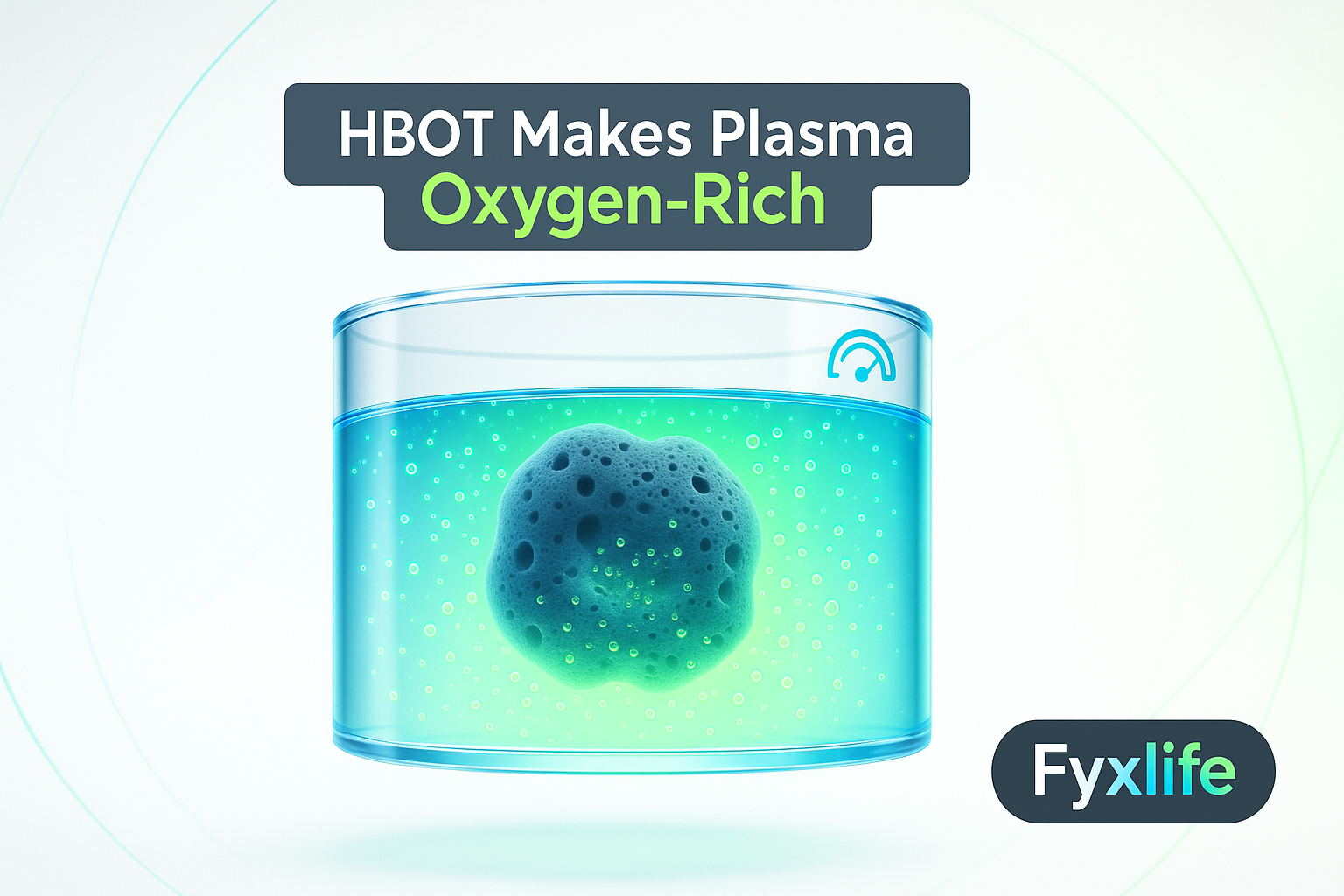
Think of your bloodstream like a sponge in a bucket of water. Normally, haemoglobin — the protein inside your red blood cells that carries oxygen — acts as the sponge, and it’s already close to fully saturated under normal conditions. You can breathe pure oxygen at sea level and barely move the needle, because the sponge is nearly full. But under hyperbaric pressure, something different happens: you force oxygen to dissolve directly into the water itself — the plasma — not just the sponge. Suddenly, even tissues that can’t get enough blood due to damage, scarring, or swelling are bathed in oxygen they couldn’t access before. This is the physics at work: increased pressure drives oxygen into plasma beyond the limits of haemoglobin saturation. The pressure doesn’t make your blood ‘better’ — it makes the medium itself oxygen-rich.
HBOT operates through more than one biological pathway, and reviewed data confirms therapeutic utility across multiple mechanisms of action — but this plasma-dissolution effect is the core one. It is why HBOT can reach tissues that a transfusion cannot.
The oxidative stress paradox — how a controlled ‘pro-damage’ signal triggers repair
Here is where the story gets genuinely counterintuitive. You’ve probably spent years trying to reduce oxidative stress — eating antioxidants, avoiding pollution, managing chronic inflammation. So it may seem strange that a therapy flooding your body with oxygen is therapeutic rather than damaging. The answer lies in a paradox that runs through much of modern biology: a small, controlled stress signal is often what activates the body’s own repair machinery.
Oxidative stress is not merely a side effect of HBOT — it is described as fundamental to the therapy’s action. The controlled oxidative signal produced by HBOT activates the body’s own repair and antioxidant pathways. The therapy essentially creates a brief, managed pro-oxidative environment, which the body reads as a damage signal and responds to by upregulating repair. It’s a sophisticated biological judo move: use pressure to induce a signal the body is already wired to respond to.
What happens to oxygen-starved tissue when suddenly flooded with oxygen
Tissue that has been deprived of adequate oxygen — through poor circulation, physical damage, radiation injury, or chronic wounds — loses its ability to heal. Collagen synthesis requires oxygen. Immune cells fighting infection require oxygen. New blood vessel formation requires oxygen. When you restore that supply under hyperbaric conditions, tissues that have been metabolically stuck can resume processes they were unable to carry out. This is not a metaphor. It is the cellular basis for why HBOT has well-documented clinical applications in specific, oxygen-debt-driven conditions.
What HBOT Is Proven to Treat
The FDA-approved and well-evidenced indications: decompression sickness, CO poisoning, non-healing wounds, radiation injury
HBOT has been used in clinical practice for many years to treat decompression sickness and carbon monoxide poisoning — these remain among its most well-established indications. Johns Hopkins Medicine identifies HBOT as a treatment used to speed healing of carbon monoxide poisoning, gangrene, and wounds that won’t heal — all conditions involving compromised oxygen delivery to tissue. Late radiation injury — the delayed tissue damage that can emerge months or years after cancer radiotherapy — is another area where the evidence is solid. Radiation scars tissue in ways that restrict blood supply, creating exactly the kind of chronic oxygen debt that HBOT is designed to address.
Why these conditions respond — the common thread is tissue oxygen debt
Look at that list and a pattern becomes clear. Decompression sickness involves gas bubbles blocking circulation. Carbon monoxide poisoning displaces oxygen on haemoglobin, starving tissue. Non-healing diabetic wounds fail because damaged peripheral circulation cannot deliver adequate oxygen for repair. Radiation injury creates fibrotic, hypovascular tissue. Every single indication shares a common thread: the target tissue is not getting the oxygen it needs through normal delivery. HBOT bypasses the delivery problem entirely by dissolving oxygen directly into plasma. The mechanism matches the pathology. That is what good medicine looks like.
What HBOT Is Being Explored For (But Isn’t Proven Yet)
Regenerative medicine and wound healing research
HBOT is being actively investigated for future applications in regenerative medicine — researchers are exploring its potential in tissue repair contexts, though the evidence base for these applications is still developing. The mechanistic rationale is coherent: if HBOT stimulates angiogenesis (the growth of new blood vessels), activates stem cell mobilisation, and triggers repair pathways, then there are legitimate reasons to study it in broader healing contexts. The research is happening. The results are not yet at a level that would justify clinical recommendations for most people.
Longevity and ageing — what the emerging studies show and what they cannot yet prove
The longevity claims are where the wellness industry has run furthest ahead of the evidence. There are early studies suggesting HBOT may influence markers of cellular ageing — including changes in telomere length, the protective caps on chromosomes often used as a proxy for biological age, and the clearance of senescent cells, meaning old or dysfunctional cells that accumulate with age and drive inflammation. These findings are intriguing. They are also small, preliminary, and nowhere near sufficient to justify the claim that booking a course of sessions at a wellness clinic will meaningfully extend your healthspan. The honest answer is that we don’t know yet. That’s not a reason to dismiss the research — it’s a reason not to let a clinic bill you as though the question is settled.
The Risks You Need to Know Before Booking a Session
Oxygen toxicity, barotrauma, and contraindications
HBOT is not universally safe. The same clinical source that defines the pressure threshold also identifies significant risks: oxygen toxicity — a condition where excessive oxygen causes seizures or lung damage — and barotrauma, pressure-related injury to the ears, sinuses, or lungs. There are genuine contraindications: untreated pneumothorax (a collapsed lung), certain medications that interact badly with hyperoxic conditions, and structural issues that make pressure equalisation dangerous. One account from patients who have experienced poorly managed HBOT is blunt — botched procedures can cause nitrogen bubbles in the blood. That outcome can kill you. The setting and the operator are not minor details. They are the difference between a therapeutic procedure and a serious medical event.
Why the operator and the chamber type matter as much as the treatment itself
Clinical HBOT is administered by trained hyperbaric medicine staff in a certified facility. Sessions are prescribed for specific indications, run at defined pressures, and monitored continuously. The equipment is regularly inspected and maintained. If you are considering HBOT for a medical condition, this standard of care is not optional. And if you are considering it for general wellness, the question of whether you’re receiving equivalent supervision — at an equivalent pressure — inside a commercial facility is one you must answer before you commit.
The Wellness-Clinic Question: Are Commercial HBOT Sessions the Same Thing?
The pressure threshold problem — why soft-shell chambers may not replicate clinical HBOT
Many commercial wellness providers — and even some clinics marketing themselves as medical — operate soft-shell inflatable chambers that cannot achieve the pressures used in clinical trials. The physics of increased pressure is what drives oxygen into plasma beyond haemoglobin saturation limits — and if the chamber cannot reach or sustain the minimum 1.4 ATA threshold, you are not getting that mechanism. You are breathing slightly enriched oxygen in a mildly pressurised tent. That may be relaxing. It is not the same thing that treated carbon monoxide poisoning, healed radiation injury, or is being studied for its effects on cellular ageing. The price tag may be the same. The mechanism is not.
How to evaluate a provider before spending money
The challenge is that this is exactly the kind of question a routine annual check-up was not designed to answer — not because doctors don’t care, but because most GPs don’t have the specialist knowledge to evaluate a commercial HBOT provider against clinical standards. That evaluation falls to you. Ask the clinic directly: what pressure does your chamber operate at, what is it certified or cleared for, and which specific condition or goal is this protocol designed to address? Vague answers to precise questions are informative. A provider that cannot tell you the operating pressure of their chamber does not understand their own equipment well enough for you to trust your body to it.
The Bottom Line — What This Mechanism Means for You
Hyperbaric oxygen therapy is real medicine with a clear mechanism and a well-evidenced set of applications. For the conditions it is proven to treat — decompression sickness, carbon monoxide poisoning, non-healing wounds, radiation injury — it is not just plausible but genuinely effective, and the mechanistic logic is tight. The therapy works because it solves a specific problem: tissue that cannot get enough oxygen through normal circulation can receive it through plasma when pressure is high enough. That is elegant and well-supported.
The longevity and general wellness applications are a different story. Not a fraudulent one — the research is real and the mechanisms are biologically coherent — but a premature one. The evidence does not yet support the claims being made in most commercial settings, and the gap between what a soft-shell consumer chamber delivers and what a certified clinical chamber delivers is not a technicality. It is the entire intervention.
HBOT is not a supplement you add to your routine on the chance it helps. It is a pressurised medical procedure with real risks, a specific mechanism, and a defined set of conditions where it earns its place. Know which category you’re in before you book.
Before booking any HBOT session, apply this mechanism insight to one decision you’re already making: check whether the clinic you’re considering operates an FDA-cleared or medically certified hard-shell chamber at therapeutic pressure (minimum 1.4 ATA), and ask the provider which specific condition or goal the protocol is designed for. If they cannot answer both questions precisely, that tells you everything you need to know about whether their offering resembles the intervention studied in clinical evidence.


