You eat reasonably well, you’re not dramatically unwell — yet something feels off. Energy dips mid-afternoon, your mood wobbles, your skin isn’t quite right, and no amount of sleep fully fixes it. The answer might not be what you’re eating too much of, but what your body isn’t getting enough of: micronutrients, the invisible control levers behind almost every biological process that keeps you functional.
This isn’t about dramatic deficiency. It’s not scurvy or rickets. It’s the quieter version — the kind that doesn’t show up on a standard blood panel, doesn’t produce a diagnosis, and gets mistaken for stress, ageing, or just not being a morning person anymore. Understanding what micronutrients actually do, and why modern life quietly depletes them, is one of the more useful things you can do for your long-term health.
What Are Micronutrients, Exactly?
Vitamins vs. minerals — the two main families and what each does
Micronutrients fall into two distinct families: vitamins and minerals. Vitamins are organic compounds — meaning they contain carbon and are made by living things. They include fat-soluble vitamins like A, D, E, and K, which your body stores in fatty tissue and the liver, and water-soluble vitamins like C and the eight B vitamins, which circulate in your bloodstream and need regular replenishment because excess is excreted rather than stored. Minerals are inorganic elements — calcium, iron, magnesium, zinc, iodine — that your body cannot manufacture and must obtain entirely from food or water. Between these two families, you’re looking at more than 30 essential compounds involved in everything from immune defence to energy production to the synthesis of hormones and neurotransmitters.
Why ‘micro’ doesn’t mean minor — the outsized role of tiny amounts
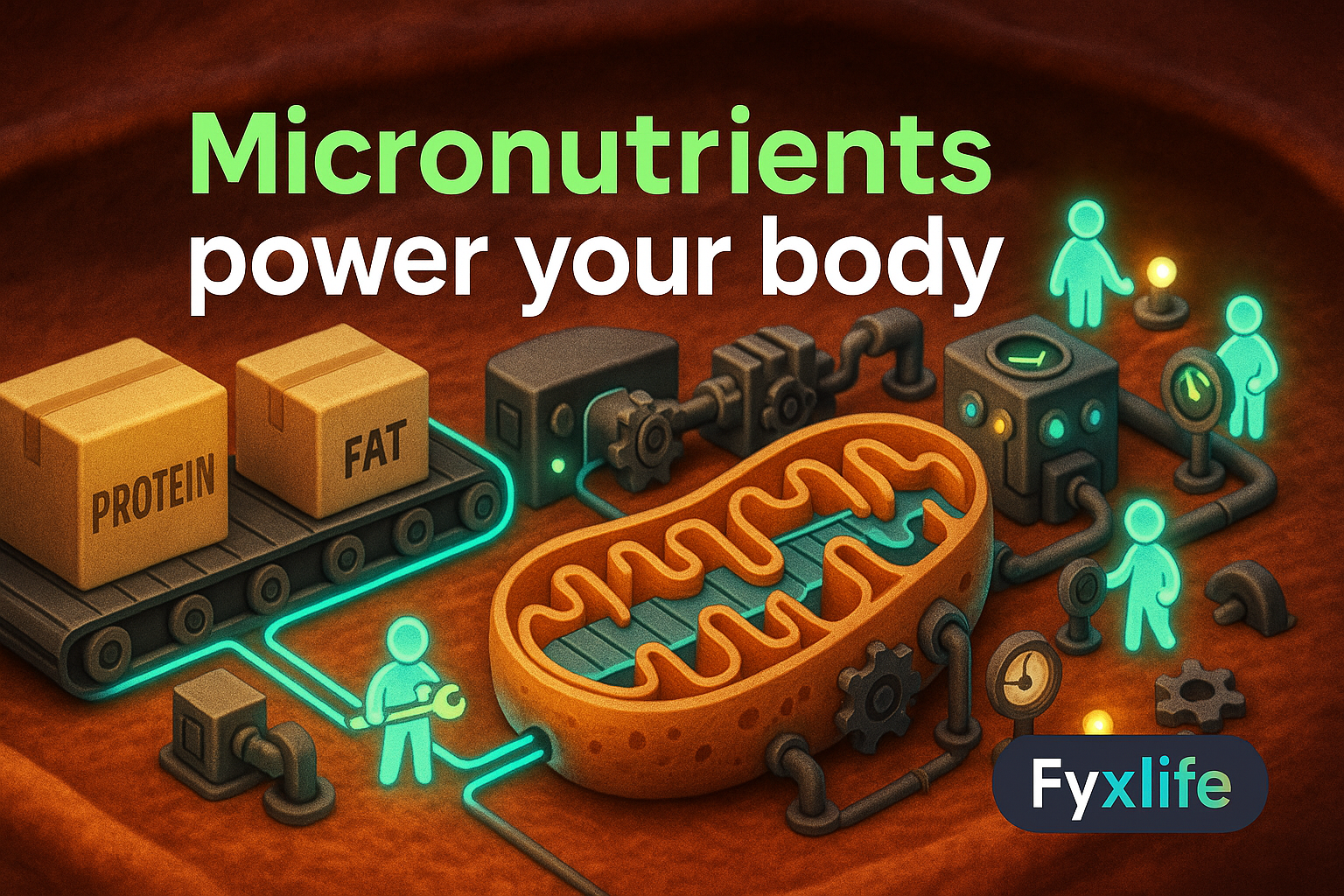
The word “micro” refers to the quantities required — milligrams, micrograms — not to the importance. This is a distinction that gets lost easily, and it matters enormously. Think of your body as a large, complex factory. Macronutrients — protein, carbohydrates, fat — are the raw materials and fuel that keep the production lines running. Micronutrients are the specialist technicians: the engineers, mechanics, and quality controllers working behind the scenes. You don’t need thousands of them, but remove just a few key ones and entire production lines grind to a halt — even if the raw materials are plentiful. The factory looks fine from the outside. But output quietly degrades.
A single enzyme involved in energy metabolism might require three or four different micronutrients to function. Remove one, and the entire chain slows. That slowdown doesn’t always produce an obvious symptom. It produces a vague one — fatigue, brain fog, a blunted immune response — that’s easy to attribute to almost anything else.
How Your Body Actually Uses Micronutrients
The concept of bioavailability — from fork to cell
Eating a micronutrient and absorbing a micronutrient are not the same thing. The gap between the two is described by the concept of bioavailability — the proportion of a nutrient that your body actually absorbs, transports, and uses at the cellular level. Bioavailability varies enormously depending on the food form, your gut health, and interactions with other nutrients you eat at the same time. Spinach contains iron, but a fraction of it reaches your bloodstream compared to the iron in red meat. The difference isn’t a labelling error — it’s biology.
What blocks absorption (and what helps it)
Several factors actively inhibit absorption. Phytates — compounds found in wholegrains, legumes, and seeds — bind to minerals like zinc and iron in the gut and reduce how much you absorb. Tannins in tea and coffee, consumed with or immediately after a meal, have a similar effect on iron specifically. Cooking method matters too: some heat-sensitive vitamins degrade significantly with prolonged cooking, while others actually become more available when food is heated.
On the other side, certain nutrients actively help each other. Vitamin C consumed alongside plant-based iron increases iron absorption substantially. Fat consumed with fat-soluble vitamins — A, D, E, K — is essential for their absorption at all. The interactions are specific and consequential. What you eat matters, but so does how and with what.
Why So Many People Are Deficient Without Knowing It
The global scale of the problem
Billions of people globally have inadequate intakes for one or more micronutrients, and deficiencies are widespread across both low- and high-income populations. This is not a problem confined to food-insecure countries. It is a structural feature of modern food environments — including Singapore and Southeast Asia — where calorie density has risen while micronutrient density in common food choices has not kept pace. You can be well-fed and undernourished at the same time. The two are not mutually exclusive.
Modern diet patterns that quietly create gaps
Ultra-processed foods — refined grains, packaged snacks, ready meals — deliver energy efficiently but are systematically stripped of the micronutrient content present in whole food versions. A diet built around convenience often meets macronutrient targets comfortably while creating chronic, low-grade shortfalls in vitamins and minerals. Add to that the narrowing of food variety that comes with busy lives and food preferences, and you begin to see how gaps form not from dramatic dietary failure but from repetition and convenience over years.
Stress, lifestyle, and the depletion cycle
Stress does something that most people don’t account for: it actively consumes micronutrient stores. The physiological stress response draws heavily on B vitamins, vitamin C, magnesium, and zinc. Stress depletes micronutrient stores, and deficiencies in those same nutrients can negatively impact mood — creating a self-reinforcing cycle. You’re stressed, which depletes your magnesium; low magnesium impairs sleep quality and increases anxiety; the anxiety drives more stress. The cycle runs quietly in the background, and neither the stress nor the deficiency ever reaches a threshold that triggers a clinical investigation.
The Most Common Deficiencies — and What They Actually Feel Like
Iron — the energy thief
Iron is one of the four most commonly deficient micronutrients globally. It is the central component of haemoglobin — the molecule that carries oxygen in your red blood cells. When iron is low, oxygen delivery to tissues falls, and the result is a fatigue that feels different from tiredness: heavier, more persistent, and unresponsive to rest. Cognitive sharpness dulls. Cold intolerance increases. In women, particularly those with heavy menstrual cycles, iron stores can deplete faster than diet replenishes them without any dramatic warning signal.
Vitamin D — the sunshine shortfall
Vitamin D occupies a strange position in nutrition science — technically a vitamin, it functions more like a hormone, influencing gene expression, immune regulation, calcium metabolism, and mood. Vitamin D deficiency is largely driven by insufficient sun exposure, making it especially relevant in populations with indoor-heavy lifestyles or darker skin tones. In Singapore, where many people commute in covered walkways, work in air-conditioned offices, and apply sunscreen consistently — all sensible behaviours — meaningful sun exposure is lower than the geography might suggest. Deficiency here is common and commonly missed.
Vitamin B12 — the nerve and mood disruptor
Vitamin B12 is essential for the maintenance of the protective sheath around nerve fibres (the technical term is myelin), for the production of red blood cells, and for the synthesis of neurotransmitters including those that regulate mood. Deficiency develops slowly — B12 is stored in the liver — but once it takes hold, the symptoms are wide-ranging: fatigue, pins and needles in the extremities, memory gaps, low mood, and eventually neurological damage that can become irreversible if left untreated long enough. Vegans and vegetarians are at elevated risk because B12 is found almost exclusively in animal-derived foods.
Iodine — the underdiagnosed thyroid driver
Iodine is the raw material your thyroid gland uses to produce the hormones that regulate metabolism, body temperature, weight, and energy. Without adequate iodine, thyroid hormone production falls, and the downstream effects — unexplained weight gain, persistent fatigue, feeling cold, hair thinning — are frequently attributed to stress or ageing rather than investigated at the source. Iodine is one of the least-discussed common deficiencies, partly because it doesn’t appear on standard blood panels unless a clinician specifically orders thyroid function tests and interprets them in context.
Who Is Most At Risk?
Vegetarians and vegans
Plant-based eating patterns deliver significant health benefits, and the evidence for their role in reducing chronic disease risk is strong. But they create predictable micronutrient gaps that require active management. B12 has no reliable plant sources. Haem iron — the highly bioavailable form found in meat — is absent. Zinc, calcium, and omega-3s require attention. The risks are manageable, but only if they’re acknowledged rather than assumed to be covered by a well-varied diet.
People with gut issues or absorption problems
Conditions that affect the gut lining — including coeliac disease, inflammatory bowel disease, and even long-term use of proton pump inhibitors (the medication class commonly used for acid reflux) — reduce the gut’s capacity to absorb micronutrients across the board. Someone with a healthy-looking diet can develop significant deficiencies simply because the absorption machinery is impaired. This is a group where diet improvement alone often isn’t sufficient.
Adults over 40 — why absorption efficiency declines with age
Ageing brings a gradual reduction in stomach acid production (a condition called hypochlorhydria), which impairs the absorption of B12, iron, calcium, and magnesium. Skin synthesis of vitamin D from sun exposure also becomes less efficient with age. The result is that people over 40 may need higher dietary intakes of certain micronutrients simply to absorb the same amount a younger person would from a smaller dose. Requirements change, but dietary advice rarely reflects this shift.
How to Find Out If You’re Actually Deficient
Which deficiencies show up clearly on blood tests
Some micronutrient deficiencies — including iron deficiency anaemia and vitamin D deficiency — can be reliably diagnosed through blood testing. For iron, clinicians typically look at serum ferritin (stored iron), haemoglobin, and sometimes a full blood count. Vitamin D is measured as serum 25-hydroxyvitamin D. B12 serum levels are available, though interpretation requires care — serum B12 can appear normal while functional deficiency exists at the cellular level. Thyroid function tests, which reflect iodine adequacy indirectly, require a specific request.
What subclinical deficiency means — and why it matters before symptoms arrive
Subclinical deficiency — a state where levels are below optimal but not yet low enough to trigger a clinical diagnosis — is where most people in high-income countries actually sit. It’s the zone where the factory is running below capacity but hasn’t stopped. Energy is lower than it should be. Immune defence is blunted. Cognitive performance is reduced. But no single test result will flash red, and no clinician will call you with a diagnosis. The challenge is that this is exactly the kind of question a routine annual check-up was not designed to answer — not because doctors don’t care, but because population-level reference ranges were never built to account for your specific risk profile, lifestyle, or the cumulative effect of multiple marginal shortfalls.
What To Do About It — The Evidence-Based Approach
Food first, supplements second — why whole food sources remain the foundation
The case for food-first isn’t nostalgic — it’s mechanistic. Whole foods deliver micronutrients in forms that are often more bioavailable than isolated supplements, and they deliver them alongside co-factors that aid absorption. Liver is extraordinarily rich in B12, iron, and vitamin A. Shellfish — particularly oysters — are among the most concentrated sources of zinc on the planet. Eggs provide vitamin D, B12, and choline. Leafy greens deliver folate, magnesium, and vitamin K. Diversity across food groups, particularly animal and plant sources combined, remains the most reliable strategy for broad micronutrient coverage. Deficiencies manifest as weakened immune responses, skin disorders, and bone abnormalities — problems that no single supplement reliably prevents when the underlying diet pattern hasn’t changed.
When supplementation makes sense
There are situations where supplementation is not optional but necessary. Vegans need B12 — the evidence on this is unambiguous and the risk of not supplementing is neurological damage over time. People with documented vitamin D deficiency need a supplement because food sources cannot realistically correct a significant shortfall. Pregnant women need folate before and during early pregnancy for reasons that cannot wait for dietary improvement to take effect. In these contexts, supplementation is a clinical decision supported by strong evidence — not a lifestyle preference. The error is the opposite of this: taking a broad-spectrum multivitamin to paper over an unidentified gap, assuming coverage, and never finding out what the actual gap was.
Your Single Next Step
Apply this mechanism insight to one decision you’re already making this week: if you eat a plant-heavy diet or spend most of your day indoors, you are statistically likely to have at least one meaningful micronutrient gap. Before buying any supplement, identify which specific nutrient is most plausible for your lifestyle — iron or B12 if you eat little or no meat, vitamin D if you rarely get midday sun — and make that the focus of a targeted conversation with your doctor at your next visit rather than reaching for a broad multivitamin and assuming the gap is covered.