
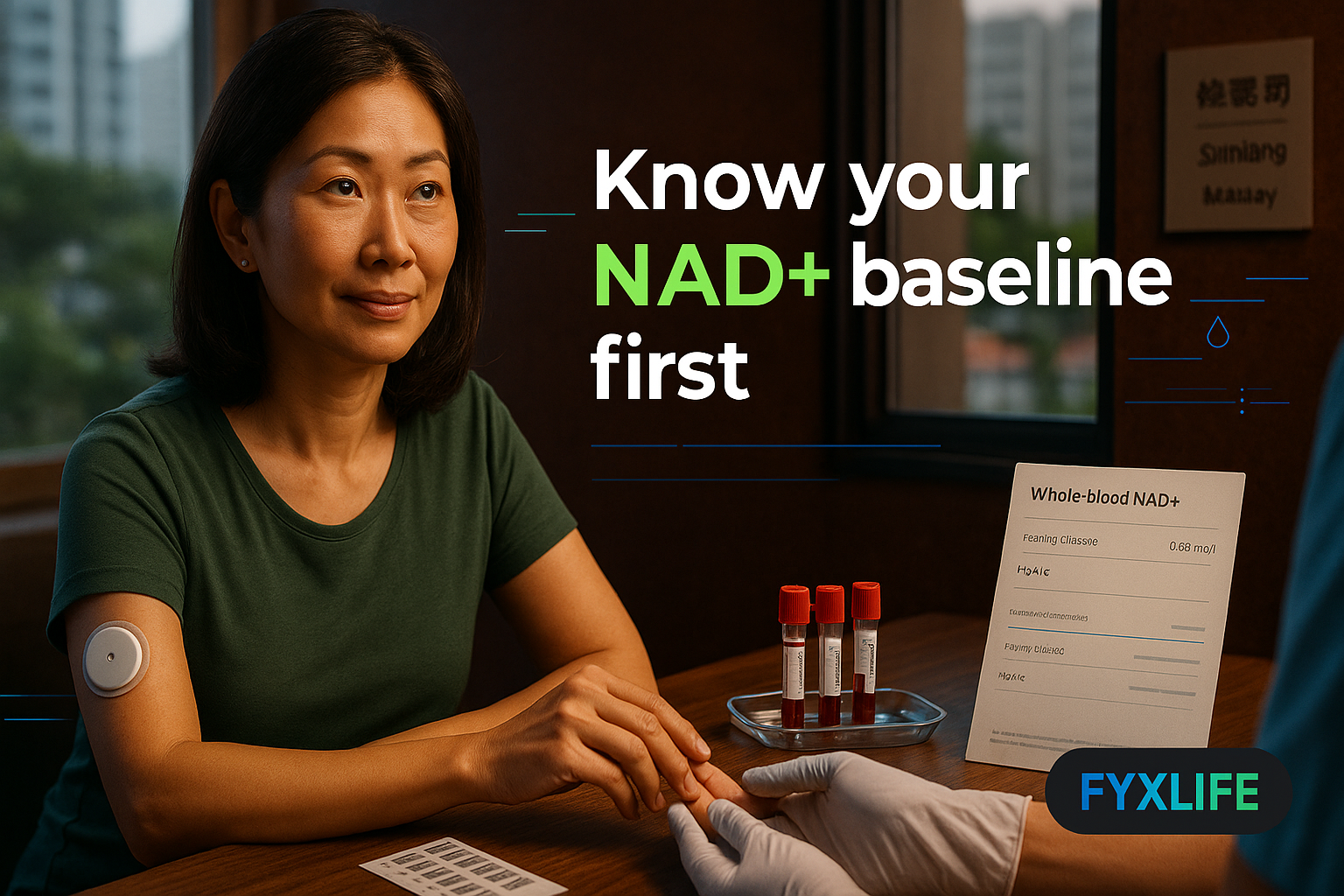
You are spending $80–$200 a month on NMN or NR supplements to boost your cellular energy — but do you actually know if your NAD+ levels are moving? Without a baseline measurement and a structured retesting plan, you are flying blind on one of the most talked-about longevity biomarkers of the decade. This is not a criticism. It is the reality for almost everyone who has started a nicotinamide adenine dinucleotide (NAD+) protocol — the coenzyme at the centre of your cells’ energy and repair machinery — because until recently, practical testing options barely existed outside research laboratories.
That has changed. And if you are serious about optimising your biology rather than just spending money on it, understanding how to test, when to retest, and what your results actually mean is the next step.
Why NAD+ Deserves a Spot on Your Biomarker Panel
What NAD+ actually does inside your cells (energy, DNA repair, longevity signalling)
NAD+ is not a wellness trend dressed up in biochemistry. It is a molecule your cells genuinely cannot function without. Think of it as the central router of your cellular economy — it directly and indirectly influences energy metabolism, DNA repair, the remodelling of how your DNA is packaged (chromatin remodelling), and the process by which cells age out of usefulness (cellular senescence). That is an unusually wide remit for a single molecule, and it is why researchers consider it a multi-system longevity biomarker rather than a single-function compound.
One of its most important roles is acting as the fuel source for a family of enzymes called sirtuins (SIRT proteins) — sometimes called the longevity proteins — which regulate how your cells respond to stress and manage metabolic pathways. NAD+ homeostasis regulates these sirtuin proteins directly, meaning your NAD+ level functions as an upstream switch for longevity-linked cellular signalling. When NAD+ is abundant, sirtuins are active. When it drops, they go quiet. That is a mechanism worth measuring.
Why levels drop with age — and why that matters more than you think
Declining NAD+ levels are recognised as a hallmark of cellular senescence — the process by which cells stop dividing and functioning properly — based on research across worm, rodent, and human cellular models. This is not just about feeling tired. The age-related reduction in NAD+ is associated with impaired mitochondrial function and reduced genomic stability — the two structural foundations of long-term cellular health. By the time you are in your forties, your NAD+ levels may be half what they were at twenty. Most people would not know, because nobody measured them at twenty either.
This is exactly the kind of gap that a routine annual check-up was not designed to address — not because your GP does not care, but because standard panels were built around population-level reference ranges for acute disease detection, not for tracking the quiet molecular decline that precedes it by decades.
What to Test — NAD+ Alone vs. the Full NADome
Whole-blood NAD+ testing: what a validated clinical assay looks like
The practical barrier to NAD+ testing has largely been a laboratory problem. That is now largely solved. A validated NAD+ assay for human blood has been described as an easy and robust tool for clinical analysis of NAD+ as an important metabolic indicator, supporting its use outside of purely research settings. What this means for you is that whole-blood NAD+ measurement — drawing a standard blood sample and running it through a high-performance liquid chromatography (HPLC) analysis — is now a realistic request at a functional medicine clinic or specialist laboratory, even if your standard GP has never ordered one.
Whole blood is the preferred sample type because it captures NAD+ across red blood cells, white blood cells, and plasma together, giving a more representative picture of your systemic levels than plasma alone.
The NADome: when to consider testing NAD+ metabolites beyond the base molecule
Here is where it gets more nuanced. NAD+ does not exist in isolation inside your body. It sits within a network of related compounds — precursors, breakdown products, and recycling intermediates — that together are called the NADome. Altered levels of the NADome are a likely indicator of poor metabolic function, and accurate measurement of the full NADome is described as crucial for understanding what is actually happening at the biochemical level. Testing NAD+ alone is useful. Testing the NADome — including metabolites like nicotinamide mononucleotide (NMN), nicotinamide riboside (NR), and NAD+ breakdown products — tells you whether your cells are producing, recycling, or burning through NAD+ efficiently.
Full NADome profiling is more expensive and less widely available than a basic NAD+ assay. For most people starting out, a validated whole-blood NAD+ baseline is the right first step. NADome testing becomes more valuable on your second or third round, once you have an intervention in place and want to understand the mechanism behind any change you see.
Related biomarkers to stack alongside NAD+ (NADH, sirtuins, mitochondrial function markers)
NAD+ does not tell the whole story on its own. Intracellular NADH — the reduced form of NAD+ — and FAD, a related coenzyme, have been identified as potential biomarkers for metabolic and mitochondrial activity, suggesting that NAD+ testing can serve as a window into mitochondrial health. The ratio of NAD+ to NADH matters: a higher ratio generally reflects more efficient energy metabolism. Fasting glucose, HbA1c, and fasting insulin round out the picture because insulin resistance accelerates NAD+ depletion. If you are already tracking a longevity panel, these are the natural companions to your NAD+ result.
When to Test and How Often
Establishing your baseline before starting any supplement protocol
Think of NAD+ like the fuel gauge on your car’s dashboard. You might feel like the engine is running fine — until it suddenly isn’t. Testing your NAD+ level is checking that gauge before a long drive, not after you have already broken down on the highway. Supplementing without a baseline is like filling up an unknown-sized tank and guessing whether it made a difference. The baseline is not optional. It is the entire reference point. Without it, you cannot know whether your current supplement protocol is doing anything — and some people’s levels do not move at all in response to oral NMN or NR without accompanying lifestyle changes.
Retesting windows after NMN, NR, or IV NAD+ interventions
The timing of your retest matters more than most people realise. In a cell model study, exposure to 100µM of Nicotinamide Riboside for three hours produced approximately a two-fold increase in cellular NAD+ levels that remained significantly higher than untreated controls. That is a cell study, not a human trial — the timelines in living humans are different and more variable — but it confirms that NAD+ precursors can produce measurable cellular changes, and that those changes are detectable in a laboratory context. For oral supplementation in humans, the practical retesting window is eight to twelve weeks of consistent daily dosing. IV NAD+ protocols tend to produce faster and larger transient increases, and retesting within two to four weeks post-infusion series is more appropriate in that context.
Frequency guidance for ongoing monitoring (annual vs. quarterly)
The recognition that NAD+ levels fall in response to stress and can be replenished through supplementation has driven significant research interest in whether NAD+ repletion can meaningfully slow aging-related decline. For ongoing monitoring without an active intervention, annual testing alongside your broader longevity panel is reasonable. If you are actively trialling a new supplement protocol, dose change, or lifestyle intervention aimed at raising NAD+, quarterly retesting gives you a meaningful signal within a practical time horizon.
How to Interpret Your Results
What low NAD+ signals — and what it does not prove on its own
A low whole-blood NAD+ result — typically defined relative to age-matched reference ranges established by the laboratory running your assay — is a legitimate signal worth taking seriously. It suggests that your cells’ energy currency is running thin, that sirtuin pathway activity may be suppressed, and that your capacity for DNA repair under cellular stress is likely reduced. What it does not prove on its own is the cause. Low NAD+ can reflect poor diet, chronic inflammation, alcohol use, high physiological stress, insulin resistance, or simply chronological aging. A number without context is just a number.
What ‘improved’ NAD+ levels do and do not tell you about downstream health outcomes
This is the part most supplement marketing skips. Raising your NAD+ level is a measurable biochemical outcome. Whether that biochemical change translates into longer telomeres, improved mitochondrial function, reduced inflammation, or slower biological aging is a separate — and still incompletely answered — question. The research is promising and mechanistically coherent, but the human trial data linking elevated NAD+ directly to specific health outcomes is still developing. An improved result tells you the intervention worked at the molecular level. It does not tell you that you have definitively reversed your biological age. Hold that distinction carefully.
Red flags that warrant a deeper metabolic workup
If your NAD+ comes back low alongside elevated fasting insulin, high HbA1c, or markers of chronic inflammation such as high-sensitivity C-reactive protein (hs-CRP), you are looking at a metabolic picture that goes beyond a simple supplementation question. Similarly, if your NAD+ does not move after a twelve-week structured NMN or NR protocol at standard doses, that is a signal to investigate absorption, gut microbiome function, and whether an enzymatic bottleneck in your NAD+ biosynthesis pathway — such as low NAMPT activity, the enzyme that drives the main NAD+ recycling route — is limiting conversion.
What to Ask Your Doctor
Specific test names and conversation starters for your next clinical visit
- Ask for a whole-blood NAD+ assay by HPLC — specify whole blood, not plasma, and confirm the laboratory uses a validated clinical method.
- Request fasting insulin alongside fasting glucose and HbA1c — standard panels often omit fasting insulin, but it is essential context for interpreting NAD+ results.
- Ask whether the clinic offers NADome profiling (full NAD+ metabolite panel) if you are already on a supplement protocol and want mechanistic detail beyond the base NAD+ number.
- If mitochondrial function is a specific concern, ask about organic acids testing, which can provide indirect markers of mitochondrial efficiency alongside your NAD+ result.
Why standard panels miss this — and how to request it
NAD+ is not on any standard blood panel in Singapore or most of Southeast Asia — not because it is experimental, but because it was not part of the disease-detection framework that standard panels were built around. The validated assays exist. The laboratories exist. The gap is one of clinical habit, not scientific readiness. You will likely need to request this through a functional medicine clinic, an executive health centre with metabolic testing capabilities, or directly through a specialist laboratory that accepts physician referrals for metabolic biomarker panels. Be prepared to explain what you are looking for — and bring this article if it helps.
What NOT to Do
Don’t start supplementing before you have a baseline
The temptation is to start the supplement first and test later. Resist it. Once you have been on NMN or NR for several months, your first test result is not a baseline — it is already a post-intervention reading, and you have permanently lost the reference point that would tell you how much your levels actually moved. The people who genuinely benefit from NAD+ supplementation are those who know where they started.
Don’t use symptom self-report as a substitute for measurement
Anecdotal accounts of NAD+ supplementation range from dramatic energy improvements to no noticeable change at all — even among people using the same dose, the same product, for the same duration. This is not surprising. The experience of a long COVID patient reporting symptom relief on 30mg daily and someone else injecting 100mg three times per week for four weeks with zero perceptible effect are both plausible outcomes, because subjective energy perception is mediated by dozens of variables that have nothing to do with intracellular NAD+. Feeling better is not the same as measuring better. And feeling the same is not proof that nothing changed.
Don’t interpret one NAD+ number in isolation without context
A single NAD+ result — unaccompanied by your metabolic markers, your supplementation history, your sleep quality, your stress load, and a second measurement to track direction — is almost meaningless. The value of NAD+ testing is in the trajectory, not the snapshot. One number tells you where you are today. Two numbers, taken under comparable conditions before and after an intervention, tell you whether you are moving. That is the data point worth making decisions from.
Before your next supplement order arrives, ask your doctor or a functional medicine clinic to run a whole-blood NAD+ test as your baseline. Note the date, your current supplement protocol (if any), and your most recent fasting glucose and HbA1c values alongside it — these metabolic markers will give your NAD+ result meaningful context. If your NAD+ comes back low relative to age-matched reference ranges, that is the data point worth discussing with your doctor before deciding whether NMN, NR, or a lifestyle intervention is the right next lever to pull.