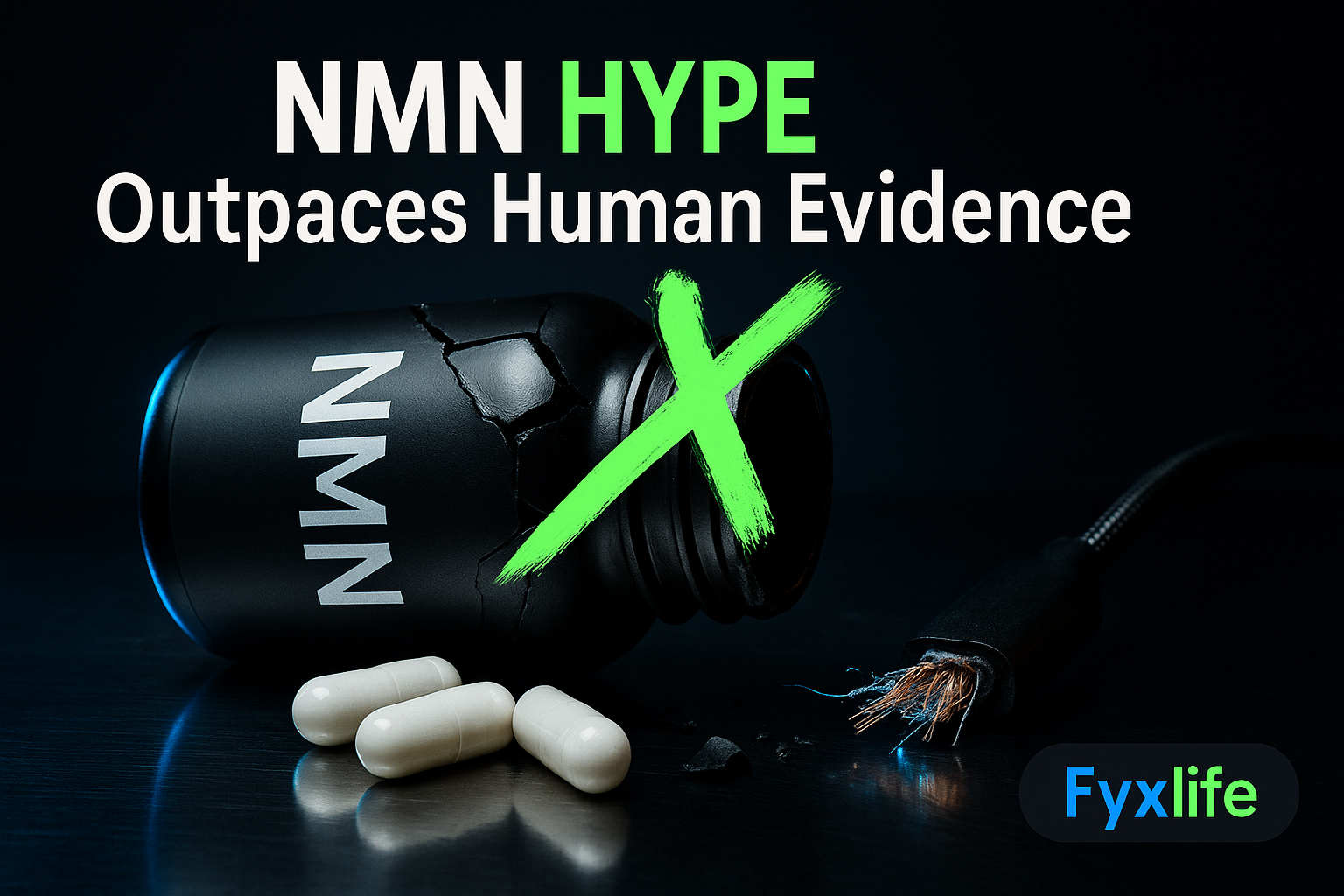
The Myth — NMN is a proven anti-ageing supplement backed by solid human science
You have seen the before-and-after promises, the David Sinclair clips, and the $80 bottles claiming to reverse your biological clock. Before you add NMN to your monthly supplement spend, there is something the marketing does not tell you: the human evidence is far thinner than the mouse evidence — and those are very different animals.
If you have been burned before — by resveratrol, by high-dose antioxidants, by whatever was trending on wellness podcasts eighteen months ago — this pattern will feel familiar. A genuinely interesting biological mechanism, impressive animal data, and a supplement industry that moves decades ahead of the clinical science. NMN is not a scam. But it is not a proven anti-ageing intervention either. The honest picture sits somewhere more complicated than either camp wants to admit.
Where this belief comes from (Sinclair, mouse studies, and the NAD+ decline narrative)
The modern NMN story begins with Harvard geneticist David Sinclair, whose research on longevity pathways generated enormous mainstream attention — and whose own supplement use became part of the brand. Sinclair’s work, alongside a wave of compelling mouse studies, built the narrative that a molecule called nicotinamide adenine dinucleotide (NAD+) declines with age, that this decline is central to ageing itself, and that supplementing with NAD+ precursors like nicotinamide mononucleotide (NMN) could reverse the clock. Mice on NMN ran further, aged better, and lived longer. The story was irresistible. The supplement industry had a $80 bottle ready before the human trials were designed.
Unpacking the claim — what NAD+ actually does in your body
NAD+ as your cells’ universal energy currency and repair coordinator
To evaluate NMN fairly, you need to understand what NAD+ actually does — because it genuinely matters. Think of NAD+ as the USB charging cable inside every one of your cells. Without it, nothing powers up: not energy production, not DNA repair, not the longevity proteins that keep cells tidy. It is not a peripheral player. NAD+ directly and indirectly influences metabolic pathways, DNA repair, chromatin remodelling — the process by which your cells control which genes get read — and cellular senescence, the mechanism by which damaged cells stop dividing. It also activates a class of proteins called sirtuins, sometimes described as the cell’s housekeeping enzymes, which regulate stress responses and repair processes. The biology is real. The question is whether taking a pill meaningfully changes it.
How NMN fits in — the precursor-to-fuel conversion chain
NMN is not NAD+ itself. It is a building block — a precursor — that your body must convert into NAD+ through an enzymatic process. This distinction matters more than most supplement marketing acknowledges. The supplement industry is selling you the component and promising you a fully charged phone. The honest answer is: sometimes it works, sometimes the assembly line is the bottleneck, and we do not yet know how long the cable lasts. Ageing itself appears to compromise the body’s conversion of NMN into NAD+, which means the problem may not be a shortage of raw material — it may be that the factory producing the final product is running less efficiently. Flooding a compromised factory with more components does not automatically increase output.
What the evidence actually shows
Claim 1 — NAD+ universally declines with age. Verdict: Not proven in humans
This is the foundational assumption the entire NMN market rests on. If NAD+ reliably falls with age, and if that fall drives the biological deterioration we associate with ageing, then restoring it becomes a compelling therapeutic target. The problem is that the human evidence for this premise is far weaker than the marketing implies. A PMC review found that evidence to support systematic claims of overall NAD+ decline with ageing in humans is described as “very limited.” The decline has been observed in specific tissues in animal models. Whether it is universal, consistent, and causally linked to ageing outcomes in humans is a different and still-open question. The foundation is shakier than anyone selling you a bottle wants you to know.
Claim 2 — NMN supplementation raises NAD+ and improves health. Verdict: Raises blood NAD+, health outcomes remain weak
Here the picture is more nuanced. NMN and NR — nicotinamide riboside, another NAD+ precursor — do raise circulating NAD+ in human blood. That part works. What has not been established is whether higher blood NAD+ translates into the health outcomes the marketing implies: better cognition, slower ageing, improved metabolic function. Existing human data is based on small participant numbers over short durations, and no long-term randomised controlled trial has demonstrated meaningful clinical benefit. There is also a telling detail buried in the community of people actually tracking their own NMN response: in some users, blood NAD+ levels peaked at month two and dropped in month three — yet remained above baseline. The supplement industry’s clean story of continuous improvement does not match even the partial human data we have.
Claim 3 — NMN is the best NAD+ precursor. Verdict: NR may outperform it on blood NAD+ levels
If you have decided a NAD+ precursor is worth trying, the assumption that NMN is the obvious choice deserves scrutiny. A human crossover trial directly comparing NAD+ precursors found that NR produced approximately 2.3 times higher blood NAD+ increase compared to NMN, while plain nicotinamide failed to achieve the same effect at all. NMN has better marketing. NR may have better short-term biochemistry, at least by the metric of blood NAD+ elevation. Neither has long-term head-to-head outcome data. The premium price of NMN relative to NR is not currently justified by the comparative evidence.
The genuine signal — what NMN research does show promise for
Ovarian ageing and fertility research
Not all NMN findings are noise. One of the more compelling areas of emerging research involves reproductive ageing. NMN supplementation has been shown to reverse the decrease in NAD+ levels that normally occurs in ovarian tissues due to ageing. This is a specific, tissue-level finding with a plausible mechanism — ovarian tissue appears particularly sensitive to NAD+ availability, and the conversion bottleneck may be less pronounced here than in other tissues. For women navigating perimenopause or fertility considerations in their late thirties, this is a research thread worth watching. It is not yet a clinical recommendation, but it is a genuine signal rather than wishful thinking.
Insulin signalling and muscle remodelling in short-term trials
A ten-week placebo-controlled trial found improved insulin signalling and muscle remodelling in participants taking NMN. This is a small sample over a short window — but it is notable because insulin sensitivity and muscle quality are two of the most evidence-backed levers for long-term health in midlife. Animal studies have consistently shown cardiometabolic benefits from interventions that raise NAD+ levels, and if this metabolic signal holds in larger human trials, it would represent the strongest clinical case for NMN in humans. For now, it remains promising but preliminary.
The safety gap nobody talks about
No long-term human safety data exists — what that means for you
The short-term tolerability data is reassuring. A 2023 human trial demonstrated that daily NMN raised NAD+ concentrations in blood and was well-tolerated without serious side effects. That matters. But tolerability in a twelve-week trial is not the same as safety over five or ten years of continuous use. No long-term human safety trials evaluating NMN or NR exist. When you buy a bottle of NMN today, you are an early adopter — in the truest sense. Some users in online communities report improved energy and sleep quality. A smaller number flag side effects that concern them. Neither group has the long-term safety infrastructure that a drug approval process would require. That is not a reason to panic. It is a reason to be honest about what you are choosing.
The standard health system was not designed to help you answer this kind of question. A routine appointment can tell you whether your current markers are normal for your age. It cannot tell you whether a decade of NAD+ precursor supplementation is safe, optimal, or worth the opportunity cost relative to other interventions. That gap between population-level guidance and personalised application is exactly where the NMN conversation gets complicated — and where most people are making decisions without enough information on either side.
The verdict — should you spend money on NMN right now?
Who might have a reasonable case for trying it
There is a narrow population for whom the current evidence makes a tentative case. If you are a woman in your late thirties or forties with fertility or perimenopause concerns, the ovarian tissue data is the most tissue-specific human finding in the NMN literature and warrants a conversation with a specialist. If your metabolic markers — fasting glucose, insulin sensitivity, HbA1c — are heading in the wrong direction and you are already doing the foundational work on diet and exercise, the short-term insulin signalling data gives a limited but real rationale. Peter Attia, whose analysis of NMN research is among the more careful in the popular longevity space, notes that supplementation may increase blood NAD+ concentrations and could enhance physical performance — while cautioning explicitly against over-interpreting early data. That calibration is right.
What free interventions raise NAD+ more reliably than supplements
Before you spend $80 a month on a precursor whose conversion efficiency your body may limit anyway, it is worth knowing what reliably moves the same biological levers. Resistance training increases NAD+ availability in muscle tissue through pathways that bypass the conversion bottleneck entirely. Fasting and caloric restriction activate the same sirtuin proteins that NAD+ supplements claim to target. High-intensity interval exercise — the kind that produces genuine metabolic stress — drives mitochondrial biogenesis, the process of growing new energy factories inside your cells, at a rate that no current supplement trial has matched. These are not consolation prizes. They are the interventions with the strongest human evidence for the outcomes NMN is being marketed to produce.
Single action — what to do with this information today
Before spending money on NMN, check whether you already have a fasting glucose or HbA1c result from the last 12 months. If your fasting glucose is above 5.5 mmol/L or your HbA1c is creeping upward, the existing NMN research on insulin signalling is the one area with some short-term human signal — worth raising with your doctor before buying a supplement. If your metabolic markers are healthy, the current evidence does not support NMN as a priority purchase over proven free interventions like resistance training and sleep.