You remember names, juggle deadlines, and stay emotionally steady — until one day you don’t. If you’ve noticed your mental sharpness slipping in your late 30s or 40s, it may not be stress or poor sleep. It may be your oestrogen levels quietly reshaping your brain — a process that starts earlier than most doctors discuss.
The experience tends to arrive without warning. One quarter you’re presenting to a boardroom with ease; the next you’re losing your thread mid-sentence, blanking on a colleague’s name, or feeling a kind of emotional fragility that doesn’t match your circumstances. Brain fog. A flattened drive. Anxiety that seems to come from nowhere. If this list sounds like your last two years, you are not imagining it — and it is not just stress. What you are experiencing has a biological mechanism, and understanding it changes how you respond to it.
What Oestrogen Actually Does In Your Brain (It’s Far More Than Reproduction)
Most women are taught to think of oestrogen as a reproductive hormone — the thing that governs your cycle, your fertility, your femininity. That framing is not wrong, but it is radically incomplete. Oestrogen is also a powerful neurochemical agent. Its receptors and signalling pathways are distributed across multiple brain systems, involved in cognition, memory formation, and mood regulation — functions that have nothing to do with reproduction. It was always doing two jobs. You just weren’t told about the second one.
The two brain regions oestrogen protects most — your memory centre and your decision-making hub
Two brain structures matter most here. The first is the part of the brain responsible for forming and retrieving memories (the technical term for this is the hippocampus). The second is the region behind your forehead that governs focus, decision-making, impulse control, and executive function — what researchers call the prefrontal cortex. Oestrogen facilitates higher cognitive functions by exerting direct effects on both of these regions. Which means when oestrogen fluctuates, the regions responsible for your sharpest professional thinking are the first to feel it.
Oestrogen as your brain’s fuel regulator — why declining levels can starve your neurons
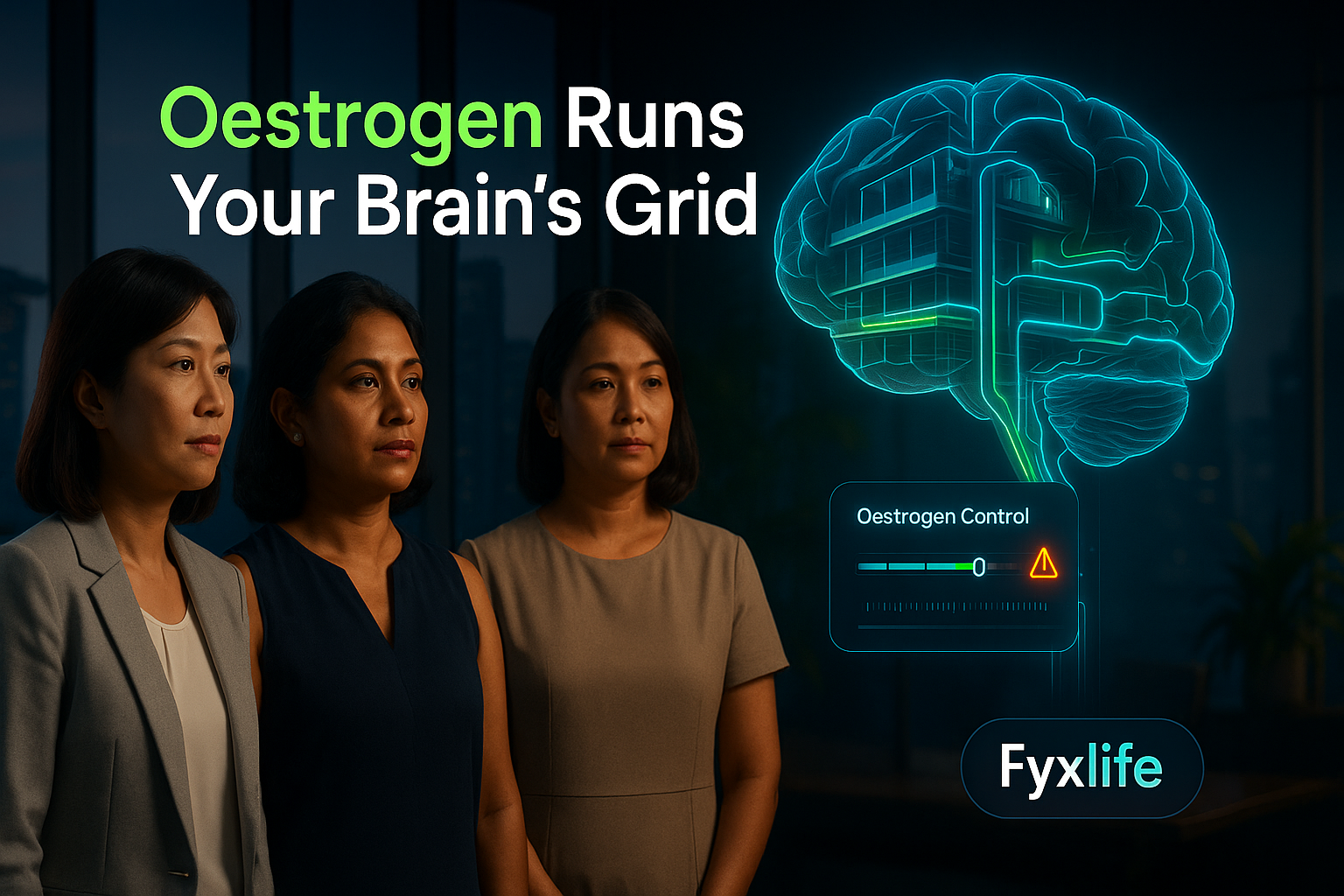
Think of oestrogen as the building manager for your brain’s power grid. It controls how much fuel gets delivered to each floor, keeps the wiring insulated against damage, and ensures the alarm systems don’t misfire. When oestrogen levels drop, it’s not that the building collapses immediately — it’s that the lights start flickering, some floors lose heat, and small faults that were once repaired quickly now linger. The effects feel personal and psychological, but the mechanism is structural and biological.
The fuel in this analogy is glucose — the brain’s primary energy source. Oestrogen is a fundamental regulator of the brain’s metabolic system, controlling glucose transport and the process by which cells convert oxygen into usable energy (aerobic metabolism) inside the brain. This means oestrogen doesn’t just support your neurons — it governs how they are powered. A decline in oestrogen is not merely a hormonal shift; it is a reduction in the brain’s energy supply infrastructure.
The Timeline: When Does Oestrogen’s Brain Protection Start To Fade?
Here is what most women are not told: the hormonal transition that reshapes your brain doesn’t begin at menopause. It begins years — sometimes a decade — earlier.
Perimenopause begins earlier than you think — and so does the cognitive shift
The phase leading up to menopause — known as perimenopause — can begin as early as the mid-30s and typically spans four to ten years. During this time, the form of oestrogen most active in the brain — the biologically potent version called oestradiol (E2) — begins to fluctuate erratically before eventually declining. Declining oestradiol levels have been directly associated with cognitive changes, disrupted sleep, and mood effects in women — all of which are documented neurological consequences, not purely psychological ones. The cognitive shifts you may be attributing to your 40s, your workload, or your lifestyle may in fact have been tracking your hormone levels all along.
The brain fog, mood swings, and sleep disruption connection explained
Women navigating perimenopause describe the cognitive experience with striking consistency: brain fog, memory lapses, inability to focus, lack of motivation, fatigue, and anxiety that arrive together in a cluster. This is not coincidence. Oestradiol influences the production and regulation of mood-stabilising brain chemicals (neurotransmitters including serotonin and dopamine), the architecture of sleep, and the brain’s ability to recover from stress. When oestradiol fluctuates unpredictably, all three systems are disrupted at once. What feels like burnout is often, at the biological level, the early signature of hormonal transition.
The Neuroprotection Mechanism — How Oestrogen Keeps Brain Cells Resilient
Beyond fuel delivery and mood chemistry, oestrogen performs a third function — one with longer-term consequences. It actively protects neurons from damage and helps them repair.
Enhancing neuronal resilience: what the preclinical evidence shows
Preclinical studies have identified biologically plausible mechanisms by which oestrogen can enhance the ability of neurons to withstand stress (neuronal resilience) and may serve a primary prevention role against neurodegeneration — the progressive breakdown of brain cells associated with conditions like Alzheimer’s disease. The mechanism involves reducing inflammation in brain tissue, supporting the survival of neurons under metabolic stress, and maintaining the structural integrity of synaptic connections — the contact points between brain cells through which all thought and memory travel. These are not speculative effects. They are observed repeatedly in laboratory conditions, which is why they have driven significant clinical interest.
The Alzheimer’s link — why women’s dementia risk is not just about living longer
Women account for approximately two-thirds of all Alzheimer’s cases globally. For a long time, this was attributed to the fact that women live longer. That explanation is increasingly understood to be incomplete. Declining oestrogen levels before, during, and after menopause are linked to increased risk for Alzheimer’s disease and memory changes — a relationship that suggests biology, not just longevity, is driving the disparity. Oestrogen provides broad neuroprotective effects, including a primary prevention role against neurodegeneration, based on both clinical observations and mechanistic research. The window in which this protection matters most — and the timing of any intervention — is an active area of scientific debate, but the relationship itself is not.
Gray Matter, Memory, and Menopause — What Happens Structurally To The Brain
The changes oestrogen decline produces are not only functional. They are visible in brain tissue.
Loss of gray matter volume and what it means for cognitive performance
Gray matter — the densely packed layer of the brain that contains most of its active neurons — changes in volume as oestrogen falls. Declining oestrogen levels before, during, and after menopause are associated with reduced gray matter volume in key brain regions. Volume loss in the hippocampus and prefrontal cortex — the same regions oestrogen protects most — translates directly into measurable reductions in memory consolidation, verbal recall, and the kind of sustained, flexible thinking that defines high performance. This is structural change. It is measurable on a scan. And it begins before menopause is complete.
Why the effects are most visible under pressure — the cognitive load finding
Here is the finding that may finally explain something you have been experiencing for years. Oestrogen’s effects on brain activation are dependent on cognitive load — meaning its impact on focus and mental performance is most pronounced when the brain is working hardest. This explains why you may feel relatively functional on a quiet day but fall apart cognitively in a high-stakes meeting, a complex negotiation, or a moment that requires you to hold multiple threads simultaneously. The deficit is real, but it surfaces under pressure. Which is precisely when you need your brain most — and precisely when declining oestrogen offers it the least support.
What This Means For You — Reading Your Own Symptoms Through An Oestrogen Lens
Understanding the mechanism is one thing. Knowing how to apply it to your own experience is another.
Brain fog, poor focus, emotional volatility — separating oestrogen depletion from other causes
The symptoms of declining oestrogen overlap significantly with burnout, anxiety, depression, thyroid dysfunction, and iron deficiency — which means they are frequently misattributed. The distinguishing feature is pattern. Oestrogen-driven cognitive symptoms tend to fluctuate with the menstrual cycle in perimenopause, worsen in the week before menstruation when oestradiol is at its lowest, and intensify under cognitive load rather than remaining constant. They also cluster — brain fog, poor sleep, mood instability, and reduced motivation rarely arrive alone when oestrogen is the driver. These are documented neurological consequences of declining oestradiol, not character flaws or signs of psychological weakness.
The challenge is that this is exactly the kind of pattern a routine annual check-up was not designed to investigate — not because doctors don’t care, but because standard reference ranges and ten-minute appointments were never built to map hormonal fluctuation against cognitive performance over time. The question of what your oestrogen is doing to your specific brain, at this specific stage of your hormonal transition, requires a different kind of conversation.
The questions worth raising with your doctor
When you do have that conversation, the most useful thing you can bring is data. Not a vague description of feeling off, but a pattern: when symptoms appear, how they track against your cycle, how they behave under pressure, and how long they have been present. This transforms a subjective complaint into a clinical observation — one that opens the door to oestradiol testing, cognitive screening, and a genuine discussion about whether hormonal intervention is appropriate for your risk profile and timeline.
The Single Most Important Insight From The Research
The research on oestrogen and brain health converges on one insight that changes how every woman over 35 should think about this transition: the cognitive and neurological effects of declining oestrogen are not a consequence of menopause arriving. They are part of the process of arriving — beginning years earlier, unfolding gradually, and accumulating in ways that become visible only in retrospect. By the time a woman attributes her mental changes to age or stress, the biological mechanism has often been operating for years. Knowing this earlier — and taking it seriously earlier — is the point.
Apply this mechanism insight to a decision you are already making: the next time you notice your focus, memory, or emotional steadiness dipping — especially under pressure at work — note where you are in your cycle or in the perimenopause timeline. Track it for four weeks alongside any other patterns (sleep quality, cycle regularity, energy). That data becomes a concrete starting point for a genuinely useful conversation with your doctor about oestrogen and brain health, rather than a vague complaint about feeling off.