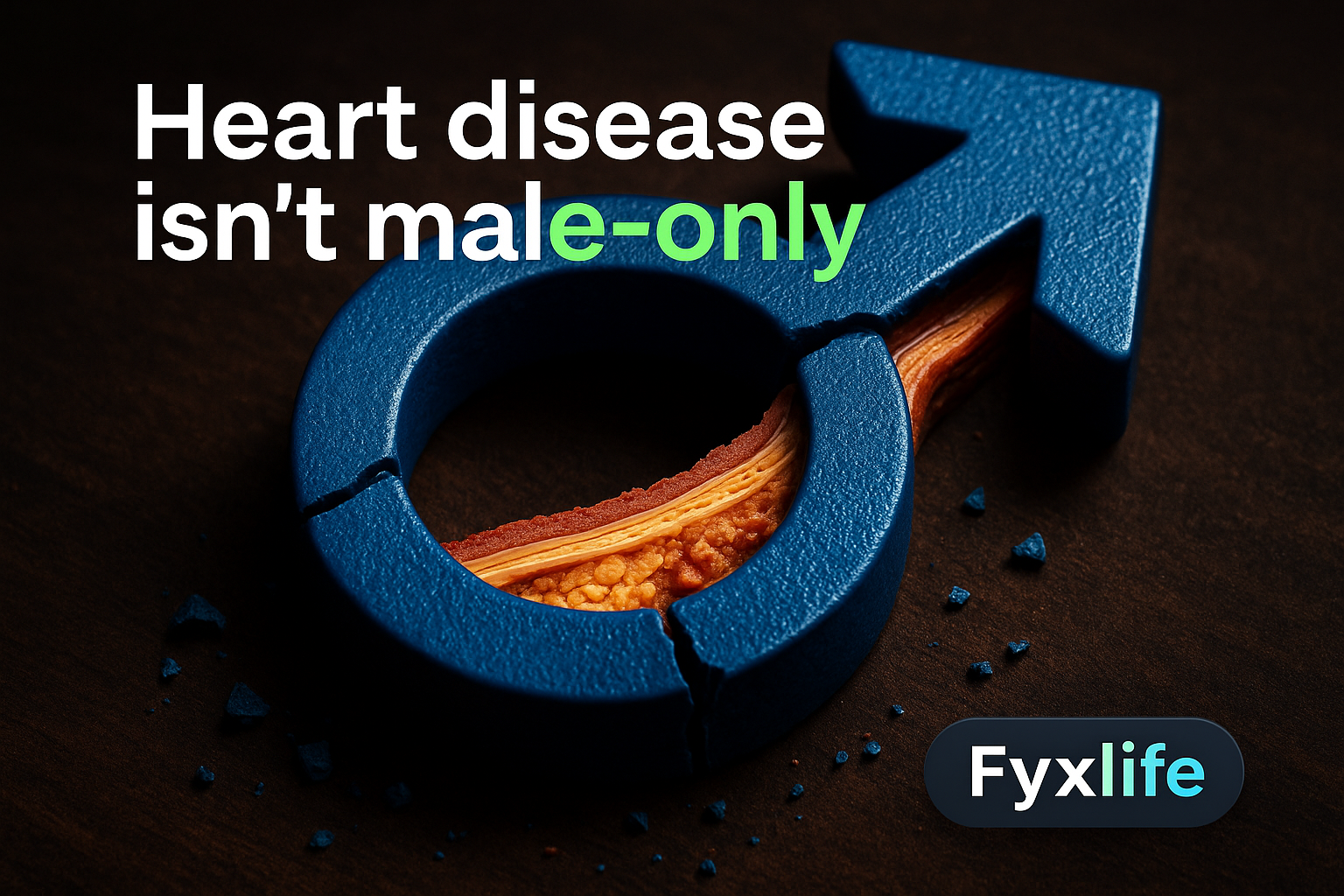
You’ve spent decades being told that heart disease is something your husband needs to worry about, not you. But here’s what the research actually shows: the moment you enter perimenopause, your cardiovascular risk begins climbing — and by the time most women realise it, they’ve already lost years of protection they didn’t know they had.
This isn’t about frightening you. It’s about correcting a belief that has quietly shaped how women approach their health in their 40s and 50s — and how their doctors have often responded. The assumption that heart disease is a male problem has its roots in real biology. The problem is that the biology has an expiry date nobody mentions at a standard check-up.
The Myth — Women Are Naturally Protected From Heart Disease
Why this belief exists and why it’s only half true
The belief isn’t baseless. For most of your reproductive years, your cardiovascular system genuinely does operate with an advantage over men of the same age. Pre-menopausal women have measurably lower cardiovascular disease risk than age-matched men, and that gap is real enough that it shaped decades of medical research, clinical guidelines, and cultural assumption. Heart disease became coded as a male disease because, for a long time, the data looked that way.
But the data was only telling part of the story. The protection was always conditional — tied directly to circulating estrogen levels. Once those levels begin falling, the protection begins dissolving. And that dissolution doesn’t start at menopause. It starts in perimenopause, which can begin years earlier, often in a woman’s early-to-mid 40s, sometimes her late 30s.
What ‘estrogen protection’ actually means — and when the clock starts ticking
Think of estrogen as a coating on the inside of your arteries — like a non-stick surface that prevents cholesterol, fat, and cellular debris from sticking and building up. While you’re premenopausal, that coating is renewed daily. The moment estrogen levels begin falling in perimenopause, the coating starts wearing thin. The arteries don’t suddenly break — but they become sticky in a way they never were before, and everything the bloodstream carries starts leaving a mark.
Ovarian hormones, especially estrogen, protect the coronary arteries of premenopausal women from the gradual accumulation of plaque inside artery walls (the process researchers call atherosclerosis). This isn’t a theory — it’s documented across multiple independent lines of evidence. The protection is real. What wasn’t communicated clearly enough is that it is entirely hormonal in origin, and therefore entirely temporary.
The Verdict — The Protection Is Real, But It Has an Expiry Date
What the research says about CVD risk after menopause
The biological advantage that premenopausal women hold over age-matched men — the decelerated progression of cardiovascular disease — ends with hormonal transition. That is not a gradual fading. The research describes it as a meaningful inflection point: a moment after which the cardiovascular risk trajectory changes direction.
Transition to postmenopausal status is associated with a worsening coronary heart disease risk profile — not just slightly worse, but deteriorating across multiple metabolic and vascular markers simultaneously. This is not simply ageing. Women who are postmenopausal show worse cardiovascular markers than men of equivalent age who have experienced the same years of normal ageing without the hormonal shift. The hormones were doing more work than most women — or most doctors, in a busy clinic setting — ever stopped to consider.
Why perimenopause — not postmenopause — is the critical window most women miss
The menopausal period itself — not just the years after — is identified in the research as a critical window for cardiovascular risk assessment and intervention. This distinction matters enormously. Most women don’t think about heart disease until they’re past 60. But the window where you can get ahead of the cascade — where the changes are beginning but haven’t compounded — is perimenopause. That’s now. For a significant number of women reading this, that window is already open.
The Cascade Nobody Warns You About
LDL rises, blood pressure climbs, insulin resistance worsens — all at once
Here is what happens in the body during perimenopause that your annual check-up may not be framing correctly. At menopause, women face increased risk for high levels of the type of cholesterol that builds up in arteries (LDL cholesterol), high blood pressure (hypertension), and impaired blood sugar regulation (diabetes) — a simultaneous worsening of the three major cardiovascular risk factors. Not one of these. All three. Together. In the same biological window.
This is not coincidence. These changes are mechanistically connected to the loss of estrogen. Cardiovascular disease risk rises sharply with menopause, driven in part by a coincident increase in the body’s resistance to insulin — the hormone that regulates blood sugar. When cells stop responding well to insulin (a condition called insulin resistance), blood sugar rises, fat storage shifts toward the abdomen, inflammation increases, and the artery walls begin to sustain damage that would have been repaired more efficiently just a few years before.
How plaque builds in arteries faster once estrogen falls
The connection between these metabolic changes and structural damage inside the arteries is direct. Without estrogen renewing that protective lining, the inner walls of the arteries (the endothelium) become more reactive to injury. LDL cholesterol particles — already rising — begin embedding in these walls. The immune system responds to this as damage, sending cells to the site. Those cells accumulate. That accumulation is plaque. Plaque that would have been resisted, deflected, or more slowly formed before the hormonal shift now progresses faster. The arteries don’t give you symptoms. They just quietly narrow.
The challenge is that this is exactly the kind of question a routine annual check-up was not designed to answer — not because doctors don’t care, but because population-level reference ranges were never built to account for where you are in your hormonal transition. A lipid panel read without knowing your menopausal status is clinical data missing its most important context.
The Timing Factor — Earlier Menopause, Higher Risk
What early menopause (before 40) means for your lifetime cardiovascular risk
If your periods stopped before age 40 — whether naturally or due to surgery — this section concerns you directly. Early menopause is linked to increased cardiovascular disease mortality, and the earlier menopause occurs, the longer the window of elevated cardiovascular risk. Women who experience menopause before 40 face a 40% higher lifetime risk of coronary heart disease compared to women who reach menopause at the expected age. That is not a marginal difference. It is a risk elevation that deserves to be tracked with the same seriousness as a family history of early heart attack.
Why your age at menopause should be in your medical record alongside your cholesterol
Age at natural menopause is a cardiovascular risk marker. Not a lifestyle detail. Not a gynaecological footnote. A marker. Later menopause is associated with lower heart attack and stroke risk, which means the inverse is equally true: earlier menopause equals longer exposure to the unprotected cardiovascular state. This information should sit next to your cholesterol results and blood pressure history in your medical record — not buried in a gynaecology referral from a decade ago. If it isn’t there, it’s worth putting it there yourself at your next appointment.
The Deadliest Misconception — Women Still Fear Cancer More Than Heart Disease
The actual numbers on what kills women after 50
Ask most women what health outcome they fear most, and the answer is cancer. Breast cancer in particular carries a cultural weight that shapes screening behaviour, fundraising, and personal anxiety in ways that heart disease simply does not. But the numbers tell a different story entirely. Women die of cardiovascular disorders more than from breast cancer, stroke, chronic obstructive pulmonary disease (a progressive lung condition), and lung cancer combined. Not more than one of those. More than all of them together.
The fear and the mortality are completely misaligned. Women are worrying about the wrong thing — not because the other things don’t matter, but because heart disease has never received the same cultural attention as cancer, and the result is that it kills more quietly, more often, and later than it should.
Why heart disease presents differently in women and gets caught later
Part of the problem is diagnostic. Heart attacks in women often do not look like the dramatic chest-clutching events depicted in medical dramas. Women are more likely to experience nausea, jaw pain, unusual fatigue, or a vague sense of pressure rather than the crushing central chest pain associated with classic male presentations. This means women are more likely to attribute symptoms to something else — and more likely to be assessed by a clinician who does the same. The result is that cardiovascular disease in women gets caught at a more advanced stage, when there are fewer options and lower odds of full recovery.
Knowing this doesn’t mean catastrophising every symptom. It means building a cardiovascular profile early enough — in perimenopause, not post-retirement — that you are not relying on symptoms to tell you something is wrong.
What You Should Actually Do With This Information
The one conversation to have at your next medical appointment
Drop the belief that heart disease is a post-retirement problem. At your next medical appointment, tell your doctor the age you first noticed perimenopausal symptoms and ask them to factor that into your cardiovascular risk profile — specifically requesting a lipid panel and blood pressure trend review if you haven’t had one in the past 12 months. Your age at hormonal transition is clinical data, not just a life stage.