
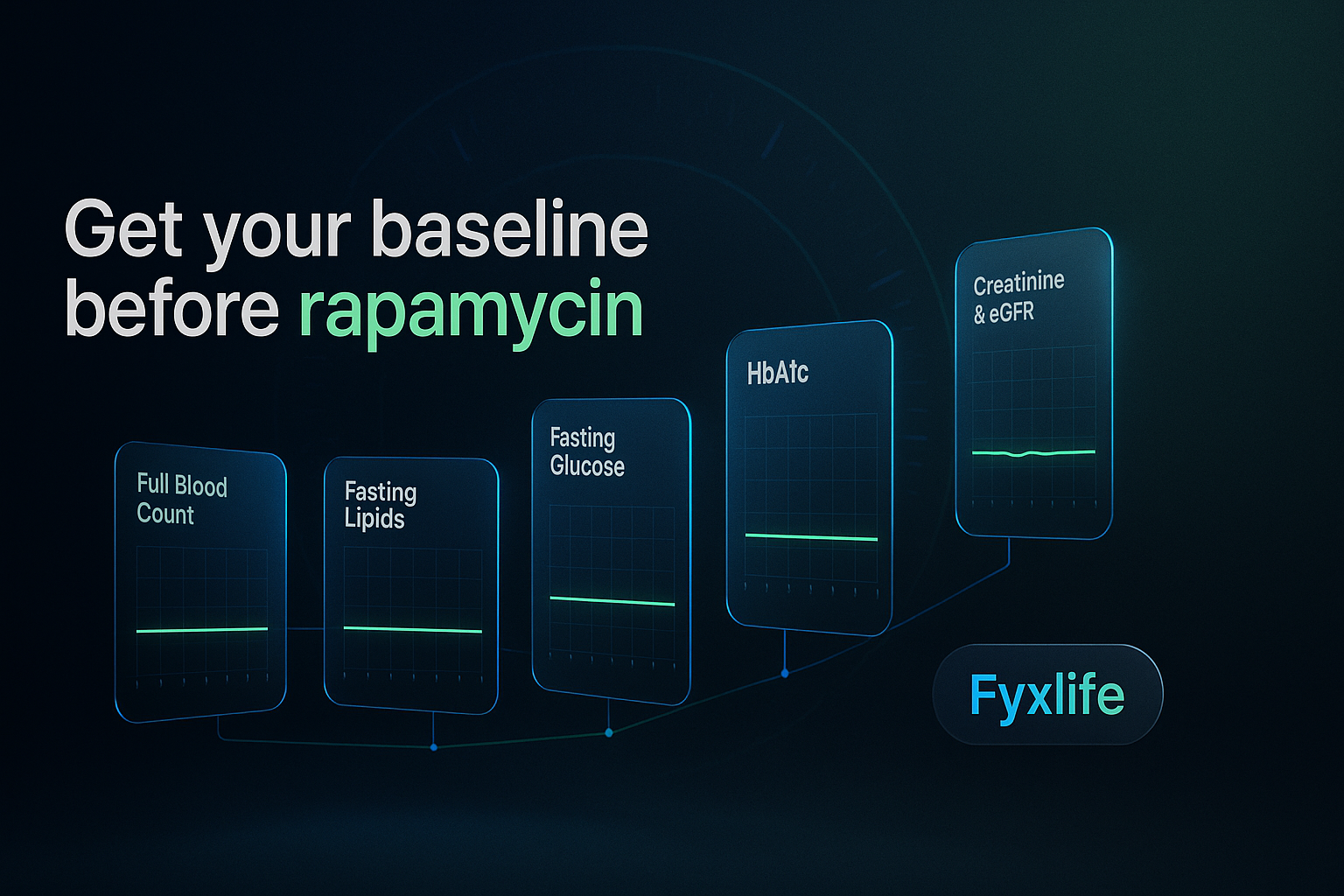
You’ve read the animal studies. You’ve heard Peter Attia mention it. Now you’re seriously considering rapamycin — or you’re already taking it off-label. The question isn’t whether to be curious. The question is: what does your body need to tell you before you start, while you’re on it, and if something goes wrong?
This is a drug that has extended healthy lifespan in every mammalian model it has been tested in. It is also a drug with real, documented risks that must be understood before use, not after. The tension between those two facts is exactly where most of the conversation about rapamycin lives — and it is exactly why structured testing matters. Not to prove the theory. To make sure your individual biology isn’t quietly paying a price while you run the experiment.
Before You Test Anything: What Rapamycin Actually Does to Your Body
The cell growth switch explained — why suppressing mTOR requires metabolic and immune surveillance
Rapamycin works by inhibiting a protein called mTOR — the mechanistic target of rapamycin, which functions as your body’s master cell-growth switch. When mTOR is active, cells grow, divide, and build new proteins. When it’s suppressed, cells shift into a more conservative mode: less building, more recycling, more quality control. In aging biology, the theory is that chronically overactive mTOR drives cellular wear-and-tear faster than necessary — and that periodic, controlled suppression may slow that process.
Think of rapamycin as turning down the thermostat on your body’s cell-growth furnace. At the right setting, less unnecessary cellular activity may slow the wear-and-tear of aging. Turn it down too far or too long, and the house gets cold in ways you don’t want — your immune system stops patrolling as effectively, your metabolism shifts, your lipids change. The tests aren’t proving the thermostat theory works. They’re making sure the house isn’t freezing while you run the experiment.
The implications of that cooling effect are what make monitoring non-negotiable. mTOR is not a switch you can suppress in one tissue without affecting others. Immune cells, metabolic pathways, and lipid regulation are all downstream of the same signal. Which is why your baseline matters.
The difference between transplant dosing and longevity dosing — and why it changes everything about risk monitoring
Rapamycin was originally developed as an immunosuppressant for organ transplant recipients. Those patients take it daily, at high doses, with the explicit goal of dampening the immune system enough to prevent rejection. Disease-oriented dosing and longevity dosing are fundamentally different regimens with different risk profiles — the therapeutic objectives differ, and that distinction drives everything about what you monitor and how often.
Most longevity protocols use intermittent, low-dose rapamycin — typically once weekly — at doses far below transplant levels. Rapamycin’s distinct pharmacokinetics mean that standard clinical dosing intervals used in transplant medicine do not directly translate to longevity protocols. The side effect profile shifts meaningfully at lower doses. But “lower risk” is not the same as “no risk,” and it is certainly not the same as “no monitoring required.”
Phase 1 — Baseline Tests Before Starting Rapamycin
Immune function markers: complete blood count, lymphocyte subsets
Your starting point for immune surveillance is a complete blood count (CBC) — a standard test that measures your white blood cells, red blood cells, and platelets. Within the white cell count, you want to pay particular attention to lymphocytes, the immune cells most directly affected by mTOR inhibition. If your lymphocyte count is already at the lower end of normal before you start, that is relevant information. Some clinicians with access to more detailed panels will also request lymphocyte subset analysis, which breaks down your T-cells, B-cells, and natural killer cells individually. This level of detail isn’t always necessary at baseline, but it sets a richer reference point if you intend to monitor closely.
Metabolic panel: fasting glucose, HbA1c, lipid panel (LDL, HDL, triglycerides)
Rapamycin’s effect on metabolism is one of its most clinically relevant monitoring targets. mTOR inhibition can impair the way cells respond to insulin — the signalling cascade that moves glucose out of the bloodstream and into tissues. This means your fasting glucose (the amount of sugar in your blood after an overnight fast) and HbA1c (a three-month average of blood sugar control, technically called glycated haemoglobin) are both worth documenting before you begin. Your full lipid panel — including total cholesterol, LDL, HDL, and critically, triglycerides — is equally important. Triglyceride elevation is often the first metabolic signal to appear after starting rapamycin, and you cannot interpret a rise if you don’t know where you started.
Kidney and liver function: creatinine, eGFR, ALT, AST
Rapamycin is processed by the liver and can affect kidney function in some individuals. Creatinine is a waste product that healthy kidneys filter efficiently — elevated creatinine suggests the kidneys are working less effectively. eGFR (estimated glomerular filtration rate) is a calculated score that translates creatinine levels into an estimate of how well your kidneys are filtering blood overall. If your eGFR is already below 60 before you start, this is a significant finding that should shape any decision about rapamycin use. For liver health, ALT and AST — enzymes that leak into the bloodstream when liver cells are stressed — establish your hepatic baseline.
Inflammatory markers: hsCRP, IL-6 if accessible
High-sensitivity C-reactive protein (hsCRP) is a blood marker of low-grade, body-wide inflammation — the kind of chronic background fire that is increasingly understood to drive accelerated aging. If rapamycin has anti-inflammatory effects in humans as it does in animal models, hsCRP is one of the signals most likely to shift. Interleukin-6 (IL-6), a chemical messenger that coordinates inflammation throughout the body, is less routinely available but increasingly accessible through specialist labs. Both establish your inflammatory baseline and give you something to compare against at re-test.
Biological age baseline: epigenetic clock test if budget allows — sets your reference point
Epigenetic clocks measure patterns of chemical tags on your DNA — called methylation marks — that shift predictably as you age. Testing companies can now use these patterns to estimate a biological age, which may differ meaningfully from your chronological age. If you are going to track whether rapamycin is doing anything useful over time, having a pre-intervention epigenetic age reading is genuinely useful — not because it will confirm anything, but because it gives you a personal reference point. These tests are not cheap, but if you are committed to long-term monitoring, the baseline is the most valuable data point you will ever collect.
What to tell your doctor before requesting these tests
Be direct. Tell your doctor you are researching off-label rapamycin use for longevity purposes and that you want a documented metabolic and immune baseline before making any decision. In Singapore, most of these tests can be ordered by a GP, though lymphocyte subsets and IL-6 may require a referral to an internal medicine specialist or a longevity-oriented clinic. Frame it as pre-decision risk assessment — because that is exactly what it is.
Phase 2 — Monitoring Tests at 4–12 Weeks After Starting
What changes first and what takes longer to shift
Not all biomarkers respond on the same timeline. Lipids tend to move earliest — often within the first four to eight weeks. Immune markers may take longer to show meaningful change, and inflammatory markers can be highly variable in the short term. In longevity medicine, testing is performed iteratively: the initial measurement sets the baseline, and subsequent regular tests help assess whether an intervention is working or causing harm. The four-to-twelve week window is not about confirming success. It is about catching early signals before they become clinical problems.
Lipid panel re-check: rapamycin can elevate triglycerides — this is the earliest metabolic signal to watch
Triglyceride elevation is one of the most consistently reported early effects of rapamycin in human users. If your triglycerides were within normal range at baseline and are now meaningfully elevated — particularly if they are approaching or exceeding 2.3 mmol/L — that is a signal worth taking seriously. It may warrant a dose adjustment, a change in timing, or a dietary review. It does not automatically mean you should stop, but ignoring it is not the answer either.
Immune surveillance: infections, wound healing, any signs of immunosuppression
At longevity doses, frank immunosuppression is uncommon — but it is not impossible, particularly if you are older, already immunocompromised, or if your lymphocyte count was low at baseline. Pay attention to whether you are getting infections more easily than before, whether cuts or minor injuries are healing more slowly, or whether you feel persistently run down. These are clinical observations, not lab results — but they are data. Report them. Your CBC at the eight-to-twelve week mark will give you the lab correlate.
Blood glucose monitoring: mTOR inhibition can impair insulin signalling at some doses
Impaired insulin signalling — where cells become less responsive to the signal that lowers blood glucose — is a known mechanism of rapamycin at higher doses. Even at low longevity doses, some individuals show meaningful fasting glucose increases. Re-testing your fasting glucose and, if the timeline allows, your HbA1c at this phase gives you the data to assess whether this is happening to you specifically. Someone who began with a fasting glucose of 5.0 mmol/L and is now sitting at 5.9 mmol/L is in a different conversation than someone whose numbers have not moved.
Phase 3 — Ongoing Testing Frequency for Long-Term Users
Quarterly versus bi-annual testing — what the longevity medicine protocol suggests
The PEARL study — the most structured current clinical trial evaluating rapamycin as a longevity intervention in humans — provides the clearest template for monitoring frequency. For established users whose markers are stable, bi-annual testing of the core metabolic and immune panel is a reasonable floor. For those who have seen early changes in triglycerides, glucose, or immune counts, quarterly re-testing until stability is established makes more sense. The right frequency is not fixed — it is responsive to what your data is telling you.
When to pause or stop: the red-flag biomarker thresholds worth knowing
There is no single universally agreed threshold for stopping rapamycin, but several findings should prompt an immediate conversation with a knowledgeable clinician. A significant and unexplained drop in lymphocyte count below the normal reference range, fasting glucose consistently above 7.0 mmol/L, eGFR declining more than 15% from your baseline, or triglycerides above 5.6 mmol/L — any of these represent meaningful signals that the thermostat has been turned down too far, or that the drug is interacting with your individual biology in a way that requires reassessment.
The iterative loop: how to use test results to adjust dose timing, not just continue blindly
The most sophisticated rapamycin users are not simply taking a fixed dose and hoping for the best. They are treating their biomarker results as feedback. Triglycerides rising? Some protocols respond by shifting the dosing day relative to meals high in fat, or by extending the interval between doses. Glucose creeping up? Some clinicians trial a dose reduction before abandoning the protocol. The data does not just tell you whether to continue — it tells you how to continue. That is a fundamentally different relationship with the drug than swallowing a tablet and waiting to feel different.
The Biological Age Layer — What It Can and Cannot Tell You
Why aging biomarkers are not yet FDA-validated endpoints for drug assessment
Aging biomarkers are not currently included in the FDA’s Table of Surrogate Endpoints — the formal list of measurements that can serve as the basis for drug approval. This is not a minor technical detail. It means that even if your epigenetic clock score improves while taking rapamycin, this result cannot be used to formally validate that the drug is extending your lifespan. The science of aging measurement is genuinely advancing — but it has not yet reached the threshold of regulatory confidence.
Epigenetic clocks as a tracking signal, not a verdict
That said, dismissing epigenetic clocks entirely because they are not yet FDA-validated would be an overcorrection. These tools measure real biology — the methylation patterns they track are mechanistically linked to aging processes. Biological age tools are increasingly used in longevity medicine to assess intervention response over time, even in the absence of formal validation. The right frame is: these are useful tracking signals, not verdicts. A falling biological age score is an encouraging data point. It is not proof of anything.
How to interpret a biological age result while on rapamycin without overclaiming
If your epigenetic age shows a meaningful reduction after six to twelve months on a rapamycin protocol, you are entitled to view that as a positive signal. If it stays flat, you should not immediately conclude the drug isn’t working — these tests have meaningful measurement variability, and the biological effects of rapamycin may not be perfectly captured by any single clock. If your biological age appears to be rising while on the drug, that is worth taking seriously — not as definitive evidence of harm, but as a reason to re-examine the protocol closely alongside your other biomarkers.
What to Ask Your Doctor — A Conversation Starter Script
How to frame an off-label rapamycin discussion in a Singapore clinical context
Most GPs in Singapore will not have encountered many patients asking about off-label rapamycin for longevity. That does not mean the conversation is impossible — it means you need to frame it carefully. Lead with the testing request, not the drug. Something like: “I’m researching a longevity protocol that involves off-label medication, and I want to establish a thorough metabolic and immune baseline before making any decisions. I’d like to document my current kidney function, liver enzymes, lipid panel including triglycerides, fasting glucose, HbA1c, and a full blood count.” Most clinicians will engage constructively with a patient who comes in asking for documented baseline data rather than a prescription.
The tests most GPs can order versus what requires a longevity or functional medicine specialist
- Standard GP-orderable: Full blood count, fasting lipids with triglycerides, fasting glucose, HbA1c, creatinine, eGFR, ALT, AST, hsCRP
- May require specialist referral or private lab: Lymphocyte subsets (T-cell/B-cell/NK-cell panels), IL-6, epigenetic clock testing
- Rapamycin prescription itself: Not available over-the-counter in Singapore; requires a physician’s prescription and, in most cases, a specialist consultation
The challenge here is real and worth naming plainly: the standard annual health screen was not designed to answer the question “is this longevity drug safe for my specific biology?” It was designed for population-level screening of common conditions. Getting the full picture rapamycin requires — including lymphocyte subsets and inflammatory markers beyond CRP — typically means going beyond what a routine check-up provides. That gap is not a failure of the healthcare system. It is simply a mismatch of purpose.
The Evidence Honest Truth: What These Tests Can and Cannot Prove
You are monitoring safety and signals, not confirming lifespan extension
Rapamycin is not officially approved for aging, and the longevity data in humans is structurally difficult to acquire — any well-designed trial attempting to assess longevity impact faces fundamental design challenges that make RCT-level certainty essentially impossible within a human research career. A current observational study examining clinical trials involving healthy adults who took low doses of rapamycin found limited evidence for longevity benefits, underscoring that the tests you run cannot yet confirm longevity outcomes. What they can confirm is whether the drug is affecting your metabolic, immune, and organ function in ways that require your attention. That is not a small thing. That is exactly the right thing to be monitoring.
Online longevity clinics have emerged offering access to rapamycin with minimal oversight as the drug gains popularity for its anti-aging potential. The people using these services without structured baseline testing are, in effect, running a biological experiment with no control conditions. The animal data that makes rapamycin so compelling was generated in controlled settings with meticulous measurement. Rapamycin is not a miracle drug, even if the consistency of its effects across mammalian models is genuinely remarkable. Your testing protocol is how you bring some of that rigour to your own self-experiment.
What the PEARL trial and current human studies are actually measuring
The PEARL study is currently the most structured human trial designed specifically to evaluate rapamycin as a longevity intervention. Its protocol is valuable not just for what it will eventually tell us about the drug, but for what it tells us right now about which biomarkers the scientific community considers most relevant to track. The markers PEARL monitors — immune function, metabolic health, organ function, inflammatory status, and biological age signals — map almost exactly to the testing protocol described in this article. That is not a coincidence. It is the most honest template available for how a rigorous self-experiment should be run.
What rapamycin research has confirmed is that the mTOR pathway — the cell’s growth and repair switch — responds to periodic inhibition in ways that consistently extend healthy lifespan in animal models. Whether the same holds true in humans at scale remains the central open question. That question is now being studied formally. In the meantime, if you are going to run this experiment on yourself, the minimum standard is knowing exactly where you stand before you begin.
Before your next appointment, ask your doctor to order a baseline panel that includes: full blood count, fasting lipids with triglycerides, fasting glucose and HbA1c, creatinine and eGFR, and ALT/AST. Tell them you are researching off-label rapamycin use and want a documented metabolic and immune baseline before making any decision. If your triglycerides are already elevated or your eGFR is below 60, that finding — not enthusiasm for the drug — should drive your next conversation about whether and how to proceed.