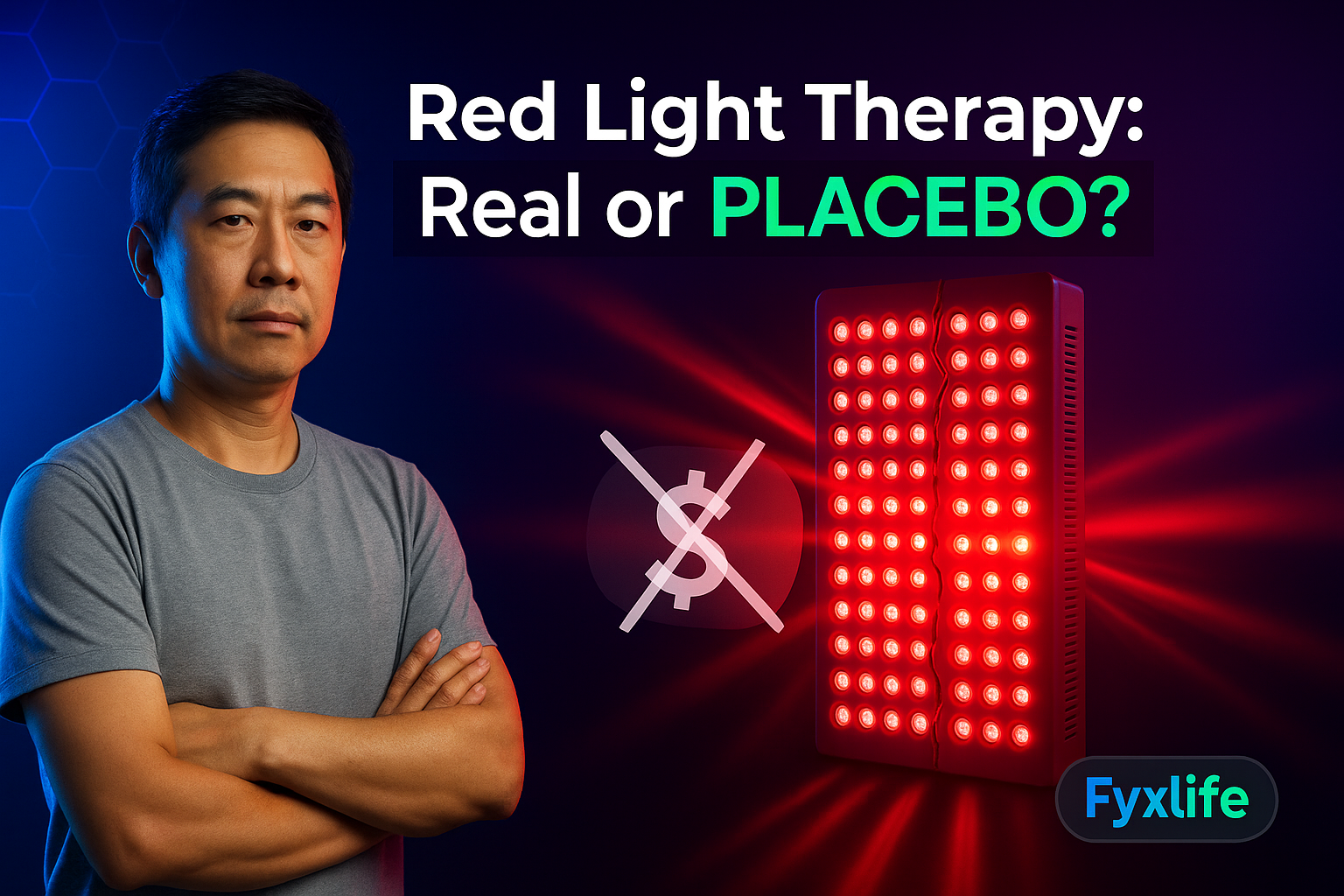
You’ve seen the panels, the pods, the sauna add-ons — and the claims that red light therapy will fix your sleep, heal your tendons, and supercharge your recovery. Some of it is real. Some of it is marketing dressed up in scientific-sounding wavelengths. Here’s how to tell the difference.
If you’ve spent any real time researching this technology, you’ll recognise the frustration. You read one convincing thread, then find a study that contradicts it. You watch a practitioner explain the mechanism with apparent authority, then realise the device they’re recommending doesn’t actually emit the wavelength they just described. You’re not being irrational for wanting this to work. Recovery tools that don’t involve more supplements, more effort, or more willpower are genuinely appealing. The question is which parts of the promise hold up when you look closely — and which parts collapse the moment you check the physics.
The Myth Stack: What Red Light Therapy Is Actually Claimed to Do
Sleep, recovery, pain, brain health, skin — the full list of claims circulating in 2025
The claims have multiplied faster than the research. In 2025, red light therapy is being marketed as a solution for poor sleep, delayed muscle recovery, chronic tendon pain, skin ageing, cognitive decline, mood disorders, and metabolic dysfunction. Some devices now claim to target specific brain regions. Others promise to accelerate healing in deep tissues and internal organs. The panels have got bigger, the price tags steeper, and the claim lists longer. Whether any of this has kept pace with peer-reviewed evidence is a different question entirely.
Why the hype has outpaced the science (and who profits from the confusion)
Even practitioners like Peter Attia, who engage seriously with longevity science, have publicly flagged that red light therapy has promising applications but is surrounded by significant hype — a signal that consumer enthusiasm has well and truly lapped the evidence base. The confusion is commercially convenient. When the categories of “red light” and “near-infrared” get collapsed into a single marketing term, when wavelength and power density get buried in fine print, and when a handful of well-designed dermatology trials get used to justify claims about brain health, the product sells better. Understanding the actual mechanism cuts through most of this immediately.
The Mechanism That Is Real — And the One Condition It Requires
How light activates your cell’s energy factories (and why wavelength and dose are everything)
Here is what the research actually supports. The primary cellular targets of red and near-infrared light are the copper centres inside mitochondrial proteins — the structures inside your cells responsible for producing energy (what researchers call the mitochondrial respiratory chain). When the right wavelength of light hits these copper centres, it appears to stimulate greater energy output from the cell. The mechanism is real. The biology is sound. But the critical word in that sentence is “right.”
Think of red light therapy like a prescription medication — the right dose at the right depth treats a real condition, but doubling the dose doesn’t double the effect. It’s more like tuning a radio: the signal only comes through clearly on the correct frequency, at the correct volume. Turn it up too high, and you get static. Point it at a wall, and nothing happens at all. Most consumer marketing skips this entirely, which is why so many people buy a device, use it inconsistently, and get inconsistent results.
Red light vs. near-infrared — two different tools being sold as one
Red light and near-infrared radiation are not the same thing. They work through overlapping but distinct mechanisms, they penetrate tissue to different depths, and conflating them — as most consumer device marketing does — is causing widespread confusion about what any given panel actually does. Visible red light, typically in the 630–700 nanometre range, penetrates to the skin surface and superficial tissue layers. Near-infrared light, generally 800–1100 nanometres, penetrates somewhat deeper. Neither, at standard consumer power levels, reaches your brain, your liver, or your heart. That distinction matters enormously for evaluating specific claims.
Myth #1 — ‘More Light Means More Healing’
The biphasic dose curve: why overdoing it actively reduces benefit
Research on photobiomodulation — the technical term for light-driven biological change — shows a clear biphasic dose-response: a low dose of light produces benefit, but increasing the dose progressively reduces that benefit, and at sufficient intensity it can produce harm. This is not a theoretical concern. It is a documented, reproducible finding. The effect exists on a curve, not a straight line, and most consumer devices are designed and marketed as though the line goes up indefinitely.
What this means for your session length and device power settings
In practical terms, this means that the person doing 20-minute sessions twice daily on a high-powered panel is not getting more benefit than the person doing a single 10-minute session at the right distance. They may be getting less. The optimal dose — the window where light actually drives the cellular response — is narrower than the marketing suggests, and it varies by tissue type, wavelength, and power density. If you own a device, the default timer settings are almost certainly not calibrated to your specific situation. They are calibrated to avoid complaints about underperformance, which biases manufacturers toward recommending longer sessions rather than more precise ones.
Myth #2 — ‘Infrared Panels Can Reach Your Brain and Deep Organs’
The physics problem: what low-wattage LEDs can and cannot penetrate
This is where some claims in this space stop being exaggerated and start being physically impossible. Extensive prior research has confirmed that infrared light from a standard 0.5-watt LED cannot penetrate the scalp and skull of a human — full stop. Bone is optically dense. The attenuation of light through skin, fat, and cranial bone reduces intensity to levels that cannot meaningfully stimulate the mitochondria of neurons in the brain’s cortex or deeper structures. The physics are not controversial. They are not a matter of emerging research. They are well-established optics.
Which claims are physically impossible at consumer device power levels
Any device marketed at standard consumer power levels that claims to improve cognitive function, treat depression, enhance neuroplasticity, or support brain health by shining LED light through your skull is making a claim the physics do not support. This is not scepticism about the potential of light-based therapies in general — research on transcranial photobiomodulation using specialised clinical equipment exists and is interesting. But a panel you buy online and hold near your head is not that. Understanding this distinction before your next purchase decision saves you both money and the cognitive dissonance of wondering why you don’t feel any different.
Myth #3 — ‘Use Red Light at Night to Sleep Better’
What the research actually found about red light and alertness
The evening red light session has become a fixture of biohacker sleep routines, positioned as a way to wind down without the blue-light stimulation of screens. The logic sounds reasonable. The evidence disagrees. Research shows that red light can actually increase subjective alertness, anxiety, and negative emotions in healthy individuals — the opposite of what you want in the hours before sleep.
The irony: evening use may be making your sleep worse
This is one of the cleaner examples in the red light therapy space of a claim that is not merely unsupported but actively contradicted. If you have been running evening red light sessions as part of your sleep hygiene routine and still finding your sleep fragmented or your mind alert at bedtime, this mechanism is a plausible explanation. The effect is not universal, and individual variation exists — but the assumption that red light is categorically sleep-friendly because it lacks blue wavelengths is not supported by the current evidence. Morning or midday sessions sidestep this problem entirely.
Where the Evidence Is Genuinely Solid
Skin and dermatology: the strongest evidence base
LED phototherapy has been determined beneficial for a range of medical and aesthetic conditions in dermatology practice — and this represents the most consistent and methodologically rigorous evidence base the technology has. Wound healing, acne treatment, photoageing, and certain inflammatory skin conditions have been studied with enough rigour and replication to constitute genuine signal rather than noise. Red light has been shown to penetrate deeper into tissue than blue light and to measurably affect sebum secretion, confirming that genuine skin-level biological effects occur — even if the depth of penetration remains far more limited than device marketing typically implies. If you have a specific dermatological application in mind, the evidence is actually there.
Musculoskeletal pain: promising but protocol-dependent
For joint and muscle pain, the picture is more complicated. Some individuals report meaningful reductions in pain and improvements in recovery — and the mechanism by which photobiomodulation reduces inflammation in superficial tissue is biologically plausible. But the clinical evidence is uneven. A systematic review found that low-level laser therapy is ineffective for lateral elbow tendinopathy when the validity of treatment protocols is properly assessed — highlighting that results in this category are highly sensitive to wavelength, power density, and application technique. The anecdote of someone finding relief from hip pain during a red light session is not fabricated. But it is not evidence that the device will work for a different person with a different condition using a different protocol.
The Verdict — What to Use It For, What to Ignore, What to Question
A plain-language scorecard: green, yellow, and red for common use cases
Skin applications — including acne, wound healing, and photoageing — sit in the green zone. The evidence is real, the mechanism is clear, and the penetration depth is appropriate for the claimed target. Musculoskeletal pain sits in the yellow zone: plausible mechanism, genuinely mixed results, highly sensitive to whether you are using the right protocol for the right condition. Brain health, deep organ claims, and any application that requires light to penetrate bone or more than a few centimetres of tissue from a consumer LED panel sits firmly in the red zone — not because the underlying science of photobiomodulation is fraudulent, but because the physics of these specific devices don’t support the claim. Evening sleep sessions sit in the yellow-to-red zone: not universally harmful, but contradicted by enough evidence that treating them as a reliable sleep aid is a mistake.
The one decision this evidence should change for you
The challenge with a field like this is that the gap between what the research shows and what the marketing claims is wide enough that even well-informed people get pulled toward the wrong conclusions. A standard health check-up will not help you calibrate this — it is not the kind of question that fits inside a 10-minute consultation. This is a case where the evidence itself, read carefully, is the guide. And the most useful thing it tells you is not which device to buy, but which claims to immediately discount regardless of how authoritative the explanation sounds.
Look at whatever red light or infrared device you currently own or are considering buying, and check its claimed use case against this evidence scorecard: skin applications — credible evidence exists; evening sleep sessions — the research suggests this may backfire, shift any sessions to morning or midday; deep organ or brain claims from a low-wattage LED panel — the physics don’t support it, drop that belief before your next purchase decision. Pick the one claim you believed most strongly, and replace it with the evidence-based alternative.