
Why Your Recovery Tools Might Be Missing a Wavelength
The tired-but-trying problem — when effort doesn’t equal rest
You sleep seven hours, eat reasonably well, and still wake up feeling like your body never fully switched off. Before you add another supplement or another habit, it’s worth understanding one of the more quietly researched recovery tools sitting at the intersection of light, biology, and cellular energy — red light and near-infrared therapy.
The frustration is a specific one. You’re not ignoring your health. You’re doing the things. And yet the tiredness persists — not the dramatic exhaustion of someone who’s burning the candle at both ends, but a lower-grade, harder-to-shake fatigue that your body seems to carry from one week into the next. Your recovery tools are ticking boxes, but something isn’t adding up.
What most conventional recovery approaches address is the input side — sleep duration, nutrition, stress management. Fewer address what’s happening at the cellular level: whether your cells are actually generating enough energy to run the repair processes that recovery depends on. That’s where light comes in. Not as a replacement for the basics, but as a biologically distinct input that the basics don’t cover.
What Red Light and Infrared Therapy Actually Are
Light as a biological input, not just illumination
Most people think of light as something that lets you see. But your body responds to light in ways that go well beyond vision. Specific wavelengths of electromagnetic light are absorbed by the body and processed at a cellular level, influencing energy production and tissue repair in ways that have been studied in clinical and research settings for decades. Red light therapy and infrared therapy are the deliberate application of this principle — delivering precise wavelengths to tissue with the intention of triggering specific biological responses.
This is not heat therapy, not UV exposure, and not the same as sitting under a lamp. The wavelength specificity is the entire point. Getting that wrong is the most common reason people try these therapies and conclude they don’t work.
The electromagnetic spectrum in plain English
The electromagnetic spectrum — the full range of energy wavelengths that exist, from radio waves to gamma rays — includes a narrow band of wavelengths that human eyes can detect as visible light. Red light sits at the far end of that visible band. Go just slightly beyond red, and you enter the infrared range: wavelengths your eyes can no longer see, but your skin and tissue can absorb. Red light is visible to the human eye, while near-infrared light sits just beyond the visible spectrum — you can feel its warmth, but you cannot see it.
Red Light vs Near-Infrared vs Far-Infrared — Three Different Tools
Both red light and infrared therapy provide diverse benefits but operate via different wavelengths of electromagnetic energy — they should not be treated as interchangeable. Understanding the three categories is not a technical formality. It directly determines which device or treatment is actually built for your goal.
Red light (630–670nm) — the skin-deep layer
Red light operates in the 630–670 nanometre range and works primarily at the skin’s surface, making it well-suited for skin health, surface tissue repair, and applications where the target is close to the skin. This is the wavelength range most associated with collagen stimulation, wound healing, and aesthetic skin outcomes. It penetrates to a depth of a few millimetres — meaningful for dermal tissue, but not enough to reach deeper muscle layers.
Near-infrared — the deeper tissue signal
Near-infrared light penetrates deeper into the body than visible red light, making it far more relevant for muscle recovery, joint tissue, and cellular energy production in deeper structures. This is the wavelength range that generates the most interest in recovery and longevity contexts — and the one most likely to matter if your goal is reducing soreness, supporting post-exercise repair, or addressing the kind of deeper tissue fatigue that doesn’t resolve with sleep alone.
Far-infrared — heat, circulation, and relaxation
Far-infrared is a third distinct category and operates differently from near-infrared in a way that matters. Far-infrared is primarily associated with heat penetration and relaxation effects, while near-infrared is linked to direct cellular light absorption. The infrared sauna experience that many people are familiar with is primarily a far-infrared experience — deep, penetrating warmth that relaxes muscles, promotes sweating, and supports circulation. Beneficial, but via a different mechanism than the direct cellular energy production associated with near-infrared.
The Core Mechanism: How Your Cells Actually Use This Light
Mitochondria (your cellular energy factories) as the primary target
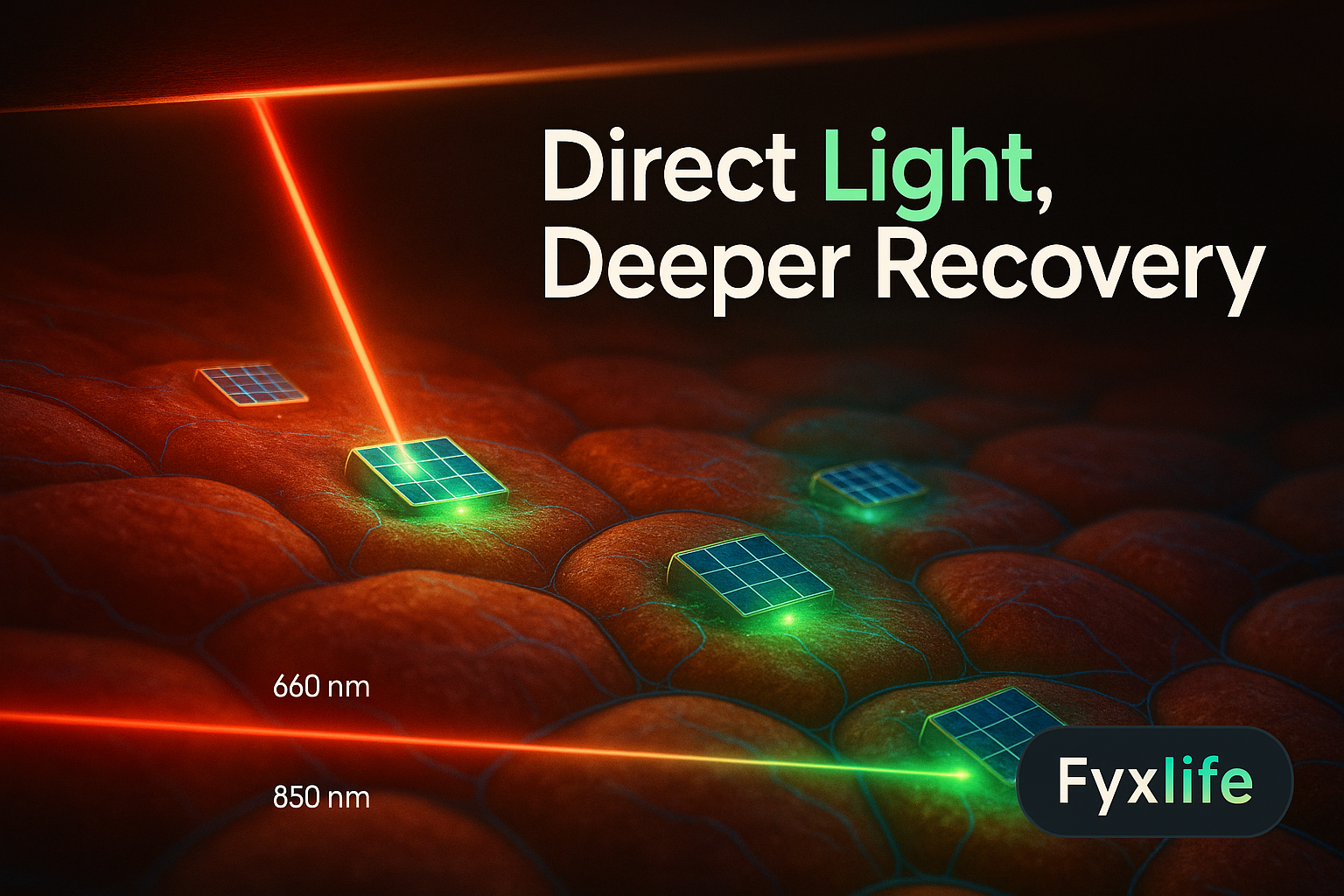
Think of your mitochondria — the tiny energy factories inside every cell, responsible for producing the fuel your body runs on — as solar panels. Most light that hits your body is the wrong frequency and simply bounces off. But specific wavelengths of red and near-infrared light are the equivalent of direct sunlight hitting the panel at exactly the right angle: the cell absorbs it, converts it, and uses it to generate more energy and accelerate repair. Red light works on the surface panels; near-infrared reaches the deeper ones buried inside muscle and connective tissue.
The biological process here involves a protein inside the mitochondria called cytochrome c oxidase — an enzyme that acts as the final step in the cell’s energy production chain. Specific wavelengths of red and near-infrared light appear to interact directly with this enzyme, enhancing its activity and allowing the cell to produce more of the energy currency it needs — known as ATP (adenosine triphosphate), the molecule that powers essentially every cellular function including repair, regeneration, and immune response.
What happens when the right wavelength hits the right tissue
Specific wavelengths of electromagnetic light are absorbed by the body and processed at a cellular level to influence energy production and repair. The downstream effects include reduced oxidative stress (the cellular equivalent of rust accumulating in the system), improved blood flow to treated tissue, and a faster return to baseline function after damage — whether that damage came from a hard training session, chronic postural strain from desk work, or the lower-grade cellular wear that accumulates with age. Red light therapy is increasingly discussed in longevity contexts for its potential to support measurable improvements in health markers including cellular energy.
What the Therapy Is Legitimately Used For
Muscle recovery and post-exercise repair
Red light and infrared therapy are documented to support cellular energy production, muscle recovery, and skin health when delivered via targeted wavelength devices. For the 35–60 professional whose body takes longer to bounce back from both exercise and sustained stress than it did a decade ago, this is the most immediately relevant application. Near-infrared, in particular, is the wavelength to focus on here — it’s what’s doing the meaningful work at muscle depth. The anecdotal experience of persistent hip and joint discomfort resolving during near-infrared sessions reflects what the mechanism predicts: increased local energy production and reduced inflammatory signalling in the treated tissue.
Skin health and surface tissue
Red light in the 630–670nm range has the strongest evidence base for surface tissue applications — stimulating the cells responsible for collagen production (called fibroblasts), improving skin texture, reducing the appearance of fine lines, and supporting wound healing. If your goal is skin-related, this is the correct frequency range, and near-infrared adds relatively little at this depth.
Circulation and relaxation
Far-infrared, delivered via sauna or mat, produces a thermal effect that dilates blood vessels, increases circulation, promotes a parasympathetic nervous system response — the body’s rest-and-digest mode, as opposed to the fight-or-flight state many busy professionals are chronically stuck in — and creates the kind of deep muscular relaxation that is genuinely useful for stress recovery. This is a different mechanism from the cellular energy production pathway, but a legitimate one with a distinct set of benefits.
What It Cannot Do — Setting Honest Expectations
Red light and near-infrared therapy are not a replacement for sleep, movement, or nutrition. They do not reverse chronic disease, and anyone selling them in those terms is selling past the evidence. The honest claim is narrower and more useful: they appear to support the cellular conditions under which recovery happens faster, particularly in tissue that is under regular stress.
They also cannot compensate for a fundamentally broken recovery environment. If you’re sleeping five hours, eating poorly, and under sustained high stress, no wavelength of light will overcome the systemic load on your body. Think of this as a tool that sharpens the edge of an already reasonable recovery practice — not one that replaces it.
The evidence base is also still developing. Many studies are small, use varying protocols, and measure different outcomes. The mechanism is well-established; the optimal dosing, session length, frequency, and wavelength combination for specific conditions is less so. Approach it with realistic expectations: useful, interesting, and worth trying — not miraculous.
Delivery Formats Explained — Panels, Wraps, Mats, and Saunas
Which format suits which goal
Delivery formats matter significantly — panels, wraps, mats, and handheld devices vary in output, coverage area, and appropriate use case. A full-body red light panel delivers broad surface coverage and is well-suited for skin health and general recovery. Near-infrared panels or targeted wraps go deeper and are the better choice for muscle and joint-specific recovery. Infrared saunas — particularly far-infrared — are primarily a heat and circulation tool, with relaxation and cardiovascular benefits as the primary mechanism. A precise, intentional approach to wavelength selection matters — applying the right type of light to the right use case determines whether the therapy is effective.
This is where most people go wrong. They purchase a device based on marketing language without verifying which wavelengths it actually emits and at what irradiance — the intensity of light energy delivered per unit area, which determines whether enough photons are reaching the target tissue to produce a biological effect. A cheap panel emitting weak red light at an unspecified wavelength will do very little. The specification sheet matters more than the brand story.
Who Is Most Likely to Benefit From This
The busy 35–60 professional recovery profile
The people who report the most meaningful results from red light and near-infrared therapy tend to share a specific profile: they’re managing sustained stress loads, their bodies are slower to recover than they were ten years ago, they’re doing reasonable things and not seeing the recovery yield they expect, and they’ve already optimised the basics without fully closing the gap. That profile describes a significant portion of working professionals in Singapore and across Southeast Asia — people who sit for long hours, train inconsistently or intensively, carry significant cognitive load, and sleep in the compressed, often disrupted way that modern professional life tends to produce.
For this group, the near-infrared pathway for cellular energy production and the far-infrared pathway for deep relaxation and parasympathetic activation are the most relevant entry points. The high-interest, low-clarity pattern — spending significant time researching before committing, uncertain about what each type actually does — is both understandable and solvable. The confusion, in most cases, comes down to not knowing that these are three distinct tools operating at three distinct depths, not one therapy with one effect.
The challenge is that matching the right wavelength to the right goal is precisely the kind of nuanced, individual-specific question that a routine check-up was never designed to answer — not because the healthcare system is indifferent, but because population-level guidance doesn’t map well onto the specific recovery gap you’re trying to close. The answer requires knowing your goal, your tissue target, and the actual output of the device you’re considering.
One Mechanism Insight to Apply This Week
This week, identify one recovery goal you are currently trying to solve — poor sleep, lingering muscle soreness, or general fatigue — and map it to the correct wavelength type using what you’ve just read: red light for surface tissue and skin, near-infrared for deeper muscle recovery and cellular energy. That single clarification will tell you whether the device or service you’re considering is actually built for your goal, or whether you’ve been shopping in the wrong frequency range entirely.


