
What This Research Is Actually Saying (And Why It Matters If You’re 35-60)
The core argument — your focus didn’t fail, it was systematically disrupted
You sit down to do something important and within minutes you’re somewhere else entirely — not because you’re lazy or undisciplined, but because an entire system has been engineered to pull you away. A growing body of research and public discourse, most recently amplified by journalist Johann Hari’s deep investigation into stolen focus, argues that the attention crisis is not a personal failing — it is a structural one. Here is what the evidence actually says, and what it means for your brain.
If you are in your forties or fifties and you have noticed that reading a long article feels harder than it used to, that you lose the thread of conversations in meetings you would once have led without effort, or that the quiet discomfort of sitting with a single task has quietly become intolerable — you are not imagining it. And you are not uniquely broken. What you may be experiencing is the accumulated cognitive cost of an environment that was redesigned, without your consent, to compete for the limited resource of your attention.
This matters in a specific and serious way for people in the 35 to 60 age bracket: the cognitive habits you build — or lose — during midlife have measurable bearing on brain health trajectories later. The question of whether your attention difficulties are environmental, metabolic, neurodevelopmental, or early signs of something more significant is not a minor one. And it deserves more than a shrug.
Why this is not just a self-help talking point — clinical and psychological practice is catching up
For a long time, the conversation about distraction and focus lived on airport bookshelf self-help titles. That has changed. Clinical psychology practice, including trauma-informed work with complex presentations, increasingly intersects with attention and focus dysfunction — suggesting that the roots of attention difficulty extend well beyond neurodevelopmental diagnoses into the territory of chronic stress, environmental overload, and the physiological effects of sustained threat responses. When psychologists who work with trauma and nervous system dysregulation start describing attention difficulties as part of their caseload, it signals something more systemic than individual weakness.
The surge in published books specifically addressing the crisis of stolen focus and attention in modern life also signals a shift — this has moved beyond self-help into a recognised area of public health concern, with clinical practitioners and researchers now actively engaging the same territory that once belonged only to productivity gurus.
The Stolen Focus Framework — Plain English
What Johann Hari’s investigation found and why researchers are taking it seriously
Johann Hari, in his extensive investigation into the science of focus, concluded that declining attention is largely a product of environmental and systemic forces rather than individual failure. What distinguishes this argument from standard productivity advice is that it does not begin by asking you to try harder. It begins by asking what changed — and when. The answer is not your character. The answer is the architecture of the information environment you live inside.
The central claim is that the business model of modern technology platforms is structurally dependent on capturing and holding your attention for as long as possible, by any means necessary. Every notification, every algorithmic feed optimised for outrage and novelty, every frictionless scroll — these are not accidents of design. They are features. And the cognitive cost is cumulative in ways we are only beginning to measure properly.
The analogy — your attention is not a muscle you failed to train, it’s a resource being mined
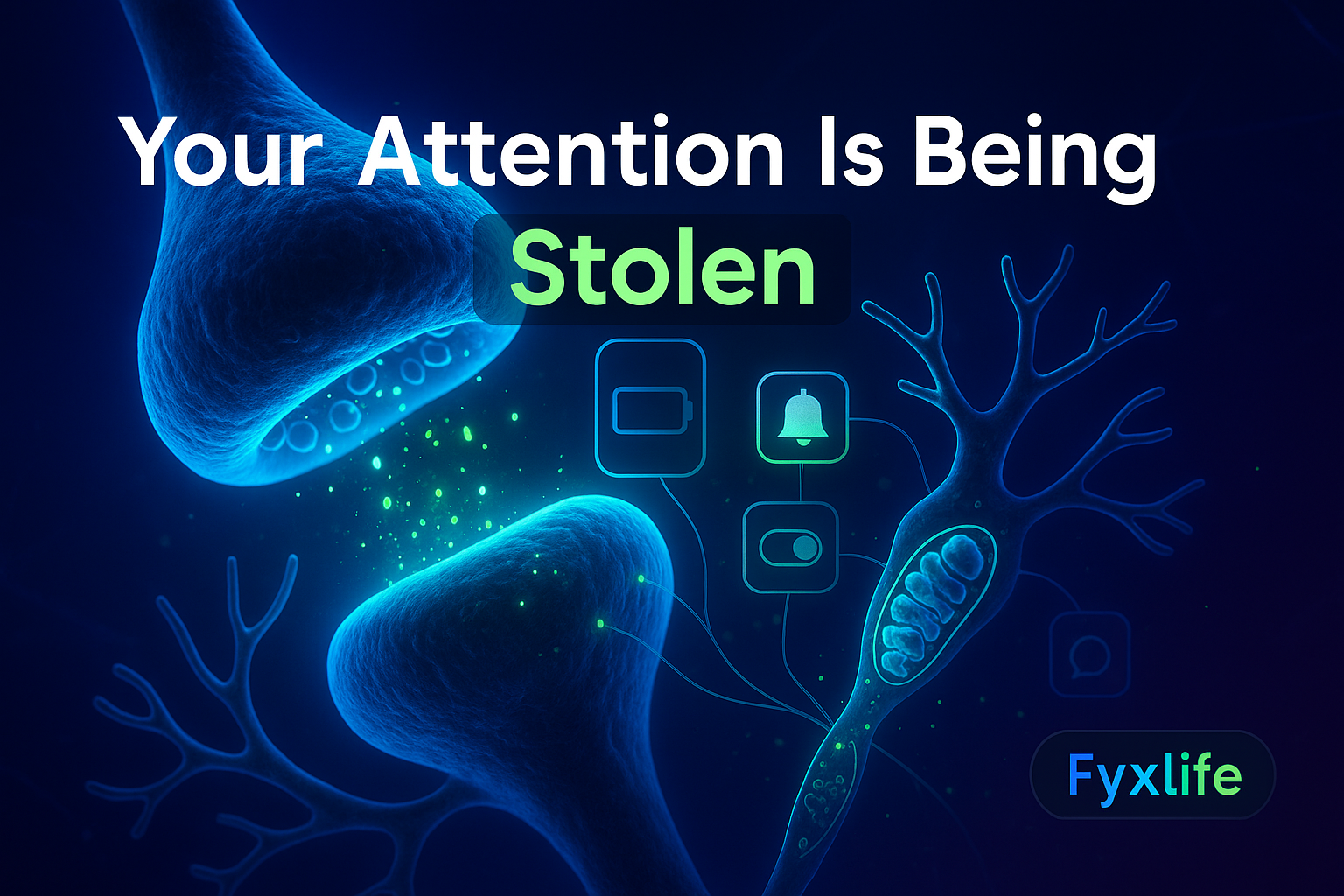
Think of your attention like a phone battery. A healthy battery holds its charge, depletes gradually with use, and recharges fully overnight. Now imagine dozens of apps running in the background, each taking a small cut of power without asking permission — notifications, context switches, background noise, decision fatigue. You didn’t get a worse battery. The system running on it became extractive. The research into stolen focus argues that modern information environments are exactly those background apps — and the solution is not to wish for a bigger battery, but to audit what is draining it.
This reframe is more than rhetorical. It shifts the intervention target from the individual to the environment. You are not trying to summon more willpower to focus. You are trying to identify which background processes are running without your awareness and shut them down deliberately. That is a practical problem with practical solutions — which is why it connects to measurable outcomes, not just to feelings of discipline or failure.
The ADHD Spectrum Question — Are We All a Bit Broken, Or Is the Environment Broken?
What neurodiversity researchers say about attention symptoms in neurotypical adults
Professor Amanda Kirby, a clinician with dual qualifications in medicine and a PhD, has publicly engaged with the question of whether modern life is producing ADHD-like symptoms across the general population — framing it as part of a growing discourse around focus and attention in modern life. The question she and others in the neurodiversity research field are examining is not whether everyone has ADHD. It is whether the same environmental conditions that make life significantly harder for people with genuine ADHD are now producing measurable attention symptoms in people who do not have the underlying neurodevelopmental profile.
The distinction is important and worth sitting with. The neurodiversity discourse — specifically the question of whether we are all experiencing a version of ADHD — has entered mainstream clinical conversation, with credentialed researchers debating the spectrum nature of attention dysfunction and its relationship to modern environmental demands. What emerges from that debate is not a clean answer but a more useful question: is your attention difficulty a signal about your neurobiology, or a signal about your environment? The intervention differs significantly depending on which it is.
Why the distinction between environmental attention erosion and clinical ADHD matters for you
If you are a professional in your forties who finds focus harder than it was a decade ago, the temptation is to either pathologise the experience (is this early dementia?) or dismiss it (everyone is distracted now). Neither response is useful. The research suggests a more precise framing: attention difficulties in midlife exist on a continuum shaped by neurobiology, environment, metabolic health, stress load, and sleep quality — and teasing apart which factors are dominant in your case is what determines whether the right intervention is a phone audit, a clinical assessment, a sleep protocol, or something else entirely.
The challenge is that this is precisely the kind of question a routine annual check-up was not designed to answer — not because your doctor doesn’t care, but because population-level screening tools were never built to map the intersection of environmental attention erosion, midlife metabolic changes, and early neurodegenerative risk in a single fifteen-minute appointment.
The Metabolic Connection — When the Brain’s Regulation System Gets Overwhelmed
Why the same modern environment that hijacks appetite also hijacks attention
Here is where the research becomes genuinely interesting for people tracking their health at a systems level. The same journalist who investigated stolen focus subsequently turned his investigation toward Ozempic and appetite regulation — pointing to a thematic link between modern environments overriding the brain’s natural regulatory systems for both attention and hunger. This is not a coincidence of subject matter. It reflects a coherent underlying argument: that the prefrontal regulation systems the brain uses to manage sustained attention and the hypothalamic systems it uses to regulate appetite are both being overwhelmed by environments engineered for excess.
Ultra-processed foods override satiety signals. Algorithmically optimised content overrides the brain’s natural disengagement from stimulation. The mechanism is different, but the pattern is the same: a system that evolved to regulate behaviour in an environment of scarcity is now operating inside an environment of engineered abundance — and the regulatory machinery is losing.
What this overlap tells us about upstream causes versus downstream symptoms
For the 35 to 60 age group specifically, this metabolic framing matters because insulin resistance, chronic inflammation — the kind that represents a sustained low-grade immune activation throughout the body — and disrupted sleep all degrade the brain’s capacity for the sustained, directed attention known as executive function. These are not separate problems that happen to co-occur. They share upstream causes. A brain running on poor metabolic fuel, insufficient sleep, and chronic low-grade stress is a brain that cannot hold a charge — no matter how motivated its owner is.
This is why the attention question is also a metabolic health question for this age group. Treating them as separate conversations misses the point.
What This Research Cannot Prove
The limits of the stolen focus argument — what remains correlation vs. causation
It is worth being honest about what this body of work does not yet establish. The stolen focus argument is compelling and internally coherent, but much of the supporting evidence remains observational and correlational. We can document that average attention spans have shortened, that smartphone use correlates with attention difficulties, and that environmental complexity has increased. What we cannot yet say with precision is how much of any individual’s attention difficulty is caused by these environmental factors versus how much is revealed by them — in the sense that an environment demanding sustained attention might simply expose a pre-existing vulnerability rather than create one.
The honest position is that the causal arrows are not fully established. The framework is useful. The interventions it implies — reducing background cognitive load, protecting extended focused work time, auditing digital environments — are unlikely to cause harm and have reasonable mechanistic support. But anyone presenting this as settled science is overstating it.
What we still don’t know about reversibility
The question of whether environmentally eroded attention is fully reversible is genuinely open. There is reasonable evidence that the brain retains significant plasticity — the capacity to form new connections and reorganise function — well into midlife and beyond. There is also emerging research suggesting that chronic digital fragmentation may produce lasting changes in default mode network activity, which is the brain system involved in sustained thought and internal narrative. Whether those changes are permanent, progressive, or recoverable with environmental intervention is a question the research has not yet answered cleanly.
What It Means For You — One Decision Worth Making
The one trackable variable that connects attention research to your own cognitive health data
The research described in this article cannot tell you whether your attention difficulties are environmental, metabolic, neurodevelopmental, or early signs of something that warrants closer monitoring. What it can tell you is that the question is worth asking precisely — not dismissing as an inevitable feature of modern life, and not catastrophising as inevitable cognitive decline. The two possibilities have different trajectories and different interventions. The gap between them is exactly what a structured assessment is designed to find.
At your next routine health check or blood panel review, ask your doctor to include a cognitive function screening — such as a validated tool like the MoCA (Montreal Cognitive Assessment), a brief standardised test that measures memory, attention, and executive function — and note your current subjective attention score out of 10 in a journal entry today. If your screening result and your subjective score diverge significantly, that gap is worth a dedicated conversation: environmental attention erosion and early cognitive change can look similar from the inside, but they have different trajectories and different interventions.


