
What Testosterone Actually Is (And What It Is Not)
You’ve noticed it — the mental fog that wasn’t there five years ago, the shorter fuse, the motivation that takes longer to arrive. Most men attribute this to stress or age and leave it there. But there is a biological mechanism worth understanding first: testosterone, and what happens when it quietly declines.
The word testosterone carries a lot of cultural baggage. Aggression. Gym culture. Midlife crisis. Strip all of that away, and what you are left with is a hormone that is less about masculinity as a performance and more about the fundamental operating conditions of the male body. Think of testosterone as your body’s chief operating officer — not just managing one department, but sending directives to your brain, muscles, bones, mood regulation centres, and cardiovascular system simultaneously. When the COO goes quiet, no single department collapses immediately, but everything runs slightly slower, slightly less decisively, and slightly less efficiently. The deterioration is gradual enough that most men chalk it up to ‘getting older’ rather than asking whether the COO has stopped showing up.
Beyond muscle — the full list of systems testosterone governs
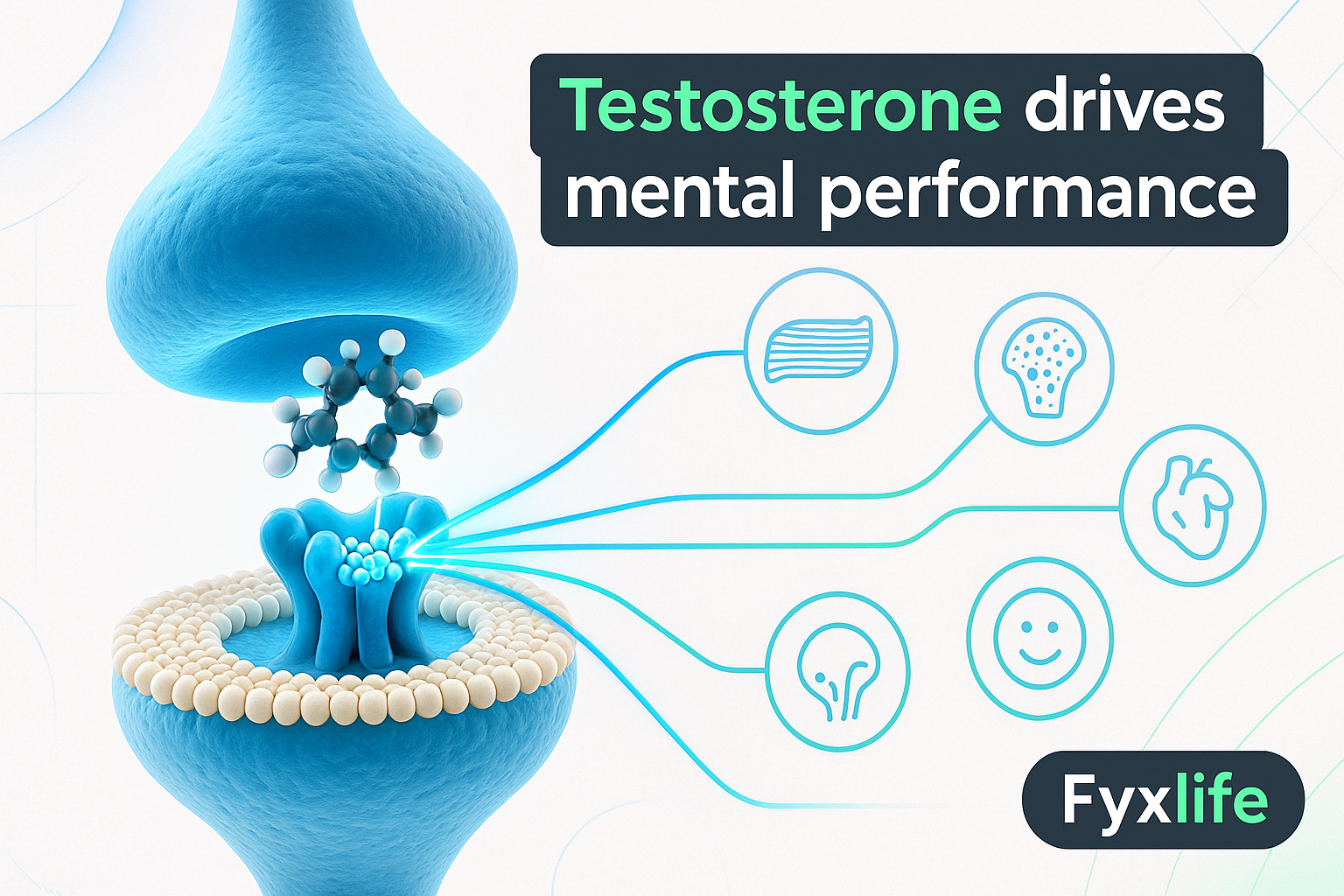
Most men, if asked what testosterone does, would say something about muscle and sex drive. Both are correct, but they represent perhaps two items on a much longer directive. Testosterone plays a role in promoting muscle growth, maintaining bone density, regulating mood, and sustaining sexual drive — making it essential for overall male health and well-being, not just reproductive function. Add to that list: red blood cell production, fat distribution, insulin sensitivity, cardiovascular function, and — critically for this audience — cognitive performance and emotional regulation. This is a whole-body signal, not a single-system switch.
The brain-testosterone connection: why cognitive professionals should pay attention
The brain is densely populated with receptors designed specifically to respond to testosterone. This is not incidental. Testosterone influences the production of neurotransmitters — the chemical messengers that carry signals between brain cells — including dopamine and serotonin, both of which govern motivation, focus, and emotional stability. It also plays a role in the health and connectivity of the prefrontal cortex, the region most responsible for executive function: planning, decision-making, and sustained attention. For a professional aged 35 to 60 who is already monitoring cognitive performance, this is not a peripheral concern. Testosterone’s role in male cognitive and emotional health — brain fog, drive, emotional resilience — is a rapidly growing area of clinical interest. The research is catching up to what many men have been experiencing for years.
How Testosterone Works in the Body
The production pathway — from brain signal to hormone release
Testosterone production begins not in the testes but in the brain. The hypothalamus releases a signalling hormone — called gonadotropin-releasing hormone, or GnRH — which prompts the pituitary gland to release two further signals: luteinising hormone (LH) and follicle-stimulating hormone (FSH). LH is the direct instruction to the Leydig cells in the testes to produce testosterone. The whole system operates as a feedback loop: when testosterone levels are sufficient, the hypothalamus eases off. When they drop, it signals again. Understanding this loop matters because it becomes directly relevant when you are weighing your options later.
Once produced, testosterone circulates in the bloodstream in two forms. Most of it — around 98 percent — is bound to proteins, primarily sex hormone-binding globulin (SHBG) and albumin. Only the unbound portion, called free testosterone, is biologically active and available to enter cells and exert its effects. This distinction is one reason why a standard total testosterone reading can sometimes miss the clinical picture entirely.
What ‘normal’ means and why it varies widely between men
Laboratory reference ranges for testosterone are broad — often quoted between 300 and 1,000 nanograms per decilitre — and this breadth is partly the problem. A man who naturally operates at 900 ng/dL in his twenties and has declined to 320 ng/dL by his late forties is technically still ‘normal’ by most reference standards, yet he has lost two-thirds of his hormonal baseline. The number alone does not tell the story. Symptoms, trajectory, SHBG levels, and free testosterone together paint a more accurate picture than a single data point ever will.
What Happens When Testosterone Declines
The gradual slide: why most men miss the signs
Men in clinical communities who have investigated their own hormonal health describe the experience of low testosterone not as a dramatic collapse but as a slow erosion. Drive and clarity quietly disappear over years before they are named. The reason this is so easy to miss is that the decline typically averages one to two percent per year from the mid-thirties onward. There is no single morning where everything changes. There is only the accumulation of small losses — a project that feels harder to start, a conversation that feels harder to sustain, a gym session that requires more recovery than it once did — until one day the cumulative drift is impossible to ignore.
The symptoms that masquerade as stress, age, or burnout
The clinical presentation of low testosterone overlaps almost perfectly with the presentation of professional burnout, chronic stress, and generalised fatigue. Brain fog. Reduced motivation. Difficulty concentrating for extended periods. Irritability disproportionate to the trigger. Disrupted sleep. Increased body fat, particularly around the abdomen. Reduced muscle tone despite maintained exercise. Each of these symptoms, in isolation, would send most GPs toward a conversation about work-life balance rather than a blood test. Together, they may represent a hormonal root cause that is straightforwardly measurable — and yet it frequently goes unchecked because the clinical default is to treat symptoms rather than investigate upstream causes.
Why erectile dysfunction is often the last symptom, not the first signal
Popular coverage of testosterone tends to lead with erectile dysfunction, which has the unintended effect of making everything else seem like a precursor to a problem many men do not yet have — and therefore not their problem yet. The clinical reality is almost the reverse. Low testosterone is a common and frequently overlooked cause of poor or declining response to erectile dysfunction medications — and should always be assessed during ED evaluation. But by the time erectile function is affected, the cognitive, mood, and metabolic consequences of low testosterone may have been present for years. The men who benefit most from early investigation are the ones who act on the earlier, subtler signals — not the ones who wait for the clearest one.
Why Low Testosterone Gets Missed in Clinical Settings
The diagnosis gap — when symptoms are treated instead of root causes
The standard annual health screen in Singapore and across most of Southeast Asia does not routinely include a testosterone panel. A man presenting with fatigue and low mood may receive a referral for a mental health assessment, a recommendation to exercise more, or a prescription for a sleep aid — all of which may be appropriate — without anyone asking whether his hormonal baseline has shifted. This is not a failure of individual clinicians. It is a structural feature of a healthcare system designed to address acute presentations, not to systematically investigate the hormonal underpinnings of slowly accumulating symptoms. The challenge is that this is exactly the kind of question a routine annual check-up was not designed to answer — not because doctors don’t care, but because population-level reference ranges were never built to account for your specific hormonal history or risk profile.
What updated expert consensus now says about evaluation
An expert panel on testosterone therapy was convened in December 2024, and the FDA subsequently updated its testosterone labeling language — signalling an active and evolving clinical consensus on how testosterone therapy should be evaluated and communicated. Updated 2025 expert consensus guidelines on male hormonal deficiency and testosterone therapy safety reflect a maturing clinical field with new standards for evaluation and management. The direction of travel is toward more nuanced, individualised assessment — not the blunt instrument of a single total testosterone reading against a population average. If your previous experience of getting testosterone checked felt like a box-ticking exercise, the clinical standard is now genuinely higher than it was.
The Spectrum of Options — From Lifestyle to TRT
What functional and natural approaches can realistically achieve
Natural and functional medicine approaches exist for addressing hormonal decline, positioning the condition as addressable through a spectrum of interventions rather than a binary choice between testosterone replacement therapy or nothing. These include optimising sleep architecture — the single most powerful natural driver of testosterone production — alongside resistance training, managing chronic psychological stress, addressing nutritional deficiencies in zinc and vitamin D, reducing alcohol intake, and in some cases using evidence-reviewed supplements. For men in the earlier stages of decline, these interventions can produce meaningful improvements. For men with significantly low levels, they can support the effectiveness of other treatments. Either way, they are not a consolation prize — they are a foundation.
What TRT is, how it works, and what the real trade-offs are
Testosterone replacement therapy — supplementing the body’s own production with exogenous, or externally sourced, testosterone — is available in several forms: injectable, transdermal gels, patches, and oral capsules. The global market for testosterone replacement therapy is projected to grow from $2.03 billion in 2024 to $2.7 billion by 2033, reflecting rapid and widespread clinical and consumer uptake. That growth signals genuine demand — but it also warrants scrutiny. TRT, when appropriately prescribed and monitored, can produce significant improvements in energy, cognitive clarity, mood stability, muscle maintenance, and libido. It is a legitimate clinical intervention with a strong evidence base in men who are genuinely deficient.
The trade-offs, however, deserve honest coverage. When you introduce testosterone from an external source, the brain’s feedback loop interprets this as sufficient — and reduces or stops signalling the testes to produce their own. Testosterone replacement therapy can decrease the body’s natural production, with some men finding their levels do not recover after stopping — a meaningful fertility and long-term health trade-off. This is not a reason to avoid TRT if it is clinically indicated. It is a reason to go in informed, with a clinician who monitors your full hormonal panel rather than just your testosterone number.
The fertility and natural production trade-off explained plainly
If you are considering TRT and have not yet completed your family, this trade-off requires a specific conversation before you begin. Sperm production depends on the same hormonal signalling pathway that TRT suppresses. There are protocols — including human chorionic gonadotropin (HCG) adjuncts — that can help preserve fertility during TRT, but they require a clinician who is managing this proactively, not reactively. The men who regret their TRT experience are rarely the ones who tried it and decided it was not for them. They are more often the ones who began without fully understanding what stopping might mean.
What This Means for You — The 35-60 Professional
The one biomarker conversation to start at your next check-up
If you have read this far and recognised yourself in any of the descriptions above — the gradual erosion of drive, the cognitive friction, the mood shifts that feel disproportionate — you are not diagnosing yourself. You are doing something more useful: forming a precise question to take into a clinical setting. The question is not “could my testosterone be low?” The question is: “Can we run a full hormonal panel that includes total testosterone, free testosterone, SHBG, and LH — and interpret the results in the context of my symptoms, not just the population reference range?”
What to track before you have that conversation
Before your next appointment, spend one week noting three things: your subjective energy levels at different times of day, your ability to sustain focused work for 90 minutes or more, and your sleep quality and morning mood. These observations will not replace a blood test, but they will give you specific, concrete inputs for a more productive clinical conversation. Vague reports of fatigue get vague responses. A pattern of morning fatigue despite adequate sleep, combined with declining afternoon concentration and a shorter emotional fuse, is a specific clinical picture that warrants specific investigation.
Pull your last fasting bloodwork and check whether a testosterone panel was included. If it wasn’t — and for most men over 35 in a standard annual screen, it won’t have been — add one specific request at your next GP visit or health screen: ask for total testosterone, free testosterone, SHBG, and LH alongside your standard bloodwork. If your results come back in the lower third of the ‘normal’ range and you are experiencing brain fog, low drive, or mood shifts, this article gives you the vocabulary to have a more precise conversation about whether hormonal health is worth investigating further.


