
You’ve optimised your sleep, cleaned up your diet, and still can’t shake the brain fog, flat mood, or low-grade anxiety that’s been following you around for months. New clinical research suggests the problem may not be in your head — it may be in a small butterfly-shaped gland in your neck that most people never think to test.
For professionals in their 40s and 50s, this particular symptom cluster tends to get attributed to stress, perimenopause, overwork, or simply getting older. Those explanations are convenient, and sometimes accurate. But a growing body of research on the brain-thyroid connection is making it harder to dismiss the thyroid’s role in mood, cognition, and long-term brain health — especially when the standard blood test you’re likely getting only tells part of the story.
What This Research Actually Found
The subclinical gap — why ‘normal’ TSH doesn’t always mean optimal
Most annual health screenings include a single thyroid marker: thyroid-stimulating hormone (TSH), the pituitary signal that tells your thyroid how hard to work. If TSH falls within the laboratory reference range, most doctors sign off the result as normal and move on. The problem is that the reference range was built to catch overt disease — not to identify the subtler functional states where symptoms are already affecting your daily life.
Subclinical hypothyroidism — the technical term for a state where TSH is borderline elevated but the thyroid hormone itself still reads as normal — turns out to matter enormously for mental health. A meta-analysis found that people with subclinical hypothyroidism had 78% higher odds of depression compared to people with genuinely normal thyroid function (OR = 1.78, 95% CI). That is not a marginal signal. That is a substantial elevation in psychiatric risk from a thyroid state that most standard panels would flag as unremarkable.
The research is equally clear that this is not only a problem of too little thyroid activity. Undiagnosed, untreated, and undertreated hypothyroidism all independently increase the risk of developing depression — meaning every point in the diagnostic chain, from the missed test to the inadequate dose, is a separate failure point that compounds the risk.
The 2025 UTMB study: thyroid treatment, dementia risk, and what changed
The research finding that elevates this conversation from mood management to genuine longevity strategy came out of the University of Texas Medical Branch in June 2025. The UTMB study found that combination thyroid therapy — using both the storage form of thyroid hormone (T4) and the active form that acts directly on brain tissue (T3) — may reduce dementia risk and mortality in hypothyroid patients, compared to T4 treatment alone.
This is significant for anyone already concerned about cognitive decline. It reframes thyroid optimisation not as a matter of correcting a single hormone number, but as a potential lever in the trajectory of brain aging. The standard treatment approach of prescribing T4 alone, and assuming the body will convert it efficiently to T3, may not be sufficient for everyone — and the brain may be the organ that suffers most when that conversion falls short.
The Mechanism in Plain English
How thyroid hormones regulate brain chemistry and energy output
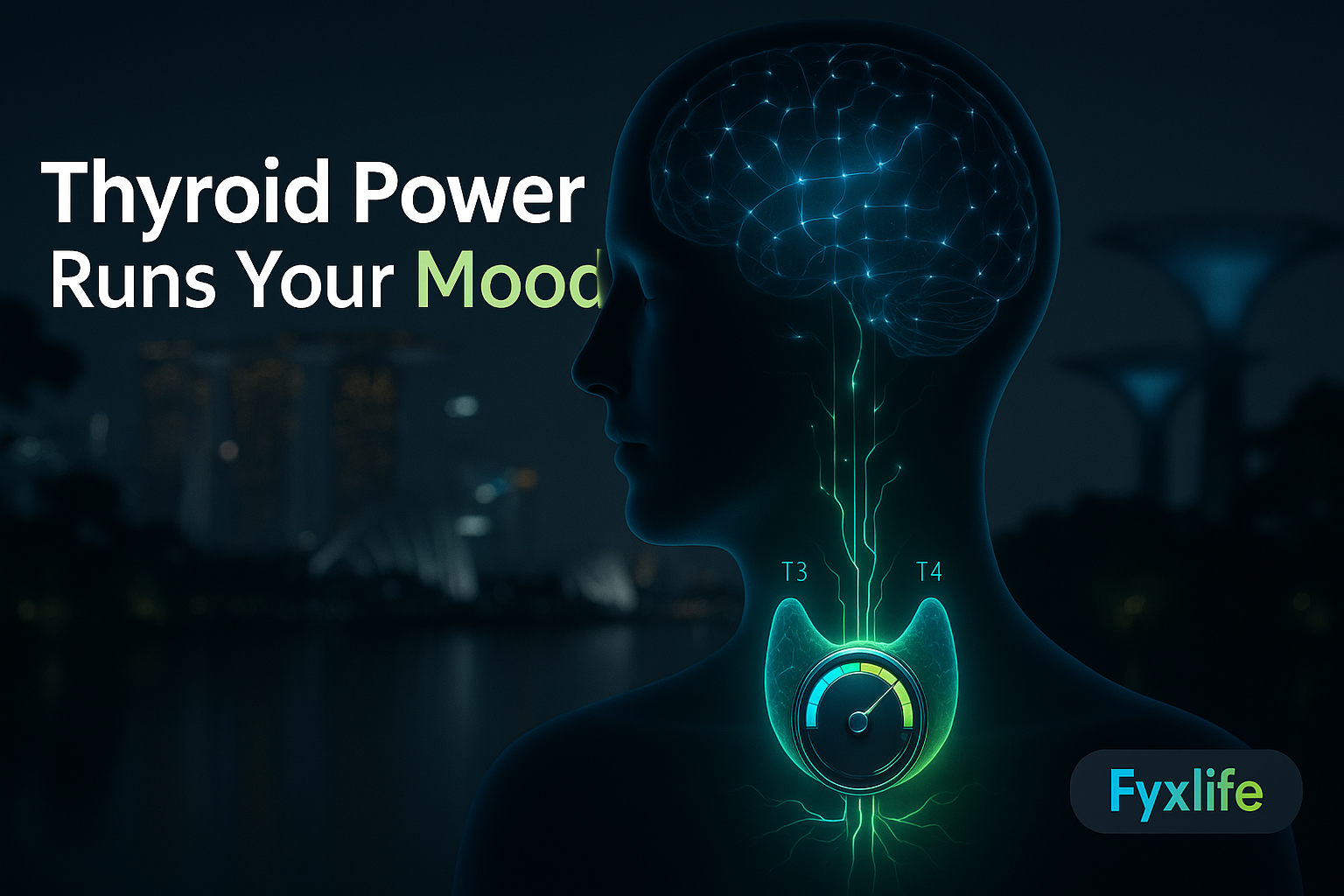
Think of thyroid hormones as the voltage regulator for your brain’s power grid. When voltage is too low — the state of hypothyroidism, meaning the thyroid is underproducing — your neurons fire slowly, neurotransmitters like serotonin don’t get produced efficiently, and the whole system runs dim. That looks and feels exactly like depression, brain fog, and the kind of cognitive blunting that makes reading a complex document feel like pushing through wet concrete. When voltage is too high — hyperthyroidism, where the thyroid is overproducing — the circuits run hot and unstable, producing anxiety, irritability, and, paradoxically, a crash into depression as the system destabilises. The research finding that matters is this: your doctor may be telling you the voltage is ‘within range’ while your brain is still running on insufficient or erratic power.
A comprehensive 2025 review documents the underlying neuroendocrine mechanisms — the biological pathways connecting the hormonal and nervous systems — linking thyroid dysfunction to psychiatric disorders, including disrupted serotonin signalling and altered neuroplasticity, the brain’s ability to form and reorganise neural connections. These are not vague associations. They are specific, measurable molecular events. The mood effects of thyroid dysfunction are not psychological responses to feeling unwell — they are direct consequences of altered brain chemistry.
There is also an energy dimension that goes deeper than fatigue. Emerging evidence links thyroid status to aging trajectories and longevity through modulation of mitochondrial function — the cellular energy production process — repositioning thyroid optimisation as a longevity variable, not just a metabolic one. When your thyroid is running below optimal, the energy factories inside your neurons are running below optimal too. Sustained over years, that gap compounds.
Why both underactive and overactive thyroid can drive depression
Hypothyroid states are associated with both functional and structural brain changes that are also observed in patients with major depression, suggesting shared neurobiological pathways rather than coincidental overlap. The brain of someone with undertreated hypothyroidism and the brain of someone with major depressive disorder are showing some of the same measurable changes. That is not a metaphor — it is a finding from neuroimaging and neurochemistry research that should change how we think about mood disorders in people whose thyroid has never been fully evaluated.
The other side of this is less well known but equally important. Hyperthyroidism is associated with a 67% higher risk of clinical depression compared to normal thyroid function (OR = 1.67, 95% CI: 1.49–1.87), with the association stronger in overt than subclinical cases. If you or your doctor assumed that an anxious, wired presentation ruled out thyroid involvement in your mood, this finding deserves a second look.
What the Research Can and Cannot Prove
Correlation vs causation — the Mendelian randomisation question
It is worth being honest about the limits of what the evidence currently establishes. Much of the association between thyroid function and mood disorders comes from observational studies, where it is genuinely difficult to disentangle cause from effect. Does thyroid dysfunction cause depression? Or does the chronic stress and inflammation associated with depression alter thyroid function? The biology allows for both directions, and in practice they likely interact.
Observational studies show that even minor variations in thyroid function — well within what most labs flag as normal — are associated with increased risk of mood disorders including major depressive disorder. Mendelian randomisation — a research method that uses genetic variants as natural experiments to test causal direction — has been applied to this question with suggestive but not yet conclusive results. The association is robust. The causal arrow is still being mapped with precision.
The treatment gap: when fixing thyroid numbers doesn’t fix the mood
A further complication is that correcting thyroid hormone levels does not automatically resolve psychiatric symptoms in every patient. Overt hypothyroidism is often associated with clinically significant decrements in mood and cognitive function, especially memory — and while treatment improves these for many people, some patients report persistent symptoms even after their TSH normalises. This may reflect the inadequacy of TSH as the sole treatment target, the T4-to-T3 conversion issue the UTMB study addresses, or individual variation in brain sensitivity to thyroid hormones.
The honest framing is this: thyroid optimisation is a necessary investigation for anyone with persistent mood or cognitive symptoms, but it is not guaranteed to be the sole answer. What the research does establish clearly is that missing or under-investigating the thyroid in this context is a meaningful oversight — and that many people fall through the gap precisely because their numbers are technically normal while their brains are not functioning optimally.
This is exactly the kind of question a routine annual check-up was not designed to answer — not because doctors don’t care, but because population-level reference ranges were never built to account for your specific symptom profile, conversion capacity, or cognitive baseline.
What This Means for You — The Practical Translation
The four thyroid markers worth knowing beyond basic TSH
TSH alone measures the pituitary’s demand signal — not the actual output of the thyroid, and not the conversion of that output into the form the brain uses. A complete picture requires four markers. Free T4 (the storage form of thyroid hormone circulating in your blood) tells you how much raw material is available. Free T3 (the active form that enters cells and drives metabolism, including in the brain) tells you how much functional hormone is actually reaching your tissues. Reverse T3 is the inactive form that blocks T3 receptors — it can rise under chronic stress and illness, effectively throttling thyroid function even when T4 looks adequate. And thyroid antibodies — specifically anti-TPO and anti-thyroglobulin — can identify Hashimoto’s thyroiditis, the autoimmune condition that is the most common cause of hypothyroidism and that can produce fluctuating symptoms long before TSH moves out of range.
What to raise with your doctor if you recognise these patterns
The conversation worth having is a specific one. If your most recent panel only included TSH, ask whether the result tells you enough given your symptoms. The research now supports requesting Free T3 and Free T4 as a minimum alongside TSH, with antibodies added if there is any family history of autoimmune thyroid disease. The 2025 UTMB findings also make it reasonable to ask — if you are already on thyroid medication — whether T3 has been evaluated as an addition to T4-only therapy, particularly if cognitive symptoms have not resolved with standard treatment.
Be specific about symptoms when you have this conversation. Brain fog, word retrieval difficulty, memory lapses, flat affect, and low-grade anxiety that does not respond to the usual interventions are all worth naming directly. Vague fatigue gets a generic workup. Precise cognitive and mood symptoms, framed in the context of thyroid neurobiology, prompt a more targeted investigation.
One Decision to Make Based on This Research
At your next blood test, check whether your results include Free T3 and Free T4 alongside TSH — not just TSH alone. If your panel only shows TSH, and you have any combination of persistent low mood, brain fog, fatigue, or memory issues, the research now supports asking your doctor specifically for a full thyroid panel including Free T3, Free T4, and thyroid antibodies. If your TSH sits anywhere in the upper half of the ‘normal’ range (roughly above 2.5 mIU/L) and your symptoms match, this is the conversation the 2025 research says is worth having.